AI Sales Engineering
The autonomous AI SDR market promised to replace your reps. Instead, it burned through domains, churned at 50-70% annually, and trained your prospects to ignore anything that reads like a template. We build custom sales AI systems on your top performers' actual data, inside your existing CRM, with deliverability engineered from day one.
50-70%
Annual churn on AI SDR platforms
GTM AI Podcast, 2026
142%
Reply rate lift from deep personalization vs. generic
Martal B2B Benchmarks, 2026
$75-$330
AI SDR cost per held meeting (industry benchmark)
Auto Interview AI, 2026
Why off-the-shelf tools keep failing sales teams
In March 2025, TechCrunch reported that 11x.ai, backed by $74M from Andreessen Horowitz and Benchmark, had lost 70-80% of its customers within months of signing them. The company claimed $14M in annual recurring revenue; actual contracts past the trial period totaled roughly $3M. ZoomInfo, one of their marquee customers, stated that 11x "performed significantly worse than their SDR employees" and churned after a single month.
This was not a single company failing. The entire autonomous AI SDR category is seeing 50-70% annual tool churn, roughly double the turnover rate of the human SDRs these tools were supposed to replace. The fundamental problem: fully autonomous systems optimize for send volume because volume is the easiest metric to show progress on. Quality degrades at scale. Show rates for AI-booked meetings run 10-15 percentage points lower than human-booked meetings. A $100 booked meeting that shows 65% of the time actually costs $154 per held meeting.
Google began actively rejecting non-compliant bulk email in November 2025. Not filtering to spam. Rejecting. Microsoft followed with enforcement in May 2025. The requirements: SPF, DKIM, and DMARC all aligned. Spam complaint rates below 0.3%. One-click unsubscribe for sends above 5,000 per day.
One bad AI campaign that triggers complaints above 0.3% can cause a 50% drop in deliverability across all your company email. Not just outbound. Your CFO's board updates. Your support team's ticket responses. Your CEO's investor emails. All of it. Recovery takes 3-12 months. Most AI SDR tools manage their own sending infrastructure, which means you have no visibility into domain reputation until the damage is done. By then, you are calling Mailforge or Warmly trying to figure out why your entire company's email is landing in spam.
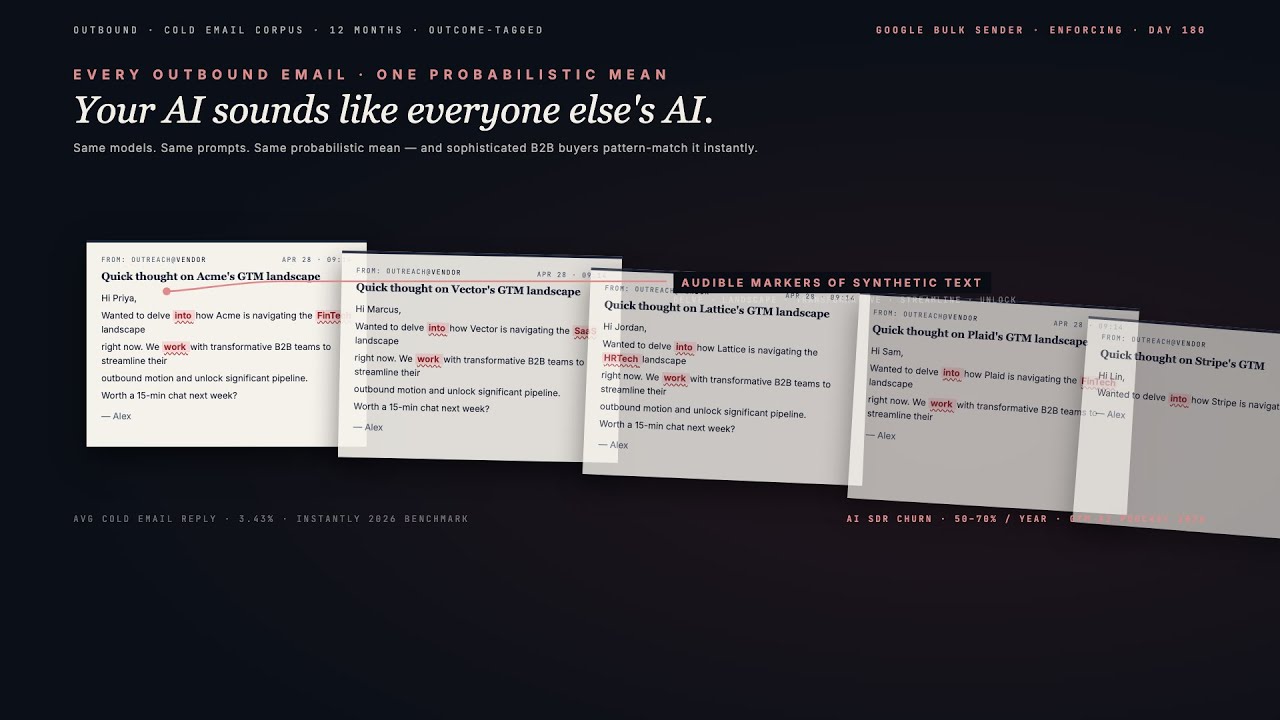
Every off-the-shelf tool generates from the same foundation models with the same general prompts. The output converges on a probabilistic mean: safe, neutral, and recognizably synthetic. Words like "delve," "landscape," and "transformative" are now audible markers of AI-generated text. Sophisticated B2B buyers, the ones you actually want to reach, have pattern-matched this tone. They delete without reading. The cold email reply rate average has fallen to 3.43% in 2026, and generic AI outreach sits below that. Human-like sentence variation, specific vocabulary, idiosyncratic structure: these are the features that get replies. They are also the features that shared platforms cannot produce because they have no access to what makes your best rep's writing distinctive.
A reference for evaluating AI sales approaches. Pull this up when your VP of Sales asks "why not just buy Outreach?"
| Approach | Representative Tools | Cost Range | What It Does Well | Where It Falls Short |
|---|---|---|---|---|
| Data Enrichment + AI Workflows | Clay, Persana AI | $134-$720/mo | 75+ enrichment sources, Claygents for research, flexible workflows | No style intelligence. Personalization is data-driven (company news, role) but tone is generic. You still need to solve how the email sounds |
| Cold Email Platforms | Instantly, Smartlead, Saleshandy | $30-$78/mo | Deliverability tooling, domain warmup, sequence management, affordable | Commoditized email generation. Limited personalization depth. Style control is a prompt field, not a retrieval system |
| Sales Intelligence Suites | Apollo.io, ZoomInfo | $49-$14.5K+/yr | Massive contact databases, intent signals, verified data | AI email generation is an add-on, not the core product. Style and personalization are afterthoughts to data access |
| Autonomous AI SDRs | 11x.ai, Artisan, AiSDR | $24K-$60K/yr | Full autonomy promise: research, write, send, follow up without human input | Category-wide churn rates (see hero stats above). Quality degrades at volume. 10-15% lower show rates than human-booked meetings. 11x.ai lost 70-80% of customers within months |
| CRM-Native AI Agents | Salesforce Agentforce SDR | $125-$550/user/mo + CRM base | Deep CRM integration, ecosystem, enterprise trust | Requires Salesforce base license. Expensive for what you get. Platform lock-in. Personalization quality limited by what Salesforce data contains |
| Big 4 / Large SIs | Accenture, Deloitte, KPMG | $200K-$2M+ | Brand trust, large teams, existing enterprise relationships | They implement platforms, not build custom intelligence. A Deloitte engagement deploys Salesforce Agentforce; it does not build a style retrieval system on your data. Engagements take 6-12 months and cost 5-20x a custom build |
| Internal Build | Your engineering team | $150K-$400K+ (eng time) | Full control, no vendor dependency, custom to your exact needs | Requires ML engineering talent your team likely does not have. Competing with product roadmap for eng cycles. Deliverability expertise is specialized. Most internal builds stall at the data pipeline stage |
The honest gap Veriprajna does not solve: If your ICP targeting is wrong, no amount of personalization fixes it. If your sales team cannot close the meetings AI books, the problem is downstream. We build the top-of-funnel intelligence layer. We cannot fix product-market fit, pricing, or a sales process that falls apart after the first call.
Four capabilities. Each addresses a specific failure mode in the current AI SDR market.
The core system. We separate content retrieval (product facts, case studies, pricing) from style retrieval (how your top reps actually write). Two independent vector pipelines feed the generation model. Content comes from your knowledge base. Style comes from your top performers' actual emails, tagged by outcome, recipient persona, and tone.
We reach for Qdrant or Weaviate for the vector layer because they support hybrid search with metadata filtering. This matters when the query is "emails that booked meetings with FinTech CTOs in a direct tone" rather than just "similar emails." Standard semantic search conflates topic with style. A query for "email to a CTO" returns emails about CTOs, not emails written for CTOs. The dual-retrieval separation fixes this.
Before we generate a single email, we build the sending architecture. Domain isolation with 3-5 dedicated outbound domains. SPF, DKIM, DMARC aligned on each. Graduated warmup over 3-4 weeks. Real-time spam complaint monitoring with automatic pause triggers before you hit the 0.3% threshold that gets you blacklisted.
The style injection system also contributes to deliverability. Emails generated from real human examples have natural sentence length variation and vocabulary diversity, which avoids the low-perplexity patterns that Gmail and Outlook filters now flag as AI-generated. Every email passes a deliverability scoring check before send. If the score is below threshold, the system rewrites rather than sends.
Most teams measure open rates and reply rates, then wonder why pipeline did not grow. We build attribution that tracks the metric that matters: cost per held meeting. The pipeline connects AI sends to CRM outcomes through the full sequence: send, open, reply, meeting booked, meeting held, opportunity created, deal closed.
The system also tracks style-variant performance. You can see which rep's style produces the best results for which prospect persona, which industries, and which deal sizes. This turns your style store into a continuously improving asset. We instrument this directly in your CRM (Salesforce or HubSpot), not in a separate dashboard. Your sales ops team manages it where they already work.
A secondary verification model checks every generated email against your product documentation before send. If the AI claims a feature you do not have or cites a price that changed last quarter, the system catches it. This is not a prompt instruction ("be accurate"). It is a separate model that reads the draft against your source-of-truth docs and flags discrepancies.
For teams selling into EU markets, we build Article 5 compliance into the generation logic: content guardrails that prevent manipulative framing, transparency mechanisms, and audit trails documenting which data informed each email. For all markets, the system handles GDPR-compliant prospect data pipelines with legitimate interest documentation and automated deletion schedules. Bulk sender compliance (one-click unsubscribe, SPF/DKIM/DMARC) is handled at the infrastructure layer.
A concrete walkthrough of what happens when your AI system generates an email for a specific prospect.
A new lead record appears in your CRM. The system pulls enrichment data from whatever sources you already use (Clay, Apollo, ZoomInfo, Clearbit). It extracts role, industry, company size, recent funding, technology stack, and any public content the prospect has written. This is the content context: what we know about this person and their company.
The system queries the style store with a composite vector: "Find 3 emails that booked meetings with VP Engineering prospects at Series B FinTech companies, written in a direct, technically-specific tone." The vector database returns 3 real emails from your top performers that matched similar prospects. These become the few-shot examples that steer the model's tone. The retrieval uses both vector similarity and metadata filters (persona, industry, outcome, tone tags), which is why standard semantic search is not sufficient for this task.
The prompt is assembled from four modules: system instructions (your brand voice rules), style context (the 3 retrieved examples with explicit instructions to match form, not content), factual context (product information relevant to this prospect's pain points), and the target task (specific prospect details and the email objective). The model generates with the style examples steering tone and structure while the content context ensures accuracy. Typical generation consumes 4,000-6,000 tokens of context window. We optimize example length to leave room for generation quality.
Before the email reaches a human reviewer or auto-sends, three checks run in sequence. The factual verification model compares claims against product docs and flags discrepancies. The deliverability scorer analyzes sentence structure, vocabulary diversity, and perplexity to predict inbox placement. The compliance check validates against applicable regulations for the prospect's jurisdiction. If any check fails, the system regenerates with adjusted constraints. The email then routes to the assigned sending domain, logs the activity in your CRM, and enters the attribution pipeline for outcome tracking.
Realistic timelines for a mid-market SaaS team with 5-20 SDRs and existing CRM.
If you have fewer than 500 tagged emails: We add a 4-week data collection phase where we instrument your existing sends with tracking and build the initial corpus from live performance.
Expect statistically significant results: Within the first 2,000 sends (most mid-market teams hit this in 2-3 weeks of production use).
Answer 8 questions about your current sales operations. The assessment identifies which components of a custom AI SDR system you are ready for today and which need groundwork first.
Off-the-shelf tools give you a shared platform with shared models. Clay is excellent at data enrichment and workflow orchestration, and Instantly solves email infrastructure at scale. We don't compete with either. We build the layer that sits between them and your sales process: the style intelligence system trained on your top performers' actual emails, the retrieval logic that selects the right tone for each prospect persona, and the attribution pipeline that connects AI-generated sends to held meetings in your CRM.
Most teams that come to us are already using Clay or Apollo for enrichment. The gap is not data access. It is what happens between enrichment and send. A shared platform generates emails from a general model. A custom system generates emails that sound like your best rep wrote them for this specific CTO at this specific company.
The measurable difference shows up in reply-to-meeting conversion: the percentage of positive replies that actually become held meetings. Generic personalization gets replies. Style-matched personalization gets meetings. We typically integrate with whatever enrichment and sending tools you already use rather than replacing them. The architecture is additive, not a rip-and-replace.
We need 12 months of outbound email data from your CRM, correlated with outcomes: which emails got replies, which led to meetings booked, which sequences produced closed-won deals. The minimum viable dataset is roughly 500 outcome-tagged emails from at least 3 reps. More data means better style differentiation, but 500 emails with clean outcome tags beats 10,000 emails with no attribution.
The cold start problem is real. If you have fewer than 500 outcome-tagged emails, we start with a 4-week data collection phase: we instrument your existing sends with tracking, tag outcomes via CRM sync, and build the initial style corpus from what your reps send during that period. It is not ideal, since you are training on current performance rather than proven winners, but it gives you a working system in 6 weeks rather than waiting for a year of data to accumulate.
For teams with good CRM hygiene, the timeline is typically 3 weeks for infrastructure and style store build, 2 weeks for A/B testing and calibration, then production deployment. You should see statistically significant reply rate differences within the first 2,000 sends, which most mid-market teams hit in 2-3 weeks of production use.
Deliverability is an architectural decision, not a setting you toggle after launch. We build sending infrastructure from the ground up: isolated sending domains with proper DNS records (SPF, DKIM, DMARC all aligned), graduated warmup sequences that build reputation over 3-4 weeks, and real-time monitoring that pauses sending before you hit Google's 0.3% spam complaint threshold.
One bad AI campaign on your primary domain can cause a 50% drop in deliverability across all company email, not just outbound. Recovery takes 3-12 months. This is why we never send AI-generated outreach from your primary business domain. We set up 3-5 isolated sending domains with proper forwarding and reply handling, so a deliverability issue on one domain does not cascade to your regular business communications.
We also build content-level protections. The style injection system produces emails with natural sentence variation and vocabulary diversity, which avoids the low-perplexity, high-uniformity patterns that Gmail and Outlook filters now flag as AI-generated text. Every email passes through a deliverability scoring check before send.
A typical engagement for a mid-market SaaS team (5-20 SDRs, Salesforce or HubSpot CRM) runs $40K-$80K for the initial build, including infrastructure setup, style store creation, CRM integration, and A/B testing calibration. Ongoing optimization runs $3K-$5K per month.
Compare this to the alternatives: an autonomous AI SDR platform like 11x.ai costs $50K-$60K per year with the churn rates described above. Salesforce Agentforce SDR costs $125-$550 per user per month plus your base CRM license. A human SDR costs $75K-$95K fully loaded in the US.
The ROI metric that matters is cost per held meeting. Industry benchmarks for AI SDR tools: $75-$330 per held meeting. Human SDRs: $965-$1,530. We target the $50-$150 range by combining higher reply rates from style-matched personalization with better show rates from quality-filtered sends. We build the measurement system as part of the engagement: a dashboard in your CRM that tracks sends, replies, meetings booked, meetings held, and pipeline generated, all attributed to specific style variants. You can see exactly which rep's style produces the best results for which prospect persona. No separate analytics platform to check.
This is the compliance question most sales AI vendors are ignoring, and it is a real risk for companies selling into EU markets. EU AI Act Article 5, enforceable since February 2025, prohibits AI that uses subliminal techniques to distort behavior causing significant harm. The European Commission guidelines clarify that personalized outreach is not inherently manipulative. But AI that exploits psychological vulnerabilities, creates invisible decision pressure, or operates below the recipient's awareness threshold crosses the line.
Where does sales AI fall? If your system analyzes a prospect's LinkedIn posts to infer communication preferences and adapts tone accordingly, that is lawful personalization. If it uses dark patterns like manufactured urgency, deceptive social proof, or psychological profiling to exploit individual vulnerabilities, that is prohibited.
We build the compliance layer into the architecture: content guardrails that prevent manipulative framing, transparency mechanisms for EU-targeted outreach, and audit trails that document what data informed each generated email. For GDPR specifically, prospect data used for enrichment (LinkedIn profiles, company information) must have a lawful basis. We architect the data pipeline with legitimate interest documentation and automated deletion schedules. If you sell into the EU, this is not optional.
Most AI SDR tool failures trace back to one of three causes. First, the style problem: the tool generates emails from a general model, not from your specific top performers. The emails are competent but generic. Sophisticated B2B buyers have seen enough AI outreach to recognize it instantly. Words like "delve," "landscape," and "transformative" are audible markers of synthetic text. A custom system trained on your actual winning emails avoids this because it is learning your voice, not a generic sales voice.
Second, the infrastructure problem: the tool managed its own sending, burned through domains too fast, and damaged deliverability. By the time you noticed spam complaints, your primary domain reputation had taken collateral damage. A custom build with proper domain isolation prevents this entirely.
Third, the measurement problem: you could not actually prove the tool booked meetings that would not have happened anyway. Without proper attribution connecting AI sends to CRM outcomes, you are guessing. When the renewal came up, nobody could justify the cost. We address all three. But we are honest about what we cannot fix: if your ICP targeting is wrong, better emails to the wrong people still waste money. If your product-market fit is unclear, no amount of personalization compensates for a value proposition that does not resonate. The custom build works better for teams that already know who to sell to and have proven they can close deals. We make the top of the funnel match the quality of the middle and bottom.
The research behind this solution page, covering the architecture and cognitive science of style-matched sales AI.
Technical architecture for dual-retrieval style injection, vector database schema design, and the cognitive science of linguistic style matching in B2B sales contexts.
A custom build costs less, integrates with your existing stack, and the style intelligence compounds over time instead of resetting every time you switch vendors.
Mid-market SaaS teams spend $31K-$147K in true Year 1 cost on AI SDR tools, including infrastructure, enrichment, setup, and optimization. Most switch tools within 12 months and start over. We build systems that stay.