Fashion E-Commerce
Fashion e-commerce loses more money to returns than to marketing, logistics, or fraud combined. The root cause in 53-70% of apparel returns is the same: the garment did not fit. Size charts reduce this to a guessing game. Generative AI virtual try-on makes the guess look convincing. Neither solves the underlying physics of how fabric interacts with a human body.
We build fit prediction systems that match the right approach to your economics: statistical size recommendation for high-SKU catalogs, body measurement pipelines for fit-sensitive categories, and physics-based simulation for brands with 3D design workflows. Vendor-neutral, privacy-compliant, and built to reduce the specific return patterns in your data.
$849.9B
U.S. retail returns, 2025
National Retail Federation
53-70%
Apparel returns caused by fit
Coresight Research / Optoro
66%
Of item price consumed by return processing
The Industry Fashion, 2025
The fit problem is mechanical, not visual. A size chart gives you four 1D measurements (bust, waist, hip, inseam) to describe a complex 3D surface. A "Medium" in Everlane corresponds to a different body geometry than a "Medium" in Zara, because the industry has no standardized grading system. Vanity sizing compounds this: brands deliberately shift size labels to flatter shoppers, making cross-brand comparison meaningless.
Generative AI virtual try-on (Stable Diffusion variants, Google Shopping VTO, Zalando's 2026 rollout) addresses the wrong problem. These tools create photorealistic images of a garment on the shopper's body by predicting statistically likely pixels. They cannot distinguish between a size M and a size L visually. They cannot tell you that the hip measurement is 2cm too narrow for the fabric's stretch limit. The diffusion model does not know that the fabric is non-stretch raw denim versus 4-way stretch ponte.
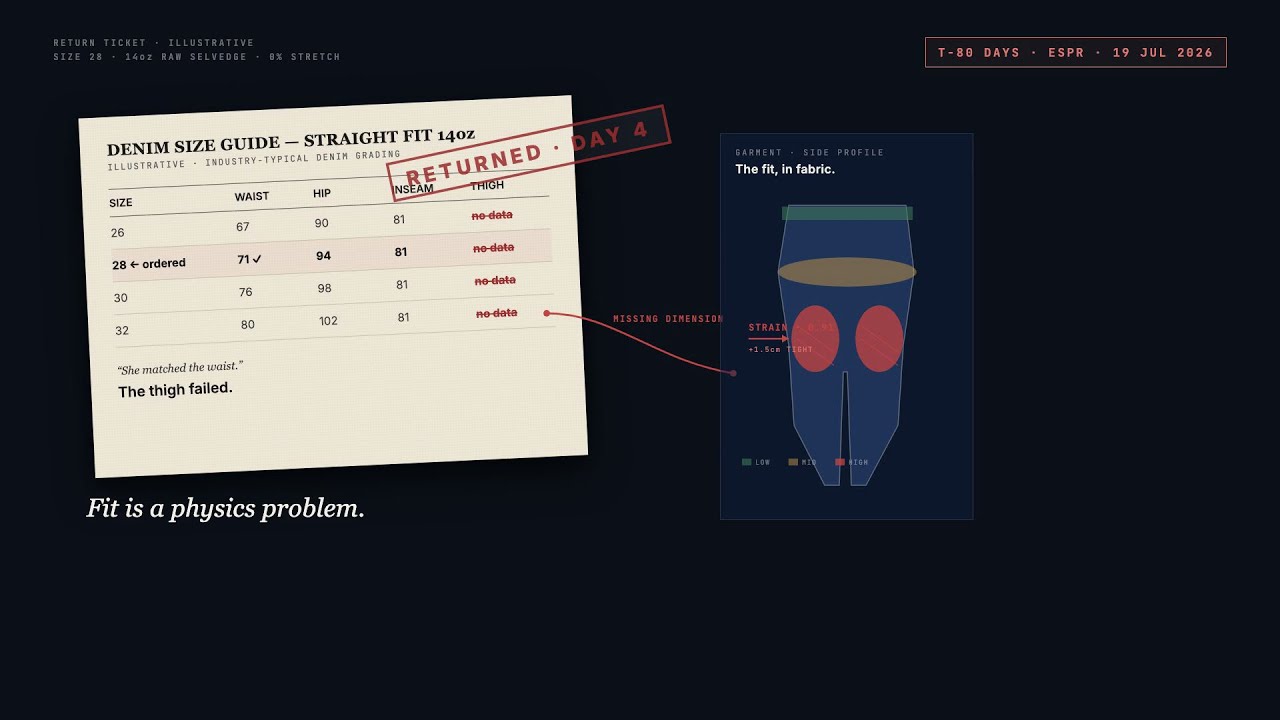
Consider a shopper buying premium denim online. She matches the waist measurement on the size chart perfectly at 71cm. She orders a size 28. The jeans arrive, and the waist fits, but the thigh is 1.5cm too narrow for comfortable sitting because the 14oz raw selvedge denim has zero stretch. The size chart had no thigh measurement. The GenAI try-on showed a flattering image. Neither tool captured the mechanical reality: this fabric's tensile stiffness means it does not accommodate the difference between standing hip geometry and seated hip geometry.
A physics-based approach simulates this interaction. It knows the fabric's bending rigidity (how it drapes), tensile stiffness (how it stretches), and shear behavior (how it conforms to curves). It drapes the digital pattern onto a 3D body mesh and calculates strain at every point. High strain at the thigh means tight fit. This is not a prediction based on what other shoppers experienced. It is a calculation based on the actual fabric and the actual body.
The result of current approaches is predictable. Shoppers adopt rational workarounds. 63% of online shoppers now "bracket": they order multiple sizes with the intent to return all but one. Bracketing doubles your outbound shipping cost, locks inventory during the return cycle, and guarantees that at least half the units you ship come back. 3DLOOK's YourFit tool reduced bracketing-related returns to 2% in a 6-month case study with TA3 SWIM by giving shoppers enough confidence to order a single size. The technology exists. The question is which approach matches your product mix, your data maturity, and your economics.
The market offers four distinct categories of fit technology. Each solves a different slice of the problem. The right choice depends on your SKU count, your 3D design maturity, and whether your return problem is "wrong size selected" or "wrong fit expectation." Honest gaps are noted for each.
| Category | Key Players | What It Does | Proven Impact | Honest Gaps |
|---|---|---|---|---|
| Statistical Size Recommendation | True Fit (65% market share, 82M users), Bold Metrics, Fit Analytics | Matches shoppers to sizes using purchase history, return data, and collaborative filtering across brand networks | 18-32% fit-return reduction (Bold Metrics). Moosejaw: 24% (True Fit). High adoption, low friction. | Black-box recommendations. Cannot explain why a size fits. Accuracy limited by data sparsity for new products. Does not address "wrong fit expectation" (fits but not as expected). |
| Photo-Based Body Measurement | 3DLOOK (YourFit), Mirrorsize, TrueToForm, Fit:Match | Extracts 50-80 body measurements from 1-2 smartphone photos using monocular 3D reconstruction | 3DLOOK: 47% lower return rate (TA3 SWIM, 6-month study). Bracketing returns to 2%. 46% conversion. | Accuracy degrades in uncontrolled conditions (3-5cm vs. 1-2cm lab). Requires shopper effort (photo upload). BIPA/GDPR compliance complexity. SMPL body models biased toward average builds. |
| Generative AI Virtual Try-On | Google Shopping VTO, Zalando (2026 rollout), Veesual, Walmart Zeekit | Diffusion-based image generation showing garment on shopper's body. Photorealistic visualization without fit data. | Conversion lift. Engagement increase. No published return rate reduction data for GenAI-only approaches. | Cannot distinguish between sizes. Hallucination risk (slimming bias, texture drift). No mechanical fit data. Drives conversion but may not reduce fit-related returns. |
| Physics-Based Simulation | CATCHES/RealFit (March 2026, $10M), CLO3D (CLO-SET API), Style3D, Browzwear Lotta | FEA cloth simulation on 3D body mesh. Calculates stress, strain, and pressure from actual fabric material properties and digital garment patterns. | CATCHES claims millimeter-level fidelity (live on AMIRI). CLO3D: 95% drape accuracy vs. physical. Style3D: <1% sizing error claimed. | Requires digital garment patterns (CAD/DXF). Requires Kawabata-tested material properties. Simulation latency (30-60s per garment). Limited to brands with 3D design workflows (~860 companies). |
| Big 4 / Large SIs | Accenture, Deloitte, McKinsey Digital, Capgemini | Strategy consulting, platform implementation, change management for digital commerce transformations | Strong in organizational change. Deep retailer relationships. Large team capacity. | They implement platforms, not build fit intelligence. A Deloitte engagement delivers a Salesforce Commerce Cloud rollout with True Fit integrated. They do not build custom body measurement pipelines, sizing APIs, or physics simulation infrastructure. Engagements run $500K-$5M+. |
| DIY / Internal Build | Internal engineering teams | Custom size recommendation from internal purchase/return data | Full control. No vendor lock-in. Works with proprietary data. | Requires ML engineering talent (hard to hire in fashion). Cold-start problem for new products. No cross-brand data network. Usually takes 12-18 months to reach production. Ongoing model maintenance burden. |
We do not sell a size recommendation widget. We build the fit intelligence infrastructure that connects the right technical approach to your specific return patterns, product mix, and data maturity.
We start with your return data, not your technology wishlist. We analyze return reason codes, category-level return rates, and bracketing patterns to determine whether your problem is "wrong size selected" (solvable with statistical recommendation) or "wrong fit expectation" (requires measurement or simulation).
A fast-fashion retailer with 50,000 SKUs and thin margins needs statistical matching. A premium denim brand with 200 SKUs and $180 average order value needs physics-level precision. We design the pipeline that matches your unit economics, not the most technically impressive option.
Gap and Bold Metrics announced the first AI agent sizing integration in March 2026. When a shopper asks ChatGPT or Google Gemini to find jeans that fit, the agent needs structured sizing data, not a widget. We build sizing APIs that deliver confidence-scored recommendations through agent interfaces.
This means decoupling your sizing logic from your frontend, adding structured fit attributes to your product data (not just S/M/L labels), and returning machine-readable responses: "92% confidence Size 30, snug at hip, relaxed at thigh." We also build the schema.org SizeSystem markup that makes your sizing data discoverable by AI crawlers.
Illinois BIPA classifies 3D body geometry as biometric data requiring written consent, disclosure of retention schedules, and prohibition on data sale. GDPR Article 9 treats biometric data as a special category. Several US states have enacted or are advancing similar laws.
We build on-device measurement architectures where the body reconstruction model runs on the shopper's phone. Photos never leave the device. Only anonymized dimensional measurements (shoulder width, bust, waist, hip, inseam as centimeter values) are transmitted to the recommendation engine. No biometric data is collected by the retailer. This is not just compliance. It is a trust differentiator that converts privacy-conscious shoppers who would otherwise abandon a photo upload flow.
63% of online shoppers bracket (order multiple sizes intending to return all but one). Most retailers do not measure this. They see "30% return rate" without knowing that 15% of those returns are the predictable result of shoppers compensating for sizing uncertainty rather than actual product dissatisfaction.
We build bracketing detection from your order data (same SKU, adjacent sizes, same session), quantify the cost, and deploy targeted interventions: pre-purchase fit confidence scores that eliminate the need to order two sizes, and post-cart nudges that flag when a second size is unnecessary based on the recommendation engine's confidence level.
For brands already using CLO3D, Browzwear, or Style3D, we build the bridge between your 3D design pipeline and your e-commerce storefront. CLO-SET's Fitting service API entered beta in 2026 and is designed for B2B design collaboration, not consumer-facing real-time rendering. We handle the integration: pre-computing fit simulations across body shape clusters for your top SKUs, building the rendering infrastructure that serves results in under 5 seconds, and creating the consumer-facing UX that translates strain maps into actionable fit guidance.
A common gap is material property data. The simulation requires tensile stiffness, bending rigidity, and shear data from Kawabata testing. Most brands know their fabric is "95% cotton, 5% elastane" but have never run KES tests. We build material property estimation models that infer approximate fabric behavior from product descriptions, fiber content, weight, and care instructions, providing 80-85% accuracy without lab testing. Not perfect, but sufficient for reliable size recommendation. Brands that want higher accuracy for premium categories can invest in targeted Kawabata testing for their core fabrics.
Every engagement starts with your return data, not a technology demo. We determine which tier of fit prediction matches your situation before writing a line of code.
We ingest your return reason codes, category-level return rates, order data (for bracketing detection), and size chart architecture. We identify whether your dominant return driver is "wrong size selected" (customer picked the wrong size from the chart) or "wrong fit expectation" (correct size, but the garment does not fit as expected).
Deliverable: Return pattern analysis with tier recommendation (statistical, measurement, or simulation) and projected ROI range based on your specific return cost structure.
For Tier 1 (statistical): we build the recommendation model from your purchase/return data, integrate with your e-commerce platform (Shopify, Salesforce Commerce Cloud, Magento), and deploy the recommendation widget or API endpoint.
For Tier 2 (body measurement): we deploy the on-device measurement pipeline, build the guided capture UX with quality thresholds, and benchmark accuracy against tape measurements on a test cohort.
For Tier 3 (physics simulation): we integrate with your CLO3D/Browzwear pipeline via CLO-SET API, pre-compute fit simulations for your top 50-100 SKUs across 10-15 body shape clusters, and build the consumer-facing fit visualization UX.
We run the fit prediction system against a control group (standard size chart experience) and measure three metrics: return rate, bracketing rate, and conversion rate. Return data has a natural lag (14-30 days between purchase and return), so this phase requires patience.
Honest caveat: If the A/B test does not show statistically significant return rate reduction after 6 weeks of sufficient volume, we diagnose why. Common causes: the recommendation is correct but the UX does not build shopper confidence, the product category has low fit sensitivity (basics, loungewear), or the return driver is not actually fit-related (impulse purchases, wardrobing). We adjust or recommend a different approach.
With validated return rate data, we expand to additional product categories, build the agentic commerce API layer for AI shopping agent compatibility, and add the structured data markup (schema.org SizeSystem, SizeGroup) that makes your fit data discoverable by AI crawlers.
Sustainability angle: The EU Ecodesign for Sustainable Products Regulation bans destruction of unsold apparel starting July 19, 2026 for large companies. Better fit prediction reduces overproduction and unsold inventory. We help quantify the sustainability impact for ESG reporting: shipments avoided, CO2 reduced, unsold inventory decreased.
Answer five questions about your current state. The assessment recommends which tier of fit prediction matches your situation and estimates the return rate impact you can realistically expect.
Question 1 of 5
Under controlled conditions (guided pose, decent lighting, form-fitting clothing), monocular body measurement achieves 1-2cm accuracy against tape measurements. In consumer-realistic conditions (mirror selfies, loose clothing, unknown focal lengths), accuracy degrades to 3-5cm or worse.
This matters because 1-2cm accuracy is sufficient for reliable size recommendation in most garment categories, but 3-5cm accuracy introduces errors that erode shopper trust. We address this with guided capture flows that enforce quality thresholds before processing. The system rejects photos with insufficient signal (heavy occlusion, extreme perspective distortion) rather than guessing.
For brands that need higher accuracy without photo friction, we build statistical sizing models that infer measurements from purchase history, quiz inputs, and demographic data, achieving comparable recommendation accuracy without body photos.
For full FEA cloth simulation, yes. The simulation requires digital garment patterns (DXF or GLB files) with material properties (tensile stiffness, bending rigidity, shear). About 860+ companies worldwide use CLO3D or Browzwear as of 2026, mostly large brands and those with established 3D design workflows.
If your brand does not have digital patterns, physics-based simulation is not your starting point. We build a tiered approach: Tier 1 uses statistical size matching (no CAD required), working from your existing size charts, purchase data, and return reason codes to build a recommendation engine. Tier 2 adds body measurement from guided photos. Tier 3 integrates with your 3D design pipeline for physics-level accuracy.
Most brands start at Tier 1 and see measurable return reduction (18-32% is typical for statistical approaches) before investing in the full simulation stack. The CAD requirement is often the wrong reason to dismiss physics-based approaches entirely. You likely already have the CAD patterns for your core 50-100 SKUs if you use any PLM system.
Implementation costs vary by tier. A statistical size recommendation engine (Tier 1) typically runs $80K-$150K for initial build with $3K-$8K monthly infrastructure. This includes integration with your e-commerce platform, return data pipeline, and recommendation widget or API endpoint.
A body measurement system (Tier 2) adds $100K-$200K for the measurement pipeline, guided capture UX, and accuracy validation, with $5K-$12K monthly for compute and model maintenance. Full physics-based simulation (Tier 3) starts at $200K-$400K, driven by CLO-SET API integration, pre-computation infrastructure, and rendering pipelines.
For context, a mid-size fashion retailer processing $200M in annual sales with a 30% return rate spends roughly $12M annually on return processing alone. A system that reduces fit-related returns by even 18% saves $1.1M-$1.5M per year in direct logistics costs, before accounting for recovered revenue from prevented returns that convert to kept sales.
Body measurement from photos sits in a regulatory gray zone that is rapidly becoming black-and-white. Under GDPR, biometric data processed for identification purposes is special category data requiring explicit consent under Article 9. Under Illinois BIPA, 3D body geometry scans explicitly qualify as biometric identifiers, requiring written disclosure of collection purpose, retention schedule, and written consent before any data capture. Several other US states have enacted or are advancing similar biometric data protections.
We build on-device measurement architectures where the body reconstruction model runs on the shopper's phone. Photos never leave the device. Only anonymized dimensional measurements (shoulder width, bust, waist, hip, inseam as centimeter values) are transmitted to the recommendation engine. No biometric data is collected by the retailer at all.
For GDPR, we implement purpose limitation (measurements used only for size recommendation, not marketing profiling), storage limitation (measurements deleted after session or retained only with explicit opt-in), and data minimization (only the measurements needed for the garment category, not a full body scan).
AI shopping agents (ChatGPT, Google Gemini, Claude-powered assistants) are becoming purchase channels. Gap and Bold Metrics announced the first AI agent sizing integration in March 2026. When a shopper asks an agent to find them jeans that fit, the agent needs structured sizing data it can reason over. Most existing size recommendation tools are widget-based: they render a UI component on your product page. That does not work when the shopping interface is a chat window.
We build sizing APIs that expose your fit intelligence as structured endpoints. The agent sends body measurements or purchase history, your API returns confidence-scored size recommendations with fit notes (e.g., "92% confidence Size 30, expect snug fit at hip"). This requires your sizing logic to be decoupled from your frontend, your product data to include structured fit attributes (not just S/M/L labels), and your recommendation engine to return machine-readable responses.
We also build the structured data layer (schema.org SizeSystem, SizeGroup markup) that makes your size data discoverable by AI crawlers before a shopper even asks.
Expect 8-12 weeks from kickoff to live A/B test for a Tier 1 statistical recommendation engine. The first 3-4 weeks are data work: ingesting your return reason codes, purchase history, and size chart data, then building the recommendation model. Weeks 4-8 cover platform integration (Shopify, Salesforce Commerce Cloud, or Magento plugin) and the recommendation UX. Weeks 8-12 are the A/B test period, where you run the recommendation widget for a control group versus standard size charts.
For body measurement systems (Tier 2), add 4-6 weeks for capture flow development, accuracy benchmarking, and UX testing. For physics-based simulation (Tier 3), add 8-12 weeks for CLO-SET integration, pre-computation of fit results across body clusters, and rendering pipeline deployment.
The honest caveat: return rate data has a natural lag. A purchase made today might not be returned for 14-30 days. So even after the A/B test starts, you will not have confident return rate numbers for 6-8 weeks after the first transactions. Plan for a 4-6 month total timeline from kickoff to validated return rate impact data.
The technical foundations behind our fit prediction approach are detailed in our interactive whitepaper.
A deep technical analysis of physics-based 3D body mesh reconstruction, FEA garment simulation, and the mathematical limitations of generative AI virtual try-on for fit prediction.
Even a Tier 1 statistical recommendation engine pays for itself within the first year for most mid-size fashion retailers.
We start with your return data, determine which tier of fit prediction matches your economics, and build a system that pays for itself within the first year. No platform lock-in. No black-box algorithms. Your data, your infrastructure, your competitive advantage.