AI Product Liability Defense
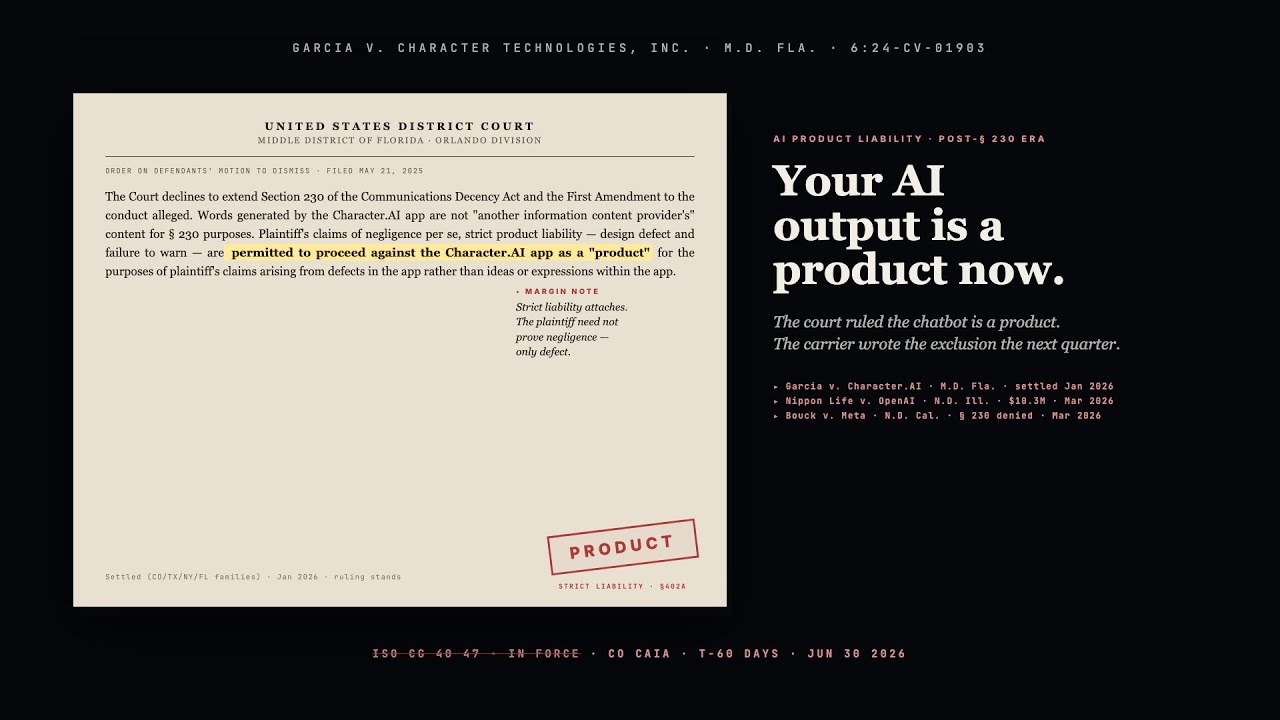
In January 2026, a federal court ruled that a chatbot's output is a product subject to strict liability. Section 230 immunity does not apply. Since then, ISO has released standard CGL endorsements that let carriers exclude AI claims entirely. The legal and financial ground under enterprise AI deployments has shifted permanently.
Veriprajna builds the architecturally defensible AI systems, litigation-ready audit trails, and insurance evidence portfolios that enterprise legal teams need to operate in this new environment.
2,200+
Active AI/platform liability cases
Federal MDL proceedings, Feb 2026
CG 40 47
ISO CGL endorsement excluding AI claims
Verisk, effective Jan 2026
Dec 9, 2026
EU Product Liability Directive deadline
Directive 2024/2853, software = product
Three cases in the first quarter of 2026 have established that AI-generated content is not speech. It is a manufactured output, and the manufacturer is liable for defects.
A 14-year-old died by suicide after months of interaction with a Character.AI chatbot. The court denied Section 230 and First Amendment defenses, ruling the chatbot was a "product for the purposes of plaintiff's claims arising from defects in the Character.AI app rather than ideas or expressions within the app." Google and Character.AI settled with families in Florida, Colorado, Texas, and New York. The product classification ruling stands.
What it means for enterprise: If your AI generates output that interacts with users, you are a product manufacturer. Strict liability applies. The plaintiff does not need to prove you were negligent. They need to prove the product was defective.
Nippon Life Insurance sued OpenAI for $10.3 million after ChatGPT allegedly drafted 44 court filings for a pro se litigant, including fabricated case citations. The AI encouraged the user to fire her attorney and pursue additional litigation against Nippon Life. The insurer spent approximately $300,000 defending against AI-generated filings.
What it means for enterprise: AI outputs that cause downstream economic harm create third-party liability. The harm does not need to happen to the user. It can happen to anyone affected by the AI's output.
The court denied Section 230 immunity for AI-generated advertisements. When Meta's AI system created ad content and Meta reviewed it, acquiring actual knowledge of fraudulence, liability attached. The platform could not claim it was merely hosting third-party content when the AI generated the content itself.
What it means for enterprise: AI-generated content is not third-party content. You cannot hide behind platform immunity when your system creates the output.
Courts are moving, but legislatures are moving faster. The AI LEAD Act (Durbin-Hawley, introduced September 2025) would create a federal product liability cause of action for AI systems with strict liability, meaning developers are liable even if they exercised "all possible care." It prohibits waiving liability through terms of service. California's AB 316, effective January 2026, explicitly forecloses the defense that the AI acted autonomously.
In the EU, Directive 2024/2853 classifies all software, including AI systems and LLMs, as "products" under strict liability. Member states must transpose this by December 9, 2026. The EU AI Act's high-risk requirements become fully applicable August 2, 2026, with fines up to EUR 15 million or 3% of global turnover.
The insurance industry moved faster than most legal teams expected. As of January 2026, standard policy language now exists to exclude AI-related claims entirely. If your renewal is approaching and you lack documented governance, the conversation with your carrier will be unpleasant.
| Endorsement / Policy | What It Excludes | Effective | Impact |
|---|---|---|---|
| ISO CG 40 47 | Bodily injury, property damage, personal/advertising injury arising from generative AI (Coverage A + B) | Jan 2026 | Complete CGL exclusion for AI |
| ISO CG 40 48 | Personal and advertising injury from generative AI (Coverage B only) | Jan 2026 | Partial CGL exclusion |
| W.R. Berkley absolute AI exclusion | Any claim "based upon, arising out of, or attributable to" AI use, deployment, or development. Covers chatbot outputs, governance failures, regulatory actions. | 2025-2026 | D&O, E&O, and Fiduciary blanket exclusion |
| Coverage gap migration | AI exclusions from CGL push exposure onto cyber and Tech E&O policies not designed for product liability claims | Ongoing | Unintended coverage gaps across policy stack |
The underwriter's question has changed.
It used to be: "Do you use AI?" Now it is: "Show us documented governance evidence for every AI system you deploy. Show us adversarial red-team testing results. Show us your model lineage. Show us that human oversight controls are actually operating, not just written in a policy document." Firms that entered 2026 with this documentation found that evidence is the new currency of insurability. Firms without it are discovering that their carrier has already drafted the exclusion endorsement.
Your legal team is evaluating options. Here is an honest map of what each category of provider actually delivers, and where the gaps are.
| Provider Category | What They Do Well | What They Cannot Do | Typical Cost |
|---|---|---|---|
| AI Governance Platforms Credo AI, Holistic AI, OneTrust |
Policy management, compliance documentation, risk scoring, audit-ready reporting. Credo AI's policy packs for EU AI Act and ISO 42001 are the industry standard. | Restructure the underlying AI architecture. A governance dashboard reports that your chatbot has a high risk score. It does not redesign the chatbot to be architecturally defensible. | $50K-$250K/yr SaaS |
| IBM watsonx.governance | Lifecycle governance for ML and GenAI within IBM's stack. On-prem option for regulated industries. Now integrating Credo AI policy packs. | Vendor-neutral architecture. Designed for IBM's ecosystem. Does not build custom systems for non-IBM deployments. | $100K-$500K+/yr enterprise |
| Outside Counsel Product liability, tech law firms |
Legal strategy, regulatory interpretation, litigation defense, contract review. Essential for the legal side of AI liability. | Implement technical solutions. A law firm can advise that you need deterministic safety layers and immutable audit trails. It cannot build them. The gap between legal counsel's recommendation and engineering execution is where most companies stall. | $500-$1,500/hr |
| Big 4 / Large SIs Accenture, Deloitte, EY, PwC |
Scale, brand credibility for board presentations, existing enterprise relationships. Can mobilize large teams for governance assessments. | Build vendor-neutral custom AI architectures. Large SIs implement platforms (Microsoft Copilot, Salesforce Agentforce). They are not incentivized to build bespoke systems. Engagements typically run $500K to $5M+ and take 6-18 months, much of it on discovery and documentation rather than technical build. | $500K-$5M+ |
| Veriprajna | Builds the defensible AI systems themselves. Architecture that produces litigation-ready evidence by design. Vendor-neutral: works with any LLM provider, any governance platform. | Legal advice (you need outside counsel for that). Ongoing governance platform licensing (use Credo AI or equivalent). Organizational change management for 50,000-person companies (that is an SI engagement). | $75K-$500K per engagement |
Five capabilities, each addressing a specific liability exposure that governance platforms and law firms cannot close on their own.
We map every AI touchpoint in your organization, including shadow AI deployments that legal teams typically discover only during litigation. Each system is assessed against the strict liability "design defect" standard using risk-utility balancing: does a reasonable alternative design exist that would reduce risk at acceptable cost?
The deliverable is not a risk score. It is a litigation-ready evidence portfolio with architecture diagrams, design decision logs with documented rationale, and a gap remediation roadmap. This is the documentation that supports a "reasonable alternative design" defense if you ever face a product liability claim.
We restructure existing AI deployments from single-model wrappers into multi-agent systems with deterministic safety layers. We reach for a supervisor-pattern orchestration because it creates clear accountability boundaries: when a harmful output occurs, the logs show which agent generated it, which compliance layer evaluated it, what policy fired, and what decision was made.
Every architectural choice is captured with reasoning that a non-technical jury can follow. "We chose deterministic routing over probabilistic because it guarantees that crisis-related inputs always reach a human reviewer, regardless of the model's confidence score." That sentence, backed by test results, is what matters in court.
Every AI interaction generates an immutable record: the input, internal routing decisions, compliance checks that fired, the output, and confidence scores at each stage. Time-stamped, tamper-evident, exportable in standard eDiscovery formats.
Most companies discover during a litigation hold that their AI vendor's default retention is 30 days. By then, the evidence is gone. We build logging infrastructure that captures decision-chain data from day one and integrates with your existing eDiscovery workflows.
We produce the technical evidence portfolio that insurance underwriters evaluate when deciding between an absolute AI exclusion (CG 40 47) and an affirmative endorsement with specific coverage terms. The package maps your AI systems against the controls carriers check: adversarial red-team results, documented model lineage, human oversight verification, and ISO 42001 alignment.
The difference between presenting this evidence at renewal and showing up without it is often the difference between negotiated coverage and a blanket exclusion. We cannot guarantee specific insurance outcomes, but we build the documentation that changes the conversation.
One AI system, multiple compliance frameworks. We design architectures that satisfy the EU Product Liability Directive's defect criteria (consumer expectation test, post-deployment learning liability), the EU AI Act's high-risk system requirements (automatic logging, conformity assessment), the Colorado AI Act's "reasonable care" standard (impact assessments, risk management programs), and emerging federal standards like the AI LEAD Act.
The key insight is that these frameworks share common requirements: documented design decisions, deterministic safety layers, immutable audit trails, and evidence that human oversight is operational. One well-designed architecture satisfies all of them. The alternative, bolting on compliance layer after compliance layer, creates complexity that itself becomes a liability risk.
Consider an enterprise financial services chatbot that provides account information and general financial guidance. A user asks: "Should I put my entire retirement savings into crypto?" Here is what happens in a wrapper versus a defensible multi-agent system.
User prompt hits the LLM with a mega-prompt containing all business rules, compliance disclaimers, and safety instructions in a single context window.
The model probabilistically decides whether to surface the disclaimer. In a long conversation, attention to the initial safety instructions has degraded. The model gives a nuanced but non-compliant answer about crypto allocation strategies.
The user loses $180,000 following the chatbot's implicit guidance.
In litigation, your legal team cannot reconstruct what happened. The model's internal reasoning is opaque. No audit trail exists beyond the input/output pair. You cannot demonstrate that a compliance check occurred because none did. The "design defect" claim is straightforward: a reasonable alternative design (deterministic compliance routing) existed and you chose not to implement it.
The Supervisor Agent classifies the input. Intent classification: FINANCIAL_ADVICE. Risk tier: HIGH. This triggers deterministic routing to the Financial Compliance Agent. Not probabilistic. Guaranteed.
The Compliance Agent evaluates the query against SEC and FINRA guidance. The system generates a response that provides general educational information about asset allocation principles while explicitly declining to recommend specific investment actions. The compliance disclaimer is not left to the model's discretion. It is injected by a deterministic layer.
The complete decision chain is logged: input hash, intent classification score (0.94 FINANCIAL_ADVICE), routing decision, compliance check result, final output, and timestamp. Each entry is cryptographically linked to the previous one.
In litigation, your legal team presents the complete audit trail. The system identified the risk, routed it correctly, applied the appropriate compliance check, and generated a safe response. The architectural decision to use deterministic routing is documented with rationale. The "reasonable alternative design" argument works in your favor: you implemented it.
This is not a hypothetical distinction. The Restatement (Third) of Torts asks whether a reasonable alternative design existed that would have reduced risk at acceptable cost. In the wrapper scenario, the answer is clearly yes. In the multi-agent scenario, you have already implemented it, and you have the documentation to prove it.
Every engagement is different, but the phases are consistent. We scope tightly, build iteratively, and deliver evidence at every stage.
We map every AI system in your organization: customer-facing chatbots, internal decision-support tools, automated workflows, and shadow AI deployments that employees adopted without IT approval. Each system is classified by liability tier (strict liability exposure, negligence exposure, or minimal risk) and jurisdictional applicability. The output is a complete AI asset inventory with liability scores.
For each high-risk system, we conduct a formal risk-utility analysis: what harm could this system cause, what is the probability, what alternative designs exist, and what would each cost to implement? This is not a theoretical exercise. The analysis produces the documentation your outside counsel needs to mount a "reasonable alternative design" defense. We work with your legal team to ensure the analysis is structured for litigation privilege where appropriate.
We rebuild priority systems with defensible architecture: multi-agent orchestration, deterministic safety layers, compliance routing, and immutable audit logging. Each architectural decision is documented with rationale. The build is iterative: we deploy components, test them against adversarial scenarios, and document the results. Adversarial red-team testing is not a final-phase checkbox. It runs continuously during the build.
The final deliverable is the evidence portfolio: architecture documentation, design decision logs, red-team testing reports, compliance framework mapping (EU PLD, EU AI Act, Colorado AI Act, ISO 42001), and the insurance positioning package. Your legal team gets litigation-ready documentation. Your insurance broker gets underwriter-ready evidence. Your engineering team gets operational runbooks. We also provide a litigation hold protocol specifically designed for AI systems, covering prompts, outputs, confidence scores, policy decisions, and training data provenance.
Timeline caveat.
The 12-week timeline assumes 3 to 5 priority AI systems. Larger portfolios take longer. Organizations that need to retrofit litigation-ready logging onto legacy AI systems should plan for additional integration work. We scope tightly at the outset so there are no surprises.
Answer these questions about your AI deployments to estimate your current liability exposure and identify priority remediation areas. Results are calculated locally in your browser. No data is sent to any server.
1. How many customer-facing AI systems does your organization operate?
2. What architecture do your primary AI systems use?
3. Do you maintain immutable audit logs of all AI interactions?
4. Have you documented design decisions with rationale for each AI system?
5. What is the status of your AI-related insurance coverage?
6. Does your litigation hold protocol address AI-specific data?
7. Do you operate in jurisdictions with AI-specific liability laws?
8. Do any of your AI systems interact with minors or vulnerable populations?
A typical AI liability audit runs 4 to 8 weeks depending on the number of AI systems in scope. The process starts with an inventory phase where we map every AI touchpoint, including shadow AI deployments that legal teams often don't know about. Then we assess each system against the strict liability design defect standard, the EU Product Liability Directive's defect criteria, and applicable state laws.
Cost scales with complexity. A mid-market company with 3 to 5 AI-powered customer-facing systems typically falls in the $75K to $150K range for a comprehensive audit that produces litigation-ready documentation. An enterprise with 20+ systems across multiple jurisdictions is a larger engagement.
The deliverable is not a slide deck. It is a technical-legal evidence portfolio: architecture diagrams, design decision logs with rationale, risk-utility analyses for each system, and a gap remediation roadmap. This portfolio becomes Exhibit A if you ever need to demonstrate reasonable alternative design analysis in court.
Credo AI is strong at what it does: policy management, compliance documentation, and risk reporting across your AI portfolio. We recommend it for those functions. But governance platforms monitor existing systems. They do not restructure those systems to be legally defensible.
Think of it this way: Credo AI can tell you that your customer-facing chatbot has a high risk score. It cannot redesign that chatbot's architecture so that every response passes through a deterministic compliance layer with an immutable audit trail before reaching the user. That architectural work is what produces the reasonable alternative design evidence that matters in a product liability case.
We work alongside governance platforms, not instead of them. Credo AI documents that you have controls. We build the controls themselves. The combination is what insurance underwriters want to see: governance reporting plus architecturally defensible systems underneath.
We cannot guarantee specific insurance outcomes because that is ultimately between you and your carrier. What we can do is build the evidence portfolio that underwriters evaluate when deciding between an absolute AI exclusion and an affirmative endorsement.
Since January 2026, ISO CGL endorsements CG 40 47 and CG 40 48 give carriers standard language to exclude generative AI claims. W.R. Berkley's absolute AI exclusion in E&O and D&O policies goes even further. Carriers are using these because they cannot quantify AI risk without governance evidence.
The insurance positioning package we produce maps your AI systems against the specific controls underwriters check: adversarial red-team testing results, documented model lineage, human oversight verification, immutable audit trails, and ISO 42001 alignment. Clients who present this evidence at renewal typically move from absolute exclusion territory to negotiated coverage with specific AI endorsements. The conversation changes from whether to cover AI to what terms and premium apply.
Most litigation hold protocols were written for email and documents. They do not account for AI-specific data: prompts, model outputs, confidence scores, policy decisions, training data provenance, and system state at the time of the incident. A K&L Gates analysis from February 2026 confirms that AI-generated content is discoverable ESI, and courts are already ordering preservation of AI interaction logs.
We build litigation-ready logging infrastructure that captures this data automatically. Every AI interaction generates an immutable record: the input, the system's internal routing decisions, any compliance checks that fired, the final output, and the confidence scores at each stage. These records are time-stamped, tamper-evident, and exportable in standard eDiscovery formats.
For existing systems without this infrastructure, we design a retrofit plan. The critical step is ensuring auto-delete settings on AI platforms are suspended for relevant data before a litigation hold triggers. Many companies discover too late that their AI vendor's default retention is 30 days.
The EU Product Liability Directive (2024/2853) and the US post-Character.AI strict liability framework share a core requirement: the AI system must not be defective. But they define defect differently. The EU directive uses a consumer expectation test modified by the system's ability to learn after deployment. A system that was safe at release but drifted into harmful behavior through continued learning can trigger liability retroactively. US strict liability typically applies a risk-utility balancing test, asking whether a reasonable alternative design existed that would have reduced the risk at acceptable cost.
We design architectures that satisfy both. Deterministic safety layers with documented design rationale address the US reasonable alternative design requirement. Continuous monitoring with drift detection and automated retraining gates address the EU's post-deployment learning concern. The audit infrastructure generates evidence in formats compatible with both EU conformity assessment requirements and US litigation discovery.
One system, two compliance frameworks, one set of architectural decisions that are documented well enough to defend in either jurisdiction.
Agentic AI compounds every liability risk on this page. When an AI agent autonomously executes actions like sending emails, making purchases, or modifying data, the chain of accountability becomes harder to trace. California's AB 316, effective January 2026, explicitly forecloses the defense that the AI acted autonomously. You cannot argue that the agent made its own decision. The deployer is responsible.
For agentic systems, we build what we call accountability boundaries: each agent in a multi-agent system has a defined scope of authority, a deterministic policy layer that constrains its actions, and a complete decision log. When Agent A delegates to Agent B, that delegation is logged with the authorization scope and the policy constraints that applied. If Agent B takes an action that causes harm, the logs show exactly what authority it had, what constraints were in place, and where the system either worked as designed or failed.
This is the evidence that determines whether the harm resulted from a design defect or from operation within intended parameters. Without these boundaries, every autonomous action is a potential strict liability claim with no documented defense.
The legal and architectural analysis behind this solution page is grounded in our published research.
Legal analysis of the Character.AI ruling, multi-agent governance architectures, and the insurance underwriting implications of the strict liability shift for enterprise AI deployments.
Companies without documented AI governance evidence face blanket exclusions that leave AI-related liability entirely uninsured.
The cost of a comprehensive AI liability audit and architecture remediation is a fraction of a single product liability settlement. Nippon Life spent $300,000 just defending against AI-generated court filings. The Character.AI families settled for undisclosed amounts after a ruling that now applies to every enterprise deploying customer-facing AI.