AI for Architecture & Structural Engineering
Generative AI creates stunning architectural concepts in seconds. Then your structural team spends weeks proving they cannot be built. Eighty percent of construction cost deviation comes from design changes, not construction mistakes.
Veriprajna builds custom AI systems that close this gap: physics-informed pre-screening during conceptual design, structural optimization against actual steel procurement, and automated BIM-to-analysis pipelines that eliminate the manual translation errors driving rework.
$177B
Annual construction rework from design errors
Trimble, 2025
80%
Of cost deviation from design changes
FMI / Industry Analysis
11.9%
Steel price increase in 2025
ENR 20-City Average
The architecture-to-engineering handoff is where projects stall, budgets overrun, and timelines collapse. Here is what that looks like in practice.
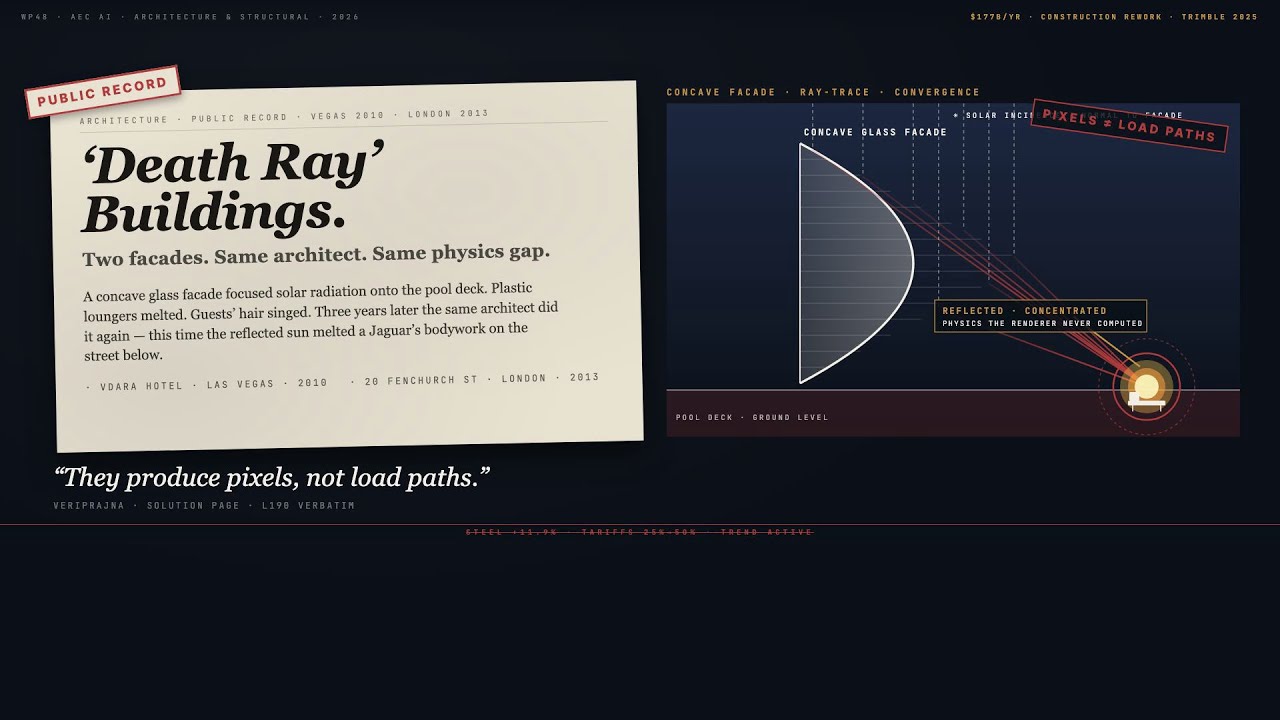
Rafael Viñoly's Vdara Hotel in Las Vegas features a crescent-shaped, south-facing glass facade. The concave geometry acted as a parabolic reflector, focusing solar radiation onto the pool deck. Temperatures soared enough to melt plastic lounge chairs and singe guests' hair. The physics were simple: a concave mirror focuses light. A ray-tracing analysis during conceptual design would have caught this in milliseconds.
The same architect repeated the error at 20 Fenchurch Street in London ("Walkie-Talkie"), where the concave facade focused sunlight hot enough to melt a Jaguar's bodywork on the street below. Two buildings, same physics failure, same architect, same gap in the design process.
The remediation at both buildings was expensive and aesthetically compromising: non-reflective film, external fins, large umbrellas. These are not edge cases. As generative AI makes it trivially easy to produce complex curved geometries, the risk of inadvertent environmental hazards (concentrated solar, wind tunneling, acoustic focusing) increases proportionally. The tools generating these forms have no physics engine. They produce pixels, not load paths.
Sixty to ninety days after schematic design approval, the general contractor prices the architect's vision. The call follows a predictable script: the facade is 3x over budget because the AI-generated concept uses double-curved glass at $100-500 per square foot instead of flat tempered glass at $18-25 per square foot. The structural steel includes mill-order-only sections (W14x730, anyone?) with 16-week lead times. The connection details require full-penetration field welding that triples labor costs.
The developer panics. Value engineering begins. The architect resists every change. The structural engineer re-runs ETABS for each proposed alternative. Each iteration takes 4-8 hours of analysis time. Ten iterations means two weeks of senior engineer time just on member resizing.
This cycle repeats on nearly every project above $50M. The industry has accepted it as inevitable. It is not. A design process that checks structural viability, material availability, and fabrication complexity during conceptual iteration eliminates the VE crisis before it starts.
Your architect works in Revit. Your structural team analyzes in ETABS. Getting the model from one to the other is a manual, error-prone process that your firm repeats hundreds of times per year.
IFC export from Revit drops analytical model data routinely. Connection types get lost. Analytical offsets reset. Load assignments disappear. Even with third-party exchange tools, the out-of-box quality of structural model transfer between BIM authoring tools and analysis software is unreliable. Your engineers spend 2-4 hours per model cleaning up the translation before they can even start analysis.
Multiply that by 15-20 iterations per project, 30-50 projects per year, and you are burning thousands of senior engineer hours on data translation. Not engineering. Not design. Translation.
A reference for evaluating where existing tools stop and where custom work begins. Pull this up in your next technology evaluation meeting.
| Platform | What It Does | Strengths | Gaps |
|---|---|---|---|
| Autodesk Forma | AI-powered site planning, massing, environmental analysis (sun, wind, energy). Neural CAD for Buildings launching 2026. | Dominant BIM ecosystem. Real-time daylight/carbon analysis. Revit integration. | Massing-level only. No structural member sizing. No cost optimization against real procurement data. |
| Altair SimSolid / PhysicsAI | Meshless FEA on full CAD assemblies. AI models predict simulation results from historical data. | Minutes instead of hours for complex assemblies. Siemens backing ($10.6B acquisition). Strong on facades and connections. | Enterprise pricing. Mechanical/automotive focus, not AEC-native. No BIM integration. No procurement awareness. |
| TestFit | AI site planning for multifamily/commercial. 3,000 valid plans in under 10 seconds. | Fast iteration. Unit mix and parking optimization. 650+ deals evaluated per week. | Site planning only. No structural engineering. No physics simulation. |
| Hypar | Parametric space planning with AI-generated massing, grids, and layouts. | Developer-friendly. Export to Revit. Fast conceptual layouts. | Space planning focus. No structural verification. No cost estimation. |
| Stru.ai | AI agent automating ETABS/SAP2000/RISA workflows. Generates calculation sheets, checks codes. | Native FEA tool integration. Code-referenced output (ACI/AISC). Claims 40% time savings. | Automation wrapper around existing FEA. Does not reduce analysis time itself. Not generative design. |
| Tekla (Trimble) | AI Model and Drawing Assistant for detailing. AI-generated fabrication drawing suggestions. | Strong fabrication and detailing workflows. Natural language modeling commands. | Detailing-focused. Not structural design or optimization. |
| Nemetschek (Allplan/Vectorworks) | AI assistants for BIM workflows. Automated design tasks. 2026: agentic AI strategy. | Multi-brand ecosystem. Connected design-to-construction data flow. | AI features are assistive (chatbot, detailing). No physics-based verification or optimization. |
| Big 4 / Large SIs | Technology consulting, digital transformation programs, BIM implementation. | Brand recognition. Large teams. Established enterprise relationships. | They implement platforms, not build physics engines. Engagements run $500K-$5M+ with 6-18 month timelines. No structural engineering domain depth. |
| Custom Build (Veriprajna) | Firm-specific AI: surrogate models trained on your projects, direct API pipelines, procurement-aware optimization. | Built for your typologies, your tools, your standards. On-premise deployment. Structural domain expertise. | Not a product you buy off the shelf. Requires 200+ historical models for surrogate training. 12-20 week engagement. |
Each capability is built specifically for your firm's tools, typologies, and engineering standards. Not a platform. Not a plugin. Custom AI integrated into the workflow you already run.
We train a Graph Neural Network surrogate on your firm's completed ETABS/SAP2000 analyses. The model learns the structural behavior patterns specific to your building typologies: steel moment frames, concrete shear walls, composite floor systems.
During conceptual design, the surrogate returns utilization ratios, drift estimates, and member adequacy checks in seconds instead of hours. We reach for GNN-based architectures because structural models are inherently graphs (nodes as members, edges as connections), and message-passing on graphs mirrors how forces actually propagate through a frame.
The surrogate handles the exploration phase. Your PE handles the final validation. Academic benchmarks from StructGNN research show 99%+ accuracy on frame displacements and forces. Our production surrogates, trained on real project data with more variability, typically achieve R-squared of 0.97-0.99 for utilization ratios.
We build multi-objective optimization engines that size structural steel members against three constraints simultaneously: structural adequacy (AISC 360 checks), material cost (weight minimization), and procurement reality (service center availability and stock lengths).
The optimizer uses NSGA-II evolutionary algorithms rather than reinforcement learning. Genetic algorithms are proven, well-understood, and produce diverse Pareto-optimal solutions without the convergence uncertainty of deep RL on building-scale problems. We categorize AISC W-shapes into availability tiers based on published rolling schedules and service center data, then penalize Tier 3 (mill-order) selections unless the structural demand genuinely requires them.
The output is a buildable member schedule with weight savings estimates, procurement lead time impacts, and estimated cost deltas. On internal benchmarks, this approach has shown 9-15% steel tonnage reduction compared to conventional sizing while eliminating schedule-critical mill orders.
We bypass IFC entirely and build direct API integrations between your BIM authoring tool and your analysis software. For the most common pipeline (Revit-to-ETABS), we use the Revit API to extract the analytical model directly from the Revit database and the CSi OAPI to push it into ETABS with full fidelity: framing connectivity, section assignments, material properties, load definitions.
The round-trip works both ways. Analysis results return through the same API and update the Revit model with color-coded utilization overlays. No IFC export, no manual cleanup, no lost connection types or reset analytical offsets.
We build the same for Revit-to-SAP2000, Revit-to-Robot, Tekla-to-STAAD, and other tool pairs. Each pipeline is custom-built for the specific software versions and engineering standards your firm uses. The goal is not a generic integration but a bulletproof data path that your team trusts enough to stop checking manually.
We build real-time cost and constructability flagging systems that run during schematic design. The system evaluates each design iteration against procurement databases, fabrication complexity heuristics, and building code requirements (ASCE 7-22, IBC 2024).
Specific flags include: curved glass penalties (flat at $18-25/sqft vs. bent at $100-500/sqft), non-standard steel connections requiring field welding, sections with mill-order lead times, thermal bridging from steel members penetrating insulation, and environmental hazards like solar convergence on concave facades.
This is the system that prevents the VE crisis. When the architect's concept triggers a constructability flag at iteration 3 instead of at contractor pricing 90 days later, the project saves weeks of redesign and hundreds of thousands in engineering rework. The system is not replacing the architect's judgment; it is giving them the same cost and feasibility awareness that the contractor has.
Three phases, 12-20 weeks. No multi-year transformation programs. No platform migration.
We map your design-to-analysis workflow end to end. Where does the architect hand off to the structural team? How long does each ETABS iteration take? Which building typologies represent 80% of your project volume? What are the highest-friction handoff points?
Deliverable: a prioritized gap analysis with time-cost quantification for each bottleneck. This determines what gets built in Phase 2.
We build the custom AI components your workflow needs. Surrogate model training requires 200-500 of your completed structural analyses. BIM-to-analysis pipelines are built against your specific Revit/ETABS versions and firm standards. The procurement optimizer is populated with current AISC availability data and your preferred service center relationships.
We handle the ML engineering and software development. Your structural team provides domain validation: reviewing surrogate predictions against their engineering intuition, confirming the optimization constraints match your standards.
Deployment to your environment (on-premise or your cloud tenant, never ours). Parallel validation on 5-10 active projects: the AI runs alongside your standard workflow, and your engineers compare results. We tune accuracy thresholds based on these real-project comparisons.
The deliverable is working software integrated into the tools your team already uses. Not a standalone platform. Not a new login. A Revit plugin, an ETABS integration, a dashboard in your existing project management stack.
Evaluate where AI intervention would have the highest ROI in your design-to-analysis workflow. Answer six questions about your current practice.
We build a custom surrogate model trained on your firm's own completed projects. The training data comes from your existing ETABS or SAP2000 analysis results: hundreds or thousands of structural models your team has already run. The surrogate learns the relationship between structural configuration (member sizes, spans, loading) and analysis results (utilization ratios, drift, deflections) for your specific building typologies.
During conceptual design, the surrogate provides instant feedback: "This bay spacing with W24x68 beams gives you a 0.87 utilization ratio under gravity; wind drift is at H/420." The architect or designer gets this in seconds instead of waiting for a full FEA run.
When the design stabilizes, your engineers still run full ETABS or SAP2000 analysis for permit submission. The PE stamps the final calculation package as always. The surrogate handles the first 15-20 iterations that currently take days of back-and-forth between the architecture and engineering teams. Integration is through your existing tools: a Revit plugin extracts the analytical model, sends it to the surrogate via API, and returns results as color-coded overlays on the BIM model. No new software to learn. No change to your final deliverable workflow.
Yes, but with honest caveats about data freshness. Steel service centers do not provide real-time inventory APIs. Availability data comes from published rolling schedules, service center stock lists (updated weekly to monthly), and historical procurement patterns from fabricators.
We build the optimization engine around AISC standard W-shapes categorized into three tiers: Tier 1 sections that are always available at major service centers (W10x12 through W12x26, W14x22 through W14x48, W16x26 through W16x40, W18x35 through W18x50, W21x44 through W21x62, W24x55 through W24x84), Tier 2 sections that are commonly stocked but may require a few days' lead time, and Tier 3 sections that are mill-order only with 8-16 week lead times.
The optimizer defaults to Tier 1 selections and only moves to Tier 2 or Tier 3 when structural demands genuinely require it. It also factors stock lengths (40-foot and 60-foot standards) to minimize cut waste. On a recent internal benchmark of a 12-story steel moment frame, this approach reduced total steel tonnage by 9% compared to conventional engineering judgment while eliminating all mill-order sections, saving an estimated 6 weeks of procurement lead time. The caveat: availability changes weekly. We build the tier database from fabricator partnerships and AISC published data, but your procurement team should still confirm critical sections with their service center contacts before final buy.
Correct, and we do not position our tools as replacements for PE-stamped calculations. No building department anywhere will accept "the AI said it is safe" as a basis for permit approval. The licensed Professional Engineer remains responsible for all structural calculations submitted for permit.
Our tools sit upstream of the PE's final analysis. They handle the exploration phase: the 15-20 design iterations during schematic and design development where the team is searching for the right structural system, member sizes, and lateral system. Currently, each iteration requires hours of manual ETABS modeling and analysis. Our surrogate models compress this to seconds, letting the PE explore more options and arrive at a better starting point for final analysis.
The final calculation package is always produced by your licensed engineers using your standard FEA software. Our AI narrows the design space; your PE validates the final answer. This mirrors how the industry already uses tools like Forma for massing studies: nobody submits a Forma model for permit, but it saves weeks of manual iteration during early design. We apply the same principle to structural engineering.
We avoid IFC entirely for structural model exchange. IFC export from Revit drops analytical model data routinely. ArchiCAD IFC and Tekla IFC use different relationship schemas. Even with Graphisoft's Archicad-Revit exchange add-in, the out-of-box quality of structural model transfer is poor: connection types get lost, analytical offsets reset, load assignments disappear.
Instead, we build direct API integrations between your BIM authoring tool and your analysis tool. For Revit-to-ETABS (the most common pipeline), we use the Revit API to extract the analytical model directly from the Revit database, including framing connectivity, section assignments, material properties, and load definitions. This data goes into ETABS through the CSi OAPI (Open Application Programming Interface), which CSi has maintained since ETABS v9. The round-trip works: analysis results come back through the same API and update the Revit model.
This is more work to set up than a generic IFC workflow, but it is reliable. We have tested this pipeline across Revit 2024 and 2025, and the analytical model transfers with 100% fidelity for steel and concrete framing. The same approach works for Revit-to-SAP2000, Revit-to-Robot, and Tekla-to-STAAD. Each pipeline is custom-built for the specific tool pair your firm uses.
A typical engagement runs 12-20 weeks across three phases. Phase 1 (Weeks 1-4): Pipeline Audit. We map your current design-to-analysis workflow end to end. Where does the architect hand off to the structural team? How long does each iteration take? Which building typologies make up 80% of your project volume? What FEA tools and BIM platforms do you use? We identify the highest-friction points and quantify the time cost of each.
Phase 2 (Weeks 5-14): Build and Train. We build the custom AI components your workflow needs. If the bottleneck is slow structural iteration, we build a surrogate model trained on your historical analysis files. If the bottleneck is BIM-to-analysis translation, we build the API pipeline. If the bottleneck is value engineering, we build the procurement-aware optimizer. Training data comes from your own completed projects, typically 200-500 structural models for a reliable surrogate. We handle the ML engineering; your structural team provides domain validation.
Phase 3 (Weeks 15-20): Integrate and Validate. We deploy into your production environment (on-premise or your cloud tenant, never ours), run parallel validation against your standard workflow on 5-10 active projects, and train your team. The deliverable is working software integrated into the tools your team already uses, not a standalone platform they need to learn. Cost depends on scope. A BIM-to-analysis pipeline for a single tool pair starts around $80K. A full surrogate model with optimization and integration runs $200-400K. We scope precisely after Phase 1.
On steel moment frames (our most-validated typology), custom surrogate models trained on 300+ firm-specific ETABS runs achieve R-squared values of 0.97-0.99 for member utilization ratios and 0.95-0.98 for story drift predictions. That means the surrogate's prediction is within 2-5% of what ETABS would calculate. For gravity-only loading on regular grids, accuracy is higher. For irregular geometries or complex lateral systems (outrigger trusses, belt walls), accuracy drops and the surrogate flags these cases for full FEA review.
We validate using a holdout set: 20% of your historical models are reserved for testing, never seen during training. The surrogate must beat a minimum accuracy threshold on the holdout set before deployment. We also run ongoing validation: every time your team runs a full FEA on a project that also went through the surrogate, we compare results and retrain if drift exceeds 5%.
Academic benchmarks from StructGNN research show GNN-based structural surrogates achieving over 99% accuracy on displacements and forces for frame structures, with 96% accuracy generalizing to taller unseen structures. Our production numbers are slightly lower because real projects have more variability than academic benchmarks, but the gap between surrogate and FEA is consistently smaller than the gap between an experienced engineer's initial guess and the final analysis.
The research foundations behind this solution page. Each whitepaper explores the technical depth that informs how we build for AEC firms.
Deep Reinforcement Learning for structural design with physics, inventory, and cost constraints hard-coded into the reward function.
Graph Neural Networks and Physics-Informed Neural Networks for structural verification, replacing pixel-based probabilistic AI with deterministic calculation.
Design rework costs the average project 5-12% of total budget. On a $100M building, that is $5-12M in avoidable engineering and redesign costs.
A 30-minute conversation is enough to identify whether your design-to-analysis workflow has automation opportunities worth pursuing.