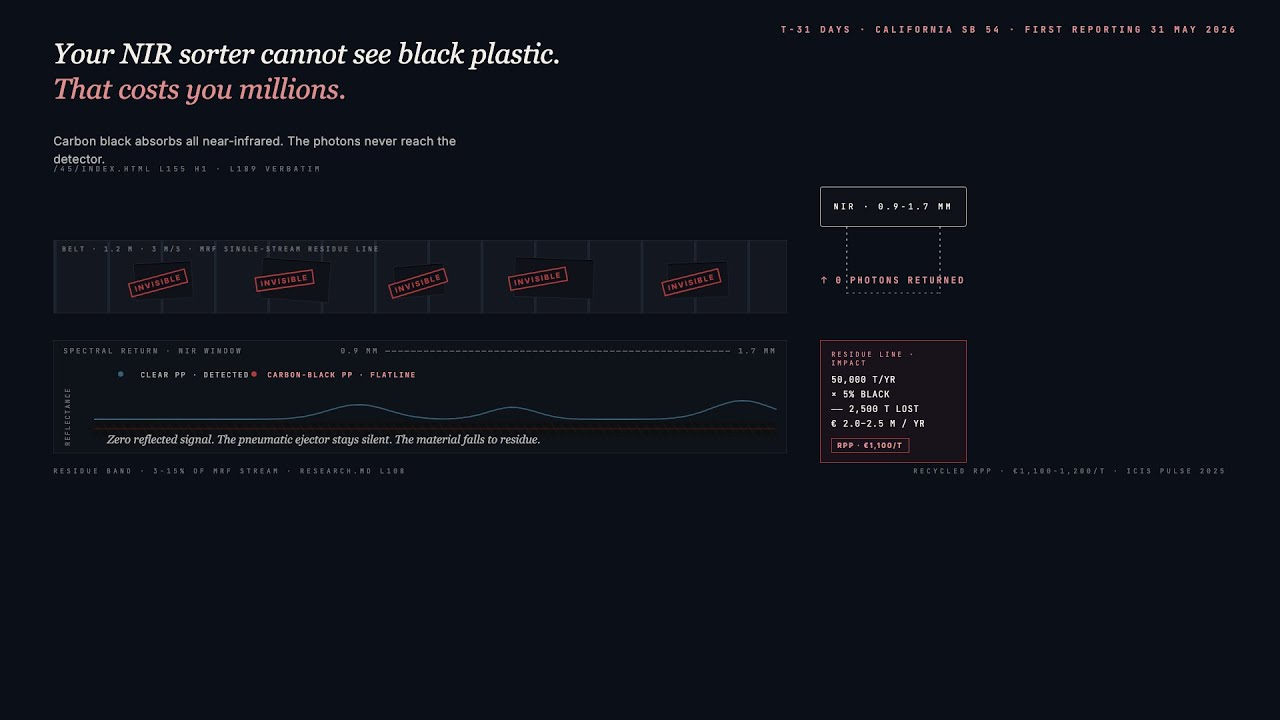
Carbon black pigment absorbs near-infrared light. Every black PP tray, PE container, and ABS housing your optical sorter misses goes to residue, then landfill. We build the MWIR sensing and edge AI layer that recovers it.
3-15%
of your waste stream is black plastic going to residue
Recycling Magazine, Plastics Engineering
83.4%
MWIR+CNN accuracy on real waste (peer-reviewed)
Resources, Conservation & Recycling, Jan 2026
Grade C+
EU PPWR recyclability minimum from 2030
PPWR Regulation 2025/40, Annex II
The problem is sensor physics, not software. No amount of AI training fixes a zero-signal input.
Standard optical sorters (TOMRA Autosort, Machinex MACH Hyspec, Pellenc Mistral+) rely on Near-Infrared spectroscopy in the 0.9-1.7 micron range. They identify polymers by reading the absorption patterns of molecular bonds: C-H, N-H, O-H stretching vibrations.
Carbon black absorbs all NIR wavelengths before they reach those bonds. The sensor receives zero reflected signal. A black PP tray on a black rubber conveyor belt is invisible. The pneumatic ejector stays silent. The material falls to residue.
This is not a firmware update problem. The photons never reach the detector. You need a different part of the electromagnetic spectrum.
Mid-Wave Infrared (2.7-5.3 micron) targets the fundamental vibrations of polymer molecules, not the weak overtones that NIR reads. At these wavelengths, the spectral signal is orders of magnitude stronger. More importantly, carbon black's absorption coefficient drops as wavelength increases. By 3.0 microns, the pigment becomes sufficiently transparent.
A black PP tray that is a void in NIR produces a sharp, jagged spectral signature in MWIR. The C-H stretching peak at 3.4 microns is strong and unambiguous. Polystyrene shows distinct aromatic C-H modes that cleanly separate from the aliphatic C-H bands of PE and PP.
The sensor we deploy (Specim FX50) captures 154 spectral bands across this range. It does not see "black shapes." It sees chemical composition at conveyor speed.
We do not replace your existing sorter. We add a sensing station, typically on a side-belt that receives the black-heavy residue reject from your primary NIR sort. The architecture has three components:
Total integration hardware: MWIR camera, mounting bracket, industrial edge GPU (NVIDIA Jetson AGX Orin or RTX workstation), GigE Vision interface, cabling. Software: pre-trained 1D-CNN with on-site calibration for the client's specific belt background and waste stream characteristics.
Pull this table up in your next vendor evaluation meeting. Every entry is based on published specs and current product availability.
| Vendor | Product | Black Plastic Capability | Throughput | Gap |
|---|---|---|---|---|
| TOMRA | AUTOSORT BLACK, GAINnext | Yes (proprietary MWIR/SWIR) | 2,000 ejections/min; 95-98% purity on standard streams | Bundled-only (EUR 450-650K). Closed software. Cannot license separately or retrofit onto non-TOMRA hardware. |
| Steinert | UniSort BlackEye | Yes (HSI in MWIR range) | ~1 t/h on 10-40mm flake fraction; belt speed up to 4 m/s | Finishing sorter, not primary sort. Optimized for clean flake, not contaminated whole-object MRF input. |
| Pellenc ST | Mistral+ CONNECT | Partial (Profile Detection) | High-speed multi-material sort | Detects "black thing in stream" for contaminant removal. Does not classify PP vs PE vs PS. |
| Machinex | MACH Hyspec, MACH Vision | No (SWIR only) | Up to 99% purity with 14 units per facility | SWIR cannot see through carbon black. Same blind spot as standard NIR. |
| AMP Sortation | Cortex, AMP ONE | No (RGB only) | 80-140 picks/min/robot. Pay-per-ton contract model. | Robotic picking throughput caps well below pneumatic ejection. RGB cannot classify polymers. |
| Greyparrot (Bollegraaf) | Analyzer, Sync | No (RGB measurement) | Measurement only, not actuation | Tells you what is flowing past. Does not sort anything. Valuable for auditing, not recovery. |
| Recycleye | QuantiSort | No (RGB + Jetson GPU) | Lower CapEx entry point for container streams | Edge GPU latency floor (~30-50ms). RGB detection only. |
| Big 4 / Large SIs | Strategy + vendor selection | Advisory | N/A | Will produce a vendor selection matrix and an implementation roadmap. Will not write the 1D-CNN kernel, calibrate a cryocooled sensor, or commission a PLC interface. Engagements run USD 750K-3M+. |
| Veriprajna | Custom MWIR + edge AI retrofit | Yes (Specim FX50 + custom 1D-CNN) | Matched to client's belt speed and ejector setup | No installed base of bundled hardware. Not a 24/7 field service organization. We build and commission; lifecycle support requires client internal team or OEM service contract. |
The other path is brands switching from carbon black to NIR-detectable pigments (UPM Circular Renewable Black, Cabot alternatives, Ampacet masterbatches). These pigments cost EUR 0.40-1.00/kg more than standard carbon black at EUR 0.20/kg, before food-contact requalification. Adoption since 2018 has been slow: less than 10% of FMCG black packaging is NIR-detectable as of 2026. Automotive interiors and electronics housings are not switching at all. The legacy carbon-black waste stream will persist for 15-20 years. MWIR sorting and pigment substitution are not competing strategies. They are co-existing pathways for a transition period measured in decades.
Four capabilities. Each addresses a gap no single platform vendor covers.
A retrofit sensing station for your existing sort line. We mount the Specim FX50 on a side-belt that receives the black-heavy residue reject from your primary NIR sorter. The 1D-CNN is trained on your specific waste stream. PLC integration feeds directly to your existing pneumatic ejector or robotic picker.
We reach for 1D-CNN over 2D-CNN because this is signal processing, not image recognition. A crushed black PP tray looks spatially identical to a crushed black PE container. Shape is unreliable. The 154-band spectral signature of the polymer bonds is not. The 1D architecture also runs at 3-5x lower latency than comparable 2D models on the same edge hardware.
Before recommending hardware, we run the latency math against your actual belt speed, ejector pitch, and throughput target. The deliverable is an architecture specification with three options: optimized GPU (lowest cost), hybrid FPGA+GPU (deterministic path for critical latency, GPU for heavier classification), or full FPGA dataflow (maximum belt speed). Each option comes with CapEx, timeline, and expected purity impact.
The honest answer is usually "edge GPU is sufficient." An NVIDIA Jetson AGX Orin with TensorRT optimization hits 12-18ms latency. For belts running at 3 m/s or below, that is enough. We do not upsell FPGA architectures unless the throughput gain justifies the EUR 25-40K hardware premium and 4-6 months of additional engineering.
For WEEE recyclers processing end-of-life electronics, we build a dual-sensor fusion pipeline: MWIR for polymer identification (ABS, HIPS, PC/ABS) and inline XRF for bromine concentration. The 1D-CNN fuses both feature sets into a single classification head. Output bins: clean rABS, clean rHIPS, BFR-positive reject, mixed reject.
Why this matters: RoHS prohibits BFR-containing recycled material in new equipment. 40-50% of captured WEEE plastics are not properly recycled because the separation is too difficult. Clean rABS commands USD 800-1,100/ton. BFR-contaminated mixed plastic is worth near zero. The margin on this separation justifies the sensor investment in under 12 months for most WEEE processors handling 500+ tons per year.
For facilities that already have optical sorters (TOMRA, Machinex, Pellenc, Steinert), we deploy a Greyparrot-style measurement camera to characterize your actual material flow, then tune your existing sorter firmware settings, belt speeds, and ejector timing to maximize purity and recovery without any new hardware purchase.
This is the engagement that costs the least and pays back the fastest. Most MRFs run their optical sorters on factory default settings. A one-week characterization and tuning engagement typically lifts recovery by 2-5 percentage points and reduces residue rate by 1-3 points. On a 50,000 t/yr facility, a 2% residue reduction saves EUR 100K-150K annually in avoided landfill costs alone.
Every sorting architecture decision comes down to one equation: belt speed times latency equals displacement. Here is how to use it.
Setup: A single-stream MRF runs a 1.2m wide belt at 3 m/s. The ejector manifold has a 12.5mm nozzle pitch. The current detection-to-firing latency is 50ms (edge GPU, unoptimized). The target object (black PP tray) averages 80mm in the belt-travel direction.
Displacement calculation: 3 m/s x 0.050s = 0.150m = 150mm. With typical jitter of plus or minus 10ms, the firing uncertainty window spans 120-180mm. The system must fire a burst covering 180mm of belt length to guarantee a hit. At 12.5mm pitch, that activates 14-15 nozzles simultaneously.
Consequence: The wide burst catches 2-3 adjacent items along with the target. Purity drops 4-6 percentage points. On a bale that needs to be at least 97% PP per APR spec, this contamination can trigger rejection.
| Fix | Latency | Displacement at 3 m/s | CapEx | Timeline | Verdict |
|---|---|---|---|---|---|
| Slow belt to 2 m/s | 50ms | 100mm | EUR 0 | Immediate | Kills 33% of throughput. Reject. |
| Optimize GPU pipeline (TensorRT, batch=1, FP16) | 12-18ms | 36-54mm | EUR 0 (software) | 2-3 weeks | Best ROI. Activates 3-4 nozzles. Acceptable purity. |
| FPGA dataflow (Kria KV260) | <2ms | 6mm | EUR 25-40K | 4-6 months | Only justified above 4.5 m/s belt speed. |
The right answer for this facility is option 2. We recommend it even though it earns us less consulting revenue than option 3. If the facility later decides to push belt speed to 5+ m/s, the FPGA upgrade path is available. But spending EUR 30K on hardware and six months of engineering for a problem that disappears with a two-week software optimization is not honest engineering.
12-18ms
Optimized edge GPU (Jetson Orin, TensorRT)
<2ms
FPGA dataflow (Kria / Zynq UltraScale+)
~500ms
Cloud inference (not viable for sorting)
Four phases. Typical timeline: 10-16 weeks from discovery to commissioning for a single-line retrofit.
We visit your facility. We measure your belt speed, ejector pitch, current detection latency, and residue composition. We run a one-day waste characterization on the black plastic fraction (RGB image capture, manual sort, weigh by polymer type). Deliverable: a go/no-go assessment with projected ROI at your facility's actual numbers. If the ROI does not clear a 12-month payback threshold, we say so and close the engagement. No charge for the assessment if we walk away.
We deploy the Specim FX50 at your facility on a temporary mount to collect MWIR spectral data from your actual waste stream. This includes dirty, crushed, wet, multi-layer packaging under real operating conditions. We collect 5,000-15,000 labeled spectra across your target polymer classes. The 1D-CNN trains on this data, not on clean laboratory samples. Validation uses a held-out test set from your stream. We report accuracy per polymer class with confidence intervals.
Permanent mount of the MWIR camera and edge compute hardware. PLC interface programming (OPC-UA, Modbus, or EtherCAT depending on your sorter). Belt background calibration. Encoder synchronization for ejector timing. Functional acceptance test: sort 100 randomly selected black objects, verify polymer classification against manual XRF spot-checks. Purity target: agreed per polymer per APR/PRE bale specification.
We train your operators on the system dashboard (real-time sort metrics, classification distribution, purity estimates, uptime). We set up the continuous recalibration pipeline: operator-verified corrections feed back into the model weekly via an automated retraining loop running on the edge hardware. We hand off all model weights, training code, and documentation. Caveat: we are not a 24/7 field service organization. For Stirling cooler maintenance, conveyor mechanical support, and emergency coverage, you need your OEM service contract or internal technician. We provide the AI and sensor layer; we are transparent about what we do not cover.
Enter your facility's numbers. The tool estimates annual revenue at risk, recommends a sensor and compute architecture, and flags regulatory exposure. If the numbers say you do not need this, the tool will tell you.
TOMRA Autosort Black and Steinert UniSort BlackEye are the two commercial systems capable of sorting black plastics by polymer type. Both use proprietary MWIR or extended-SWIR sensors paired with integrated AI. They are excellent machines. They are also closed ecosystems sold as complete lines at EUR 450K-650K installed, with no option to license the software separately or retrofit it onto third-party hardware. The Steinert BlackEye is further limited to roughly 1 ton per hour throughput on the 10-40mm flake fraction, making it a finishing sorter rather than a primary sort line.
Veriprajna works differently. We integrate the Specim FX50 MWIR camera (154 bands, 2.7-5.3 micron range) with custom 1D-CNN classification models and deploy on your existing conveyor infrastructure. This retrofit approach typically costs EUR 150K-250K including the sensor, edge compute hardware, PLC integration, and commissioning. We can mount alongside an existing TOMRA or Machinex unit on a side-belt specifically for the black fraction that your current NIR sorter rejects to residue. The sensor is the same physics. The difference is vendor independence, lower CapEx, and the ability to tune the classification model to your specific waste stream rather than running factory firmware.
This is the right question to ask, because the gap between lab and field numbers is significant. Specim's marketing materials cite near 99% accuracy for clean, single-layer flakes under controlled conditions. The peer-reviewed benchmark published in Resources, Conservation and Recycling in January 2026 reports 83.4% balanced accuracy using MWIR plus CNN on real waste samples. The difference comes from contamination (food residue, moisture, adhesive labels), multi-layer packaging (PP/EVOH/PE laminates produce composite spectra that do not match single-polymer training classes), and belt-speed-induced spectral degradation.
We address this gap in three ways. First, we train on dirty data. The 1D-CNN must see spectra from contaminated, crushed, wet samples collected from the client's actual waste stream, not clean laboratory flakes. Second, we build a reject class. When the model's confidence drops below threshold (typically 85%), the object is routed to a manual QC station rather than contaminating a sorted bale. Third, we run continuous recalibration loops, feeding operator-verified corrections back into the model weekly. With these adjustments, field accuracy on the five major black polymers (PP, PE, PS, ABS, PVC) stabilizes in the 88-93% range after two to three months of operation. That is not 99%. It is high enough to produce bales that meet PRE and APR specification thresholds for Grade A rPP (at least 97% PP, no more than 0.5% PVC), provided the downstream bale QA step is in place.
It depends on your belt speed and ejector pitch. The math is straightforward. Multiply your belt speed in meters per second by your detection-to-firing latency in seconds. That gives you the displacement in meters between when the camera sees the object and when the air jet fires. Compare that displacement to your ejector nozzle pitch (typically 12.5mm to 31mm). If the displacement is within one to two nozzle pitches, edge GPU is fine. If it exceeds that, you either slow the belt (killing throughput), widen the air burst (killing purity), or reduce latency.
An NVIDIA Jetson AGX Orin running an optimized TensorRT pipeline achieves 12-18ms inference latency with roughly plus or minus 5ms jitter. At 3 meters per second, that is 36-54mm of travel, which is workable for most 12.5mm-pitch manifolds with single-nozzle activation. At 5 meters per second, the same latency produces 60-90mm of travel plus 25mm of jitter envelope, and purity degrades by 4-6 percentage points.
An FPGA dataflow pipeline on an AMD Kria KV260 or Zynq UltraScale+ achieves under 2ms deterministic latency with near-zero jitter. At 5 meters per second, displacement is 10mm. That level of precision is only justified for facilities pushing belt speeds above 4.5 meters per second or running ultra-fine fraction sorts where every millimeter matters. We run the latency math for every engagement before recommending an architecture. In roughly 70% of cases, optimized edge GPU is the right answer. The FPGA path adds EUR 25-40K in hardware cost plus four to six months of engineering. We do not recommend it unless the throughput gain justifies the investment.
The Specim FX50 cools its InSb detector to approximately 77 Kelvin using an integrated Stirling cryocooler. The datasheet rates cooler life at 10,000 hours. In a real MRF environment with dust, vibration from conveyor motors, and thermal cycling from shift start/stop, expect 7,000 to 8,000 hours before the cooler requires service. At 16 hours per day of operation, that is roughly 14 to 18 months between cooler swaps. Replacement coolers from Specim carry a lead time of 12 to 16 weeks. This is the single biggest operational risk of any MWIR sorting deployment, and every plant director asks about it.
We mitigate it with four measures. First, a hot-swap camera mount. The FX50 mounts on a quick-release bracket so the entire camera unit can be swapped in under 30 minutes without stopping the belt. Second, a rotational spare program. We recommend purchasing a second FX50 (or qualifying an alternate sensor like the Telops Hyper-Cam Mini-MWIR) as a maintenance spare. Camera one swaps out at 6,500 hours for preventive cooler service and becomes the spare. Camera two goes live. This keeps the line running continuously. Third, a fallback classification mode. When no MWIR sensor is available, the system reverts to RGB-only segmentation. This mode cannot classify polymer type, but it can separate black objects from the stream for manual sort or stockpiling until the MWIR camera returns. The line never stops. Fourth, alternate sensor qualification. We maintain validated model weights for at least one additional MWIR sensor platform to protect against Specim supply chain disruptions.
Yes, and this is one of the highest-value applications. WEEE recyclers process large volumes of black ABS, HIPS, and PC/ABS blends from end-of-life electronics. The RoHS Directive prohibits brominated flame retardants (BFRs) in recycled feedstock for new equipment, but 40 to 50% of captured WEEE plastics are not properly recycled because separating BFR-positive from BFR-negative material is difficult.
The current best practice combines XRF (X-ray fluorescence) for bromine detection with NIR for polymer identification. The problem is that NIR cannot see through black casings, so the polymer classification step fails. MWIR solves the polymer side. It identifies whether a black piece is ABS, HIPS, or PC/ABS regardless of the carbon black pigment. For the BFR determination, we fuse the MWIR spectral data with inline XRF readings. Certain BFR compounds produce detectable absorption features in the 3.0-4.5 micron MWIR range, particularly the C-Br stretching modes, though this is less reliable than XRF at production speed. The combined sensor fusion approach classifies each piece into clean rABS, clean rHIPS, BFR-positive reject, and mixed reject.
Literature reports show that combined NIR plus XRF approaches remove up to 98% of BFR-containing plastics. By substituting MWIR for NIR on the black fraction, we extend that capability to the material stream that currently gets skipped entirely. The economics are attractive. Clean rABS commands USD 800-1,100 per ton. BFR-contaminated mixed WEEE plastic is worth near zero. Separating 500 tons per year of clean rABS from a WEEE stream that currently goes to energy recovery represents USD 400K-550K in recovered value.
The EU Packaging and Packaging Waste Regulation (PPWR, Regulation 2025/40) introduces mandatory recyclability performance grades for all packaging sold in the EU. The European Commission must adopt delegated acts setting design-for-recycling criteria and grade thresholds by January 1, 2028. From 2030, only packaging graded A, B, or C may be placed on the EU market. From 2038, the minimum rises to Grade B.
RecyClass (operated by Plastics Recyclers Europe) currently grades carbon-black-pigmented packaging as recyclable only if MWIR-capable sorting infrastructure exists at the processing facility. Without that infrastructure, the packaging defaults to a lower grade. If it falls below Grade C, it becomes unmarketable in the EU after 2030.
For brands, this creates an urgent incentive to either switch to NIR-detectable black pigments (which is happening slowly, with less than 10% of FMCG black packaging converted as of 2026 due to cost premiums of EUR 0.40-1.00 per kilogram over standard carbon black) or to ensure their packaging reaches MRFs equipped with MWIR sorting. For MRF operators, this creates a commercial opportunity. Facilities that can demonstrate MWIR black plastic recovery become preferred partners for brand EPR compliance. In parallel, California SB 54 begins collecting EPR fees in 2027, with an estimated USD 500 million annually from consumer packaged goods companies plus up to USD 150 million from resin manufacturers. The recycled content mandates (30% rPET in bottles, 35% in other plastic packaging by 2030) will drive demand for high-purity recycled pellets, including black rPP and rABS, well above current supply. MRFs that can produce these bales at Grade A purity will capture premium pricing that facilities limited to NIR-only sorting cannot access.
The interactive whitepapers behind this solution page. For the detailed physics, architecture, and economic modeling.
MWIR hyperspectral imaging architecture, 1D-CNN spectral classification, sensor fusion with RGB segmentation, and the economic case for black plastic recovery in MRFs.
FPGA vs. GPU edge inference architectures for high-speed conveyor sorting. Latency analysis, quantization strategies, and the kinematics of pneumatic ejection timing.
A 50,000 t/yr MRF recovering 5% black plastic generates EUR 2.0-2.5M in annual pellet revenue from material currently going to landfill.
We start with a no-cost discovery visit: measure your residue composition, run the latency math on your sort line, and deliver a go/no-go assessment with real numbers. If the ROI is not there, we tell you.