Data Center Grid Interaction
PJM capacity prices increased tenfold in two years. NERC is writing new standards for data center loads. Virginia is considering a moratorium on new facilities. The operators who survive this wave will be the ones who can prove their facility helps the grid, not hurts it.
We build AI-powered grid flexibility systems for data centers. Demand response orchestration, capacity market optimization, NERC compliance automation, and interconnection acceleration. Vendor-neutral, multi-tenant-ready, built for how colocation actually works.
$28 → $329/MW-day
PJM capacity price in 24 months
IEEFA, 2026
1,500 MW in 82 sec
July 2024 Virginia byte blackout
NERC Incident Review, 2024
EOY 2026
NERC large load standards deadline
NERC LLWG Action Plan
The data center industry faces a simultaneous financial, regulatory, and operational reckoning. Each pressure alone would demand attention. Together, they create an environment where grid-interactive capability shifts from optional to existential.
Capacity costs have become a line item that boards notice. A 100 MW facility's annual PJM capacity obligation went from $1.1 million to $12 million in two auction cycles. Data centers drove 63% of the price increase in the 2025/26 auction, translating to $9.3 billion recovered from all PJM ratepayers.
Starting June 2026, PJM ratepayers collectively pay an additional $1.4 billion per year in capacity costs. That visibility is creating political backlash that flows directly into permitting and rate design.
Four regulatory actions are landing between now and January 2027. FERC Docket RM26-4-000 (large load interconnection rules, final action due April 30, 2026). NERC LLWG standards development (initial standards by EOY 2026). PJM's Expedited Interconnection Track (mid-2026). Virginia's GS-5 rate class for loads over 25 MW (January 1, 2027).
Each creates new obligations or opportunities. The common thread: facilities that can demonstrate grid flexibility get faster connections, lower costs, and fewer regulatory surprises.
PJM will operate with minimal reliability margin starting summer 2026. By June 2027, the region may fall below reliability standards. Under PJM's emerging curtailment framework, data centers that cannot demonstrate flexibility face mandatory load shedding before emergency demand response programs are even activated.
The July 2024 byte blackout proved that data centers are already a grid stability risk. The next event may not be a near-miss.
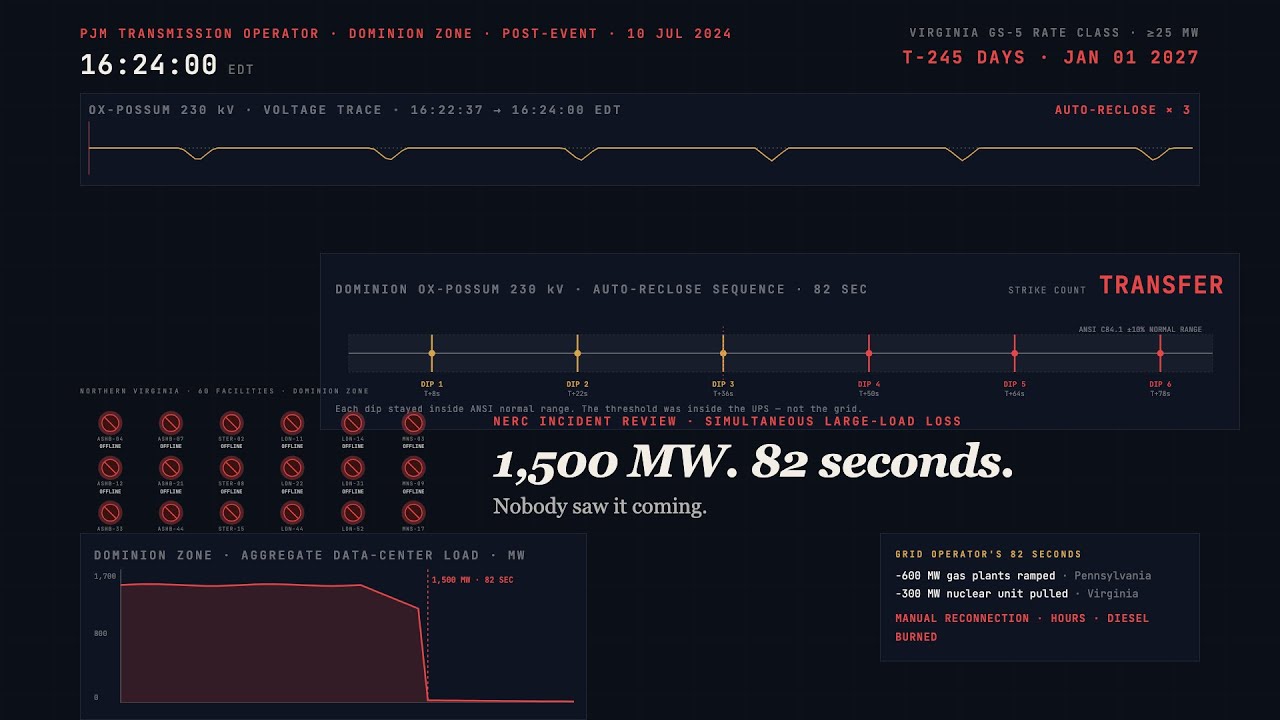
On July 10, 2024, a lightning arrestor failed on Dominion Energy's Ox-Possum 230 kV line near Fairfax, Virginia. The protection system attempted three auto-reclosing sequences from each end of the line, creating six voltage depressions over 82 seconds. Each individual dip stayed within ANSI C84.1 normal range (±10%).
The problem was UPS counting logic. Most data center UPS systems run a "three-strike" algorithm: if three voltage disturbances occur within one minute, the system transfers the entire facility to diesel backup. The auto-reclosing sequence triggered exactly this threshold across approximately 60 data centers simultaneously.
Here is what grid operators did not know: Eaton, Vertiv, and Schneider UPS systems implement counting logic differently. Some count per-phase, others aggregate. Some facilities had mixed UPS architectures with different thresholds. No transmission operator had visibility into how any of these facilities would respond to a multi-contingency voltage event.
The result was 1,500 MW of load vanishing in seconds. Grid operators scrambled to ramp down 600 MW of gas plants in Pennsylvania and 300 MW from a nuclear unit in Virginia to prevent the frequency surge from damaging equipment. Reconnection required manual intervention at each facility and took hours, burning thousands of gallons of diesel.
The data center grid interaction market is moving fast. Understanding what each player actually delivers (versus what they announce) determines whether you need a partner, a platform, or a custom build.
| Company | What They Ship | Strength | Gap |
|---|---|---|---|
| Emerald AI | Conductor platform for AI factory grid orchestration. Demonstrated 25% power reduction over 3 hours (Nature Energy). | $68M funded. NVIDIA, Eaton, GE Vernova, IQT as investors. Nature Energy validation. Power producer partnerships (AES, Constellation, NextEra). | NVIDIA-centric. Built for single-tenant hyperscaler AI factories, not multi-tenant colocation. Pre-revenue. No NERC compliance modeling. No capacity market bid optimization. |
| Schneider Electric | EcoStruxure IT (monitoring), Fast Frequency Reserve via UPS (30-second grid disconnect), One Digital Grid Platform (utility-side). | Massive installed base. Joined DCFlex (March 2026). FFR UPS capability. Hardware across power and cooling. | FFR is 30-second reactive, not hours-long strategic DR. No workload-aware load shifting. No capacity market tools. No OpenADR integration in EcoStruxure. |
| Eaton | Bidirectional UPS for grid services. Beam Rubin DSX platform (NVIDIA partnership). Frequency response capability. | UPS as grid resource concept. $50M Virginia manufacturing facility. NERC LMWG presenter. Invested in Emerald AI for the software they lack. | Hardware company. Invested in Emerald AI because they do not have orchestration software. No multi-tenant coordination. No capacity market positioning. |
| GE Vernova | GridOS (utility-side grid orchestration). Substation equipment for data center interconnection. GridOS Data Fabric. | GridOS manages grids with 70% renewables. Invested in Emerald AI. Supplies high-voltage equipment for data center substations. | Utility-side only. No product for the data center side of the meter. Their Emerald investment signals they will not build this themselves. |
| Lancium | Smart Response for flexible compute. 1.2 GW Stargate data center (Abilene, TX). CLR qualification under ERCOT. | Proven at gigawatt scale. ERCOT-approved. Flexible/critical cluster separation for batch workloads. | ERCOT only (Texas). Proprietary, closed platform. Only works at Lancium-operated facilities. Not available as software to third parties. |
| Google / Microsoft (in-house) | Google: 1 GW DR committed across utility contracts. Microsoft: "pay its way" cost recovery framework. | Proving the model works. Google's 350 MW DR in a single 2.7 GW contract shows scale is possible. | Proprietary. Not available to other operators. Raises the competitive bar for colocation providers who must now match this capability. |
| Big 4 / Large SIs | Strategy consulting on energy procurement, sustainability reporting, regulatory advisory. McKinsey, Deloitte have published data center energy reports. | Senior-level access. Regulatory expertise. Industry benchmarking data. | They advise on strategy, not build orchestration systems. Engagements run $500K-$2M+ for recommendations. The gap between "here is your strategy" and "here is your working grid flexibility platform" is where most projects stall. |
Note: This landscape is evolving rapidly. Emerald AI's mid-2026 demonstration at NVIDIA's 96 MW Virginia facility will be a significant data point. The table reflects shipped capabilities as of April 2026, not roadmap announcements.
Four capabilities, each addressing a specific gap no current vendor covers for independent colocation operators.
We build the orchestration layer that coordinates all five flexibility vectors simultaneously: GPU/compute workload scheduling, cooling system thermal storage, UPS and battery dispatch, grid demand response signal execution, and capacity market position management.
The system is vendor-neutral by design. It works with NVIDIA, AMD, Intel, and custom ASIC environments. It integrates with Eaton, Vertiv, and Schneider UPS systems. It reads from whatever DCIM platform you run (Nlyte, Sunbird, EcoStruxure IT, or custom).
For multi-tenant colocation, the orchestrator builds per-tenant flexibility profiles from 30-60 days of instrumented power draw data. It classifies each tenant's load into baseline (SLA-protected, non-curtailable) and elastic (deferrable, shiftable) components. The aggregated facility flexibility is what gets bid into PJM's capacity auction.
PJM capacity auction mechanics are complex. The auction clears three years ahead, uses a Variable Resource Requirement curve, and applies location-specific delivery factors. Most data center operators participate passively through their utility's load forecast. That passivity is expensive.
We build analytics that model your facility's capacity obligation under different load growth scenarios, identify the optimal volume of curtailable load to offer as a DR resource, and calculate the net financial position across capacity payments received versus obligations owed.
At $329.17/MW-day, a 50 MW facility offering 10 MW of verified curtailable load earns approximately $1.2 million per year in capacity payments. The analytics engine optimizes this position across seasonal variations in load, cooling demand, and market conditions. It also tracks PJM's evolving curtailment hierarchy (NCBL vs. PRD) and adjusts bidding strategy as market rules change.
NERC's PERC1 load model requires facility-specific parameterization data that no commercial tool currently collects. Utilities need to know how your UPS systems, cooling plants, and power electronics behave during voltage transients, frequency excursions, and multi-contingency events. You probably do not have this data in a format they can use.
We build the instrumentation layer that captures PERC1-relevant data from your BMS, DCIM, and UPS monitoring systems. The system records actual facility behavior during routine grid disturbances (voltage sags, frequency deviations) and builds a validated dynamic load model.
The output is a PERC1-compliant load model package that your utility can drop directly into their transmission planning software (PSS/E, PowerWorld, PSLF). When NERC finalizes its large load standards (targeted EOY 2026), facilities with validated models will face fewer surprises during interconnection studies and compliance reviews.
FERC's proposed 60-day expedited study pathway (Docket RM26-4-000) creates a fast lane for data centers that can prove curtailability. PJM's Expedited Interconnection Track, expected operational mid-2026, runs parallel to the standard 3-5 year queue.
Qualification requires three things: real-time load telemetry that PJM can verify, a documented curtailment plan with demonstrated response times, and a contractual flexibility commitment. We build the monitoring, verification, and reporting infrastructure that satisfies all three.
The system instruments your point-of-interconnection metering, runs periodic test curtailments to validate response capability, and generates compliance reports in the format PJM's interconnection study engineers expect. For operators sitting in a 4-year queue, qualification for the 60-day pathway compresses years of waiting into months of measurable activity.
Walk through the decision chain at a 50 MW multi-tenant colocation facility when PJM issues a pre-emergency load management warning. This is the sequence our orchestration layer automates.
PJM issues a Hot Weather Alert or pre-emergency load management warning via their eData portal. The system receives the signal, parses the severity level, expected duration, and affected transmission zone. If your facility participates in PJM's demand response program, this triggers your committed curtailment obligation.
The system queries current state across all flexibility vectors. Compute: which tenants have opted into DR participation and what is their current elastic load? Cooling: what is the current thermal headroom? If data halls are at 72°F with a 77°F inlet limit, you have 10-15 minutes of cooling deferral available. UPS/battery: what is the state of charge and how many minutes of backup capacity exist beyond the DR event duration? The output is a real-time flexibility envelope: the MW range you can curtail without violating any tenant SLA or thermal threshold.
The orchestrator builds the curtailment plan. First tier: cooling system setpoint adjustments (raise chilled water supply temperature from 44°F to 48°F, reducing chiller power by 15-20%). Second tier: deferrable compute workloads (batch ML training jobs paused, backup replication deferred). Third tier: lighting, supplementary cooling fans, non-critical IT loads. Each tier has a pre-calculated MW reduction and a time limit before thermal or SLA constraints are breached.
Commands dispatch to BMS (cooling setpoints), job schedulers (workload deferral), and facility power management. Point-of-interconnection metering confirms the MW reduction in real time. PJM receives telemetry verifying compliance with your curtailment commitment. The system monitors thermal trajectory continuously: if server inlet temperatures approach the SLA limit, it pulls back curtailment depth and shifts to the next available flexibility vector.
When PJM clears the event, the system ramps load back in a controlled sequence (cooling first, then compute) to avoid the "snapback" surge that grid operators fear. Post-event, the system generates settlement documentation: verified MW-hours curtailed, telemetry logs for PJM compliance, and tenant-level reporting showing which loads participated and for how long. This feeds into capacity market settlement and next-auction bidding optimization.
Three phases. The assessment phase takes 4-6 weeks for a single-campus facility. Build runs 8-12 weeks. Operate is ongoing. Total time from engagement start to first PJM DR event participation: 4-6 months.
4-6 weeks
8-12 weeks
Ongoing
Caveat: timelines assume existing BMS and DCIM infrastructure with API access. Facilities running legacy monitoring without APIs require additional integration work during the build phase, typically adding 3-4 weeks.
Answer six questions about your facility. The assessment scores your readiness across four dimensions and identifies specific gaps with actionable next steps you can take independently.
PJM capacity prices jumped from $28.92/MW-day in 2024/25 to $329.17/MW-day in 2026/27. For a 100 MW facility, that is roughly $12 million per year in capacity obligations. The most direct reduction path is qualifying curtailable load as a demand response resource. PJM's capacity auction cleared 7,299 MW of DR in the 2027/28 auction, up 32% from the prior year.
To participate, your facility needs telemetry that PJM can verify, a curtailment plan that specifies which loads shed in which sequence, and a response time under 30 minutes for most DR products. We build the orchestration layer that classifies your workloads by deferability, maps your thermal buffer capacity, and automates the curtailment sequence so your facility can bid into the capacity auction as a DR resource. A 100 MW colocation facility offering 20% flexibility (20 MW curtailable) earns approximately $2.4 million per year in capacity payments at current prices.
The key technical challenge for colocation operators is tenant workload diversity: you cannot curtail a financial services customer's latency-sensitive trading infrastructure the same way you curtail a batch ML training job. Our system builds per-tenant flexibility profiles and aggregates them into a facility-level curtailment plan that respects SLA boundaries.
NERC's Large Loads Working Group published a gap assessment in March 2026 identifying nine areas where existing reliability standards fail to address data center load behavior: interconnection processes, planning and resource adequacy, balancing and operations, disturbance ride-through, stability and power quality, security, resilience, event analysis, and load modeling.
The most immediate requirement is load modeling. NERC has endorsed the PERC1 (Power Electronic Reconnecting and Ceasing) model specifically for data center loads. PERC1 requires facility-specific parameterization data: how your UPS systems behave during voltage transients, how your cooling plants respond to frequency deviations, and how your power electronics (VFDs, rectifiers, GPU power supplies) interact during multi-contingency events. No utility currently has this data for most connected data centers.
NERC's target is to complete initial standards development by end of 2026. Separately, FERC Docket RM26-4-000 proposes expedited 60-day interconnection studies for loads over 20 MW that can demonstrate curtailability. The practical implication: data centers that can provide validated PERC1 parameters and documented ride-through behavior will get connected faster and face fewer regulatory surprises. We build the instrumentation and reporting layer that collects PERC1-relevant data from your DCIM and BMS systems, validates it against NERC's modeling requirements, and generates the compliance documentation utilities will require.
Yes, but the orchestration is fundamentally different from single-tenant hyperscaler facilities. In a hyperscaler AI factory, the operator controls every workload and can shift ML training batches freely. In a colocation environment, tenants have diverse SLA requirements: a financial services firm running sub-millisecond trading systems has zero flexibility, while a media company running overnight video transcoding has hours of deferability.
The approach requires three layers. First, a tenant flexibility census: we instrument each tenant's power draw patterns over 30-60 days to build per-tenant load profiles that distinguish between baseline (non-negotiable) and elastic (deferrable) consumption. Second, contractual framework: demand response participation terms get embedded in lease agreements. Some tenants opt in for reduced rates, others opt out entirely. The system respects these boundaries automatically. Third, aggregated curtailment planning: the orchestration layer sums available flexibility across all opted-in tenants, accounts for cooling system thermal inertia (typically 10-15 minutes of buffer from pre-cooling), and builds a facility-level curtailment plan that PJM can verify.
The critical constraint is cooling. When you reduce compute load, cooling demand drops proportionally, but the thermal mass of the facility provides a buffer. A well-insulated data hall with pre-cooling can maintain safe inlet temperatures for 12-18 minutes after cooling reduction. That window is enough for most PJM DR event durations.
The root cause was UPS counting logic interacting with transmission auto-reclosing sequences in a way nobody had tested. The detailed timeline is covered above in the technical failure section. The question every operator should ask is: would my facility have done the same thing?
Prevention starts with three specific actions. First, pull the ride-through configuration from every UPS system on your campus. Eaton's 93PM stores counting thresholds in the Power Xpert interface under Protection Settings. Vertiv Liebert EXL uses the IntelliSlot card configuration menu. Schneider Galaxy VX exposes these parameters through EcoStruxure IT Expert. Document the count threshold (typically 3 events), the time window (typically 60 seconds), the per-phase vs. aggregate counting mode, and the transfer timing. If you have mixed UPS vendors, model the aggregate campus response: the system with the most sensitive settings determines when your entire facility goes dark.
Second, share this documentation with your transmission operator. Before the Virginia event, no TOP had visibility into how data center UPS systems would respond to a multi-contingency scenario. NERC's March 2026 gap assessment specifically calls out this blind spot. Getting ahead of the upcoming disclosure requirement positions you as a cooperative grid participant.
Third, evaluate whether your counting thresholds are calibrated for modern conditions. The three-strike-in-one-minute default dates from an era when voltage events were rare and widely spaced. In a dense data center corridor with shared transmission infrastructure, auto-reclosing sequences can trigger multiple voltage dips in rapid succession. Some operators have moved to a five-event threshold with a 90-second window, maintaining equipment protection while avoiding unnecessary grid disconnection. The right threshold depends on your UPS technology, battery reserve capacity, and the grid topology serving your facility.
The interconnection bottleneck in PJM is severe: 3-5 year queues for new large load connections. FERC Docket RM26-4-000, with final action due by April 30, 2026, proposes a 60-day expedited interconnection study pathway for loads over 20 MW that can demonstrate curtailability and flexibility.
The logic is straightforward: a 100 MW data center that can verifiably curtail to 60 MW during grid emergencies imposes the same grid impact as a 60 MW facility. The grid upgrades required are proportional to the firm (non-curtailable) load, not the nameplate capacity. PJM's Expedited Interconnection Track (EIT), expected operational by mid-2026, creates a parallel fast lane for qualifying loads.
To qualify, you need three things: a monitoring system that provides real-time load telemetry to PJM, a verified curtailment capability with documented response times, and a contractual commitment to curtail during system emergencies. We build the monitoring and verification infrastructure. The system instruments your facility's actual power draw at the point of interconnection, demonstrates curtailment capability through scheduled test events, and generates the documentation PJM requires for EIT qualification. For operators sitting in a 4-year interconnection queue, qualifying for the 60-day pathway can mean the difference between a 2027 go-live and a 2030 go-live. At current market rates, each year of delay represents $12-15 million in foregone revenue for a 100 MW facility.
The ROI calculation has four distinct streams, and they compound. For a 50 MW colocation facility, here is the math. Stream one, capacity market revenue: offering 10 MW of curtailable load generates approximately $1.2 million per year at current PJM prices. Stream two, avoided forced curtailment: under PJM's emerging Non-Capacity-Backed Load framework, facilities without demonstrated flexibility get curtailed first during grid emergencies, before any demand response program is activated. Your competitors with grid-interactive capability stay online while you go dark. The revenue protection value depends on your SLA penalties, but for a facility with 99.999% uptime commitments, a single forced outage can cost more than the entire grid flexibility investment.
Stream three, interconnection acceleration: if you are expanding or building new capacity, qualifying for the 60-day expedited study pathway instead of the standard 3-5 year queue compresses your go-live timeline by years. At current capacity obligations, each year of delay costs a 50 MW facility $6-7 million in obligations it pays but cannot offset with revenue. Stream four, rate class positioning: Virginia's GS-5 rate class (January 2027) and similar regulatory actions across PJM create a cost structure where grid-friendly operators pay less. The specific savings depend on rate design details still being finalized, but the direction is clear.
Implementation runs $150,000-$400,000 for a 50 MW facility: instrumentation hardware, orchestration software deployment, PJM DR program enrollment, and NERC compliance documentation. Against $1.2 million in annual capacity revenue alone, payback is under four months. The less quantifiable but potentially larger value is political: PJM ratepayers are now paying $1.4 billion more per year in capacity costs driven largely by data center demand, and residential bills across the region have increased $16-21/month. Operators who cannot demonstrate grid responsibility face permitting delays, community opposition, and legislative risk. Grid flexibility is becoming a license to operate.
Emerald AI is the best-funded player in this space ($68 million, backed by NVIDIA, Eaton, GE Vernova, and the CIA's venture arm). Their Conductor platform demonstrated a 25% power reduction over three hours at a hyperscaler facility, validated in Nature Energy. They are a serious company solving a real problem.
The difference is market focus and architecture. Emerald is building for NVIDIA AI factories: single-tenant, GPU-homogeneous, hyperscaler-operated facilities where one orchestrator controls every workload. Their mid-2026 demonstration is at NVIDIA's 96 MW Vera Rubin AI Factory in Virginia. That is a fundamentally different environment from a multi-tenant colocation facility where QTS or Digital Realty hosts 40 different customers with different SLA requirements, mixed GPU vendors (NVIDIA, AMD, Intel, custom ASICs), and UPS architectures from three different manufacturers.
We build for the colocation reality. Our orchestration layer works with heterogeneous hardware, respects per-tenant SLA boundaries, and aggregates flexibility across tenants into a unified curtailment plan. We also cover capability gaps that Emerald does not address: NERC PERC1 compliance modeling, PJM capacity market bid optimization, and UPS ride-through behavior documentation for transmission operators. Schneider Electric and Eaton are hardware companies that invested in Emerald for the software layer they lack. GE Vernova's GridOS operates on the utility side of the meter. Lancium's Smart Response is proprietary to their own ERCOT facilities. None of these serve the independent colocation operator who needs a vendor-neutral software platform.
The detailed technical analysis behind this solution page.
Technical analysis of the July 2024 Virginia byte blackout, NERC regulatory response, physics-informed neural networks for grid control, and the case for deep AI architectures in critical infrastructure management.
At $329/MW-day, grid flexibility is no longer optional. It is a revenue line.
We build the orchestration, compliance, and market participation systems that turn your data center from a grid liability into a grid asset. Vendor-neutral. Multi-tenant-ready. Deployed in 4-6 months.