Whether you have deployed facial recognition and need to know your exposure, or you are evaluating vendors and want to get it right the first time, we audit biometric systems against the regulations, benchmarks, and operational standards that actually matter.
$136.6M
BIPA settlements in 2025 alone
Privacy World Year-in-Review, 2025
7,203x
False positive rate variance across demographics
NIST FRVT Demographics, March 2025
108 Days
Wrongful detention from a single FR false match
Angela Lipps case, Fargo ND, 2025
The failures are rarely about bad algorithms. They are about bad procurement, bad data, and missing governance.
The pattern repeats across every major facial recognition incident. A retailer or financial institution selects a vendor. The vendor's contract disclaims any warranty of accuracy. The enterprise loads a watchlist with enrollment images: some are controlled headshots, but many are grainy CCTV stills, cell phone photos, or booking photos from a decade ago. The system goes live in hundreds of locations.
What happens next is a math problem the enterprise never ran. The system is optimized for closed-set matching (is this person in the database?) but deployed for open-set screening (is this person, out of thousands of daily visitors, one of the 200 people on our watchlist?). In a store with 8,000 daily visitors and a 200-person watchlist, 97.5% of scans are against people who are not enrolled. A closed-set algorithm tries to find the best match for every face it sees, and with that volume, even a 0.1% false positive rate generates 8 incorrect alerts per day per store. Across 500 locations, that is 4,000 false alerts daily.
Those false alerts disproportionately target specific demographics. NIST FRVT testing shows false positive rates for some demographic groups run thousands of times higher than others. When Rite Aid deployed its system, the FTC found that stores in plurality-Black and Asian communities generated significantly more false alerts than stores in plurality-White communities. Employees, untrained in the system's limitations, followed and confronted customers based on automated alerts they treated as fact.
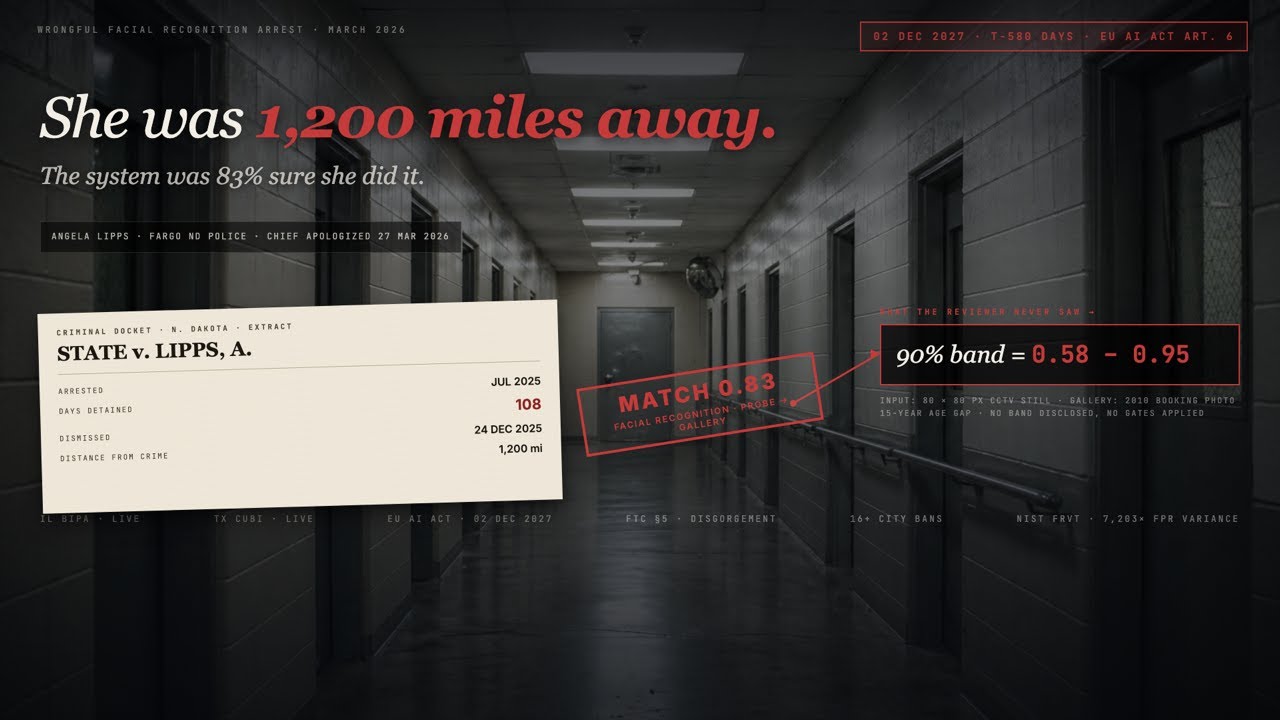
Angela Lipps, a 50-year-old grandmother from Tennessee, was arrested in July 2025 by U.S. Marshals after Fargo police used facial recognition to identify her as a suspect. She was 1,200 miles away at the time of the crime. She spent 108 days in jail before charges were dismissed on Christmas Eve 2025. The Fargo police chief publicly apologized on March 27, 2026.
This is what happens when a match score is treated as evidence. The system produced a number. Nobody checked whether that number was reliable given the image quality, the age gap between the probe and gallery images, or the demographic performance of the algorithm on the subject's population group. Civil rights claims are being prepared.
The Rite Aid consequence: a five-year ban on facial recognition, mandatory destruction of all biometric data and every model trained on that data (FTC model disgorgement), and a comprehensive information security program overseen by top executives. The Harvey Murphy consequence: a $10 million lawsuit after 10 days of wrongful detention that included physical assault. These are not edge cases. The Washington Post documented at least 8 Americans wrongfully arrested after facial recognition matches, with investigators in every case skipping fundamental steps like checking alibis.
No federal US law governs facial recognition. Instead, you face a patchwork of state laws, city bans, and international regulations, each with different consent requirements and penalty structures.
| Law / Regulation | Jurisdiction | Key Requirement | Penalty | Status (2026) |
|---|---|---|---|---|
| Illinois BIPA | Illinois | Written consent before collection; public retention schedule; no sale of biometric data | $1,000-$5,000 per violation | Active enforcement. 107+ class actions filed in 2025. Private right of action. |
| Texas CUBI | Texas | Consent for commercial use. TRAIGA (June 2025) exempts security/fraud prevention. | Up to $25,000 per violation | Active. $1.375B Google settlement. AG enforcement only (no private right of action). |
| EU AI Act | European Union | Real-time remote biometric ID banned (exceptions for serious crime). Conformity assessments for high-risk systems. | Up to 35M euros or 7% global turnover | Prohibitions enforceable since Feb 2025. High-risk deadlines extended to Dec 2027. |
| Colorado Privacy Act | Colorado | Consent for biometric identifiers; retention schedules; security controls | AG enforcement | Biometric amendments effective July 2025. AI Act adds impact assessments (Feb 2026). |
| Washington Biometric Law | Washington State | Consent before enrollment in a biometric database | AG enforcement | Active. No private right of action. |
| City-Level Bans | 16+ US cities | Outright ban on government and/or private facial recognition use | Varies by ordinance | San Francisco, Boston, Oakland, Portland, others. Active enforcement. |
| FTC Section 5 | Federal (US) | "Unfair or deceptive practices." Basis for Rite Aid action. Includes model disgorgement. | Injunctive relief + data/model deletion | Active. Disgorgement becoming standard enforcement tool (May 2025 edtech case). |
10+ additional states expected to pass biometric privacy protections by end of 2026. Amazon's Ring "Familiar Faces" feature (launched December 2025) was blocked in Illinois, Texas, and Portland within weeks.
A reference for evaluating vendors and alternatives. The "Gap" column is honest: some gaps are things we solve, and some are organizational problems nobody can solve for you.
| Category | Examples | Strength | Gap for Buyer |
|---|---|---|---|
| Full-Stack Biometrics | NEC, IDEMIA, Thales | Top NIST FRVT rankings. Decades of R&D. Government contracts and hardware integration. | Expensive ($500K+ deployments). Long sales cycles. Vendor lock-in. They sell you the system but do not audit your compliance with the laws governing its use. |
| Software-Only FR | Paravision, Rank One Computing | Strong NIST rankings. Easier integration. Some bias mitigation focus. Edge-deployable. | You still need someone to validate their claims against your deployment conditions. NIST results on controlled datasets do not predict performance on your CCTV feeds. |
| Cloud FR APIs | Amazon Rekognition, Microsoft Azure Face | Low cost. Massive scale. Easy integration. Enterprise trust. | Both have indefinite moratoriums on police sales. Data sovereignty concerns (images processed in third-party cloud). Limited control over algorithm updates. |
| Retail LP Platforms | FaceFirst, Gatekeeper + ROC (2026) | Built for retail workflows. VMS integration (Genetec, Milestone). Loss prevention focused. | Compliance is your responsibility. Vendor contracts disclaim accuracy warranties. No independent bias testing included. |
| Fintech Biometrics | FacePhi, iProov | Banking KYC focus. Liveness detection. GDPR-compliant design. | Narrow vertical. Not designed for open-set surveillance. Integration with legacy core banking systems is often harder than vendors advertise. |
| Big 4 / Large SIs | Deloitte, Accenture, EY, PwC | Broad compliance expertise. Regulatory relationships. Enterprise trust. | Biometric compliance is a line item in a broader privacy engagement, not a specialty. They do not parse NIST FRVT data, test your deployed algorithm for bias, or audit your enrollment database quality. Engagements run $300K-$2M+ for general AI governance that includes biometrics as one of many topics. |
| Internal Build | Hire a compliance officer + CV engineer | Full control. Deep institutional knowledge. | Biometric compliance requires expertise that spans computer vision, regulatory law, and testing methodology. Finding one person with all three is nearly impossible. Building a team takes 6-12 months and $400K+ annually in loaded salary. |
Six capabilities, each addressing a specific gap that vendors and Big 4 firms leave open.
We pull raw NIST FRVT data for your vendor's algorithm, then normalize it to your deployment scenario. A vendor's 1:1 verification ranking is irrelevant if you are running 1:N watchlist screening. We break down performance by gallery size (your watchlist count matters), image quality tier (CCTV stills vs. controlled enrollment), and demographic group. The output is a risk-rated go/no-go scorecard, not a NIST report repackaged as a slide deck. If you are evaluating multiple vendors, we run comparative analysis weighted to your specific parameters.
We map your biometric deployment against every applicable law simultaneously: BIPA, CUBI, Washington, Colorado, EU AI Act, and city-level bans. The output is a location-by-location compliance matrix showing which stores/branches can legally operate FR, which need consent modifications, and which must deactivate entirely. We account for the Texas TRAIGA exemptions (security/fraud prevention carve-outs effective June 2025) and the EU AI Act's "publicly accessible space" definition that catches private retail floors. The matrix updates quarterly.
The single highest-ROI intervention for reducing false alerts. We audit your watchlist/gallery database for image quality scores (resolution, lighting, pose angle), age-gap risk (gallery photo vs. estimated current appearance), demographic representation balance, and list hygiene (how many entries are older than 2 years, how many lack a documented source). At Rite Aid, cell phone photos and low-quality CCTV stills were used as enrollment images. That is where false positives originate: not in the algorithm, but in the data you feed it.
We run structured testing on your deployed system using probe image sets across age, gender, skin tone (Fitzpatrick I-VI), and lighting conditions matching your actual locations. We measure False Match Rate and False Non-Match Rate per demographic group, then benchmark against NIST FRVT data for your vendor. The legal threshold we watch: the four-fifths rule from employment discrimination law is increasingly cited in biometric bias cases. If your false positive rate for any group exceeds 125% of the best-performing group, you have documentable disparity.
Regulators demand "meaningful" human oversight but do not define it. We assess your human-in-the-loop workflow against what enforcement actions actually cite: confidence threshold configuration, reviewer interface quality (can reviewers see source images alongside gallery images?), reviewer training documentation, escalation protocol existence and adherence, average review time per alert (under 3 seconds means rubber-stamping), and audit trail completeness. We flag where your HITL is ceremonial vs. substantive, and build the documentation trail that serves as legal defense.
A lightweight API layer that sits between your FR vendor and your decision workflow. Instead of a binary match score (0.85), your security team sees calibrated confidence: "0.85 match, but the 90% prediction interval is 0.62-0.94 given image quality and lighting conditions." We build this using Conformal Prediction to provide guaranteed coverage bounds. The middleware is vendor-agnostic, works with any FR engine's output, and adds the uncertainty dimension that turns automated alerts into calibrated risk signals. This is the technical layer that makes HITL decisions defensible.
A step-by-step walkthrough of where deployments break down and what a governed system catches.
A customer enters the store. The overhead camera captures a frame at 720p from 6 meters, 22-degree downward angle, mixed fluorescent and natural lighting. The face region occupies roughly 80x80 pixels after extraction. This is the image quality most retail FR systems work with, and it is dramatically worse than the controlled enrollment photos vendors use for demos. The relationship between input quality and match reliability is non-linear: a 50% reduction in resolution can increase false positive rates by 300-400%.
The system runs 1:N matching against a 300-person watchlist. The gallery includes 15-year-old booking photos, cell phone snapshots from incident reports, and a handful of controlled enrollment images. The algorithm returns a match: 0.83 similarity score against a gallery entry enrolled from a booking photo taken in 2011. The algorithm does not know that a 0.83 against a 15-year-old photo with different lighting, weight, and hairstyle is far less reliable than a 0.83 against a recent enrollment. It reports the number without context.
The alert goes to a loss prevention associate's tablet. They see: "Match Found: 83% confidence." No source image comparison. No information about image quality, enrollment age, or demographic performance at this confidence level. They follow the customer. In the Rite Aid scenario, the associate confronted the customer, searched their belongings, and accused them of previous theft. The customer was innocent. Multiply this by hundreds of stores and years of operation, and you get thousands of incidents.
Failure points: no image quality gate, no enrollment age check, no uncertainty quantification, no meaningful HITL interface, no reviewer training, no audit trail.
With our audit recommendations implemented: the image quality gate rejects the 80x80 pixel capture as below minimum resolution threshold (we recommend 100x100 minimum for 1:N matching). If the image passes quality, the uncertainty quantification layer wraps the 0.83 score with a prediction interval: "0.83 match, but 90% confidence interval is 0.58-0.95 given capture quality." The wide interval flags this as unreliable. The enrollment age checker flags the 15-year-old gallery photo. The alert, if it reaches a reviewer at all, displays the source capture alongside the gallery image with metadata: capture distance, lighting assessment, enrollment date, and confidence bounds. The reviewer, trained to recognize unreliable matches, rejects the alert. The decision is logged with timestamp, reviewer ID, and rationale.
Four phases. Realistic timelines. The assessment phase often reveals enough to justify the engagement on its own.
We inventory your biometric deployment: which vendor(s), which locations, what camera infrastructure, what enrollment database, what HITL process exists. We pull your vendor's NIST FRVT data (if ranked) and map your store/branch footprint against applicable biometric privacy laws. Deliverable: a risk assessment report that quantifies your exposure in dollars, identifies the three highest-priority remediation items, and provides the business case for the next phase.
We run demographic bias testing on your deployed system, audit enrollment database quality, validate HITL process maturity, and produce a jurisdiction-by-jurisdiction compliance matrix. Deliverable: a prioritized remediation plan with specific technical and procedural changes, estimated effort for each, and a compliance timeline aligned to enforcement deadlines. This document becomes your compliance roadmap and your legal defense exhibit.
We build what cannot be bought off the shelf: uncertainty quantification middleware for your FR vendor, confidence threshold tuning calibrated to your store conditions, reviewer training programs, enrollment database cleanup workflows, and jurisdiction-aware policy enforcement configurations for your VMS platform. Timeline depends on scope. Middleware integration with Genetec or Milestone typically takes 3-4 weeks. HITL process redesign with training rollout takes 4-6 weeks across a multi-store operation. We are honest about what takes time.
Biometric compliance is not a one-time fix. New state laws pass quarterly. NIST updates FRVT rankings. Your vendor ships algorithm updates that change demographic performance. Your watchlist grows and degrades. We run quarterly recertification: re-test demographic bias on updated algorithms, refresh the jurisdiction compliance matrix, audit enrollment database drift, and review HITL adherence metrics. This is the engagement that prevents the next Rite Aid scenario.
Caveats: Phase 3 timelines assume your VMS platform supports API-level integration. Legacy analog CCTV systems require infrastructure upgrades before governance layers can be applied. We scope this in Phase 1 so there are no surprises. Multi-country deployments (US + EU) add 2-3 weeks to Phase 2 for EU AI Act conformity assessment mapping.
Answer 8 questions about your facial recognition deployment to get a risk assessment with specific next steps. Your answers are not stored or transmitted.
BIPA requires written informed consent before collecting any biometric identifier, a publicly available retention and destruction schedule, and a prohibition on selling or profiting from biometric data. For retail facial recognition, this creates a practical problem: you cannot obtain written consent from every person who walks through the door. Some retailers have tried notice-and-opt-out models (posting signs at entrances), but regulators and courts have been skeptical. The Bunnings case in Australia found that signage alone was insufficient, and BIPA's text requires affirmative written consent, not passive notice.
The viable approaches we see working are geofenced deactivation (disabling FR in Illinois locations entirely), enrollment-only consent (only matching against a database of individuals who have provided written consent, such as employees or known repeat offenders with prior legal process), or shifting to non-biometric computer vision (behavior analytics that detect concealment patterns without identifying individuals). Each approach has trade-offs in coverage vs. compliance. We map your specific deployment against BIPA's requirements and recommend the approach that matches your risk tolerance. The $5,000 per-violation intentional penalty compounds fast: 10,000 daily scans across 50 Illinois locations creates $2.5 billion in annual theoretical exposure.
NIST FRVT publishes detailed performance data, but the reports are dense and the metrics that matter depend entirely on your deployment scenario. For retail watchlist screening (1:N open-set identification), the critical metric is False Negative Identification Rate at a fixed False Positive Identification Rate. Most vendors showcase their 1:1 verification numbers (used for phone unlock or border control), which look impressive but are irrelevant for retail surveillance. A vendor with 99.5% accuracy on 1:1 verification might produce thousands of false positives when searching against a gallery of 500 suspects across 10,000 daily visitors.
You need to check: FRVT 1:N results specifically (not 1:1), performance at your expected gallery size (100 vs. 10,000 subjects changes everything), demographic false positive rates across the populations in your stores, and performance degradation on low-quality imagery (CCTV stills vs. controlled photos). We pull the raw NIST data for your shortlisted vendors, normalize it to your deployment parameters, and produce a comparative scorecard. We also check whether the vendor's submitted FRVT algorithm matches what they actually ship commercially, since some vendors submit optimized research models to NIST that differ from their production software.
Model disgorgement is the FTC's most severe AI enforcement tool. It requires a company to delete not just improperly collected data, but any algorithm or model that was trained on that data. The FTC used it against Rite Aid in 2023, requiring destruction of all biometric models derived from unconsented facial scans. They used it against Everalbum (now Paravision) in 2021 for the same reason. In May 2025, an edtech company received the same order.
The practical implication: if your facial recognition system was trained on, or enrolled with, biometric data collected without proper consent, the FTC can order you to destroy the entire system, not just the data. For enterprises using third-party FR vendors, the risk transfers through your vendor agreement. If your vendor trained their model on improperly collected images (and several major vendors have faced exactly this accusation), and the FTC orders disgorgement, your vendor's algorithm gets deleted and your deployment goes dark. We audit your vendor's data provenance chain: where their training data came from, whether consent was obtained, and whether your enrollment database was built with compliant collection practices. This is the single most overlooked risk in biometric procurement.
Closed-set recognition assumes the person being scanned is definitely in the database. It answers: which person in my gallery is this? Phone unlock and employee time-clock systems are closed-set problems, and commercial FR algorithms are heavily optimized for them. Open-set recognition handles the reality that most people are not in the database. It must answer two questions: is this person in my gallery at all, and if so, who?
Retail watchlist screening is fundamentally an open-set problem. In a store with 5,000 daily visitors and a watchlist of 200 suspects, 99.6% of scans are non-mated (the person is not in the database). A closed-set algorithm will always try to find the best match, even when the person is not enrolled. This is exactly what happened at Rite Aid: the system generated thousands of false positives because it was matching every visitor against the watchlist and returning the closest gallery match regardless of actual similarity. Open-set algorithms use specialized loss functions and rejection thresholds to explicitly classify unknowns as unknown. If your vendor's NIST FRVT submission only covers 1:1 verification (closed-set), they have not demonstrated open-set capability. We test your deployed system specifically for open-set performance: how well it rejects non-mated subjects under your actual store conditions.
Meaningful HITL is the difference between a defensible deployment and a lawsuit. The FTC cited Rite Aid specifically for lacking meaningful human review: employees acted on automated alerts without training, context, or the ability to question the system. A defensible HITL process requires four components. First, confidence thresholding: auto-reject matches below a minimum threshold (we typically recommend 0.70 for retail) so reviewers only see plausible matches, preventing alert fatigue. Second, reviewer interface design: the reviewer must see the original CCTV capture alongside the gallery enrollment image, with metadata showing capture conditions (distance, lighting, angle) and the match confidence score with uncertainty bounds.
Third, reviewer training and certification: reviewers need documented training on false positive recognition, demographic bias awareness, and escalation procedures. They need to understand that a 0.85 match score from a grainy CCTV still at 15 meters is far less reliable than a 0.85 from a controlled enrollment camera at 2 meters. Fourth, audit trail completeness: every alert, every reviewer decision (approve, reject, escalate), and every subsequent action must be logged with timestamps and reviewer ID. This is your legal defense. The most common failure we see: retailers configure confidence thresholds but skip reviewer training. A threshold only works if the human reviewing the alert knows what they are looking at.
Multi-state compliance is the hardest operational problem in biometric deployment. Illinois BIPA requires written consent before collection with statutory damages up to $5,000 per violation. Texas CUBI allows up to $25,000 per violation but exempts security and fraud prevention uses (as of June 2025). Washington requires consent but has no private right of action. Colorado added biometric protections in July 2025. Connecticut expanded sensitive data definitions to include biometric data. And 16+ cities have outright bans on facial recognition use.
The practical options are: deploy the strictest standard everywhere (BIPA-level consent for all locations, which effectively kills retail FR), deploy jurisdiction-specific configurations (FR active in permissive states, deactivated in restrictive ones), or deploy non-biometric alternatives in restrictive jurisdictions while maintaining FR in permissive ones. Each option requires a different technical architecture. Jurisdiction-specific deployment means your VMS platform needs location-aware policy enforcement. Deactivation means your loss prevention team needs alternative workflows for high-shrink Illinois stores. We build a jurisdiction matrix for your specific store footprint, map each location against applicable federal, state, and local requirements, and design an operational model that balances coverage with compliance. The matrix updates quarterly as new legislation passes.
NIST FRVT demographic testing shows false positive rates varying by up to 7,203x across demographic groups. Your vendor may have a NIST ranking, but that ranking reflects performance on NIST's test datasets, not your specific deployment conditions. Store lighting, camera angles, image resolution, and the demographic composition of your customer base all affect real-world bias differently than controlled test conditions.
We run structured bias testing on your deployed system, not your vendor's lab version. The process uses diverse probe image sets covering age brackets (18-30, 31-50, 51-70, 70+), gender, skin tone (Fitzpatrick scale I-VI), and lighting conditions that match your actual stores (fluorescent overhead, mixed natural/artificial, low-light). For each demographic segment, we measure False Match Rate and False Non-Match Rate, then compare across groups. The legal threshold to watch: the four-fifths rule used in employment discrimination (EEOC) is increasingly cited in biometric bias litigation. If your system's false positive rate for any demographic group exceeds 125% of the rate for the best-performing group, you have a documentable disparity. We produce a statistical report with specific thresholds where your bias exposure becomes legally actionable, not just ethically concerning.
The research behind this solution page.
Deep technical analysis of the Rite Aid FTC ban and Harvey Murphy wrongful arrest, with architectural frameworks for uncertainty quantification, open-set recognition, and human-in-the-loop governance in biometric systems.
Harvey Murphy's suit against Macy's: $10 million. The average BIPA class action settlement: $12-75 million.
Our biometric compliance assessment identifies your exposure in 2-3 weeks. Most enterprises discover gaps they did not know existed, from enrollment database contamination to HITL processes that would not survive regulatory scrutiny.