We build conversational AI engines on top of publisher archives. Citation-enforced answers, temporal reasoning, GraphRAG entity resolution, and a parallel licensing strategy that captures revenue from the AI engines you do not control. For mid-tier publishers who cannot afford a six-engineer ML team but cannot afford to wait, either.
48%
of Google queries now show AI Overviews
theStacc / Search Engine Land, Mar 2026
-33%
YoY publisher search traffic, year to Nov 2025
Reuters Institute, 2026
-43%
further decline news execs expect by 2029
Reuters Institute Trends 2026 survey
A specific scenario, not an abstract problem.
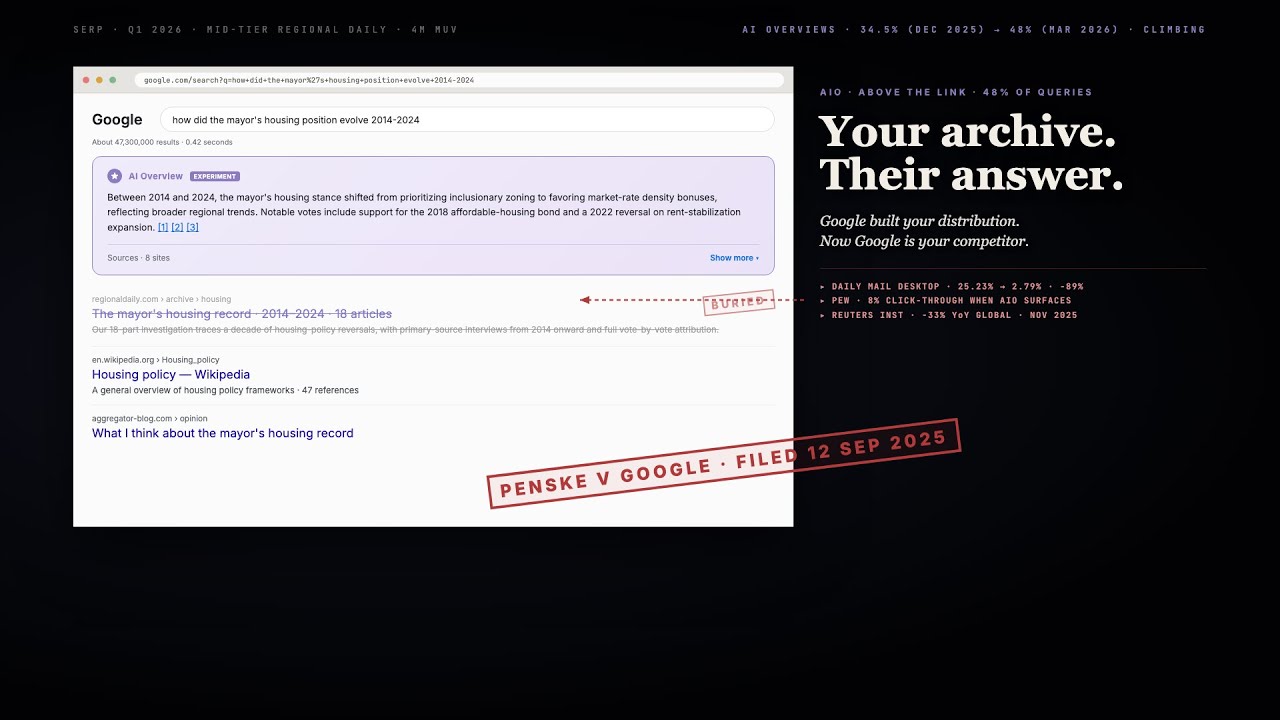
A regional daily with 4 million monthly uniques and a 32-year archive runs the numbers in their February 2026 board pack. Organic search referrals are down 41% year over year. Programmatic CPMs are down another 18%. Their affiliate revenue, which kept the business model afloat in 2023, has collapsed to a third of its peak. Same trajectory Penske Media cited in its September 2025 antitrust filing against Google. The CFO asks the obvious question: what exactly does Google owe us, and how do we make it pay?
The answer is uncomfortable. Google does not owe them anything contractually. The unwritten deal (you crawl us, you send us traffic) was unilaterally rewritten when AI Overviews began appearing on 48% of queries. When an AI Overview surfaces above an organic link, the Daily Mail measured a 89% drop in desktop click-through. Pew's March 2025 panel found that users encountering an AI Overview clicked through to a traditional link in just 8% of all visits. The publisher's content is still being read. The publisher is no longer being paid.
Meanwhile, the obvious response, "build our own AI", has its own scar tissue. The Washington Post launched Ask The Post AI in November 2024. By December 2025, internal Slack messages from the standards editor leaked: their AI-generated podcast was inventing quotes, misattributing sources, and inserting commentary as if it were the paper's editorial position. "It is truly astonishing that this was allowed to go forward at all," one editor wrote, "never would I have imagined that the Washington Post would deliberately warp its own journalism and then push these errors out to our audience at scale." The technical failure was a missing citation-verification step. The reputational damage was global.
This is the real shape of the problem. Mid-tier publishers cannot afford to do nothing. The search engine that built their distribution is now their largest competitor. They also cannot afford to ship a hallucinating chatbot under their own masthead. And they cannot replicate the in-house ML teams that the FT, Bloomberg, and the New York Times built before the cliff. They need a build partner who has done the unsexy work: archive ingestion, entity resolution, citation enforcement, editorial review queues, and a parallel licensing strategy that captures revenue from the AI engines they will never own.
Pull this up in your next strategy meeting. We have tried to be honest about what each option does and does not do.
| Option | What it actually does | Where it falls short |
|---|---|---|
| SaaS chatbot vendor (Tars, basic on-site search wrappers) | Drops a chat widget on your site. Vector embeddings of your articles. Quoted at $60K-$120K, deployed in weeks. | No entity resolution. No temporal reasoning. No citation verification. Hallucinates on the queries that matter (multi-hop, longitudinal). Your archive is in their cloud. |
| Big Five in-house build (FT, NYT, Bloomberg, WaPo, Guardian) | Custom RAG over proprietary archive. Ask FT runs on Anthropic Claude with mandatory citations. Bloomberg has BloombergGPT and BQL translation. | Built by 6-20 engineer ML teams over 12-24 months. Cost runs to seven figures. Mid-tier publishers cannot replicate the headcount, full stop. |
| Big 4 / large SI (Accenture, Deloitte, IBM iX) | Will build it. Have done generative AI work for adjacent industries. | Engagements run $1.5M-$5M+ with a discovery phase that lasts longer than your runway. They reach for the same Microsoft GraphRAG and Neo4j stack we do, but charge for partner-tier consulting on top. They have not built five publisher archives back to back. |
| Cloudflare Pay Per Crawl (Jan 2026) | Default-blocks AI crawlers across ~20% of global web traffic. Lets you set Allow / Charge / Block per crawler at a domain-wide per-request price. | Does not stop AI Overviews from summarizing your content (they retrieve at query time). Does not generate retention. Pure leakage capture, and the price discovery is still immature. |
| News/Media Alliance + ProRata (Mar 2026) | Collective licensing pool for 2,200 small/mid publishers. 50/50 revenue share on attribution-tracked AI answers via Gist.ai. NMA handles paperwork. | Revenue depends on Gist.ai gaining adoption against ChatGPT, Perplexity, and Gemini. Early days. The NMA+Bria parallel deal is enterprise RAG only. |
| Tollbit / direct bot tolls | Charges per crawl request, similar mechanism to Cloudflare but bot-by-bot configurable. Boston Globe, Vox, Future have piloted. | Same structural limit as Cloudflare: it captures crawler revenue, not query revenue. Honest publishers should run both Tollbit and a query-side play. |
| Veriprajna (us) | Custom build of the conversational engine on your stack, with citation enforcement, GraphRAG entity resolution, temporal reasoning, and editorial governance. Plus integration of ProRata, Bria, Tollbit, and Cloudflare into a single revenue strategy. | We are a consultancy, not a SaaS. We do not solve the platform power asymmetry. Only your government can do that. We will not pretend the licensing dollars from ProRata or Bria will replace 100% of lost search revenue. They will not, in 2026. |
Each engagement is custom. These are the four capability areas we keep being asked to combine.
The unsexy 60% of every project. Layout-aware OCR for scanned microfilm and pre-2005 PDFs (Tesseract for clean documents, Azure Document Intelligence or Google Document AI for column-heavy newspaper pages). Semantic chunking that respects headlines, decks, and bylines instead of slicing every 500 words. Metadata enrichment with publication date, author, section, and Named Entity Recognition for People, Organizations, Locations, Bills, and Cases.
Then the entity resolution pass: collapsing "Mr. Musk", "Elon Musk", "Tesla CEO" into one node, and disambiguating "John Smith the councilor" from "John Smith the principal" across 25 years of bylines. We combine LLM-based extraction with deterministic rules tuned to your beat, then human review for the top 200 entities by article count. Senzing or Neo4j Graph Data Science handles the algorithmic side. The judgment calls are ours and yours, jointly.
Vector search alone cannot answer "How did the mayor's housing stance change between 2010 and 2024" because the answer is not in any single chunk. We process the archive into a Neo4j or Amazon Neptune knowledge graph with typed edges (HAS_STANCE, ENDORSED_BY, VOTED_ON), then version every edge with valid_start and valid_end timestamps derived from publication dates.
At query time, an agentic planner decomposes the question into temporal sub-queries, traverses the graph, and assembles a chronological narrative with inline citations. We use Microsoft GraphRAG as the open-source backbone and customize the entity extraction prompts to your specific beats. For longer archives we layer T-GRAG (arXiv 2510.13590) for time-sensitive retrieval. This is the difference between a chatbot that finds articles and one that synthesizes the story across them.
The Washington Post podcast incident is the cautionary case. Three layers, no shortcuts. First, a strict-grounding system prompt forbids any claim not in the retrieved context. Second, a post-hoc verifier (a separate LLM call) checks each generated sentence against its cited source and drops any sentence whose citation does not actually contain the claim. Third, a confidence threshold routes low-confidence answers into an editorial review queue before they reach the user, with configurable severity tiers.
We instrument the answer log so your standards desk can audit any session inside an hour. We also build a "kill switch", a single dashboard control that disables the public widget while keeping the back end running for engineering. Boring, essential, never in a SaaS chatbot.
Most consultancies sell you one play. The honest answer is you need both. The retention play is your own conversational engine, packaged as a premium "Intelligence" subscription tier (the Ask FT model: $1,000+/year per professional user with unlimited agentic queries). The leakage capture play is opting into ProRata (50/50 revenue share via Gist.ai), Bria (enterprise internal-AI use), and Tollbit (direct bot tolls), plus a Cloudflare Pay Per Crawl posture that blocks GPTBot, ClaudeBot, CCBot, and Google-Extended while charging Perplexity and Mistral.
We integrate the licensing dashboards with your existing revenue analytics so your CFO sees one view, not five. We will not promise the licensing dollars will replace lost search revenue in 2026. We will promise you are not leaving them on the table.
No discovery deck that takes a quarter. No 80-page strategy document. We ship a working chat widget in front of your editorial team in week 8 and iterate from there.
We sample 1% of your archive, measure ingestion difficulty (clean Arc XP export vs. scanned microfilm vs. broken 2003 HTML), draft an entity inventory of your top 200 People/Orgs/Places, and price the full build with a defensible confidence interval. The variance between best and worst case for ingestion alone is roughly 8 to 1 in effort. We give your CFO a number, not a range.
Build the ingestion pipeline (OCR, semantic chunking, metadata enrichment). Stand up the hybrid retrieval layer: BM25 sparse search for exact entity matches plus dense vector embeddings for semantic similarity, with a Cohere or BGE reranker on top. Deploy the chat widget to a staging environment your editors can break in private.
Run entity extraction and resolution across the full archive. Stand up Neo4j with versioned edges. Add the temporal query decomposer. By the end of Phase 2 the chat widget can answer "how did X evolve over Y years" with a chronologically ordered, citation-backed answer.
Deploy the post-hoc citation verifier, the confidence-threshold review queue, and the standards desk audit tooling. Open the widget to a small percentage of authenticated subscribers behind a feature flag. Tune the answer-length policy and the refusal templates against real query logs, not synthetic benchmarks.
Wire ProRata and Bria attribution into your revenue dashboard. Configure Cloudflare Pay Per Crawl rules per crawler. Help product and pricing design the Intelligence tier and its trial flow. Hand off operational ownership to your team with a 90-day paired support runway.
Honest caveat: timelines assume a 100K-500K article archive on Arc XP, Brightspot, or WordPress VIP. A 5-million-article scholarly archive on Atypon, or a 1990s scanned-microfilm pile, can add 8-16 weeks to Phase 1 alone. The Phase 0 audit exists to catch this before you sign a number.
Eight questions. Tells you which phase will dominate your build cost and what to fix before quoting any vendor.
For a 10-25 year archive of 100K-500K articles, a production-grade conversational engine runs roughly $180K-$450K for the initial build, plus $4K-$15K monthly for inference, vector storage, and reranker calls at typical mid-tier publisher query volumes. The ingestion pipeline is the largest line item, usually 50-60% of the build cost. The variance depends on three things: how clean the archive already is (modern Arc XP exports vs. 1990s scanned microfilm), whether you need a knowledge graph layer for multi-hop queries, and the depth of editorial review tooling. A SaaS chatbot wrapper sold by a platform vendor will quote you $60K but it will hallucinate on the queries that matter, because it never built an entity-resolved view of your specific archive.
The early data from FT Professional and Bloomberg Terminal points the other way. Ask FT increased what FT internally calls Actual Core Reader engagement by surfacing evergreen archive content that subscribers would otherwise never find. The cannibalization fear assumes a static pool of intent. In reality, conversational queries pull users into deeper sessions on topics they would have abandoned after one search-result skim. The risk is real for thin general-news content where the chatbot can summarize a single article into one paragraph. It is much lower for analytical, longitudinal, and investigative content where the chat experience is a research assistant, not a TL;DR. We size the pricing tier and the answer-length policy to match your content depth, not to copy a template from a different publisher.
Cloudflare Pay Per Crawl, launched January 2026 across roughly 20 percent of global web traffic, lets you set Allow, Charge, or Block per crawler at a domain-wide price. The technically correct answer is that you can block GPTBot, ClaudeBot, CCBot, and PerplexityBot while still allowing Googlebot and Bingbot, because Google publicly separates Googlebot crawling from Google-Extended (the Gemini training fetcher). Blocking Google-Extended does not affect search ranking. The political concern is that Google AI Overviews still surface content from indexed pages even when Google-Extended is blocked, because they retrieve at query time. So blocking does not stop your content from being summarized in AIO, it only stops it from being used to train future Gemini versions. A defensible posture for most mid-tier publishers in 2026 is: Block GPTBot, ClaudeBot, CCBot, and Google-Extended. Charge PerplexityBot and Mistral. Allow Googlebot and Bingbot. Then route licensing dollars through ProRata, Bria, and Tollbit to capture revenue from the AI engines you do not control.
You are. The Washington Post AI podcast incident from December 2025 (fictional quotes, inserting commentary as the paper's editorial position) is the cautionary case that turned this from a hypothetical into a board-level question for publishers. There is no Section 230 shield for content your own system generates from your own archive; the AI output is treated as your editorial work product. The mitigations are architectural, not contractual. We enforce three layers: a strict-grounding system prompt that forbids using any knowledge outside the retrieved chunks, post-hoc citation verification that drops any sentence whose cited source does not contain the claim, and a confidence threshold that routes low-confidence answers into an editorial review queue before they reach the user. We also instrument the answer log so your standards desk can audit any session within an hour of it happening. None of this exists in a SaaS chatbot wrapper.
Vector RAG retrieves chunks that are semantically similar to the query. That works for fact lookup. It fails for the queries that make a news archive valuable: How did the mayor's housing position evolve over 12 years. Who connects Person X to Scandal Z through which intermediate organizations. What were the recurring sources cited in coverage of the school board controversy. These are multi-hop, longitudinal, and entity-driven queries. GraphRAG preprocesses the archive into an entity graph (people, organizations, places, events) with typed relationships, then traverses the graph at query time. The hard part is not the graph database (Neo4j or Amazon Neptune handle it). The hard part is entity resolution: collapsing 'Mr. Musk', 'Elon Musk', 'Tesla CEO', and 'X owner' into a single node, and disambiguating 'John Smith the city councilor' from 'John Smith the high school principal' across 25 years of bylines and stringer typos. We use a combination of LLM-based extraction, deterministic entity resolution rules tuned to your beat, and human review for the top 200 entities by article count. That is the part nobody else will do for you.
The conversational engine is a separate service that consumes a feed from your CMS and exposes a chat API back to your site. The integration pattern differs by stack. Arc XP exposes a Content API and webhooks but no embedding hooks, so we run a sync job that pulls new and updated stories every five minutes and re-embeds them. WordPress VIP supports custom REST endpoints and we typically deploy as a separate microservice plus a Gutenberg block for the chat widget. Brightspot is the most flexible because of its content-type model, which makes structured metadata extraction much cleaner. Atypon publishers (mostly scholarly) sit alongside Literatum search rather than replacing it. In every case the chat widget is a JS embed your editors can drop on any page, and the back end runs in your cloud account, not ours. We do not lock you into a hosted service.
Both, and they solve different problems. The NMA + ProRata deal announced March 2026 is a collective licensing pool: 2,200 publishers can opt in to monetize RAG-driven enterprise demand for a 50/50 revenue share, attribution-tracked. Bria is the parallel deal targeting enterprise internal AI use. These are leakage capture, they pay you when an AI engine you do not own uses your content. Your own conversational engine is the retention play: it deepens engagement with your existing audience and creates a premium tier. ProRata pays you a fraction of a fraction per query. Your own intelligence tier (Ask FT charges $1K+/year per professional user) is high margin and compounds with the value of your archive. Run both. The cost of ProRata participation is near zero (NMA handles paperwork), and the revenue is incremental on the engineering investment you are already making.
For a clean Arc XP or Brightspot archive of 100K-500K articles, a citation-grounded chat widget with hybrid search and basic temporal filtering ships in 14-18 weeks. GraphRAG with entity resolution adds another 10-14 weeks. An agentic research-assistant tier adds 8-12 weeks on top. The longest single line item is always archive ingestion, especially if you have pre-2005 content with broken HTML, missing photos, or scanned PDFs from a microfilm digitization project. We start with a 2-week archive audit before quoting a fixed timeline, because the variance between 'export from CMS' and 'OCR a million scanned pages' is 8 to 1 in effort. The audit gives you a defensible number to take to your CFO.
The interactive whitepaper that backs this solution page.
Full architectural treatment: GraphRAG, Temporal RAG, Agentic RAG, the Intelligence-as-a-Service business model, and detailed case studies of Ask FT and Bloomberg Terminal AI.
Start with the 2-week archive audit. Fixed price, no commitment to the full build.
We sample 1% of your content, measure ingestion difficulty, draft your top 200 entities, and give your CFO a defensible number for the full build. If the audit says don't build, we tell you that.