We build end-to-end audio provenance pipelines for labels, DSPs, distributors, and ad agencies. Watermark embedding and detection, C2PA content credentials, DDEX AI disclosure, licensed voice conversion, takedown workflows, indemnification-grade chain of title. The Article 50 clock is 4 months out.
Aug 2, 2026
EU AI Act Article 50 effective
European Commission, Jan 2026 Code of Practice
28%
Daily uploads fully AI-generated
Deezer newsroom, Sep 2025
$2–3B
Annual royalty fraud diversion
Beatdapp / Beatport, 2025
A year ago the urgent question for a media company was "is generative audio safe to use." That argument partially collapsed in a six-week window.
OCT 30, 2025
Strategic agreement for a new licensed AI music platform, launching 2026, trained on an approved UMG corpus. Existing Udio product enters a walled-garden transition with fingerprinting and filtering added. Users on the new platform cannot download or export creations off-service.
NOV 25, 2025
Joint venture to build licensed, opt-in AI music. Suno phases out existing models for new licensed ones. Artist opt-in framework for likeness and music. Only paid-tier subscribers can download off-platform, and downloads are capped.
The European Commission's first draft Code of Practice on Marking and Labelling of AI-Generated Content (published January 2026, finalized June 2026) converts the high-level Article 50 obligations into operational expectations. Here is what it actually demands for audio.
Article 99 penalties: up to EUR 15 million or 3% of total worldwide annual turnover (whichever is higher) for Article 50 infringements. Enforcement begins day one, Aug 2, 2026. The Commission has been explicit that the voluntary Code of Practice will serve as the compliance benchmark used by regulators and courts.
A mid-tier label distributes 400 new releases per month through CD Baby into 180 DSPs across 40 markets. Twelve of those releases use generative AI vocals (a dub track, a multilingual cover, two ad syncs, eight catalog refresh pieces). The tracks carry no C2PA manifest, no watermark, and the DDEX ERN 4.3 delivery lacks the AI disclosure extension (still in draft as of April 2026).
On Aug 3, 2026, a Spanish regulator audits a Spotify playlist, finds two of the label's AI tracks not machine-readably marked, and opens an Article 50 inquiry against the provider (Spotify), who in turn opens a compliance dispute against the label for missing disclosure fields. The exposure cascades: provider penalty up to 3% of turnover, label delisted from Spotify Spain pending remediation, ad sync client pulls the campaign, insurance carrier flags all future AI-linked assets as uncovered.
The fix is not technical heroics, it is the whole chain. Watermark at generation or ingest, C2PA manifest with soft binding, DDEX AI disclosure fields populated via middleware, detector at the distribution gate, takedown runbook with named owners, documentation package ready for regulators. Four months to build this is not a lot. Eight weeks is achievable if you start now.
No single vendor solves the audio provenance problem end-to-end. The honest answer is that you need to integrate several tools and build the glue. Here is what actually exists, what each covers, and where the gaps are.
| Vendor / tool | What it covers | Honest gap |
|---|---|---|
| Google SynthID Audio DeepMind |
Baked into Lyria and NotebookLM. Detector portal globally rolled out Nov 2025. 10B+ assets watermarked across modalities. Strong robustness. | Closed detection (Google-only). Not open-sourced for audio (text only). Works only on Google-generated content. No integration services. |
| Meta AudioSeal Meta Seal suite, MIT license |
Sample-level localized watermark detection, 24/44.5/48 kHz, streaming variant (0.2 Dec 2024). Free for any deployment. | Speech-first, weaker music robustness under adversarial edits (15% detection vs 68% for XAttnMark under waveform HSJA). Research-grade support. Customer builds everything around it. |
| AudioShake $14M Series A |
Best-in-class enterprise stem separation (~2 dB SDR above open-source Demucs). Clients: all 3 majors, Hipgnosis, Primary Wave, Concord, CD Baby, Disney Music Group. | Not a watermarking or provenance company. Clients still need the rest of the pipeline (embedding, C2PA, DDEX, detection, takedown). |
| Pex Attribution Engine Fingerprint + AI voice ID |
Real-time fingerprint matching (under 5 sec), Voice ID + ACR, identifies AI platform of origin (Suno, Udio) at high confidence. Rights DB hooks. | Fingerprint-based. Limited against never-heard AI outputs. Does not solve the embedding problem or the machine-readable marking obligation under Article 50. |
| Beatdapp $17M raised, MLC partner |
Stream-level fraud detection. Partners with UMG, SoundCloud, Beatport, 7digital, MLC. Focused on behavioral anomaly detection. | Not provenance. Flags fraudulent plays, does not label content. Does not help with Article 50 marking or C2PA. |
| Deezer AI detector Patented Dec 2024 |
Production detector running on 28% of daily uploads. 70% of AI-only track plays flagged as fraudulent. Available for license to rival platforms (Jan 2026 announcement). | Single-point detector. Licensing terms not public. Still requires the surrounding pipeline. Competitor DSPs cautious about core-infrastructure dependency on Deezer. |
| Digimarc / Verance Commercial incumbents |
Decades of enterprise watermarking (retail, broadcast, NextGen TV, Blu-ray Cinavia). Strong patent position, standards body presence. | Retail and broadcast heritage, slow to adapt to generative-AI threat models. Not developer-friendly. Weak integration with modern ML-generated content pipelines. |
| Licensed Suno / Udio Post-settlement 2026 |
Consumer UX, major label catalog rights, opt-in artist framework, fingerprinting and filtering built in. | Walled garden: no off-platform download in most tiers. Unusable for assets that must ship across broadcast, social, cinema, and in-game. Prompt-only outputs still not registerable at US Copyright Office. |
| Big 4 / Accenture Song / WPP IX Large SI arms |
Existing relationships, scale, insurance backing, delivery governance. | AI audio is a niche they don't staff deeply. Engagements typically $500K-$5M+ and measured in quarters. Tend to recommend a platform purchase rather than build the integration layer. Four-month Article 50 window is tight for them. |
| In-house build Your rights-tech team |
Full control, institutional knowledge, long-term ownership of the stack. | Rights-tech engineers who understand DDEX, C2PA, AudioSeal, and DSP ingest in one brain are scarce. Four months is not enough time to hire and ship. Most teams will be mid-build on Aug 2. |
We do not build a competing watermark algorithm. Google and Meta have that covered and we are happy to integrate their work. We do not build a fraud graph to rival Beatdapp or a separation model to compete with AudioShake. We build the integration layer, the policy and workflow design, the multi-standard detector, the soft binding architecture, the DDEX middleware, the licensed voice bank plumbing, and the regulator-ready documentation package. The parts that no single vendor ships and that a large SI cannot deliver inside your deadline.
Six concrete capabilities. Every engagement starts with one and usually grows into the others as the dependencies surface. Scope is agreed up front, including what we explicitly will not do.
01 / COMPLIANCE
Gap assessment against the European Commission draft Code of Practice (Jan 2026), embedding stack selection, DDEX AI disclosure wiring, detector deployment at your ingest gate, documentation package ready for a regulator inquiry. We work backward from Aug 2, 2026 with weekly checkpoints and a named remediation owner for every gap.
Deliverable: audit-ready provenance chain + regulator dossier
02 / DETECTION
One detector that reads SynthID Audio, AudioSeal, and Digimarc marks, cross-references C2PA manifests via soft binding, matches fingerprints through Pex or Audible Magic, and routes uploads to the right treatment (auto-tag, human review, takedown). Confidence-scored, auditable, and built to survive the transcode-to-social pipeline. Deployed at your DSP ingest gate or label distribution handoff.
Deliverable: production detector + routing rules + runbook
03 / PROVENANCE
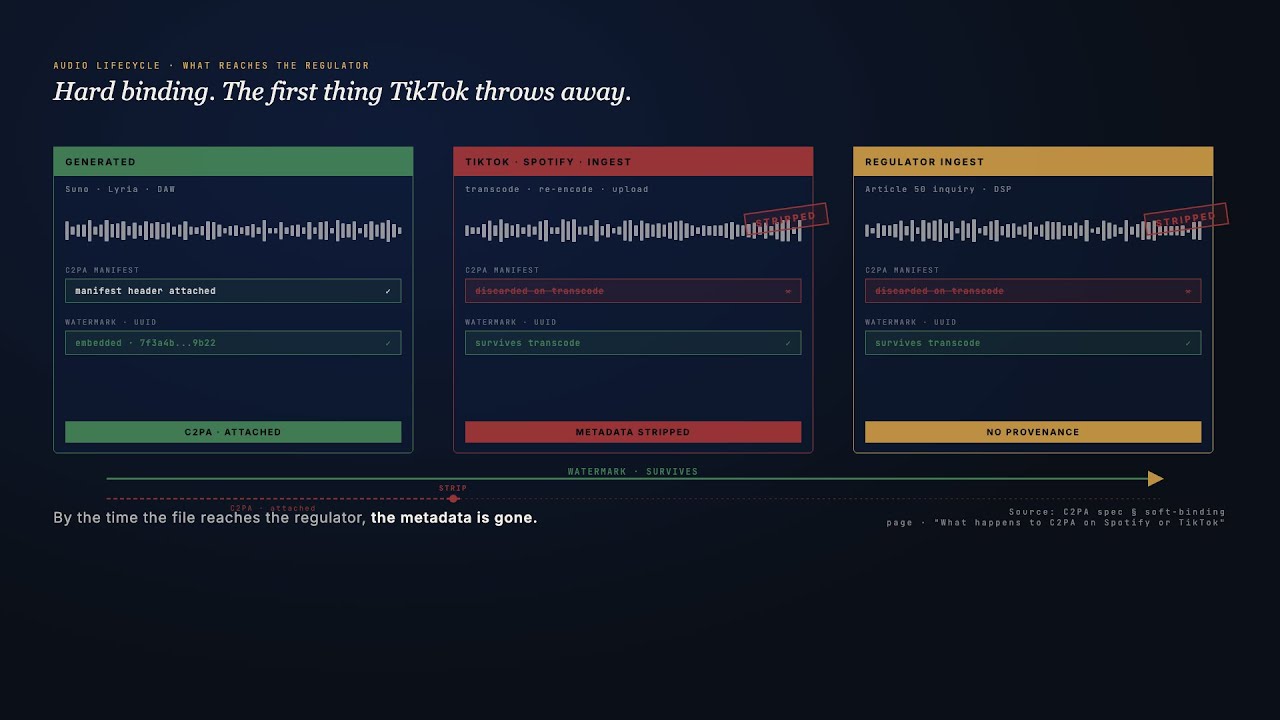
Hard binding (metadata-only C2PA) fails the moment your content hits TikTok, Instagram, or any platform that recompresses on upload. We design the soft binding: imperceptible watermark carrying a UUID, cloud manifest store with GDPR-compliant data residency for EU clients, pseudonymity and redaction for artists who do not want legal identity in the public manifest, multi-watermark coexistence testing, offline ledger fallback. This is the thing that makes C2PA actually work in the real world.
Deliverable: soft binding SDK + manifest infrastructure
04 / VOICE PIPELINE
For podcast localization, radio imaging, audiobook narration, YouTube dubbing, accessibility, and ad-sync work where walled-garden outputs do not fit. Commissioned voice actors with signed commercial releases, AudioShake for stem separation, RVC or ElevenLabs for voice conversion, C2PA stamping at each stage, Tennessee ELVIS Act and California AB 2602 compliance baked into the actor contracts. Targeted libraries (e.g. 20 actors across 4 languages for podcast localization) rather than a bloated general-purpose bank. We reach for RVC when latency and cost matter, ElevenLabs enterprise when voice fidelity and liability matter more.
Deliverable: voice bank + API + per-minute processing infra
05 / DDEX MIDDLEWARE
Spotify's September 2025 policy and 15+ labels' committed DDEX AI disclosure standard are still catching up to ERN 4.3. Most aggregators (CD Baby, DistroKid, Believe) are not yet passing granular AI disclosure fields through. We build the middleware that sits between your rights admin system and your aggregator, populates the AI disclosure fields (vocals, instrumentation, mixing, mastering), and survives the round trip through DSP ingest. Also covers the MLC and similar CMO delivery chains for mechanical royalty compliance.
Deliverable: DDEX middleware + QA suite + CD Baby/DistroKid/MLC connectors
06 / AGENCY LIABILITY
4A's MSA risk allocation guidance makes clear that agencies must negotiate AI-specific indemnity in both the client MSA and the vendor chain. We do the chain-of-title audit on every audio asset in a campaign, structure the contractual cascade to shift residual liability to the licensed voice provider, coordinate with the production insurer, and generate the C2PA documentation package the client's legal team needs before a national buy goes live. This is the difference between "we think it's fine" and "here is the dossier."
Deliverable: chain-of-title audit + indemnity clause library + campaign dossier
Realistic phases, realistic timelines. We do not promise eight-week miracles on a stack that takes twelve weeks to ship responsibly. We do promise you will know on day one whether the Aug 2 deadline is achievable for your situation.
Interview rights admin, legal, distribution, ingest, trust & safety. Inventory your current stack (DAM, MAM, DAW, DDEX aggregator, fingerprint DB, any existing watermarking). Map content flows end-to-end. Produce a gap report against the EU AI Act draft Code of Practice with a honest feasibility verdict on the Aug 2 deadline. If it is not achievable, we say so on day 10.
Pick watermark stack (AudioSeal, SynthID detector integration, Digimarc, or combination), design soft binding architecture, run watermark survival tests across your specific ingest chain (Opus, AAC, MP3 multi-bitrate, social upload, analog gap if broadcast). Build one end-to-end pilot content flow from creation through ingest through detection. Fail fast on any standard that cannot survive your pipeline.
Deploy detector at ingest gate. Wire DDEX AI disclosure middleware into your aggregator path. Provision cloud manifest store with correct data residency. Train the trust & safety team on the takedown runbook. Integrate with your existing rights admin and royalty systems. Parallel run with current state for two weeks before cutover.
Regulator-ready dossier: architecture diagram, data flow maps, vendor selection rationale, test results, runbook, incident response plan. Knowledge transfer to your in-house team so you own the stack, not us. Optional 90-day support window for the first regulator inquiry or major incident.
What we will not do. We will not rebrand open-source code as proprietary IP. We will not promise audit immunity. We will not claim indemnification coverage we cannot actually underwrite. We will not tell you Suno or Udio is unusable if your use case is walled-garden-compatible. We will not write content moderation policy for you (that is your governance team's job; we build the technical enforcement layer).
Ten yes/no questions specific to audio provenance compliance. Answer honestly. You get a readiness score and a list of concrete remediation steps you can action without us. The result is yours whether or not you ever call Veriprajna.
READINESS SCORE
—
Concrete next actions (yours to run, with or without us):
These are the verbatim queries rights tech leads and trust & safety heads send us. No marketing polish.
Article 50 takes effect August 2, 2026, and requires that outputs of any AI system generating synthetic audio be marked in a machine-readable format and detectable as artificially generated. The Commission's draft Code of Practice (Jan 2026) makes clear that metadata alone is not enough. You need a multi-layered stack: C2PA manifests for verifiable provenance, imperceptible watermarking at generation or ingest, and a detector that can read the mark after transcoding, social upload, and re-encoding. Missing fields from your DDEX delivery chain also count as a gap. We run a gap assessment against the draft Code, pick an embedding stack (SynthID Audio, AudioSeal, or Digimarc depending on your generator and distribution path), stand up the detector on your ingest, wire the DDEX AI disclosure fields, and document the whole chain for regulators. Penalties under Article 99 reach EUR 15M or 3% of global turnover.
The October 30, 2025 UMG-Udio settlement and November 25, 2025 WMG-Suno settlement changed the answer. Both platforms are moving to licensed, opt-in models in 2026. The catch is portability. Udio's new platform keeps creations inside a walled garden with no off-platform export. Suno restricts downloads to paid tiers with caps. For a media company that needs to ship the same asset across broadcast, streaming, social, cinema, and in-game, walled-garden outputs are unusable regardless of their legal status. There is also the copyright ownership question. The US Copyright Office position from January 2025 is that prompts alone do not establish human authorship, so a Suno output may not be registerable even if it is licensed. We help clients decide per-use-case: ideation inside the walled garden is fine, commercial assets get built through licensed voice transformation pipelines where chain of title is auditable and the output is portable.
Detection is a three-layer problem and no single vendor covers all of it. Layer one is watermark extraction. If a track was generated by a licensed platform it likely carries SynthID Audio (Lyria, NotebookLM), AudioSeal (Meta Seal suite), or a proprietary mark. You need a detector that reads all of them, not just one. Layer two is fingerprint matching via Pex Attribution Engine, Audible Magic, or Universal/Sony's neural fingerprinting partners. Fingerprinting fails on never-heard AI outputs but catches derivative and cover variants. Layer three is behavioral and contextual: Deezer-style classifiers trained on uploader patterns, Beatdapp-style stream anomaly detection, and DDEX disclosure cross-referencing. We build the combined detection layer on your ingest, with a confidence-scored routing system that sends high-risk uploads to human review and low-risk AI-tagged content to appropriate labels and royalty treatment. Deezer has been running this in production since June 2025 and found 28% of daily uploads are fully AI-generated, with 70% of the plays on those tracks flagged as fraudulent.
Fingerprinting extracts a perceptual hash from existing audio and matches it against a database of known reference files. It is identification. Shazam, Content ID, and Audible Magic all work this way. The fatal flaw in the generative era is that new AI outputs have no reference to match against. A brand-new AI spam track and a brand-new human masterpiece both look like unknown content to the fingerprinter. Watermarking is different. It embeds an imperceptible signal into the waveform itself, at generation or ingest, so the mark travels with the file. It is authentication. A well-designed watermark survives MP3 compression, social media re-encoding, and in good cases the analog gap where audio is played through a speaker and recaptured by a microphone. The catch is that watermarking is only useful if both the embedder and the detector are deployed, which is the chicken-and-egg problem Google (SynthID), Meta (AudioSeal), and C2PA are working to solve. In practice you need both fingerprinting and watermarking, plus C2PA manifests for verifiable provenance. They answer different questions.
Most social media platforms strip C2PA metadata on upload. They recompress, reformat, and discard embedded manifest headers as part of normal transcoding. This is the hard binding failure mode and it is the single biggest operational weakness in the C2PA ecosystem today. The workaround is soft binding: you embed a short unique identifier (UUID) into the audio using an imperceptible watermark, and the UUID points to a cloud-hosted manifest store. Even after the file is stripped of headers, re-encoded, and played over the radio, the watermark survives, the UUID can be extracted, and the original C2PA manifest can be retrieved from the ledger. This is how you ship provenance that actually works in the wild. Designing the soft binding correctly involves real engineering choices: where the manifest store lives (GDPR matters for EU clients), how redaction and pseudonymity work for artists who do not want their legal identity in the manifest, what happens if the ledger is offline, and how watermarks from different systems coexist on the same file without interference.
Standard Suno and Udio plans do not include indemnification. The 4A's MSA guidance on allocation of risk makes clear that agencies need to negotiate AI-specific indemnity clauses with both their clients (upstream) and any AI vendor in the chain (downstream). Most agency-client MSAs written before 2024 do not contemplate generative AI at all, and most AI vendor terms of service disclaim liability for third-party IP infringement caused by user prompts. The exposure on a national campaign is real: if an AI jingle triggers a rights claim mid-flight, the agency eats production re-shoot, media reschedule, and reputational damage. Our approach is a chain-of-title audit on every audio asset in a campaign, built on licensed voice bank outputs where the voice actor has signed a commercial release and the guide track has clear provenance. The contractual structure shifts residual liability to the licensed voice provider, insurance is coordinated, and C2PA manifests document the origin chain for any future dispute. It is not a silver bullet but it is defensible, which is what your client's legal team actually needs.
The US Copyright Office Part 2 report on Copyrightability, published January 29, 2025, is clear: purely AI-generated outputs are not eligible for copyright. Prompts alone do not constitute sufficient human authorship. However, a work that includes AI-generated material can be registered if the human author's contributions are disclosed and are themselves copyrightable. The Office has registered more than a thousand works under this guidance. Practically this means a Suno or Udio output built from a text prompt is uncopyrightable and can be free-ridden by competitors. A work built from a human-created guide track, arrangement, and lyrics, where AI is used for voice transformation or stem processing, has a much stronger claim. We structure client pipelines to preserve that human-in-the-loop chain end-to-end, document the human authorship contributions at each step, and generate the disclosure language needed for registration.
Technically yes, legally it depends entirely on what you feed them. Demucs is MIT-licensed, RVC is open-source, and HuBERT, HiFi-GAN, and FAISS are all permissively licensed. The licensing risk is not in the code, it is in the training data and the voice models. A community RVC model trained on scraped celebrity vocals is a Tennessee ELVIS Act and California AB 2602 liability waiting to happen. A production pipeline requires commissioned voice actors with signed commercial releases, guide tracks from owned or licensed catalog, and documented training data provenance. Quality-wise, open-source Demucs runs about 2 dB SDR below AudioShake's commercial separation, and RVC introduces audible artifacts when source and target voices differ significantly in pitch range. For enterprise-grade outputs we typically layer AudioShake for separation and RVC for voice conversion, with C2PA stamping at each stage and a voice bank of commissioned actors covering the target use case. A podcast localization library of 20 actors across 4 languages runs roughly $160K-$360K in upfront voice commissioning, depending on union status and buy-out scope, before any per-minute processing cost.
The interactive whitepapers that back the technical claims on this page. Both are long-form and go deeper than a solution page should.
Deterministic source-separated licensing engines, HT Demucs and MDX-Net ensemble separation, retrieval-based voice conversion (HuBERT + FAISS + HiFi-GAN), C2PA manifest embedding, and the legal theory behind licensed voice banks.
Spread spectrum and psychoacoustic masking, iterative filtering with SVD, autocorrelation-based analog gap recovery, adversarial resistance via AWARE and XAttnMark cross-attention, soft binding to C2PA manifests, and deployment at inference or ingress level.
EUR 15M or 3% of global turnover is the Article 99 penalty ceiling. The remediation path is well-mapped if you start now.
Bring us your ingest chain diagram, your DDEX delivery path, and your current AI audio inventory. Two weeks later you will know what the Aug 2 position looks like for your specific situation, with or without us.