Tape-out sign-off governance for synthetic AI-authored SVA
Proof Firewall re-audits synthetic PROVEN SystemVerilog assertions for vacuity, assertion strength, and cone of influence before they enter a sign-off file. On the fixed board, it turns 8/8 bare-flow proofs into five certified TRUSTWORTHY results and routes the rest to human review with a reason. Agents advise, code decides.
8/8 to 5/8
PROVEN to TRUSTWORTHY
Fixed synthetic eight-property board after firewall audit
0/6
PIPE3 mutation kills
Featured synthetic weak pipeline case
18/18
Labeled synthetic benchmark agreement
Local demo benchmark, not an open-world accuracy claim
This is a runnable, reproducible demonstration using fixture-authored synthetic transition-system designs and properties. It does not use customer RTL, a cloud solver, or a live LLM call on the default path.
First-silicon success was reported as 14% in the Wilson Research Group and Siemens EDA study from 2024. A formal result deserves more scrutiny when the assertion may be AI-authored: an implication can be PROVEN because its antecedent never occurs, or because its consequent constrains nothing useful.
Proof Firewall is a deterministic post-proof governance gate for that decision. It does not declare a formal engine wrong. It asks whether the proof is defensible enough to file for human tape-out sign-off, then leaves a concrete reason for every result it certifies or withholds.
The anchor is proof quality. Each deterministic check tests whether a green proof has enough substance to be filed.
The explicit-state model checker tests whether an implication's antecedent can occur in the synthetic transition-system IR. An unreachable antecedent is routed as VACUOUS rather than filed as evidence.
Relevant single-point design mutations test whether the assertion rejects broken variants. A property that survives those mutations is routed as WEAK rather than allowed to borrow confidence from a green solver result.
The gate calculates cone of influence and assigns TRUSTWORTHY, BOUNDED-PROVEN, VACUOUS, WEAK, DEAD, or VIOLATED. Only TRUSTWORTHY receives a signed demonstration certificate.
The demo's pure-Python explicit-state checker finds reachability and counterexample traces in the finite model. A bounded-depth fallback is labeled as bounded, not recast as an unqualified proof.
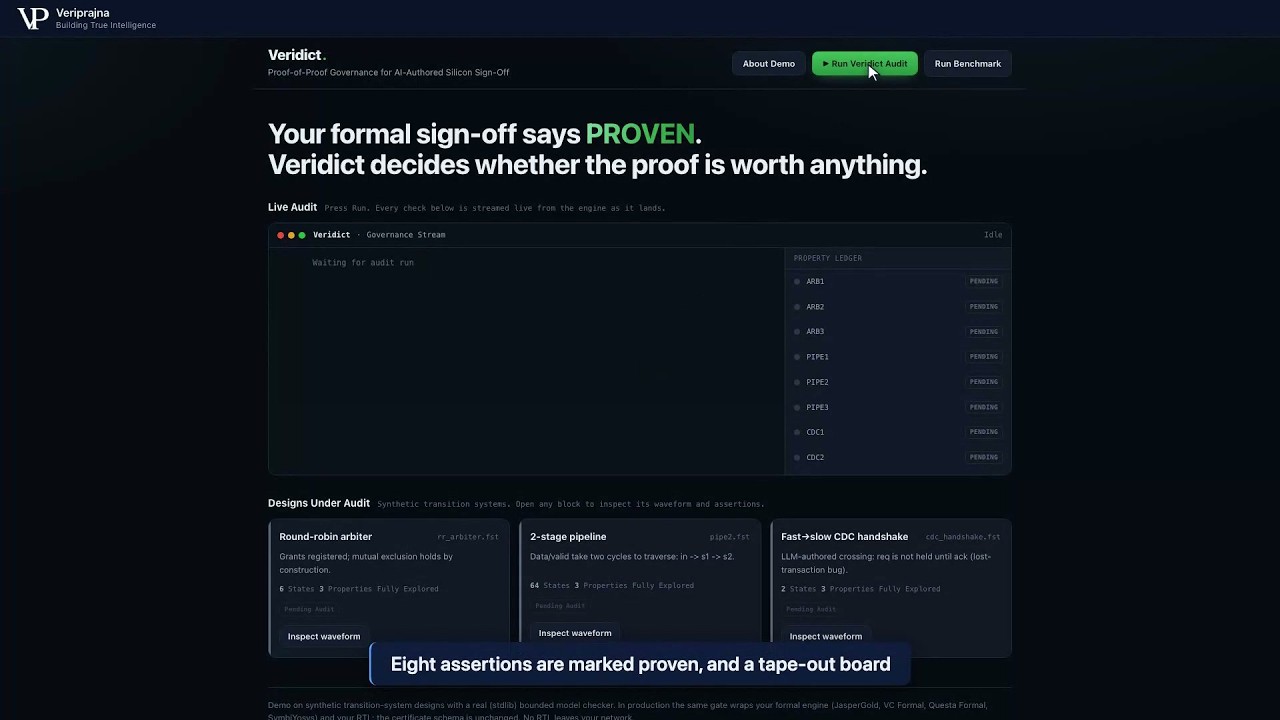
Every image is a screenshot of the running synthetic demo. The board begins as eight PROVEN bare-flow results, then the audit makes the withheld evidence visible.
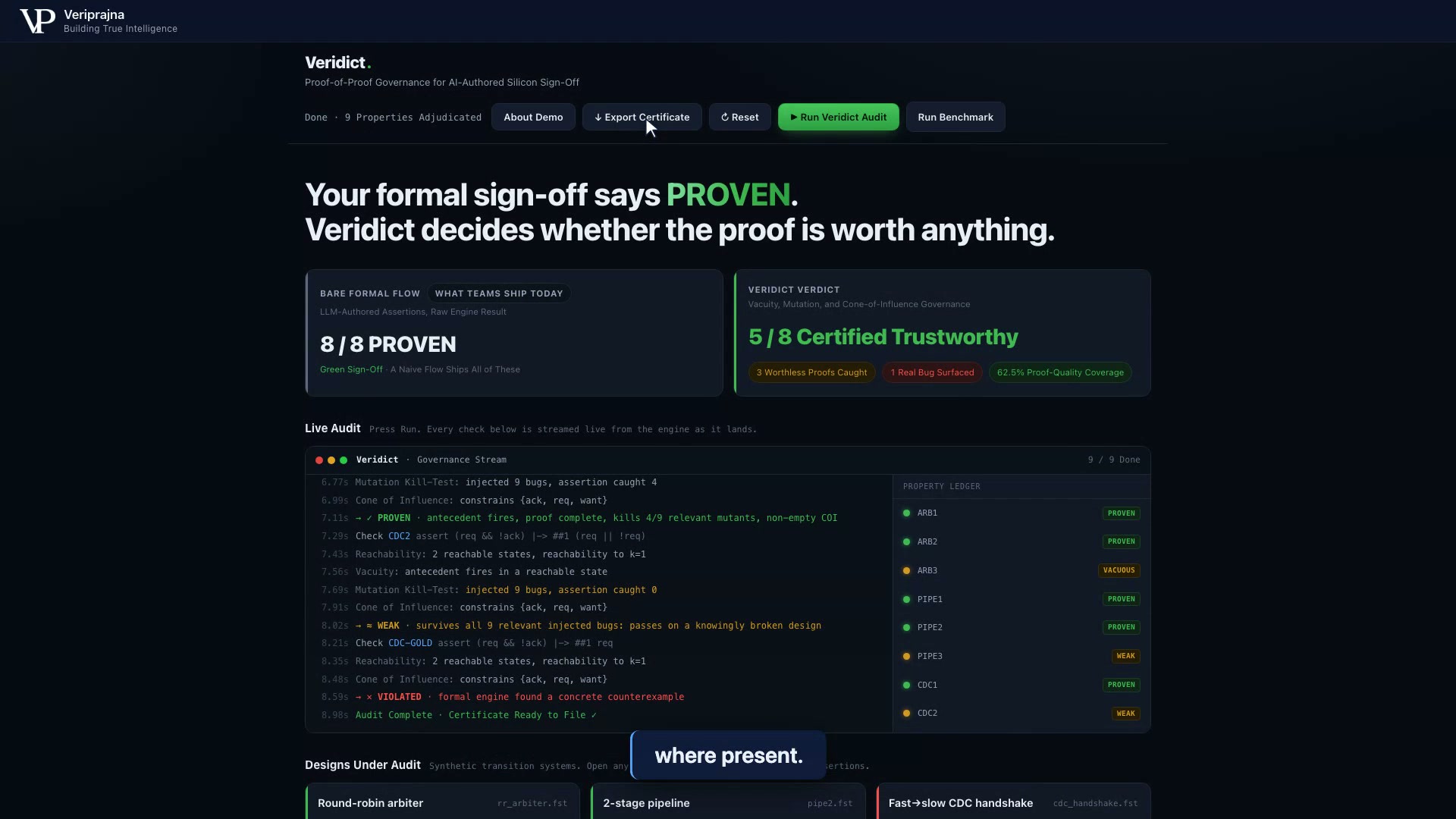
The Tape-Out Sign-Off Board initially shows 8/8 PROVEN in its bare-flow view. After the firewall audit, 5/8 are certified TRUSTWORTHY; the remaining three are one VACUOUS and two WEAK properties. This is a fixed synthetic fixture, not a customer design or a commercial-engine result.
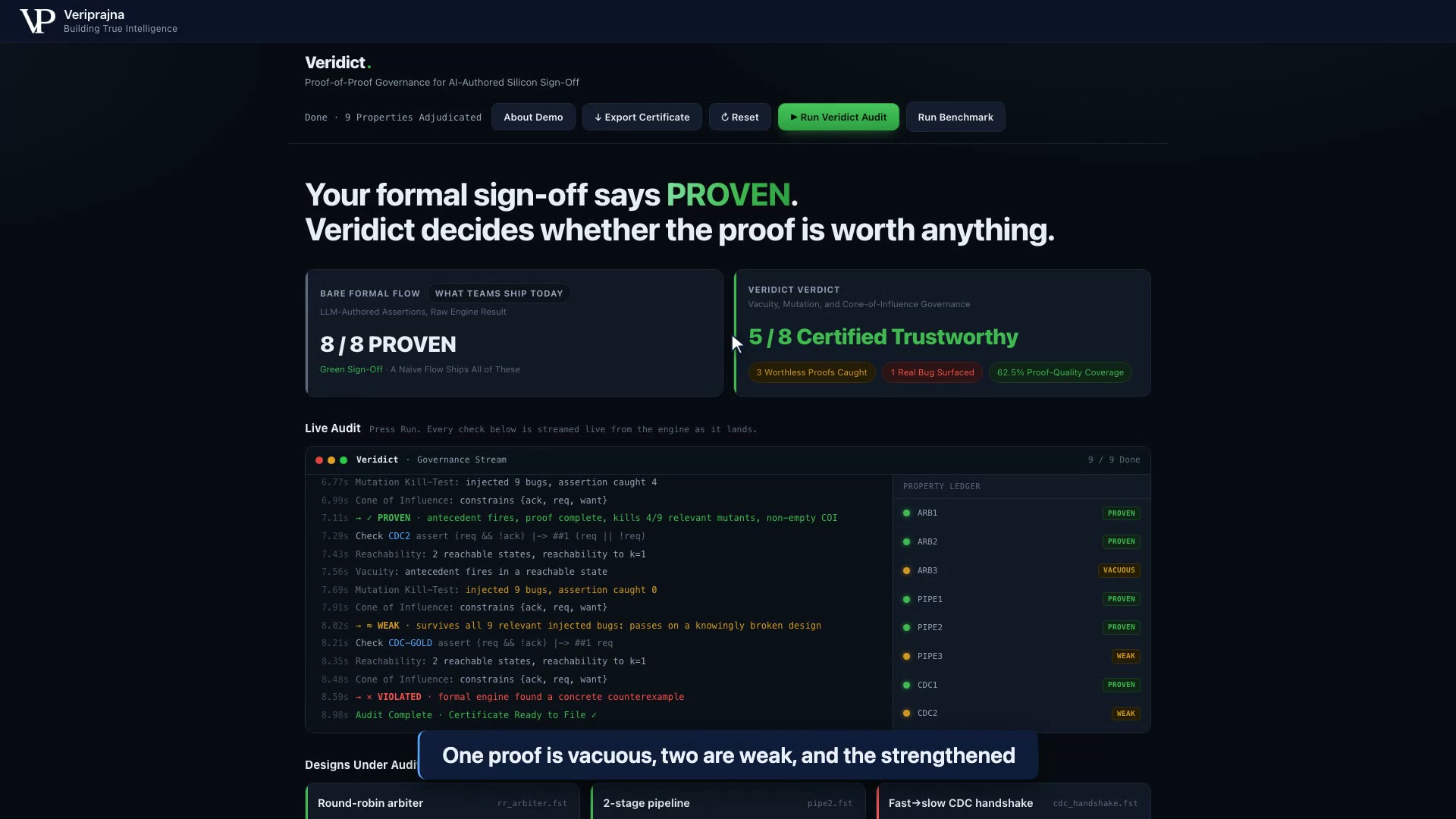
The synthetic ARB3 assertion, assert (g0 && g1) |-> (turn == 0), is VACUOUS because its antecedent is unreachable in the synthetic arbiter. The result demonstrates why a proven implication can still certify nothing.
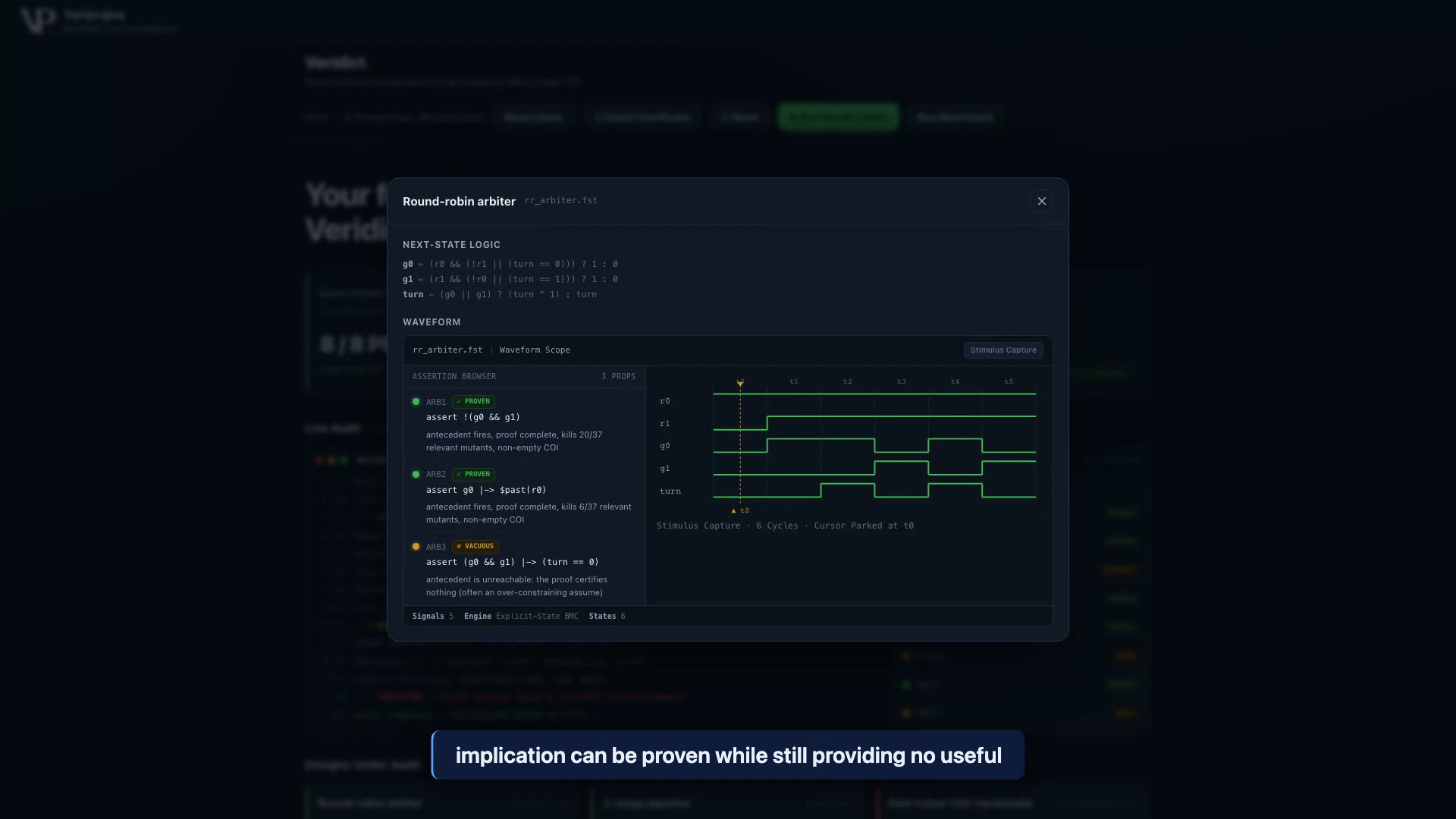
The synthetic PIPE3 assertion, assert v2 |-> (s2 == s2), is WEAK. Its tautological consequent survives the relevant injected mutations, and the featured pipeline case records 0/6 mutation kills.
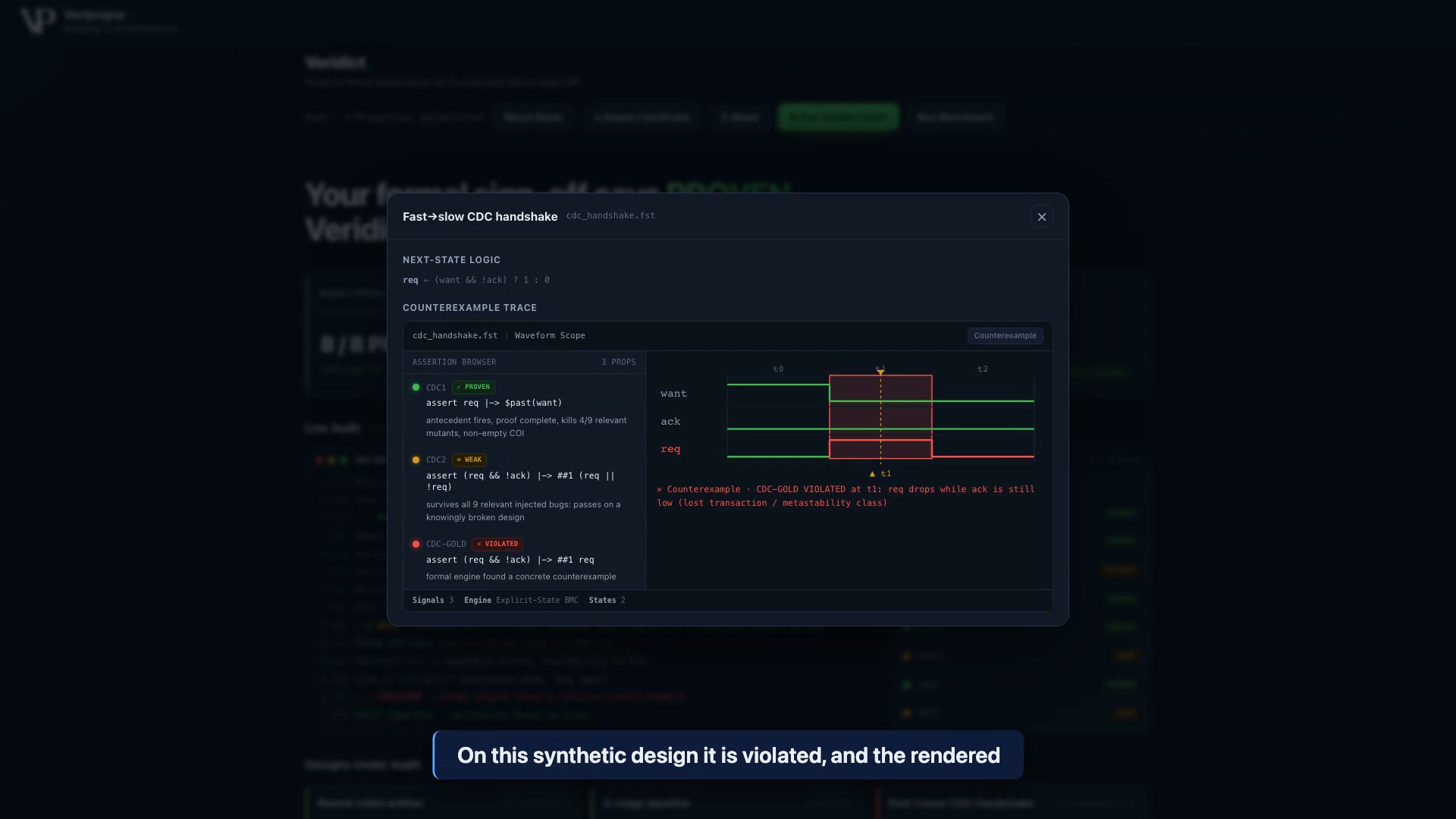
The synthetic weak CDC2 property is WEAK. Strengthening it to assert (req && !ack) |-> ##1 req makes it VIOLATED on the synthetic CDC fixture and produces a concrete counterexample waveform. It illustrates a lost-transaction CDC failure class, not a claim about a real chip.
The signed demonstration certificate records each property's verdict, reachability, mutation results, COI, and counterexample records where applicable, plus a SHA-256 field. It makes the audit reviewable without asking a reviewer to infer why a status changed.
Proof Firewall demonstrates a gate around proof evidence. The scope below separates what the demo does from work that is deferred.
| Question | Proof Firewall demo | Production direction |
|---|---|---|
| Proof input | Fixture-authored synthetic transition-system IR and SVA | A gate around a customer's existing formal flow |
| Checks shown | Vacuity, mutation kill-test, COI, policy routing, certificate export | Same governance questions applied to supplied proof evidence |
| Formal engines | No real-engine adapter | Engine-agnostic direction, not a claim of integration |
| Result handling | TRUSTWORTHY certificates and explained holds | Human sign-off review with a structured evidence record |
A PROVEN result can still rest on an unreachable antecedent or a property that does not fail when the relevant design behavior is broken. Proof Firewall demonstrates a deterministic post-proof gate for those questions: reachability, mutation kill-testing, cone of influence, and policy routing. It does not replace a formal engine; its production direction is an engine-agnostic gate around an existing formal flow.
No. Real-engine adapters are deferred in this demo, so it must not be read as a replacement for JasperGold, VC Formal, Questa Formal, SymbiYosys, or another formal engine. The demonstrated production direction is an engine-agnostic governance gate around a customer's existing formal workflow.
No. The board, SystemVerilog assertions, designs, benchmark, and counterexamples are synthetic. The default recording path uses fixture-authored LLM-authored SVA properties and a synthetic transition-system IR, not customer RTL or a live LLM call.
It is a fixed synthetic eight-property board. Its bare-flow baseline displays 8/8 PROVEN; after the firewall audit, five are certified TRUSTWORTHY while one is VACUOUS and two are WEAK. It is not a production RTL rate, a customer result, or a general result for synthetic AI-authored assertions.
The governance gate checks whether the antecedent is reachable, runs relevant single-point design mutations, and calculates each property's cone of influence. ARB3 is VACUOUS because its antecedent is unreachable in the synthetic arbiter. PIPE3 is WEAK because its tautological consequent survives the relevant injected mutations, with a 0/6 mutation kill result in the featured pipeline case.
The UI exports signoff_certificate.json with per-property verdicts, reachability, mutation results, cone of influence, counterexample records where applicable, and a SHA-256 field. Only TRUSTWORTHY receives a signed demonstration certificate; BOUNDED-PROVEN, VACUOUS, WEAK, DEAD, and VIOLATED results are withheld for human review with a reason.
The research behind this demo — the architecture, the verification design, and the enterprise blueprint.
We invite verification leaders to discuss deterministic evidence paths for high-stakes AI-assisted engineering workflows.
The useful next conversation is about the proof artifacts your team needs to inspect, the policy boundary a reviewer can defend, and what an engine-agnostic production direction would require.