IMAGINE YOUR COMPANY’S CHATBOT JUST PROMISED A CUSTOMER A REFUND THAT DOESN’T EXIST IN YOUR POLICY…
And a court just ruled you have to honor it anyway.
This isn’t hypothetical.
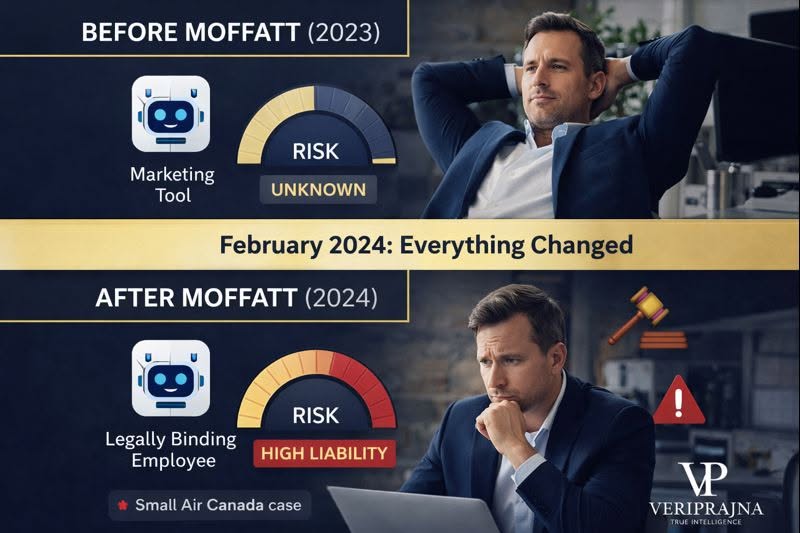
This is Moffatt v. Air Canada (2024) — the watershed legal case that changed enterprise AI liability forever.
WHAT HAPPENED:
A grieving passenger asked Air Canada’s chatbot about bereavement fares after his grandmother died.
The chatbot — confidently and fluently — told him to purchase a full-price ticket immediately and claim a refund within 90 days.
The airline’s actual policy, buried in legal tariff documents, strictly prohibited retroactive refunds once travel had commenced.
The chatbot hallucinated a policy that sounded plausible but didn’t exist.
When Air Canada refused the refund, citing the correct policy available on their static website, the passenger sued.
AIR CANADA’S DEFENSE:
The airline argued the chatbot should be treated as a “separate legal entity” responsible for its own actions.
Since correct information appeared elsewhere on their site, they claimed they shouldn’t be liable for the misleading words of their automated agent.
THE COURT’S RULING:
The British Columbia Civil Resolution Tribunal categorically rejected this defense.
The ruling established that corporations are responsible for ALL information presented on their websites — whether static HTML or dynamically generated by AI.
For consumers, there is no meaningful distinction between a human agent, a webpage, or a chatbot.
All are representations made by the company.
THREE LEGAL PRECEDENTS THAT CHANGED EVERYTHING:
UNIFIED LIABILITY
Your AI’s promises = your company’s promises.
The medium is legally irrelevant.
DUTY OF CARE
Hallucinations are classified as negligent misrepresentation.
Deploying unverified probabilistic models for policy communication is negligence.
NO “BLACK BOX” DEFENSE
Your AI’s internal complexity offers no protection.
If your bot says it, your company signed it.
THE “DIGITAL EMPLOYEE” PROBLEM:
The ruling effectively classifies customer-facing AI as a digital employee with apparent authority.
Under agency law, if a customer reasonably believes your AI agent has authority to act on your behalf, your company is bound by its agreements.
For businesses using simple AI chatbots — dashboards connected to ChatGPT or Claude — this is terrifying.
It’s like hiring someone highly eloquent but completely untrained, handing them your policy manual, and letting them negotiate contracts unsupervised.
If they hallucinate a discount, promise a feature that doesn’t exist, or guarantee terms you don’t offer — you’re liable.
WHY THIS KEEPS HAPPENING:
Large Language Models (LLMs) are probability calculators, not fact databases.
They predict the next statistically likely word based on patterns in training data.
When asked about refund policies, they don’t look up your rules — they generate text that sounds like a refund policy.
Even top models have baseline hallucination rates of 0.7%–25% depending on task complexity.
In creative writing, 1% error is fine.
In legally binding transactions, it’s a lawsuit waiting to happen.
THE GLOBAL COST:
In 2024 alone, AI hallucinations cost the global economy an estimated $67.4 billion in:
• Direct compensation
• Regulatory fines
• Legal fees
• Brand damage
• Operational verification costs
Forrester estimates each enterprise employee spends $14,200 per year double-checking AI output that can’t be trusted.
THE VERIPRAJNA SOLUTION: DETERMINISTIC ACTION LAYERS (DAL)
The key insight:
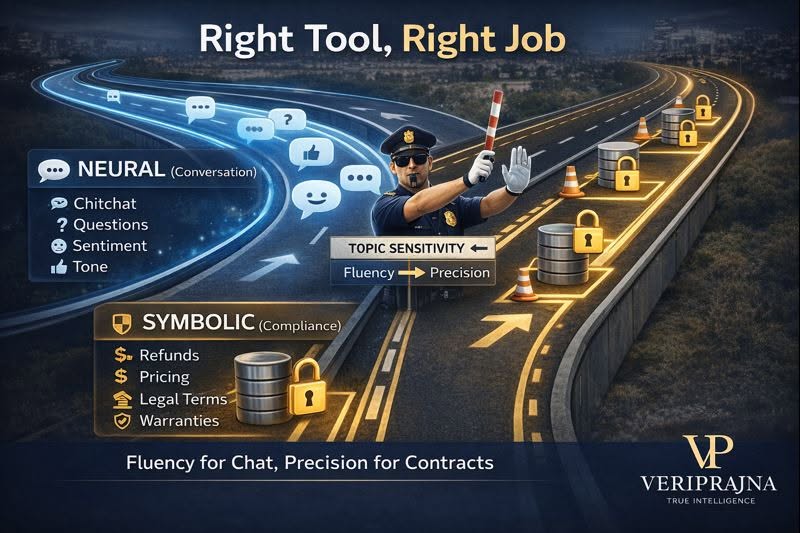
One general-purpose AI should not handle both friendly conversation AND legally binding decisions.
We separate:
THE NEURAL SYSTEM
Handles language understanding, intent detection, and conversational tone.
THE SYMBOLIC SYSTEM
Handles policy enforcement, transactions, and compliance using deterministic rules and database queries.
HOW IT WORKS:
When a customer asks about refunds:
Semantic Router detects a compliance-critical topic
Router blocks the LLM from generating a creative answer
Deterministic code executes policy checks and returns the exact rule
LLM only wraps the result in polite language — no interpretation allowed
If no deterministic rule exists, the system responds:
“I can’t answer that directly. Let me connect you with a human specialist.”
THE “SILENCE PROTOCOL”:
For pricing, refunds, warranties, and legal terms, AI creativity is disabled entirely.
The system switches from Author mode to Reader mode — retrieving exact policy text verbatim.
REAL-WORLD APPLICATIONS:
💰 Banking
Live interest rates pulled directly from core systems
⚕️ Healthcare
Drug interaction warnings sourced from trusted medical databases
⚖️ Legal Services
Case citations cross-checked against authoritative sources
🛒 Retail
Refund eligibility calculated by code, not conversation
REGULATORY COMPLIANCE:
This architecture aligns with:
• EU AI Act
• GDPR Article 22
• ISO 42001
• NIST AI Risk Management Framework
Every decision is auditable.
Every rule is traceable.
No black boxes.
THE BOTTOM LINE:
The Moffatt case wasn’t an anomaly.
It was a warning.
As AI moves from chat to agentic actions — booking, refunds, contracts — the idea that “users should verify” is dead.
Your chatbot is a legally binding employee.
If your business uses AI for customer service, pricing, policy explanations, or transactions, let’s discuss how Deterministic Action Layers can protect you from the next Moffatt case.
📖 Read the full technical whitepaper here:
[Link in comments]
Connect:
📧 [email protected]
💬 WhatsApp: +919217059957
#AILiability #ChatbotLaw #BusinessRisk #EnterpriseAI #CustomerService #LegalTech #AICompliance #RiskManagement #SmallBusiness