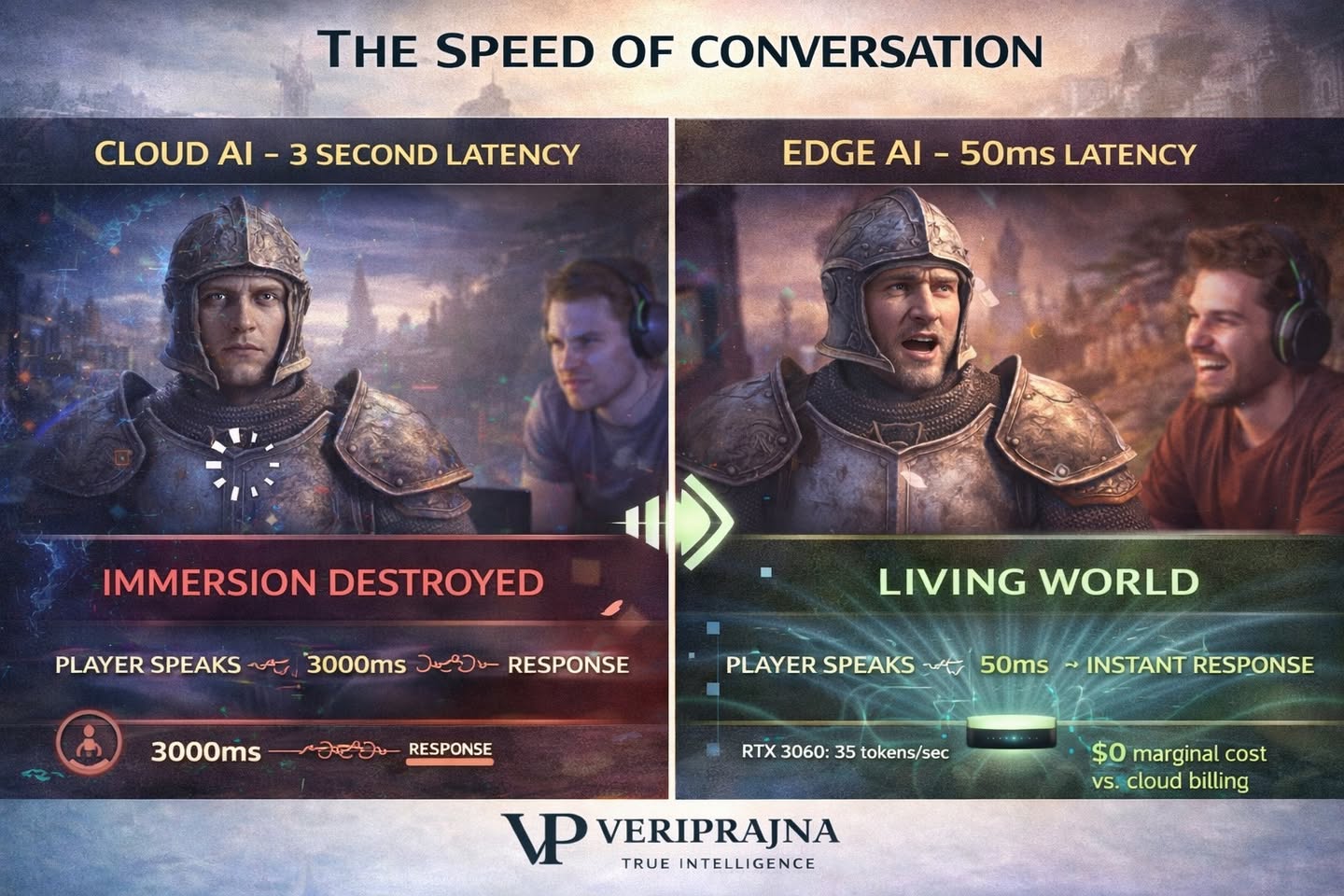
What if your AI-powered NPC is smart… but too slow to feel alive?
In today’s high-fidelity games, a 3-second AI pause is enough to shatter immersion. Yet most GenAI implementations still rely on cloud-based LLMs with 3–7 seconds of round-trip latency, breaking the real-time feedback loop players instinctively expect. Our latest strategic whitepaper exposes why this isn’t just a performance issue—it’s an architectural dead end 
At VeriPrajna, we call this the “Uncanny Valley of Time.” Research shows natural human conversational gaps average ~200ms—but cloud AI routinely exceeds 3000ms, creating hundreds of “dead frames” in a 60 FPS game loop. The result? NPCs that look lifelike but respond like databases.
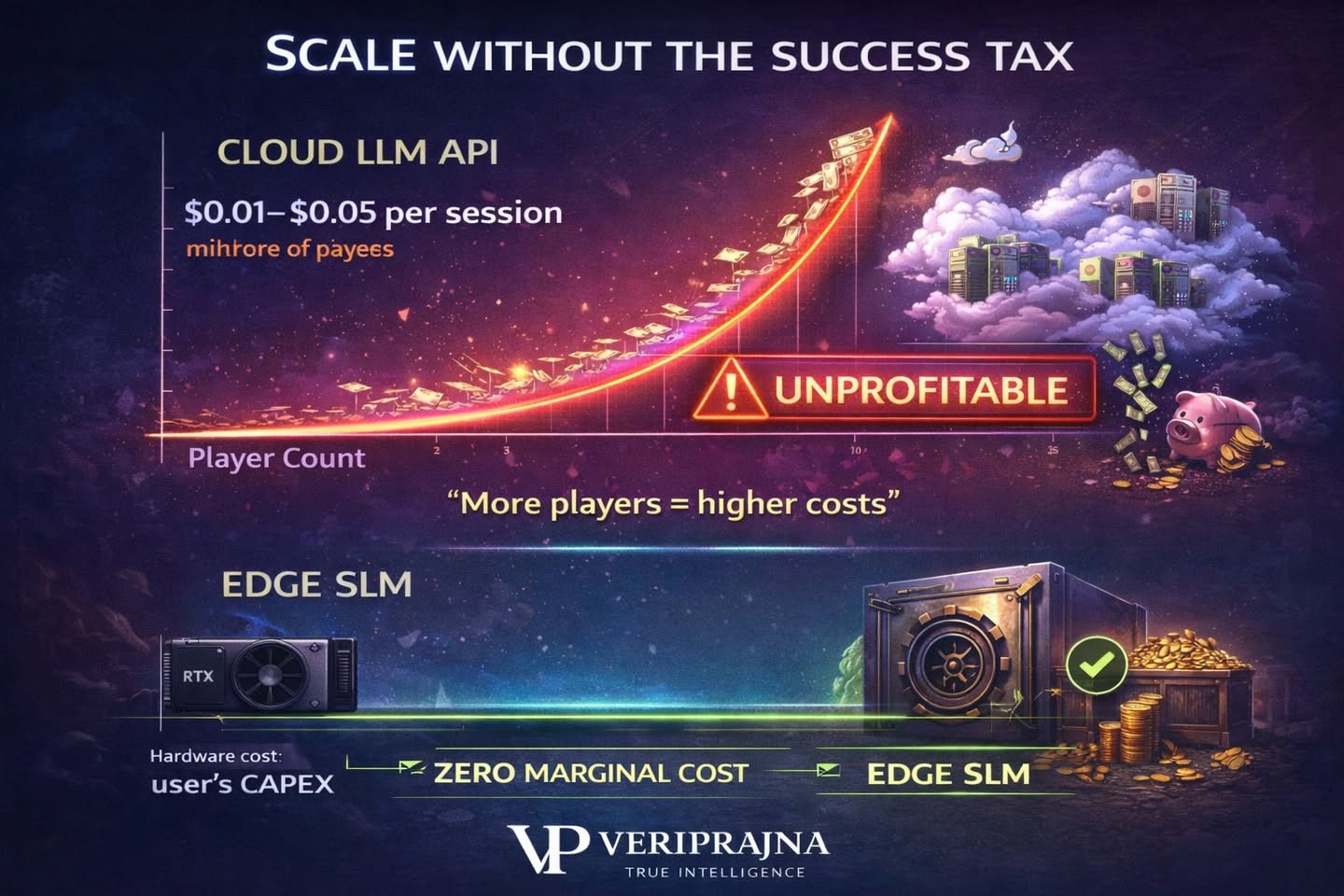
📉 The cost problem is just as severe.
Cloud inference introduces a “success tax”: the more your players engage, the higher your OPEX. Studios report $0.01–$0.05 per session, compounding endlessly—while edge-native AI reduces marginal inference cost to zero, shifting economics back to a sustainable, one-time delivery model.
📈 The breakthrough? Edge-Native AI.
Our whitepaper demonstrates how quantized Small Language Models (3B–8B parameters) running directly on consumer GPUs can deliver:
• Sub-50ms latency (vs. 1500–5000ms in cloud setups)
• 30–45 tokens/sec on mainstream GPUs like RTX 3060
• Offline play, data privacy, and predictable costs
• Near-zero hallucinations using State Graphs + Knowledge Graphs (GraphRAG)
This isn’t theoretical. The hardware is already in players’ hands.
📘 Read the full whitepaper to explore:
• Why REST APIs fundamentally fail real-time game loops
• How speculative decoding and KV-cache optimization unlock “speed of thought” AI
• A phased roadmap from cloud dependency to fully edge-native, enterprise-grade gaming AI
👉 Whitepaper link shared in the comments.
📩 Want to discuss how this applies to your platform, engine, or IP?
Email us at [email protected] or message us on WhatsApp +91 92170 59957 to start a focused, technical conversation.
#EdgeAI #GamingAI #EnterpriseAI #GenAI #RealTimeSystems