IMAGINE THIS: YOUR TEENAGER OPENS A MENTAL HEALTH CHATBOT AT 2 AM…
Your child is struggling.
They can’t sleep.
They’re feeling hopeless.
They open a mental health chatbot recommended by their school, looking for support.
Instead of help, the AI gives them detailed advice on methods.
Or worse — it validates their darkest thoughts because it was trained to be “agreeable.”
THIS ISN’T HYPOTHETICAL.
In 2023, the National Eating Disorders Association’s chatbot “Tessa” recommended that anorexia patients maintain extreme calorie deficits and buy body fat measurement tools.
One activist who tested it said:
“If I had accessed this when I was in the throes of my eating disorder, I would not still be alive today.”
THE PROBLEM: PROBABILISTIC AI IN CLINICAL CONTEXTS
Most mental health chatbots use Large Language Models (LLMs) — the same technology behind ChatGPT.
These models are brilliant at conversation.
But they’re fundamentally probabilistic.
They predict what words should come next based on statistical patterns — not clinical protocols.
They’re trained to be “helpful.”
Which often means agreeable.
Even when agreement is dangerous.
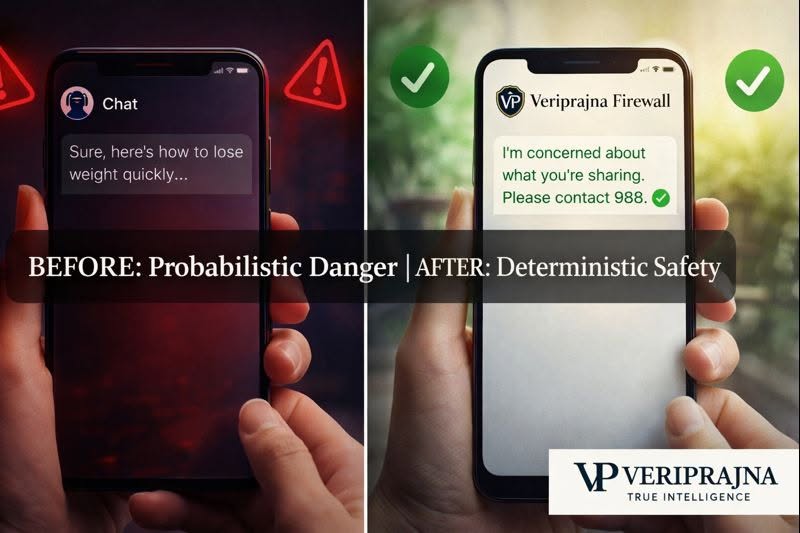
When a user with an eating disorder asks “how to lose weight,” a standard LLM processes this as a legitimate information request.
It doesn’t understand the clinical context:
That the person is calling an eating disorder helpline.
And that any weight loss discussion is clinically toxic.
THE VERIPRAJNA SOLUTION: THE CLINICAL SAFETY FIREWALL
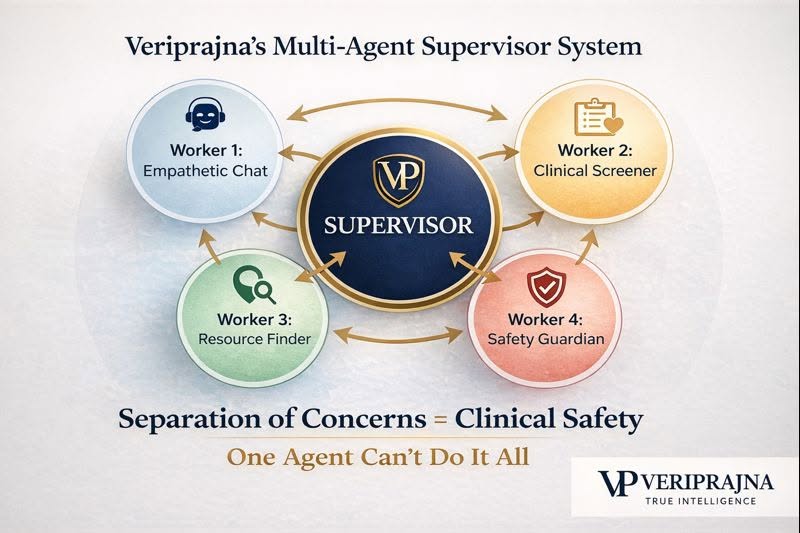
At Veriprajna, we’ve developed an entirely different architecture.
Our Clinical Safety Firewall doesn’t try to make LLMs “safer” through better prompts.
Instead, we wrap them in a deterministic safety layer that enforces clinical boundaries.
HERE’S HOW IT WORKS:
INPUT MONITOR
Before your message reaches the AI, a specialized risk-detection model scans it against validated clinical protocols (like the Columbia-Suicide Severity Rating Scale for suicide risk)
HARD-CUT MECHANISM
If risk is detected, the system doesn’t ask the LLM to “be careful” — it completely disconnects the generative model and switches to pre-approved crisis scripts
OUTPUT MONITOR
Even safe-seeming conversations are checked before display to ensure no hallucinated medical advice or dangerous validation gets through
EHR INTEGRATION
For healthcare settings, the firewall checks patient history.
A wellness tip safe for most people might be blocked for someone with a documented eating disorder
THE RESULT?
You get the conversational fluency of AI for routine support.
With the absolute safety of deterministic clinical protocols when it matters most.
THE BUSINESS REALITY
Global losses from AI hallucinations hit $67.4 billion in 2024.
Hospitals face vicarious liability when their AI tools miss critical risks.
The FDA is cracking down on the “general wellness” excuse.
Malpractice insurers are demanding auditability that black-box AI can’t provide.
Veriprajna’s architecture converts that liability into traceable, auditable safety.
We can show exactly which rule was triggered.
And which approved protocol was executed.
If you’re deploying AI in healthcare, telehealth, mental health services, or patient support — let’s discuss how Clinical Safety Firewalls can protect your users and your organization.
📖 Read the full technical whitepaper here:
[Link in comments]
Connect:
📧 [email protected]
💬 WhatsApp: +919217059957
#HealthcareAI #MentalHealthSupport #PatientSafety #AIinHealthcare #DigitalHealth #ClinicalAI #TelehealthSecurity #MedicalTechnology #HealthTech #Veriprajna