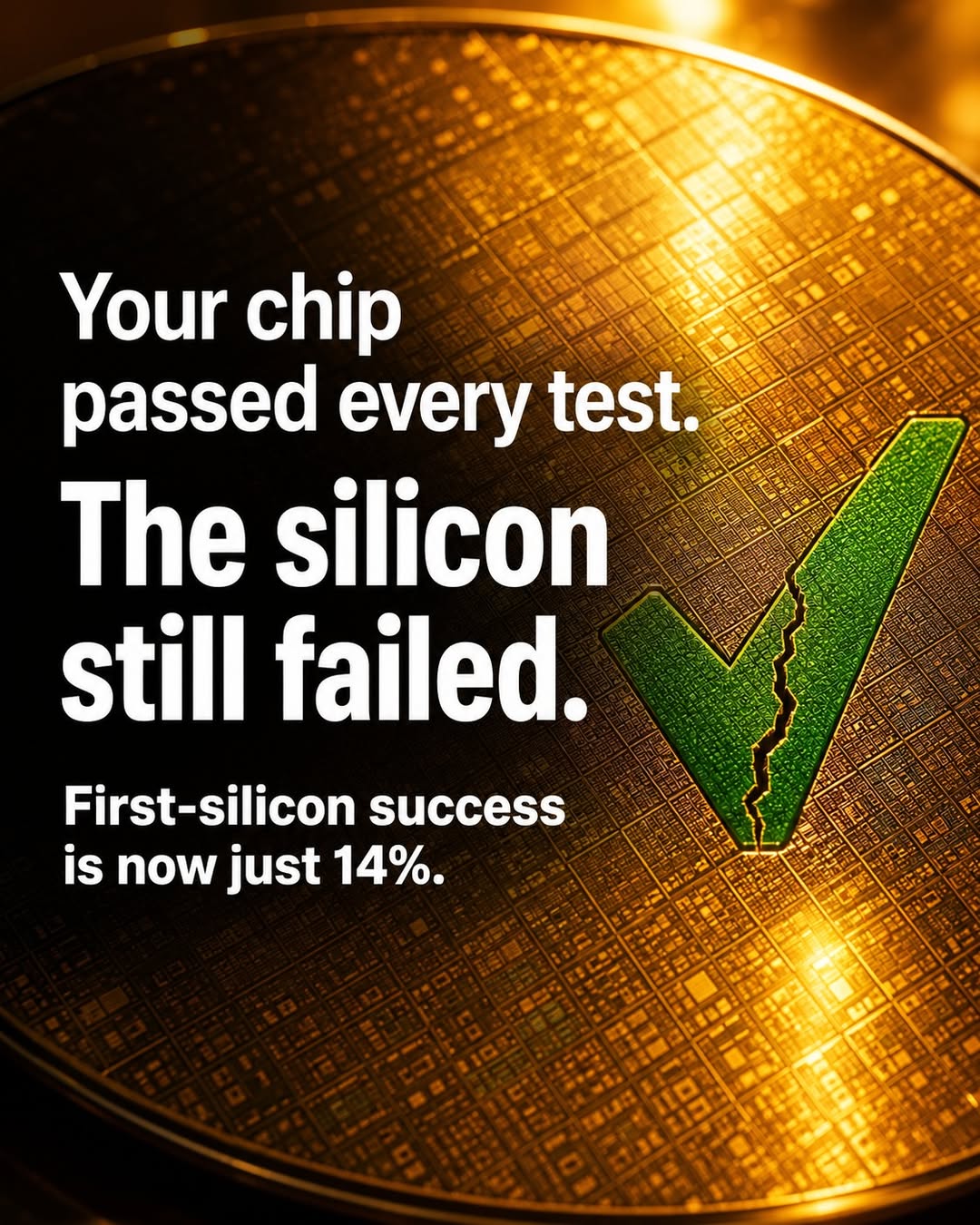
First-time silicon success just dropped to 14% — the lowest in 20 years of tracking. In 2020 it was 32%.
That's not sloppy engineering. It's complexity outrunning verification, specs mutating faster than the testbench, and a new failure mode: teams pointing general-purpose LLMs at Verilog to move faster.
The trap isn't the code an LLM writes that won't compile — that's caught in seconds. It's the code that passes every test and still kills the chip.
The most dangerous class we see, we call vacuity. The LLM writes a SystemVerilog assertion. Your formal engine proves it. You sign off. Except the property was trivially true — the condition it was meant to check never fires (req |-> gnt, where req is tied low and never asserts). The solver dutifully "proves" a broken design correct. Formal verification that skips vacuity checks is worse than none, because now you trust it.
A 5nm mask set runs $10–20M. At 3nm it nears $40M. A respin is a 3–6 month slip that can erase half a product's lifetime revenue. That's the cost of one assertion nobody double-checked.
The fix isn't more AI. It's wrapping the model in the unglamorous discipline — vacuity detection, proof coverage, cone-of-influence — around the formal engine you already own (JasperGold, VC Formal, Questa, SymbiYosys), running on your own hardware so no RTL leaves your network.
Verification leads: what's the bug that passed every check and still reached silicon?
#FormalVerification #SemiconductorDesign #RISCV