What if your AI claims engine is persuasive… but wrong?
In liability decisions, fluency is not truth—and probabilistic AI is quietly rewriting justice.
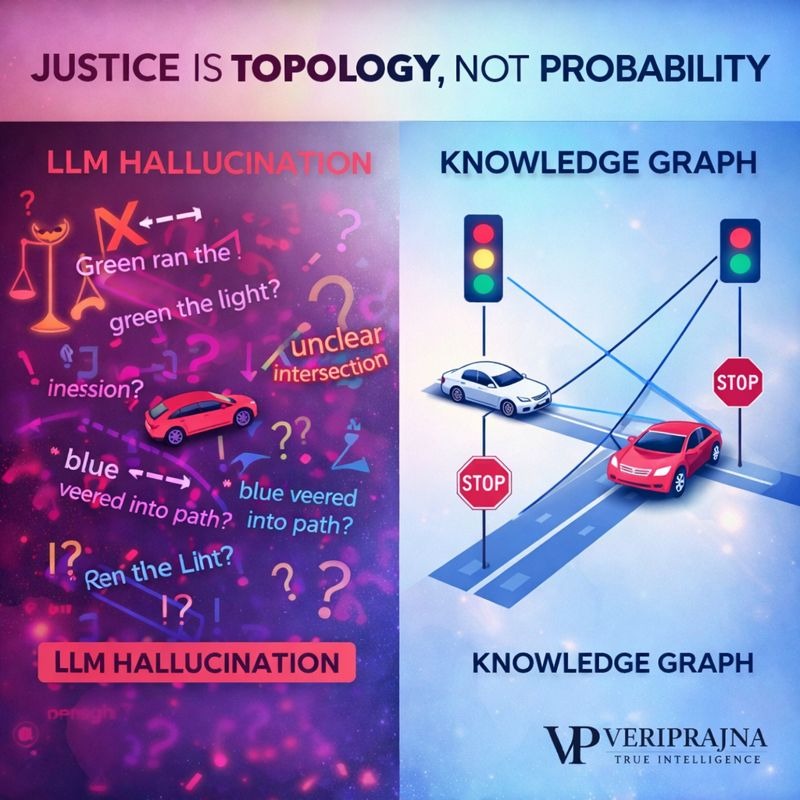
Today, many insurers are experimenting with LLM-as-a-Judge systems to read police reports and assign fault. Our latest whitepaper exposes why this is a systemic risk. Research cited shows legal hallucination rates as high as 69–88%, with LLMs favoring longer narratives over factual accuracy (verbosity bias) and aligning with user assumptions instead of evidence (sycophancy). In high-stakes claims, this doesn’t just increase leakage—it creates regulatory and litigation exposure.
VeriPrajna’s answer is deterministic justice.
We replace probabilistic judgment with Knowledge Graph Event Reconstruction (KGER)—a neuro-symbolic architecture where:
• LLMs extract entities, not verdicts
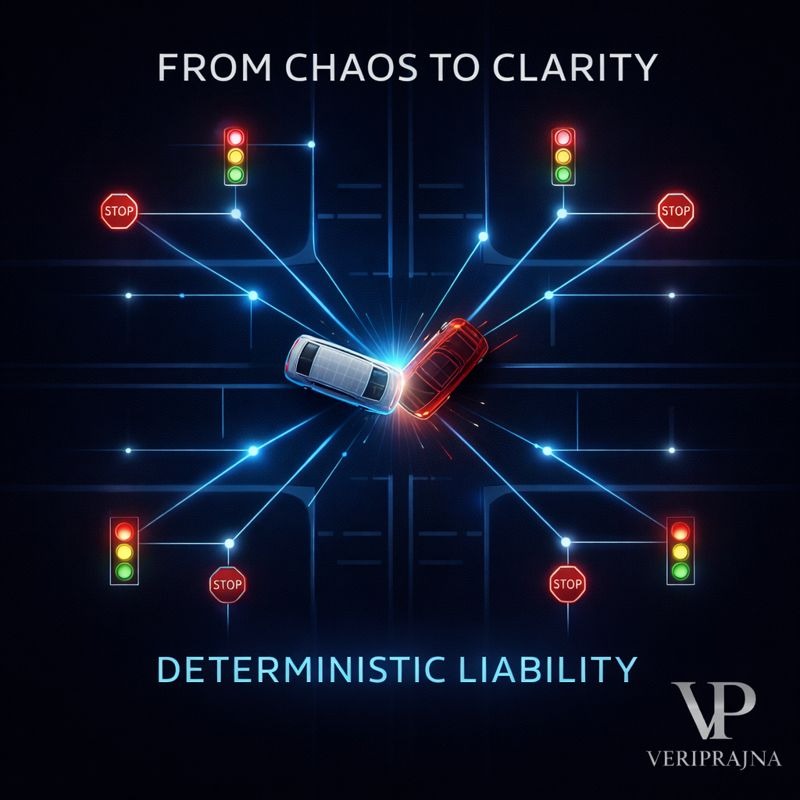
• Accidents are reconstructed as spatio-temporal graphs
• Traffic laws are executed as formal deontic logic
• Fault is computed via causal and counterfactual analysis
The result? 100% repeatable liability decisions, near-zero hallucination risk, full auditability, and measurable reduction in claims leakage—while enabling straight-through processing even for complex intersection crashes.
Stop guessing liability. Start reconstructing it.
👉 Read the whitepaper (link shared in comments) to see how topology, logic, and physics redefine AI-driven claims adjudication.
👉 Talk to our experts about deploying deterministic liability systems in your workflow:
📧 [email protected]
📱 WhatsApp +91 92170 59957
#NeuroSymbolicAI #InsuranceInnovation #ExplainableAI #KnowledgeGraphs