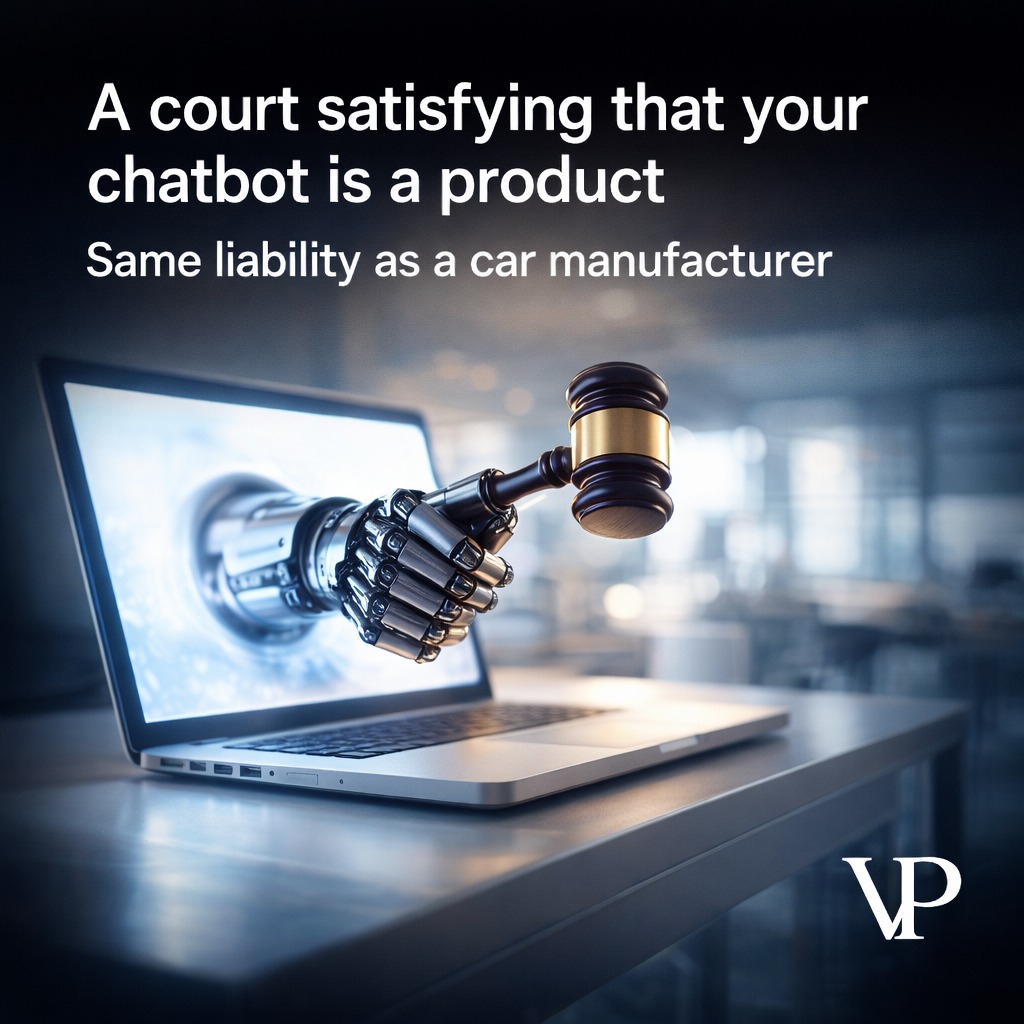
A court just ruled that chatbot output is a product — not speech. That changes everything for AI companies.
Here's what happened and why it matters for every business deploying AI right now.
In January 2026, a landmark settlement between Google, Character.AI, and a teen's family reshaped the legal landscape. The court rejected Section 230 protection for AI-generated content and applied strict product liability instead.
That means if your AI causes harm — financial loss, emotional damage, bad advice — you're treated like a manufacturer. Same legal standard as a car company or a pharma brand.
Three things changed overnight:
→ The "black box" defense is dead. Courts no longer accept "we couldn't predict what the model would say" as an excuse.
→ Thin wrapper apps built on third-party APIs carry the most exposure. One prompt layer over someone else's model won't hold up in court.
→ The EU AI Act hits full enforcement for high-risk systems in August 2026, with fines up to 3% of global revenue. Colorado's AI Act follows in June.
What actually reduces risk? Multi-agent architecture with deterministic safety layers, real-time compliance checks, human oversight at critical decision points, and full audit trails that can reconstruct any AI decision months later.
The era of "ship fast and patch later" is over. Strong governance isn't a barrier to scaling AI — it's the only way to scale it without betting your company.
Save this if your team is building with AI in 2026 — you'll want this reference.
Is your org still running wrapper-based AI, or have you started moving toward deeper architecture? 👇
#AIProductLiability #AIGovernance #EnterpriseAI #Section230 #AICompliance