Westlaw Precision hallucinated on 33% of complex legal queries in peer-reviewed Stanford testing. The part that should worry you isn't the fake citations.
Everyone knows the Mata v. Avianca story — an AI invents a case that doesn't exist, the citator catches it, the lawyer gets fined. That failure mode is mostly solved. Shepard's and KeyCite flag any citation that resolves to nothing.
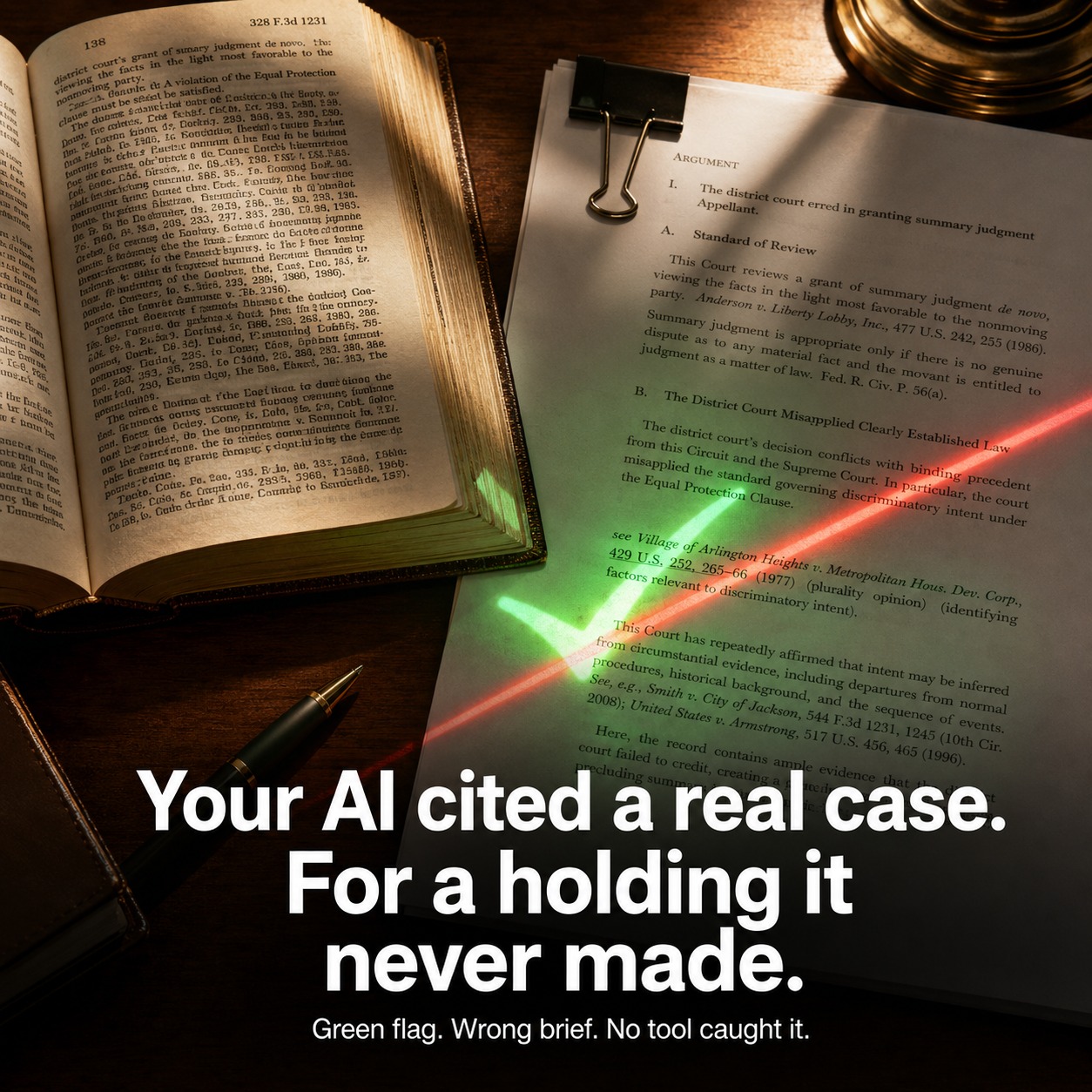
The dangerous failure is the one your tools can't see: contextual hallucination. The AI cites a real case — valid docket, green KeyCite flag — for a proposition it doesn't actually support. It quotes the dissent as the majority. It leans on a statute amended two years ago.
A concrete one our team mapped: ask a legal AI for Delaware fiduciary-duty defenses and it cites Stone v. Ritter (2006). Real case. Accurate summary — for 2006. What it misses is Marchand v. Barnhill (2019), which substantially expanded that duty. Stone still has a green flag. The brief built on it is still wrong for a 2026 filing.
Your citator checks whether the case exists. It doesn't check whether the AI read it correctly. That gap is why a New Orleans attorney got sanctioned in 2026 after running BOTH ChatGPT and Westlaw Precision AI — 11 fabricated or mischaracterized citations, with two tools running. That's the malpractice and sanctions exposure no citator was built to close.
This is the layer we build: verification pipelines that check subsequent treatment, not just citator status — plus the governance to prove every citation was checked when a judge asks. It sits on top of Harvey, Lexis Protege, or your own models. We don't replace your stack. We catch what it misses.
The Sixth Circuit hit two attorneys with $30,000 in March 2026 for fabricated citations — and that's the easy failure to catch. Save this before your next technology-committee meeting.
#LegalAI #LegalTech #AIGovernance #LawFirmInnovation #CitationVerification