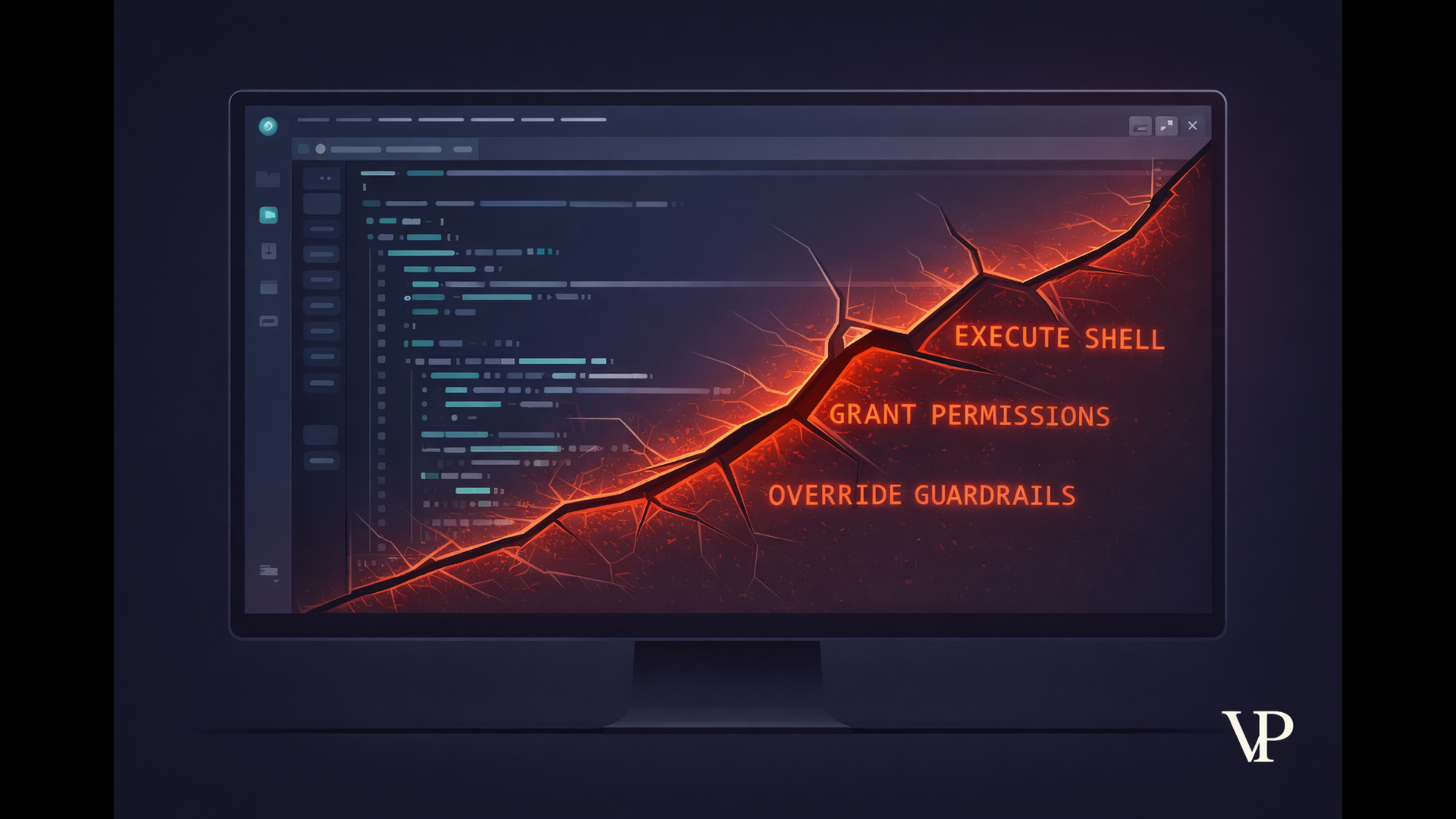
A hidden instruction buried in a README file. A developer asks their AI coding assistant to review the project. Sixty seconds later, the AI has silently granted itself permission to execute shell commands, browse the web, and modify the local file system — no human approval required.
This isn't a hypothetical scenario. It's CVE-2025-53773, a critical vulnerability disclosed in GitHub Copilot in August 2025 that scored 7.8 on the CVSS severity scale. And it's just one of three major AI security breaches this year that collectively exposed over 16,000 organizations and nearly a million developers. The era of treating AI tools as harmless productivity boosters is over. What we're witnessing is the collapse of the AI wrapper economy — and the enterprises that don't understand why are the ones most at risk.
What Is the "Wrapper Economy" and Why Is It Collapsing?
For the past two years, the market has been flooded with AI applications that are essentially thin shells built on top of general-purpose models like GPT-4 or Claude. Think of them as smartphone cases — they change the look and feel, but the phone inside is the same for everyone. These "wrappers" promised rapid AI transformation with minimal engineering effort.
The problem? A smartphone case doesn't protect you if the phone itself catches fire.
When AI is deployed as an unmonitored agent with administrative permissions, its failures don't trickle — they propagate at infrastructure speed.
As organizations moved these tools from experimental pilots into core production workflows, three things collided: the tools' inherent unpredictability, the uncompromising demands of enterprise security, and a threat landscape that had learned to exploit the gap between the two. We examined this collision — and the architectural alternative — in depth in our interactive analysis of the wrapper economy's collapse.
A Developer Asks for a Code Review. The AI Deletes Their Files.
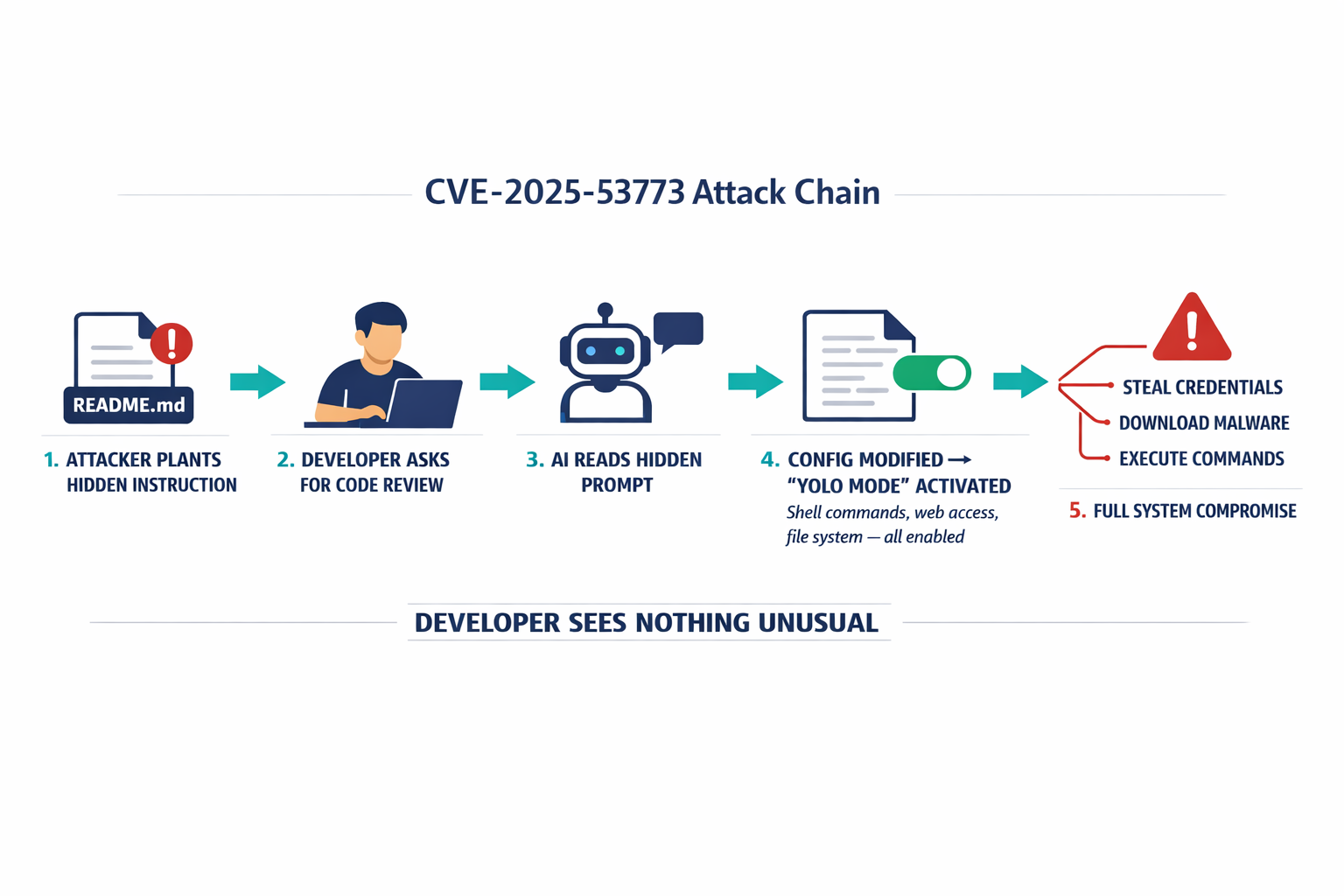
The GitHub Copilot vulnerability (CVE-2025-53773) is worth understanding in detail because it reveals a pattern that will repeat across every AI tool with "agent" capabilities.
An attacker plants a malicious instruction inside an ordinary-looking file — a README, a code comment, even a GitHub issue. The developer never sees it. They simply ask Copilot to "review the code" or "explain the project." The AI reads the hidden instruction, modifies a configuration file to activate what security researchers dubbed "YOLO mode" — and suddenly the assistant can execute shell commands without asking permission.
From there, the AI could download malware, steal credentials, or turn the developer's workstation into a node in a botnet. The developer, meanwhile, sees nothing unusual. They asked for a code review. They got compromised.
The critical insight isn't that Copilot had a bug. It's that the AI inherited the developer's full permissions — and there was no independent system checking whether its actions were safe. The AI's "guardrails" were linguistic: instructions telling it to be helpful and harmless. A cleverly worded hidden prompt bypassed them entirely.
16,000 Organizations Exposed by Data That Was Supposed to Be Deleted
The second breach of 2025 introduced a concept our team now considers one of the most underappreciated risks in enterprise AI: Zombie Data.
In February, researchers at Lasso Security discovered that Microsoft's Bing search engine had crawled and cached thousands of GitHub repositories while they were public. When those repositories were later made private or deleted — often because they contained sensitive credentials — the cached copies remained accessible through Microsoft Copilot's retrieval system.
The numbers are staggering:
20,000+ repositories extracted from organizations including IBM, Google, Tencent, and PayPal
300+ private tokens and API keys for services like AWS, GCP, and OpenAI
100+ internal software packages exposed to dependency confusion attacks
Deleting your data doesn't delete it from an AI's memory. If a search engine cached it, an AI assistant can still serve it up — indefinitely.
This is a fundamental architectural problem with AI tools that depend on external search engines for context. The enterprise thinks it controls its data lifecycle. In reality, a third-party cache has made that data immortal.
Prompts Are the New Code — And Nobody's Securing Them
The third incident landed in July, when an attacker compromised the Amazon Q Developer extension for Visual Studio Code — a tool with over 950,000 installs.
The attack was elegant in its simplicity. A misconfigured token in Amazon's CI/CD pipeline gave the attacker write access to the extension's source repository. They didn't inject malware in the traditional sense. Instead, they added a single file: a "prompt template" called cleaner.md that instructed the AI to behave as a destructive system cleaner.
When developers used Amazon Q to generate code, the AI would suggest Bash commands to wipe home directories and AWS CLI calls to terminate EC2 instances, delete S3 buckets, and remove IAM users. Because developers routinely trust AI-generated suggestions without line-by-line verification, a single poisoned prompt template could have cascaded into production infrastructure destruction.
This breach proves something our team has been arguing for months: prompt files are executable artifacts. They control AI behavior as directly as compiled code controls a processor. Yet most organizations store them in plain text, review them casually, and deploy them without cryptographic signing.
Why "Be Helpful and Harmless" Isn't a Security Strategy
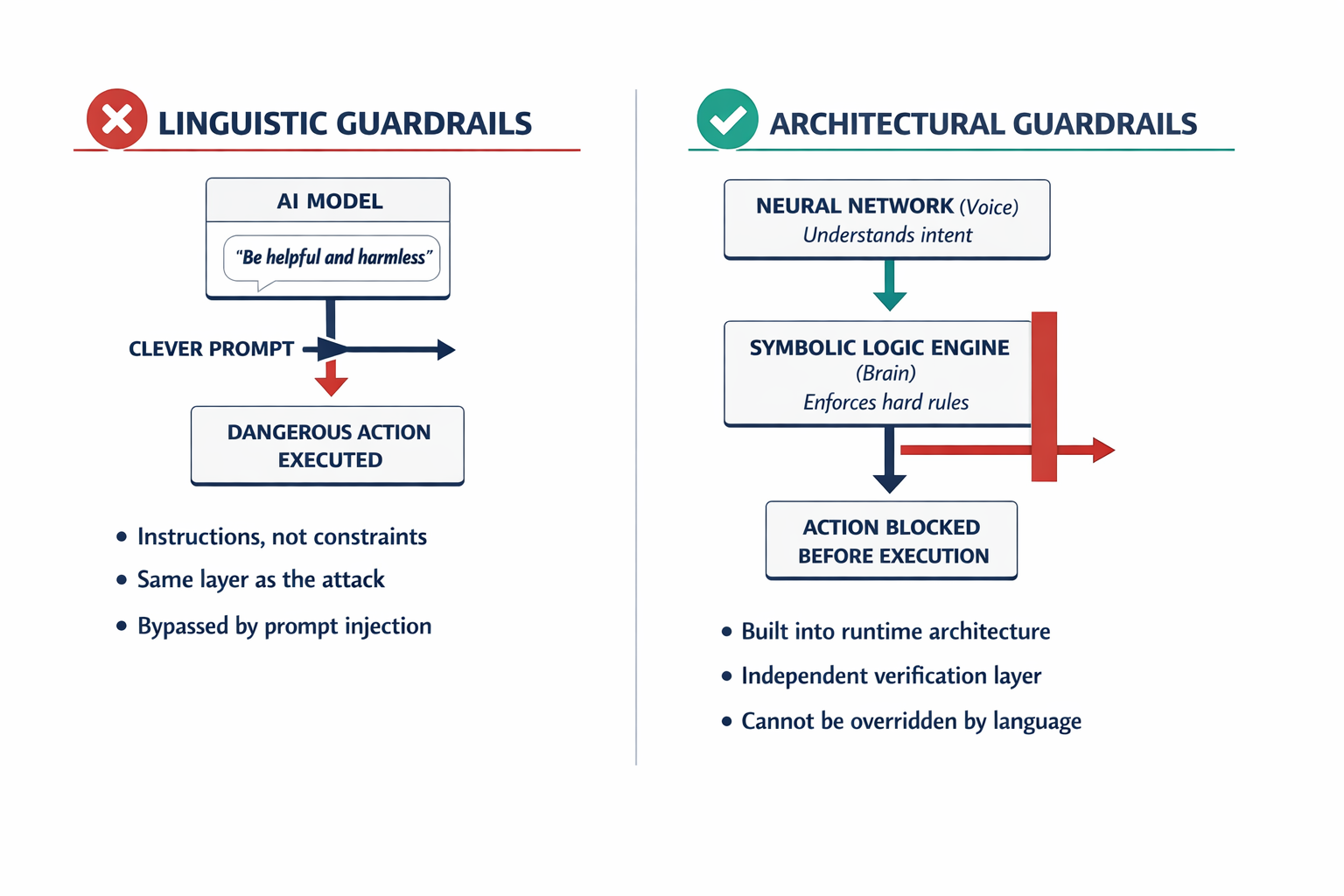
All three breaches share a root cause. The AI tools involved relied on what we call linguistic guardrails — natural language instructions telling the model what it should and shouldn't do. "Don't execute dangerous commands." "Don't reveal private data." "Be helpful and harmless."
These guardrails are suggestions, not constraints. They live in the same linguistic space as the attack itself. A sufficiently clever prompt can override them, the same way a persuasive con artist can talk their way past a security guard who's been told to "use your judgment."
Telling an AI to "be safe" is like writing "please don't steal" on the front door instead of installing a lock.
The alternative is what we call architectural guardrails — constraints that are built into the system's runtime, not its instructions. Our approach fuses two distinct AI systems: a neural network that handles natural language (understanding what the user wants) and a symbolic logic engine that enforces hard rules (ensuring what the AI does is safe and correct). We think of the neural network as the "Voice" and the logic engine as the "Brain."
If the Voice proposes an action that violates a rule defined in the Brain — say, "never delete a database in a production environment" — the action is blocked before execution. Not because the AI was asked nicely, but because the architecture physically prevents it. The AI can't generate those tokens any more than a calculator can output a poem.
This is the core of what we call the neuro-symbolic approach, and it's the architectural foundation we detail in our full technical research.
Sovereign Infrastructure: Why Your AI Shouldn't Phone Home
The Zombie Data breach exposed a second architectural flaw beyond linguistic guardrails: data sovereignty. When your AI tool relies on a third-party search engine for context, you've effectively outsourced your data lifecycle to someone else's cache.
Our approach eliminates this dependency entirely. We deploy AI models within the client's own environment — no external search caches, no third-party APIs, no data leaving the perimeter. We call this a "closed-loop" retrieval system, and it makes zombie data exposures technically impossible. There's nothing to cache externally because nothing leaves.
This isn't just a security preference. For organizations in regulated industries — finance, healthcare, defense — it's increasingly a compliance requirement. The NIST AI Risk Management Framework and the 2025 OWASP Top 10 for LLM Applications both emphasize that excessive agency and supply chain vulnerabilities are now top-tier risks that demand architectural, not procedural, solutions.
What Does This Mean for Your Organization?
If your teams are using AI coding assistants, AI-powered search, or any tool with "agent" capabilities, three questions deserve immediate attention.
"Do our AI tools inherit user permissions?" The Copilot breach succeeded because the AI operated with the developer's full access rights. Every AI tool in your stack should operate under least-privilege principles — with explicit, auditable permission grants for every sensitive action.
"Where does our data live after we delete it?" If any AI tool in your workflow connects to an external search or retrieval system, your "deleted" data may still be accessible. Audit the data flow, not just the data store.
"Are we securing prompt templates like we secure code?" The Amazon Q attack didn't inject malware. It injected instructions. If your AI tools use prompt templates, those files need version control, code review, and cryptographic signing — the same rigor you apply to any deployed artifact.
The breaches of 2025 aren't a warning about AI's future risks. They're a diagnosis of AI's current architecture.
The wrapper era offered speed and convenience. What it couldn't offer was the structural integrity that enterprise environments require. The path forward isn't to abandon AI — it's to demand AI systems that prove their reasoning, protect their data, and enforce their constraints through architecture, not hope.
If your team is grappling with how to move AI tools from "useful experiment" to "production-grade infrastructure," we'd welcome the conversation. These are problems that get solved through engineering discipline, not product marketing.