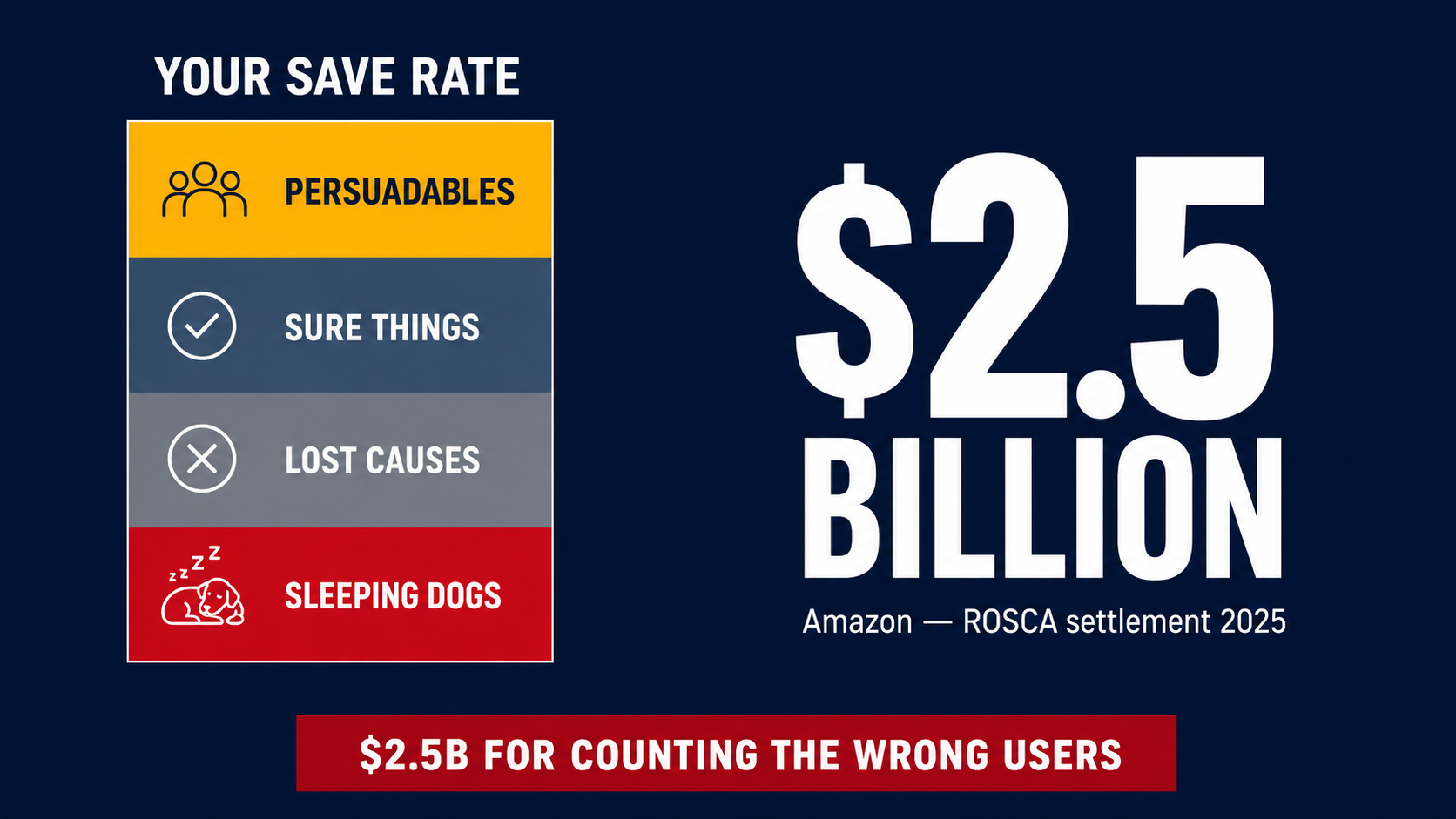
Save rate is the number your retention team celebrates. It is also the number hiding a revenue problem that can cost you more than you saved.
When Amazon's Prime cancellation flow—the so-called "Iliad Flow," a 4-page, 6-click, 15-option maze—settled with the FTC in September 2025 for $2.5 billion, most SaaS commentary focused on the dark pattern angle: too many steps, too much friction, regulators got them. That reading is incomplete. The bigger operational failure was that Amazon had optimized a system around save rate without ever distinguishing the four kinds of users inside that number. We've spent the last two years rebuilding cancel flows for subscription businesses, and the same structural error appears in virtually every one we've reviewed.
The Ethical Subscription Retention AI system we built addresses both problems together—causal segmentation and compliance architecture—because they're not separable.
The Four Users Save Rate Can't See
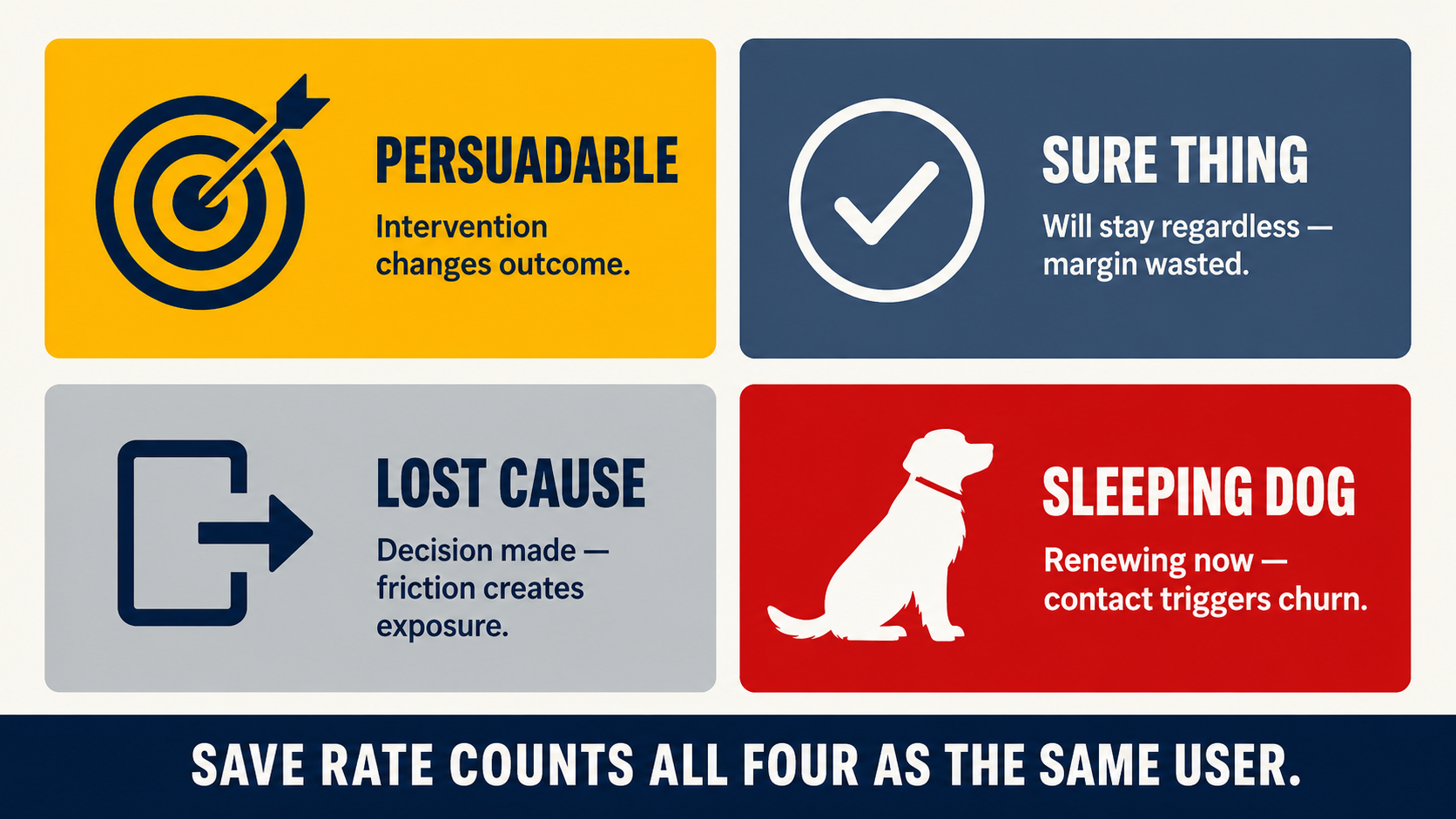
Every subscription platform's cancel flow touches four distinct user populations. Standard save-rate measurement aggregates all of them into one number.
Standard save-rate measurement treats every cancel-intent user as a Persuadable—someone who, with the right offer, will stay. In practice, that population splits four ways. Persuadables are the only group where intervention actually changes an outcome: they reached genuine cancel intent, but a plan adjustment or feature walkthrough keeps them. Sure Things were never leaving; they clicked cancel by accident or to probe for a discount, and any margin spent on them is wasted—but save rate counts them as won. Lost Causes have already decided; every additional screen they're forced through generates a support ticket and FTC exposure, not a retained subscriber. Then there are Sleeping Dogs—currently-renewing subscribers who, left alone, would continue paying. Contact them with a save offer or a retention email, and you remind them they're paying $49 a month for something they haven't opened in three months. Your retention system manufactured churn that wouldn't have existed.
Save rate optimization without causal segmentation is the operational equivalent of treating all four groups as if they're the same person. Three of the four groups shouldn't be in your cancel flow at all.
Telenor, the Norwegian telecom, discovered the Sleeping Dog problem empirically: their retention campaigns were producing 2% higher churn in the treatment group compared to the holdout. They only found out because they ran a proper holdout experiment. Most subscription businesses have never run one.
What That Math Looks Like in Practice
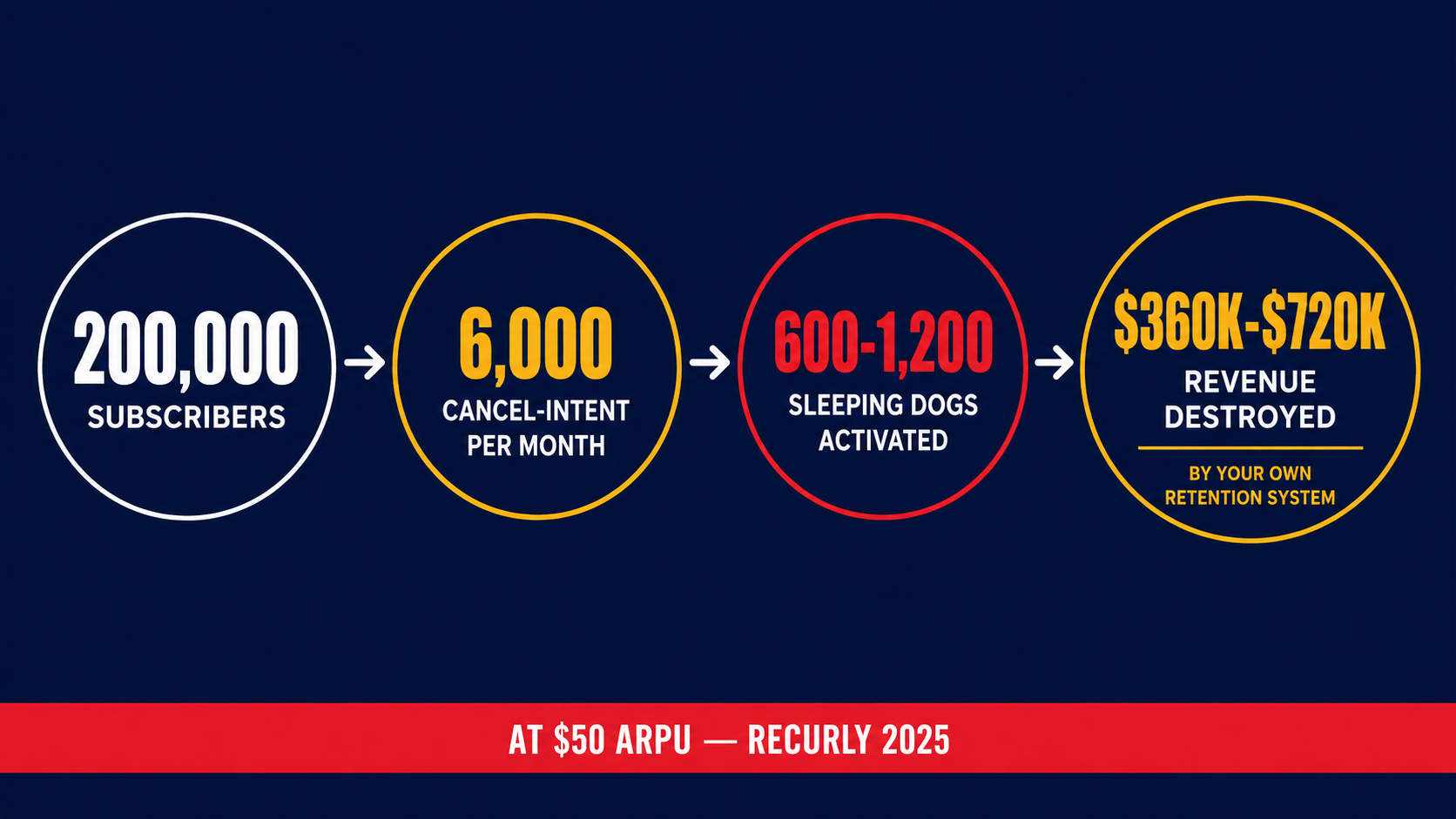
A B2B SaaS company with 200,000 subscribers and 3% monthly voluntary churn has roughly 6,000 cancel-intent users per month. Research benchmarks suggest 10–20% of cancellers are Sleeping Dogs—users who would have continued if untouched. If your cancel flow contacts all 6,000 (which is what ProsperStack, Chargebee Retention, and every off-the-shelf tool does by default), you're activating somewhere between 600 and 1,200 Sleeping Dog cancellations per month.
At $50 average revenue per user, that's $360K–$720K in annual revenue destroyed by the retention system itself.
The ROSCA compliance checklist your outside counsel reviews every quarter doesn't catch this. It reviews whether your flow has too many steps, whether consent language is clear, whether cancellation is as easy as signup. It doesn't review whether your segmentation model is contacting users who were never going to leave.
The Enforcement Trajectory
The FTC's Click-to-Cancel rule was vacated by the Eighth Circuit in July 2025—but not on the merits. The court found a procedural defect: the agency failed to issue a required preliminary regulatory analysis. The FTC responded by restarting rulemaking. An Advance Notice of Proposed Rulemaking entered the Federal Register in January 2026, with comments due April 2026.
Meanwhile, ROSCA and Section 5 of the FTC Act remain fully operational. The enforcement record since 2022 is unambiguous:
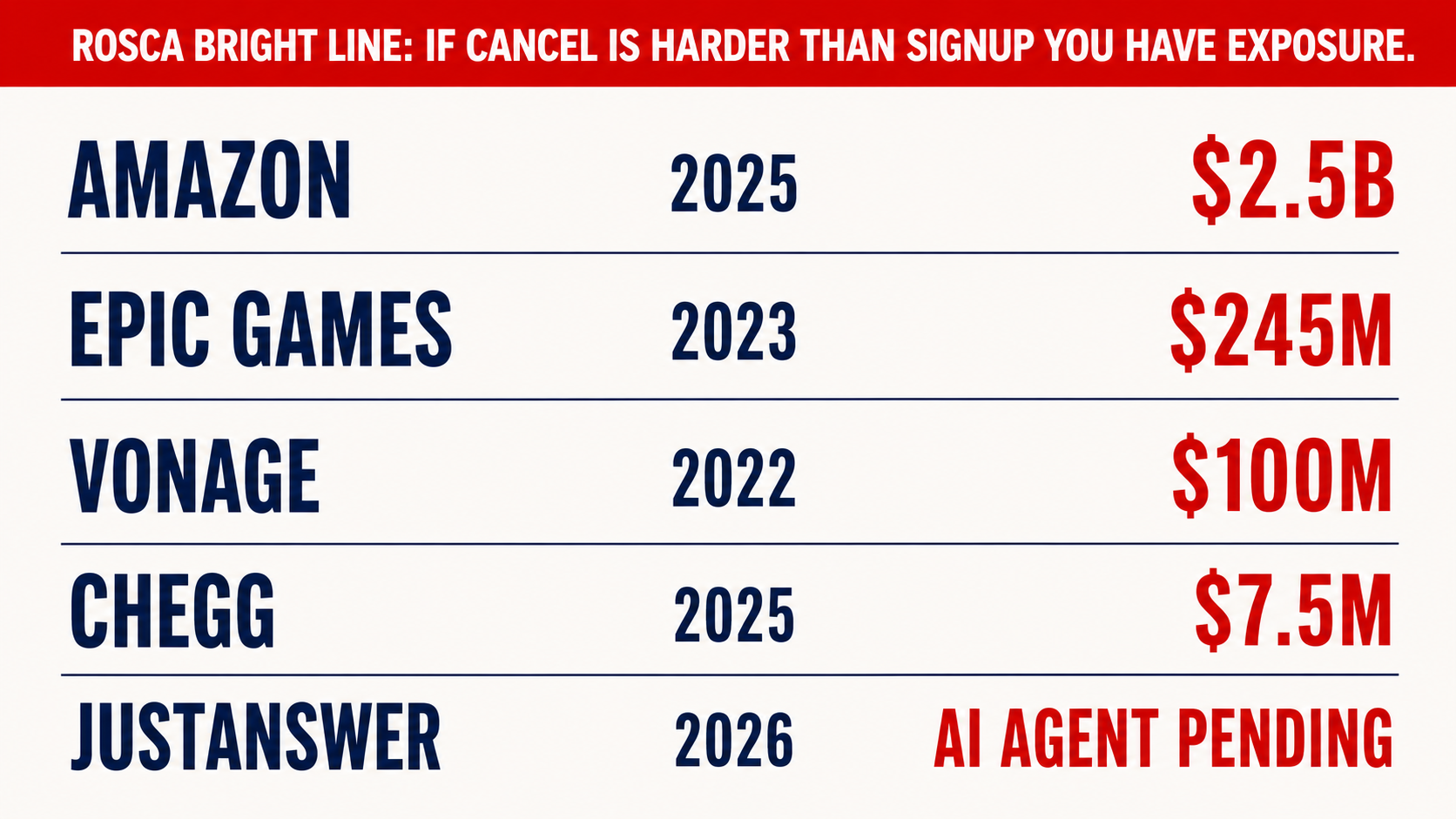
Amazon's $2.5 billion settlement is the headline, and the enforcement pattern runs to every scale below it. Epic Games paid $245 million in December 2023. Vonage paid $100 million in November 2022 for continued charging after cancellation requests—389,000 consumers refunded. Chegg and HelloFresh each paid $7.5 million in September 2025. JustAnswer entered FTC proceedings in January 2026 for an AI chatbot called "Pearl" that locked consumers into recurring charges—the first major enforcement action against an AI-agent save flow.
The JustAnswer action deserves specific attention for any company deploying conversational AI in cancellation workflows. The FTC's complaint described the Pearl chatbot as a tool for "rampant consumer deception." The legal basis was the same as Amazon's case: not a specific dark-pattern statute, but the FTC's broad Section 5 authority over deceptive practices. An AI save agent that adds conversational friction before allowing cancellation carries the same exposure as an extra screen in a manual flow.
The legal test under ROSCA doesn't require proving a specific dark pattern. The FTC only needs to show that cancellation was "not simple." If your cancel flow has more steps than your signup flow, that test is already in play.
Why Existing Tools Don't Solve This
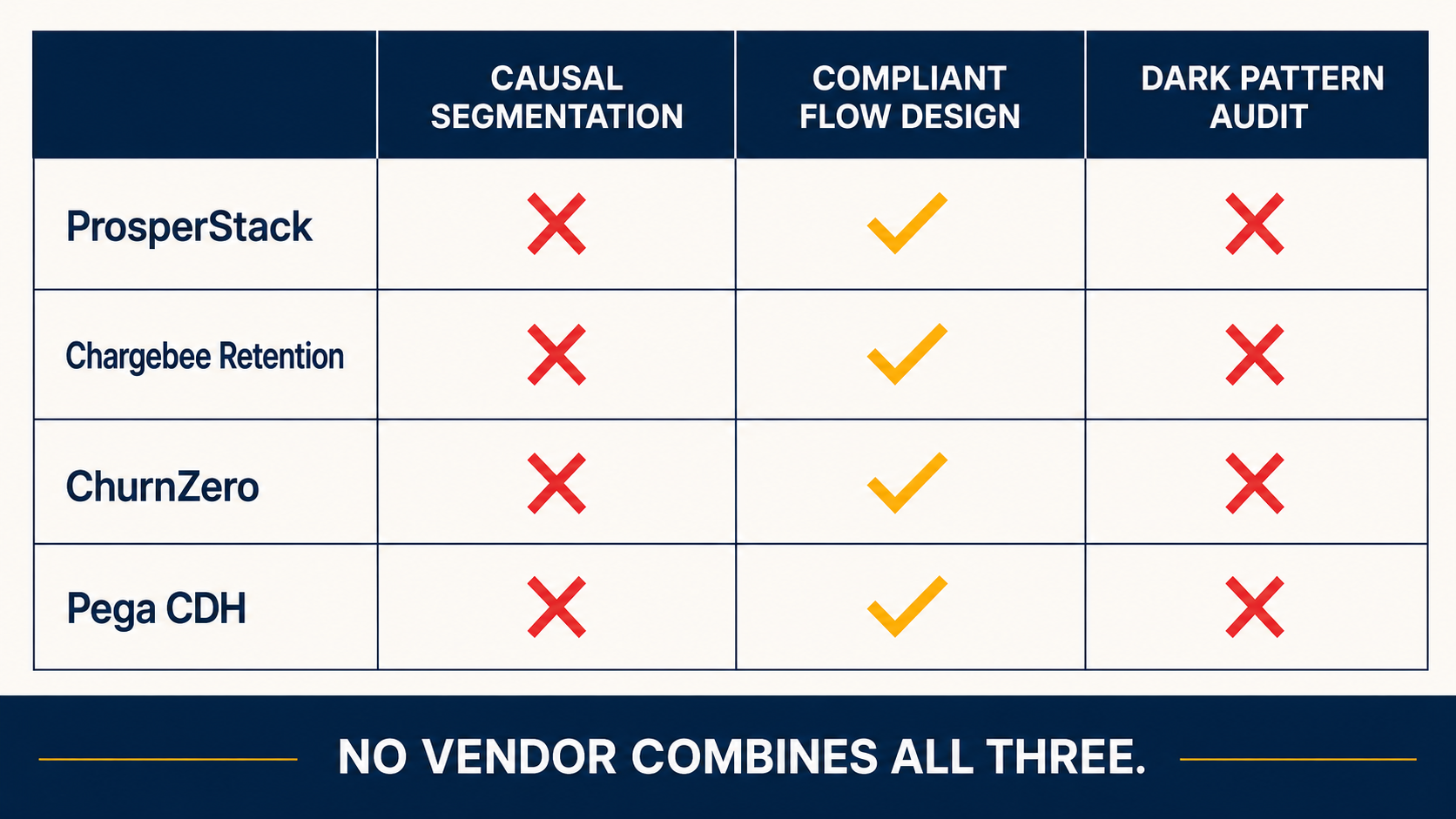
The vendor landscape for subscription retention splits into two categories that don't talk to each other.
Cancel-flow platforms—ProsperStack, Chargebee Retention (formerly Brightback), Stay AI—optimize the save offer experience. They run A/B tests on which offer wins, integrate with billing systems to surface the right discount, and report save rate back to the growth team. What they can't do is distinguish a Persuadable from a Sleeping Dog before showing the offer. The A/B framework is fundamentally misaligned with the causal question: it measures which offer converts, not which users convert because of the offer.
Customer-success platforms—ChurnZero, Custify—predict churn using health scores and usage patterns, then trigger automated playbooks. The prediction is not the same as uplift modeling. A high-churn-risk score identifies who is likely to leave; it says nothing about whether contacting that user will change the outcome or accelerate it.
Pega Customer Decision Hub does next-best-action decisioning at enterprise scale, with documented results at telco operators. It costs north of $500,000 to implement, doesn't audit cancel flows for ROSCA compliance, and predates the Sleeping Dog framework as an operational concept.
None of these tools combine causal segmentation, compliant flow design, and dark pattern auditing in one system. That gap is structural, not accidental—it reflects how the market evolved: retention optimization and compliance grew in separate departments, and no incumbent had the incentive to bridge them.
The Architecture That Addresses Both Problems
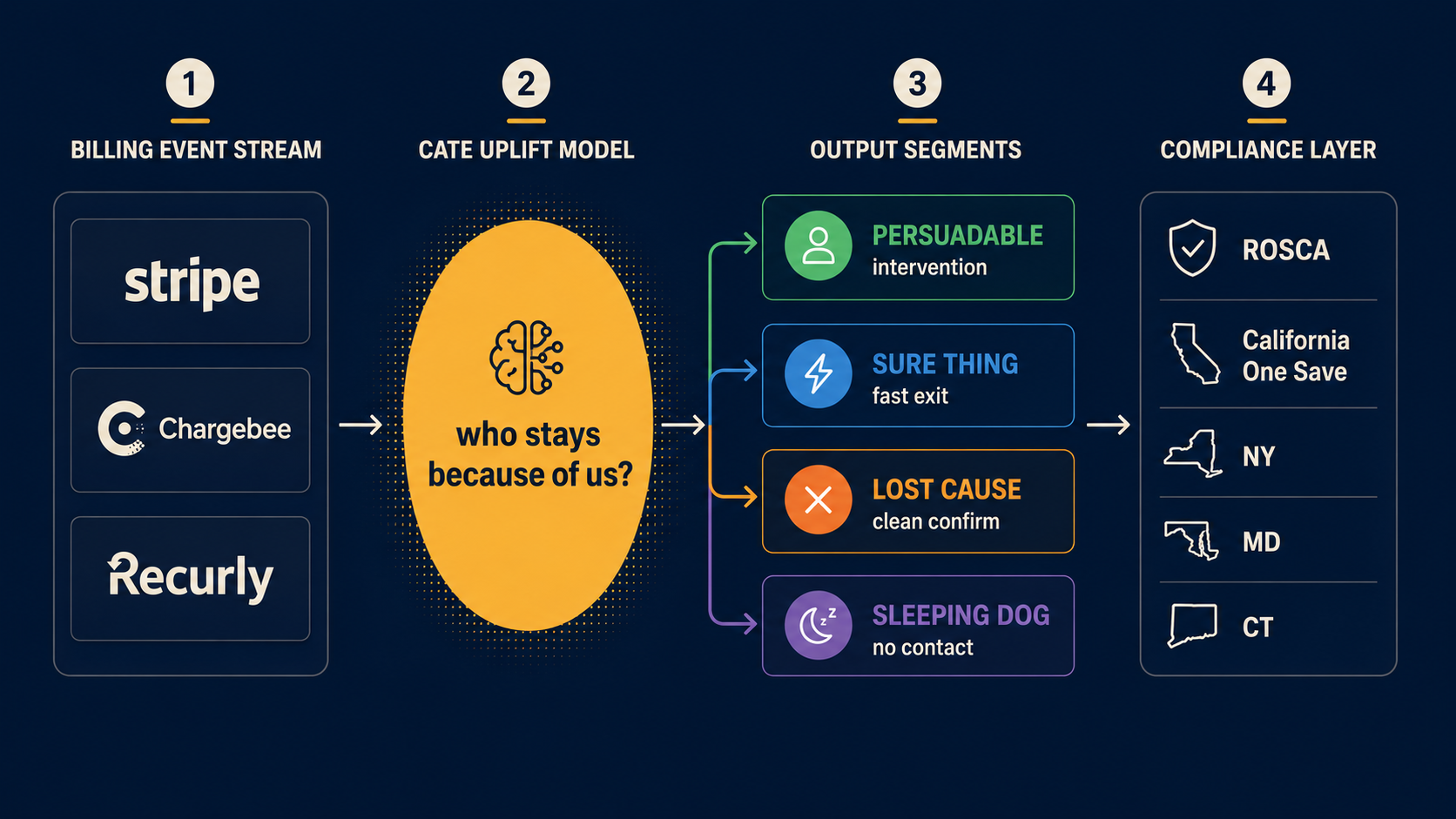
Our work at Veriprajna builds four integrated capabilities for subscription businesses.
The foundation is causal retention segmentation. We connect uplift models to billing event streams—Stripe webhooks, Chargebee events, Recurly signals—and estimate the Conditional Average Treatment Effect (CATE) for each cancel-intent user. CATE answers a different question than standard churn prediction: not "is this user likely to leave?" but "will this specific user stay because of our intervention, or regardless of it?" Persuadables and Sleeping Dogs both have elevated cancel signals. CATE separates them.
Running uplift modeling at production requires either RCT (randomized controlled trial) data—a proper holdout group—or strong instrumental variables. Most subscription businesses have never run holdout experiments on their cancel flow, which means the first deployment includes instrumenting the holdout infrastructure itself. The Telenor result isn't an outlier; it's what happens when you measure causally for the first time.
Compliant flow architecture means routing each segment to an appropriate experience: Persuadables get relevant intervention, Sure Things get a fast-exit path that doesn't damage the relationship, Lost Causes get clean confirmation, Sleeping Dogs don't enter the cancel flow at all. California's "One Save" rule limits retention offers to one per cancellation attempt; New York requires online-only cancellation for online signups; Maryland and Connecticut have specific disclosure and pre-renewal notification requirements. When your subscriber base spans multiple states, the strictest applicable law governs. We build the routing logic against a live compliance matrix, not a quarterly legal review.
Dark pattern auditing covers both the UX and the AI layer. Any AI agent deployed in a save flow requires the same scrutiny as a manually-designed multi-step screen sequence—the JustAnswer enforcement action established that precedent. We audit for step-count vs. signup-count ratios, confirmshaming language, artificial urgency, and AI-added conversational friction.
The compliance audit trail produces jurisdiction-stamped documentation of every cancellation interaction—the kind of output that responds to an FTC CID without requiring a months-long document collection effort.
The Diagnostic Your Retention Team Should Run This Quarter
If your team has never run a holdout experiment on your cancel flow, you don't know your Sleeping Dog rate. The standard approach—A/B testing save offers—can't answer the question because both arms still contact the user.
A properly instrumented holdout assigns a random subset of cancel-intent users to a control condition: no save offer, immediate clean exit. After 90 days, compare churn rates between the treatment and control groups. If the control group retains at comparable or higher rates for any segment, you have a Sleeping Dog problem in your save flow.
Three questions worth running through your next ROSCA compliance checklist:
How many steps does your cancel flow require, compared to your signup flow? The FTC's bright-line test is that cancellation should be as simple as signing up.
Does your AI save agent add conversational steps before surfacing the cancellation confirmation? If yes, you have JustAnswer-pattern exposure under current Section 5 enforcement posture.
Which states in your subscriber base have automatic renewal laws stricter than ROSCA? California, New York, Maryland, and Connecticut all do. If you're not tracking subscriber jurisdiction against compliance requirements, you're complying with the wrong floor.
The enforcement math—$2.5 billion, $245 million, $100 million, $7.5 million—is not a big-company problem. Chegg and HelloFresh are mid-market companies. The FTC has demonstrated it will pursue ROSCA violations regardless of company size when the pattern is clear.
If your team is working through what a proper causal segmentation baseline and compliant cancel architecture looks like for your specific platform, we'd be glad to hear where you're starting from. The Sleeping Dog problem tends to look different across verticals—what it looks like in B2B SaaS differs from DTC e-commerce—and the holdout instrumentation needs to fit the billing stack you're already running.