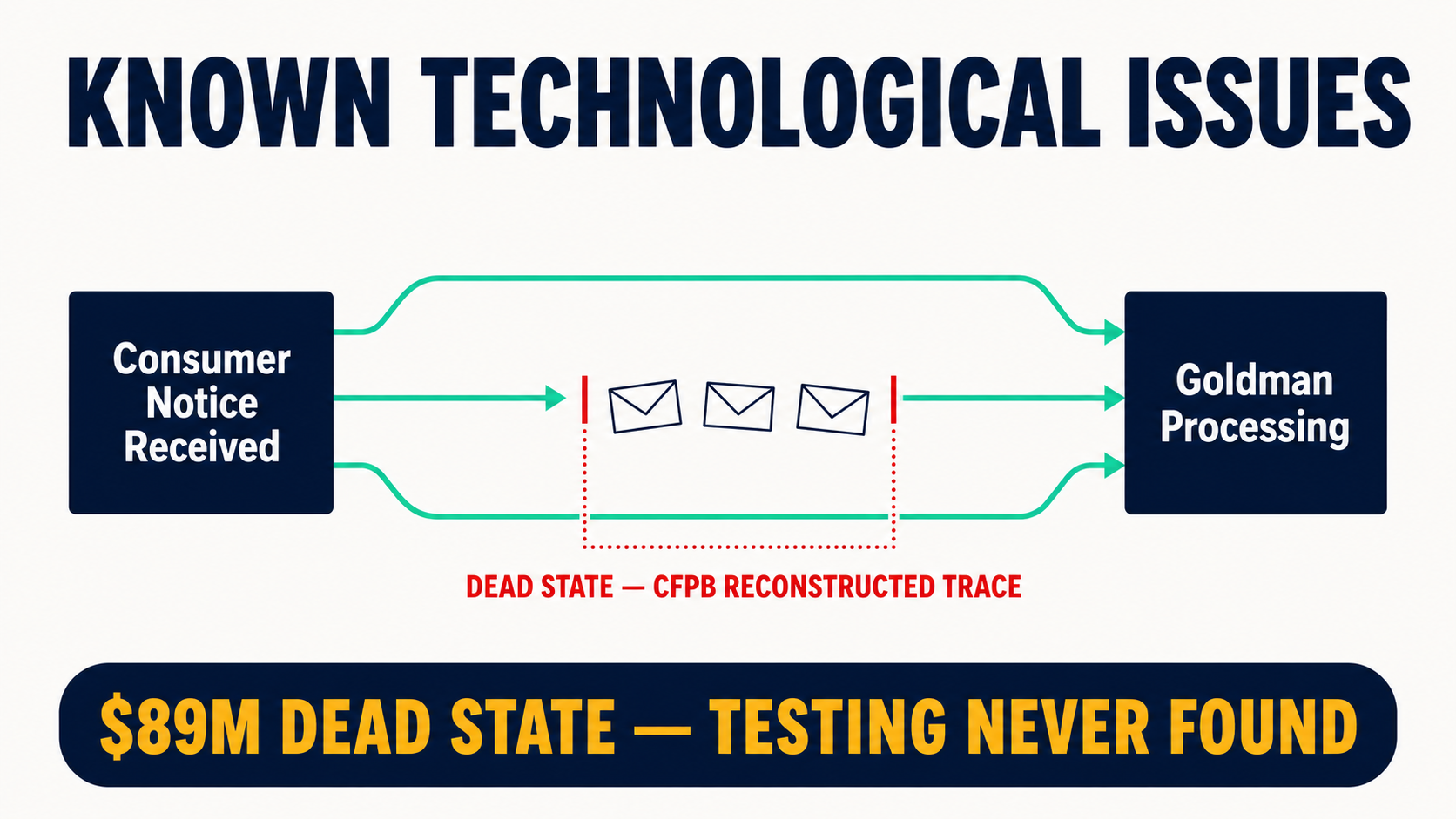
Apple and Goldman Sachs paid $89 million not because their engineers were careless, but because their dispute routing workflow contained dead states — sequences of events a valid billing error notice could enter and never exit. Thousands of consumers submitted disputes that were silently abandoned between Apple's system and Goldman's. The CFPB's examiners found those paths by reconstructing state machine traces through the workflow. The engineers who built the system hadn't known to look there.
That's the structural problem the $89 million (CFPB, October 2024) actually represents: a compliance failure that standard testing methods can't surface. You can write every test your QA team knows to write and still ship a dispute workflow that silently drops valid billing error notices under a specific multi-system failure sequence no test exercised. The technical term for what CFPB found is a dead state in the routing state machine. The remediation is formal verification.
Three Clocks, One Dispute, and the Math That Doesn't Align
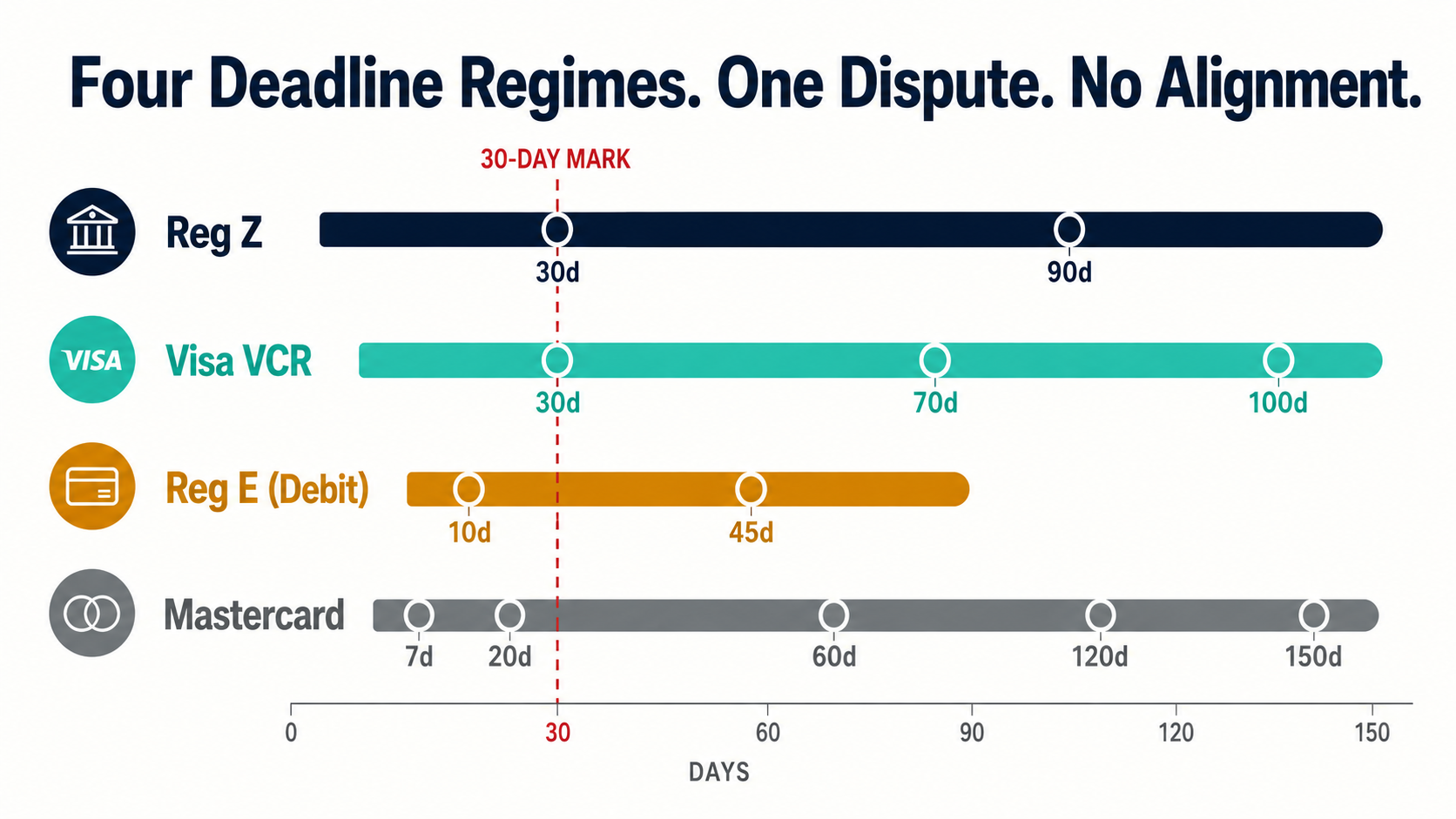
Reg Z Section 1026.13 sets three hard deadlines: 30 days to deliver written acknowledgment of a billing error notice, two complete billing cycles (maximum 90 days) to investigate and resolve the dispute, and a prohibition on adverse credit reporting during the resolution window. These aren't aspirational targets — they're binary compliance outcomes with examination consequences.
The 30-day acknowledgment clock deserves particular attention. It starts when the consumer's notice reaches any system in the chain — the routing layer, the intake handler, any component that touches the notice — not when your downstream dispute management platform has formally logged it. That gap is where the Apple-Goldman failure lived: notices technically received by the intake layer, never forwarded to the processing side, acknowledgment clock running on a dispute no one was tracking.
That same dispute may simultaneously be governed by Visa Claims Resolution — allocation cases run up to 70 days, collaboration cases up to 100 — and, if a debit card is involved, Reg E's entirely different timeline structure (10 days for provisional credit, 45 days to investigate). Mastercard's dispute framework adds a fourth timeline that practitioners have described as an even more complex transition than Visa's VCR overhaul. A bank managing credit and debit dispute workflows across multiple card networks is running four overlapping timeline regimes on a single dispute type, and those regimes don't align.
CFPB examiners don't grade your QA process. They reconstruct execution traces through production workflows looking for the path where a valid notice entered a system and silently stopped moving.
The Wolters Kluwer Q1 2026 Banking Compliance AI survey found that 42% of institutions "often" rely on manual compliance processes for exactly these workflows, with another 31% doing so "sometimes." Compliance officers from those institutions described the technology gap between customer operations and compliance as a "fundamental vulnerability that threatens operational resilience, regulatory compliance, and institutional survival." That language came from the practitioners, not from the report authors.
What Dispute Automation Solved — and What It Didn't
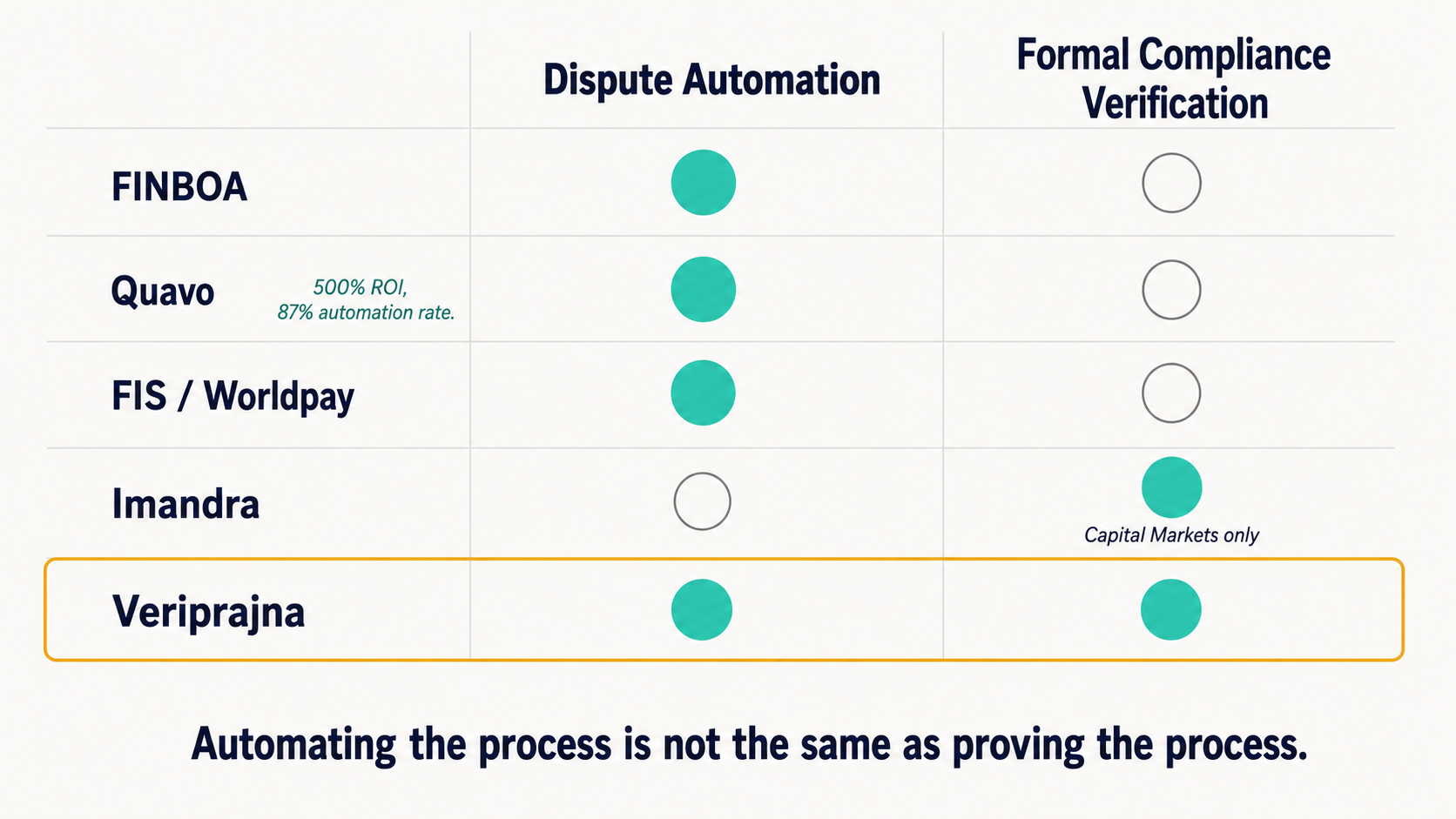
The dispute processing market has produced meaningful efficiency gains. A regional credit union using Quavo's automation platform reached an 87% automation rate within one month — 42% of disputes resolved without human intervention — and documented 500% ROI. FINBOA's Reg E dispute tracking reduces processing time by 90%, according to the company's published case studies. FIS's Disputes Direct API and chargeback management tooling automate network-level integration with Visa Claims Resolution and Mastercom.
What none of these systems produce is a compliance proof. They automate the dispute process; they don't verify that the automated process satisfies the regulatory timeline constraints it's supposed to satisfy. FINBOA tracks deadlines and alerts when one is approaching — it doesn't determine whether the workflow itself is architecturally capable of missing one under conditions no test exercised. A 500% ROI from dispute automation is real and worth pursuing; it's orthogonal to whether the automated workflow can be proven compliant.
The one company applying formal verification to financial services infrastructure is Imandra, whose clients include Goldman Sachs, Itiviti, and OneChronos. Imandra formally verifies exchange matching logic and trading algorithm correctness — capital markets infrastructure where formal methods have a long history. Goldman Sachs uses Imandra for trading system verification and paid $45 million to the CFPB for consumer dispute system failures in the same period. The domain gap between capital markets formal verification and consumer compliance formal verification is that explicit.
The Proof — or the Counterexample
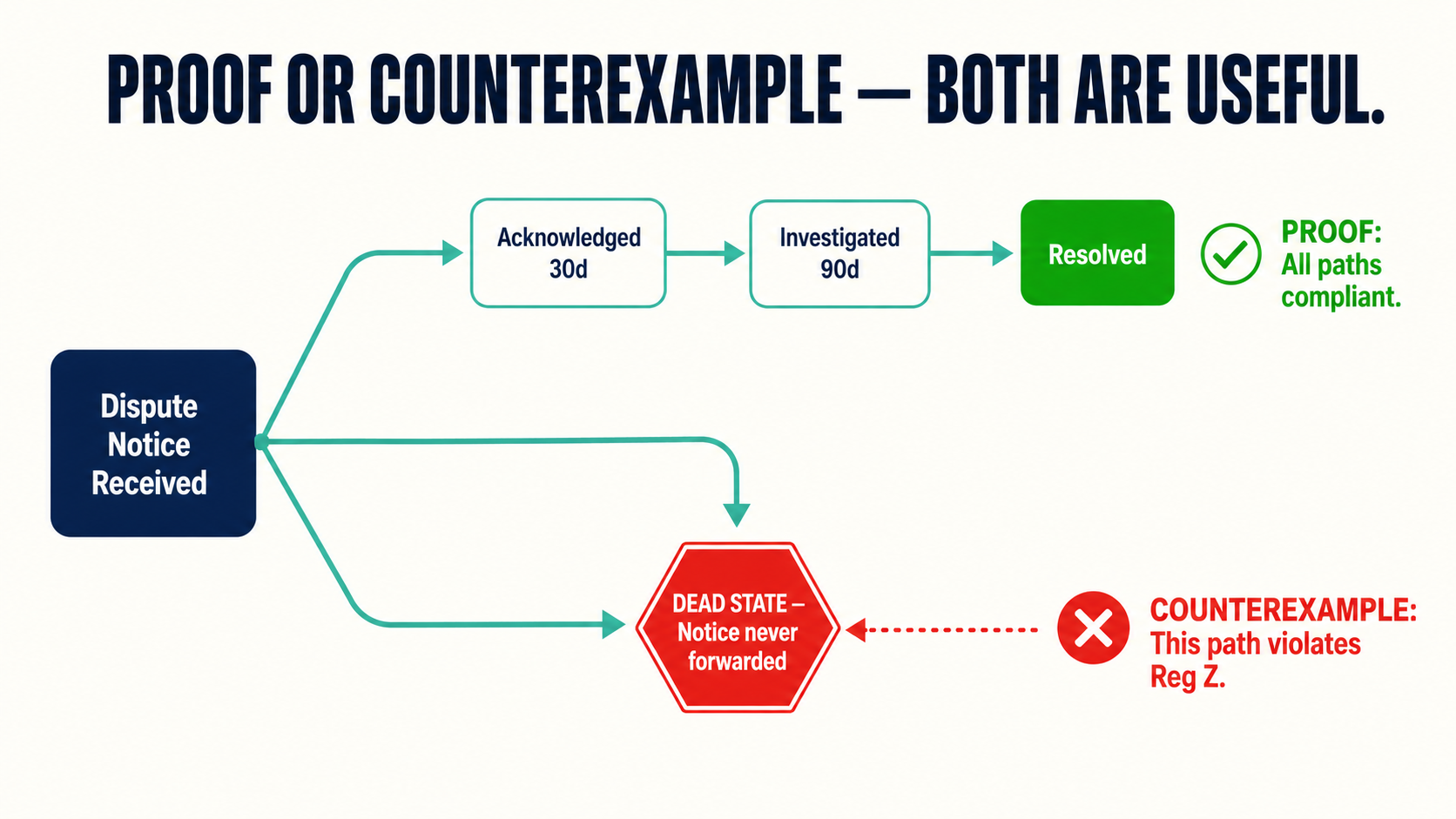
A formal verification system models the dispute workflow as a state machine — every possible submission timing, system state, routing outcome, and failure condition — then applies temporal logic to prove that the state machine satisfies the regulatory deadline constraints in all reachable states.
The output isn't a test result or a performance metric. It's either a mathematical proof that no execution path produces a compliance violation, or a counterexample: a specific sequence of events that leads to a deadline miss. Both outputs are useful. The proof is what you bring to an examiner. The counterexample is what you bring to the engineering team before deployment — the exact execution path that would have produced the Apple-Goldman failure, surfaced before the CFPB found it.
A counterexample isn't a failed test. It's the exact sequence through your workflow that an examiner's state machine reconstruction would find. You want to find it first.
Veriprajna's financial compliance formal verification system builds this for dispute workflows: model the state machine, specify the Reg Z and Reg E timing constraints as temporal properties, and generate either the proof or the counterexample that locates the routing gap before it becomes a consent order.
Why Regulators Are Now Requiring Provable Properties
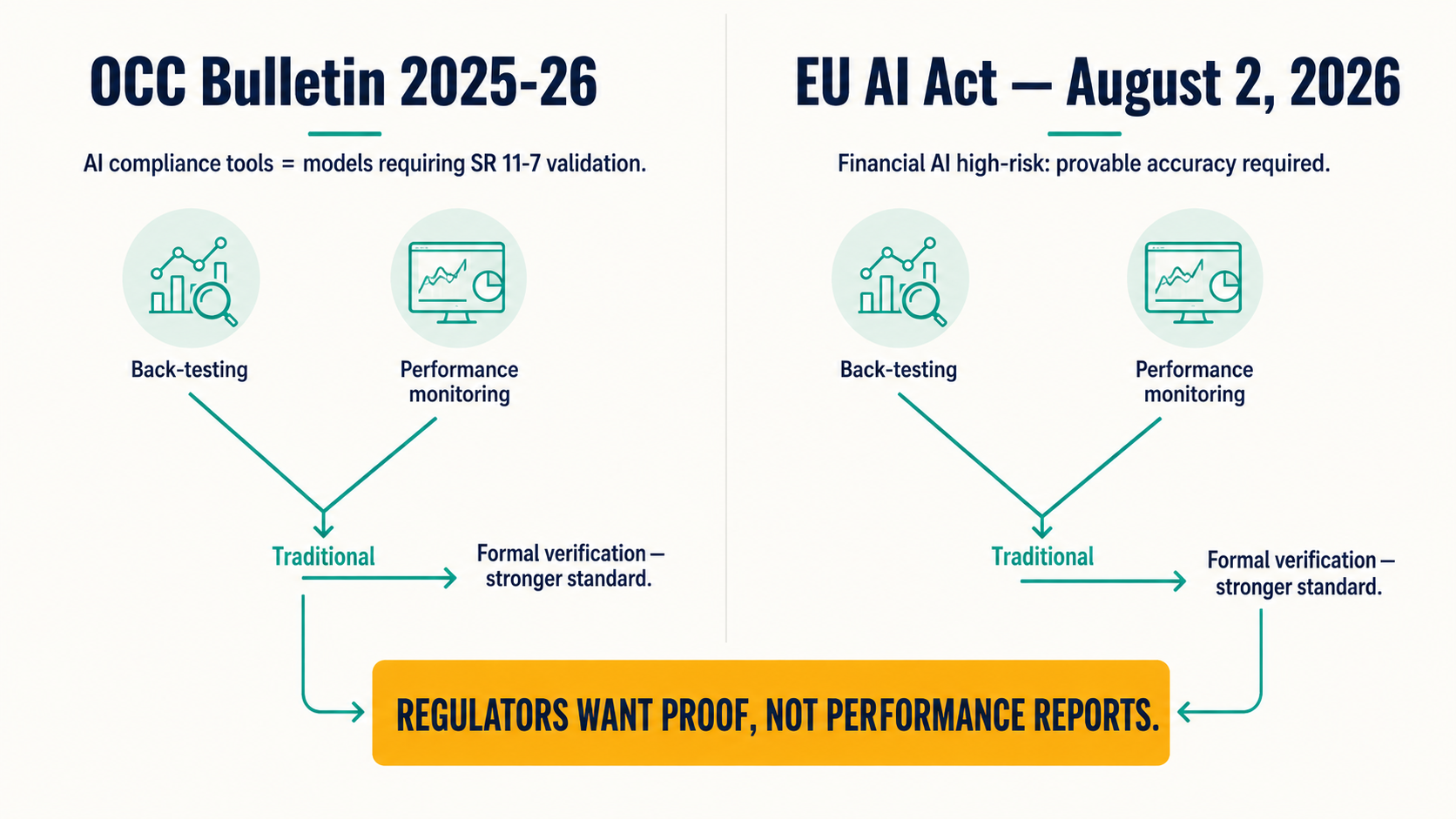
OCC Bulletin 2025-26 established that any quantitative method materially influencing compliance decisions — including automated dispute decisioning — constitutes a "model" subject to SR 11-7 model validation standards. Traditional SR 11-7 validation means back-testing and performance monitoring — statistical approaches that evaluate how a model performed on historical data. Formal verification is a stronger standard: it proves properties over the complete future state space, not over a historical sample.
The EU AI Act adds a hard deadline. AI systems in credit and payment services that influence creditworthiness determinations are classified as high-risk under Annex III, with an August 2, 2026 compliance deadline for banks operating in EU markets. High-risk AI systems require documented, provable accuracy and robustness properties. The strongest possible compliance evidence for that requirement is a formal proof — not a performance report, not a test-coverage summary.
Both frameworks are pointing in the same direction: regulators want banks to demonstrate that their compliance systems are architecturally incapable of producing certain failure modes, not merely that they haven't produced them in recent history.
The Change That Introduces the New Vulnerability
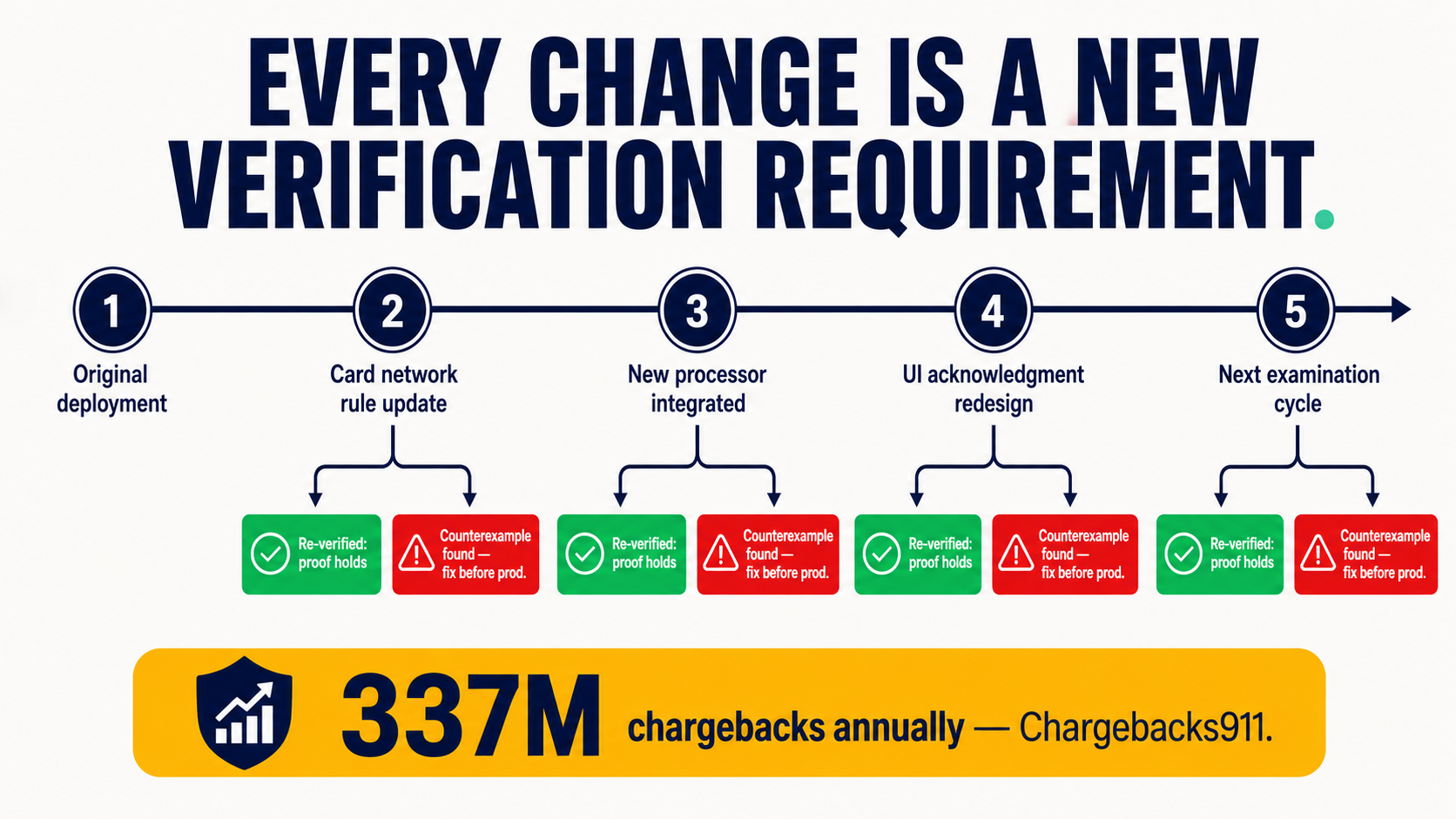
The compliance failure that draws examiner scrutiny often isn't the original system — it's the version deployed six months later after a card network updated its timeline requirements, a new payment processor was integrated, or a UI redesign changed when the dispute acknowledgment fires.
Standard regression testing doesn't catch compliance violations that surface only under specific multi-system failure sequences no one modeled. Each system change potentially modifies the state machine that governs deadline compliance. Re-verifying the modified workflow against the same temporal logic specifications is the only way to know whether the modification broke a regulatory constraint — if the proof holds, the change was safe; if it produces a new counterexample, the regression is caught before it reaches production.
With global chargeback volumes projected at 337 million annually by 2026 (Chargebacks911) and a 24% increase from 2025 to 2028 (BankInfoSecurity) — partly from new dispute types created by AI-agent-initiated transactions that existing processes don't handle — banks will be modifying dispute workflows at higher frequency than at any point in the last decade. Each modification is a new verification requirement.
What the $89 Million Distinction Actually Was
The Apple-Goldman consent order established a costly line: tested-and-compliant is not the same as architecturally-incapable-of-failing. CFPB examiners don't review test coverage reports; they reconstruct execution traces through production workflows searching for dead states. What they found at Goldman was a known architectural gap — a routing path a valid dispute notice could enter and never leave.
The stronger position, for boards, audit committees, and examiners alike, is a mathematical proof that no path through the architecture produces that outcome. If your institution is managing Reg Z or Reg E dispute deadlines through calendar flags, case management alerts, or staff training — and the underlying workflow hasn't been formally verified against those deadlines — the financial compliance verification work we're doing is worth a conversation.
What's the part of your dispute workflow that would most concern you if an examiner reconstructed the state machine?