A record label that dutifully tagged its entire AI catalog with C2PA is, operationally, uncovered the instant one of those tracks hits TikTok. The metadata is stripped on upload, and stripped metadata proves nothing. That is the trap sitting under the EU AI Act's Article 50, which takes effect on August 2, 2026 (EU AI Act): the industry reflex is "add C2PA," but C2PA is hard binding, and hard binding does not survive the transcode-to-social chain. The thing that survives is soft binding, an imperceptible watermark carrying a small UUID that re-resolves the manifest from a ledger after the metadata is gone. So the real question for AI audio is not which watermark you chose. It is whether provenance survives the wild, and provenance survival is the thing almost no one is measuring yet.
The failure the market is walking into
Three gaps compound here, and none of them is a modeling problem. The first is that C2PA hard binding is stripped by most social platforms on upload, which the WP31 solution source (Veriprajna, 2026) calls the single biggest operational weakness in the C2PA ecosystem today. The second is that DDEX ERN 4.3, the delivery standard the whole distribution chain runs on, has no AI-disclosure fields at all, and most aggregators (CD Baby, DistroKid, Believe) do not pass granular disclosure through even when a label supplies it (Veriprajna WP31 solution source, 2026). The third is scale: on Deezer roughly 28 percent of daily uploads are now fully AI-generated, with about 70 percent of the plays on AI-only tracks flagged as fraudulent, tied to an estimated 2 to 3 billion dollars a year in royalty fraud (Beatdapp/Beatport, cited in WP31 research, 2026).
Set that against Article 99, where penalties reach 15 million euros or 3 percent of global turnover (EU AI Act), and the incentive structure gets sharp. Under a deadline with numbers like those, the tempting failure mode for any automated compliance tool is to wave tracks through and stamp "compliant." A false pass is the expensive kind of wrong. We built Tessera (veriprajna.com/demos/ai-audio-licensing-provenance) to make the honest version concrete: one Article 50 ingest gate that runs a label's distribution batch (twelve synthetic releases here, procedural audio and fictitious names, no real music), proves on screen whether each track's provenance actually survived the channel it came in on, and refuses to certify when it did not.
What actually survives a transcode
Take the case the gate is built to show first. Neon Tide is an AI-dubbed release delivered through the social channel, the same mp3-128 transcode a track meets on the way to a platform. On the hard-binding side, the C2PA metadata is stripped, exactly as it would be in the wild. On the soft-binding side, a real spread-spectrum decoder (numpy FFT) recovers the embedded 32-bit asset key 0x51000abc at confidence 0.989 from the delivered waveform, and that key re-resolves the C2PA manifest stand-in from the SQLite ledger. The same file, side by side: metadata gone, UUID recovered.
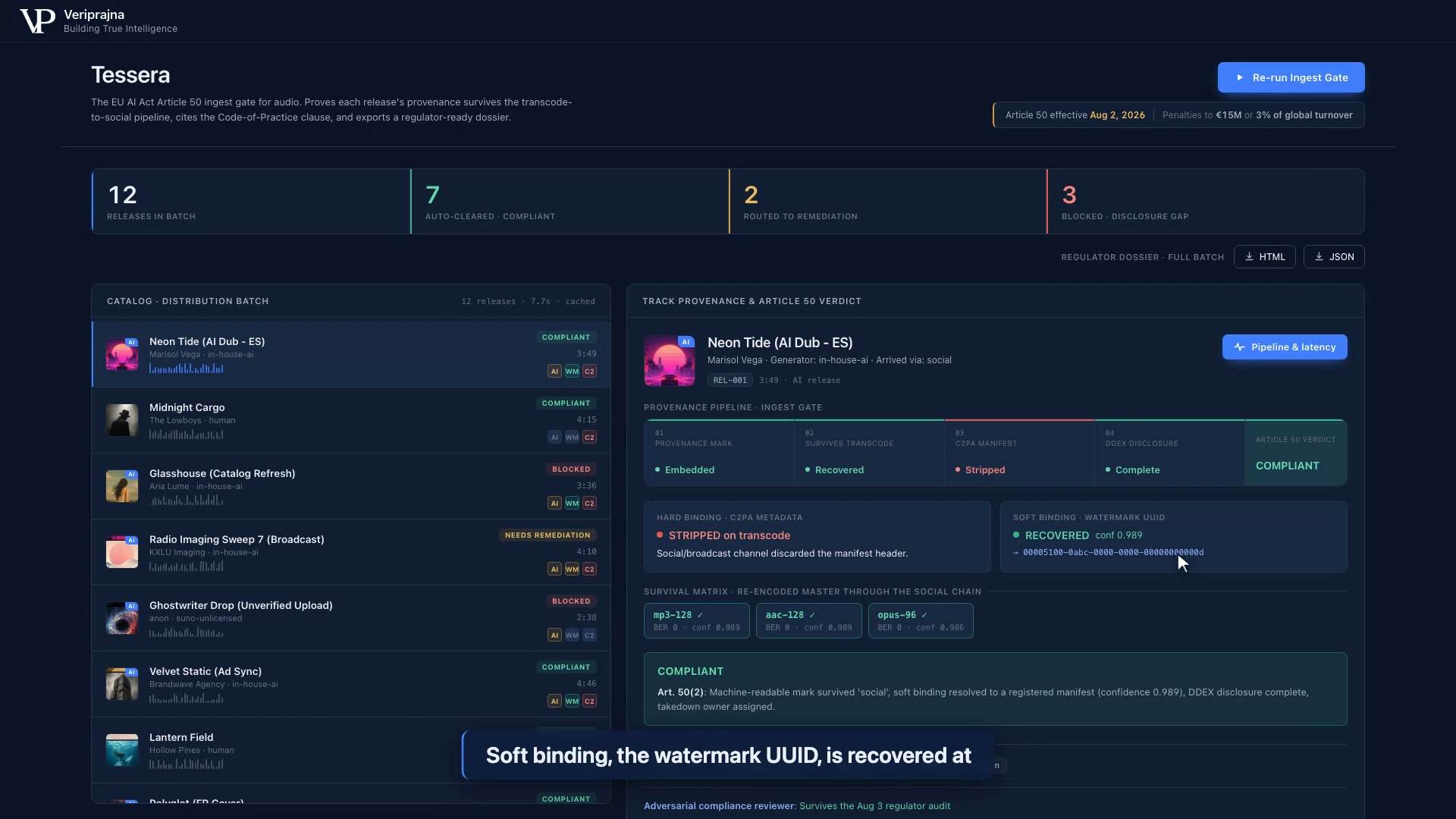 Neon Tide, delivered through the social channel. Hard binding (C2PA metadata) is STRIPPED on transcode; the soft-binding watermark UUID is RECOVERED at confidence 0.989 and re-resolves the manifest from the ledger. The Article 50 verdict is COMPLIANT under Art. 50(2).
Then the survival matrix re-encodes the watermarked master through mp3-128, aac-128, and opus-96 with real ffmpeg (the header reads ffmpeg (real codec transcode), not a simulator) and re-decodes the UUID each time. All three recover at a bit-error rate of 0.0. That is the whole argument for soft binding in one panel, and it is worth being precise about scope: this is our spread-spectrum mark on a fixed synthetic corpus of 12 releases through those three codecs, not an open-world guarantee and not a robustness benchmark against SynthID-Audio, AudioSeal, or Digimarc, which sit behind the detector as documented stub adapters. We do not claim to beat anyone's watermark. We measure whether the one carrying the UUID makes it through.
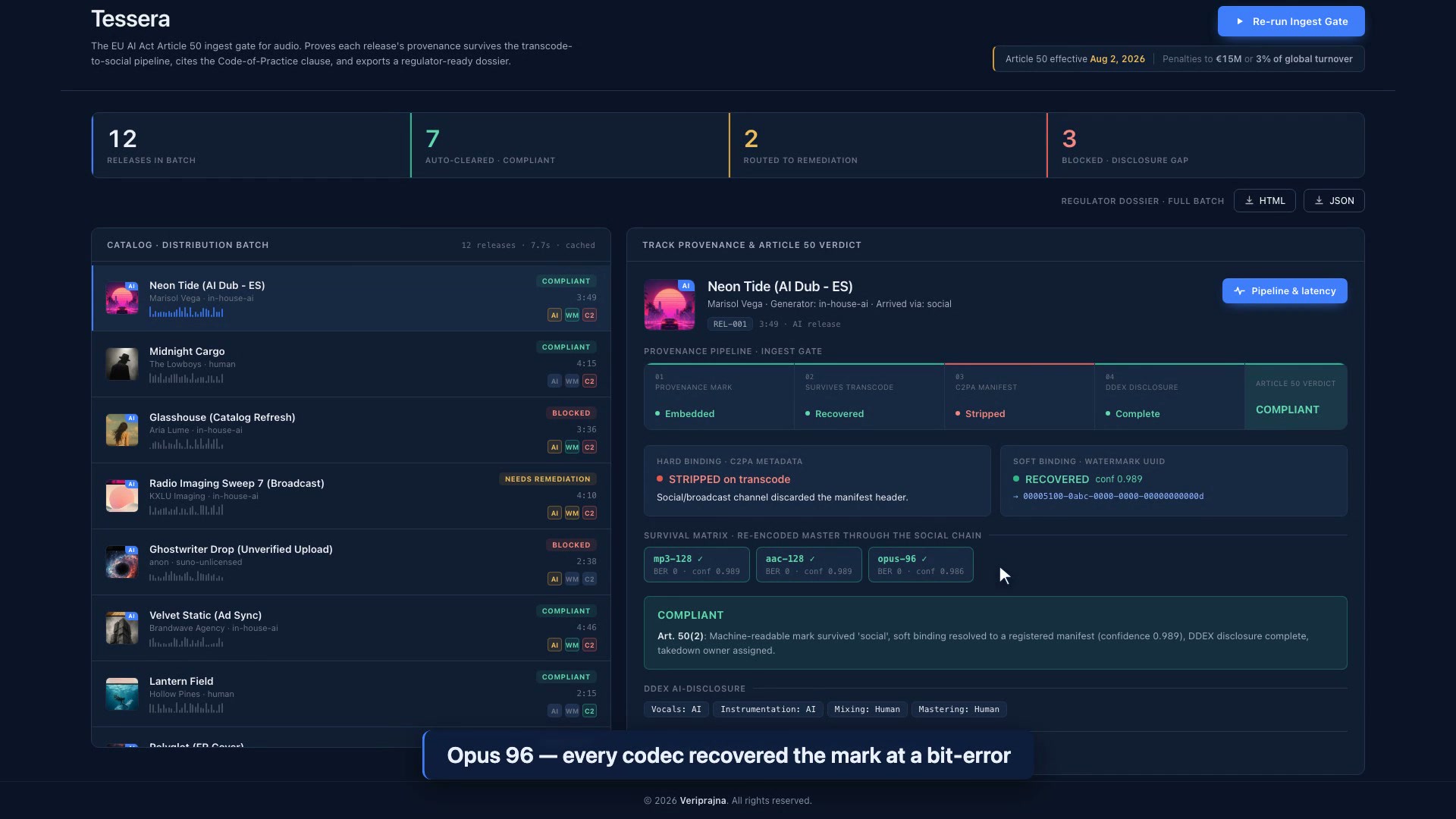 The survival matrix, re-encoded through the social chain with real ffmpeg. mp3-128, aac-128, and opus-96 each recover the UUID at BER 0 (confidence 0.989, 0.989, 0.986). Scope: our spread-spectrum mark on a fixed 12-release synthetic corpus.
Hard binding is stripped by the social transcode; the soft-binding UUID is recovered and the manifest re-resolved from the ledger. That is the single most important real-world fact about C2PA, which is why provenance has to be measured after the channel, not assumed at the point of tagging.
The gate reads the whole chain, and it abstains
Recovering a mark is necessary, not sufficient. Glasshouse recovers its watermark cleanly at confidence 0.992, so provenance is fine, and the gate still returns BLOCKED under Art. 50(4): the DDEX AI-disclosure is incomplete, missing instrumentation, mixing, and mastering because the aggregator never passed them through. A recovered mark on an undisclosed track is still an active Article 50 disclosure violation, and shipping it as-is is the failure the gate is there to catch. It checks the whole chain, mark plus soft-binding recovery plus DDEX disclosure plus a named takedown owner, and cites the exact clause per verdict.
The harder discipline shows up when the mark genuinely does not survive. Radio Imaging Sweep 7 arrived through the analog gap, a speaker-to-mic broadcast recapture, and the soft-binding key is not recoverable (confidence 0.699, CRC fails). The gate does not guess. It returns NEEDS PROOF, routes the track to human review, and writes "Do NOT certify." The honest nuance is on the same screen: the survival matrix, run on the clean master through the social codecs, shows the mark would survive a normal transcode at BER 0. It was the analog-gap delivery this track actually came through that broke it, and the gate refuses to let a hypothetical survival stand in for the real one.
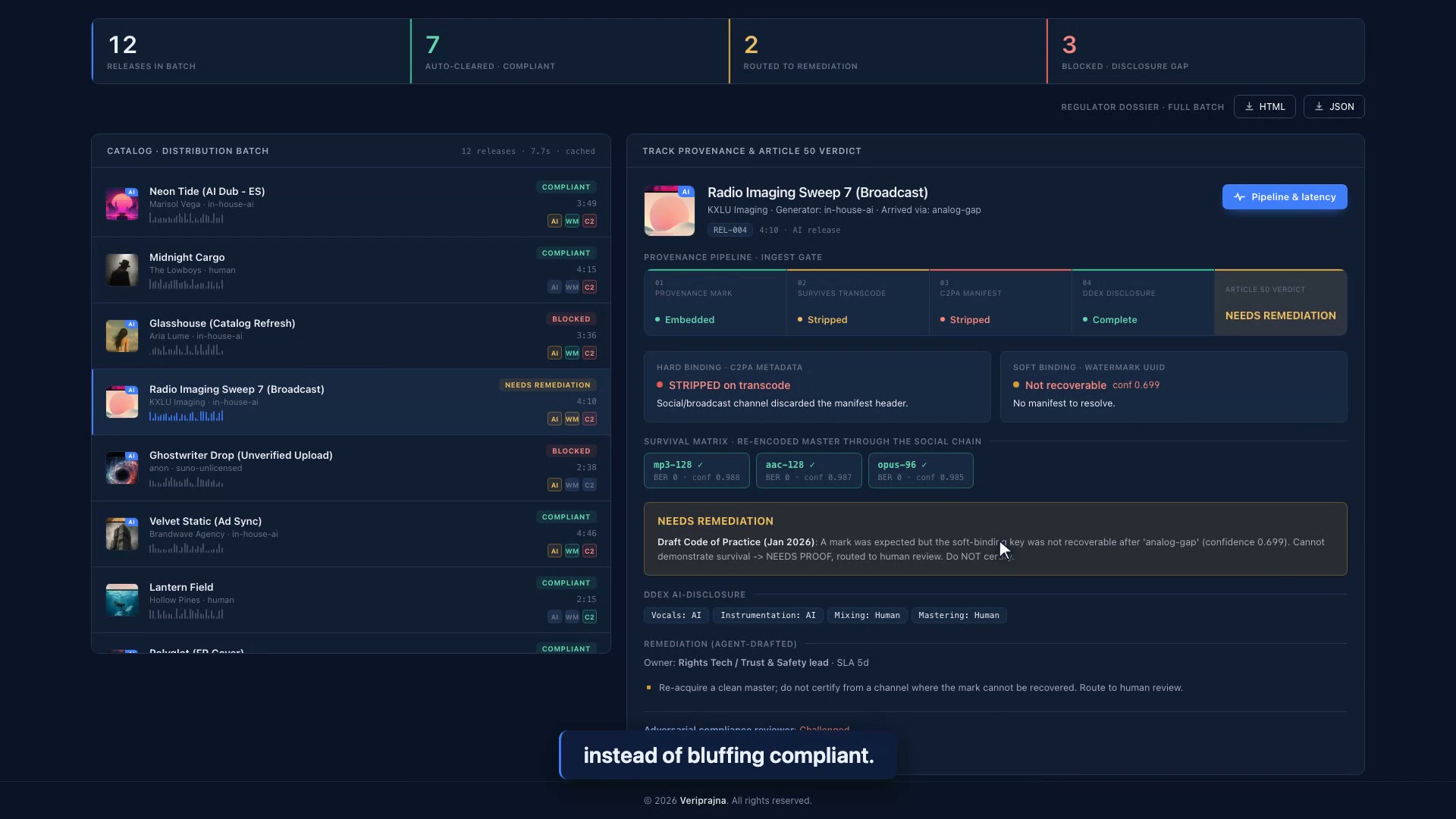 Radio Imaging Sweep 7 came in through the analog gap. The soft-binding key is not recoverable (confidence 0.699), so the gate abstains: NEEDS PROOF, routed to human review, not certified. The abstain is a unit-tested invariant, not a fallback.
Why this holds as the watermarking models get better
The tempting read is that this is a watermarking story, so a stronger algorithm settles it. It does not. Google and Meta own the algorithm layer, and we are happy to integrate their work rather than compete with it; SynthID-Audio is Google-closed and AudioSeal needs a GPU, which is exactly why both live behind a swap-for-SDK interface here. Swap in a better detector tomorrow and everything around it still has to run: the multi-standard detection, the soft-binding resolution against the ledger, the survival measurement, the DDEX middleware that fills the disclosure gap the standard leaves open, the deterministic Article 50 gate, and the regulator-ready dossier. None of that ages out as models improve.
It matters that the trust core is deterministic and stays out of the model's hands. Watermark recovery, survival measurement, the soft-binding lookup, and the Article 50 pass or fail are plain code, and the whole demo runs keyless through a deterministic fallback, so the survival and gate numbers are identical with or without an LLM. The optional Pydantic AI agents extract disclosure, draft remediation, and adversarially attack each certification ("would this survive the Aug 3 regulator audit?"), and anything the reviewer cannot tie to stored evidence forces a downgrade to human review. Agents advise; the code decides. Across the 12-release batch that produces 7 COMPLIANT, 2 routed to remediation, and 3 BLOCKED, a 58 percent auto-clear on a fixed synthetic corpus, with a dossier that covers all 12 with a cited-clause verdict and 7 unit tests green.
As watermarking models get better, the value does not move to the algorithm. It stays in the integration layer that makes provenance survive the real world, and in the discipline to abstain when it does not.
These are durable metrics: provenance survival, governance throughput, dossier coverage, honesty invariants. They do not measure a model's error rate, so a better model does not retire them. That is the moat we think the deadline actually rewards, and it is the opposite of a watermark you hope is robust enough.
We built Tessera (veriprajna.com/demos/ai-audio-licensing-provenance) as a working proof of that layer on a fixed synthetic corpus, not a deployment, and the C2PA manifests are JSON stand-ins in a ledger rather than cryptographically signed 2.0 manifests, which is a deliberate next step. The sharper questions belong to the teams staring down August 2. Here is the one we keep putting to our own design, and it is a fair one to put to your stack: after one of your AI tracks has been through a social transcode and the C2PA header is gone, does anything actually re-recover the manifest from what survived the upload, or are you still trusting metadata that the encode already discarded? We would genuinely like to hear how rights and trust teams are planning to answer that, because the deadline is industry-wide and the answers will be too.