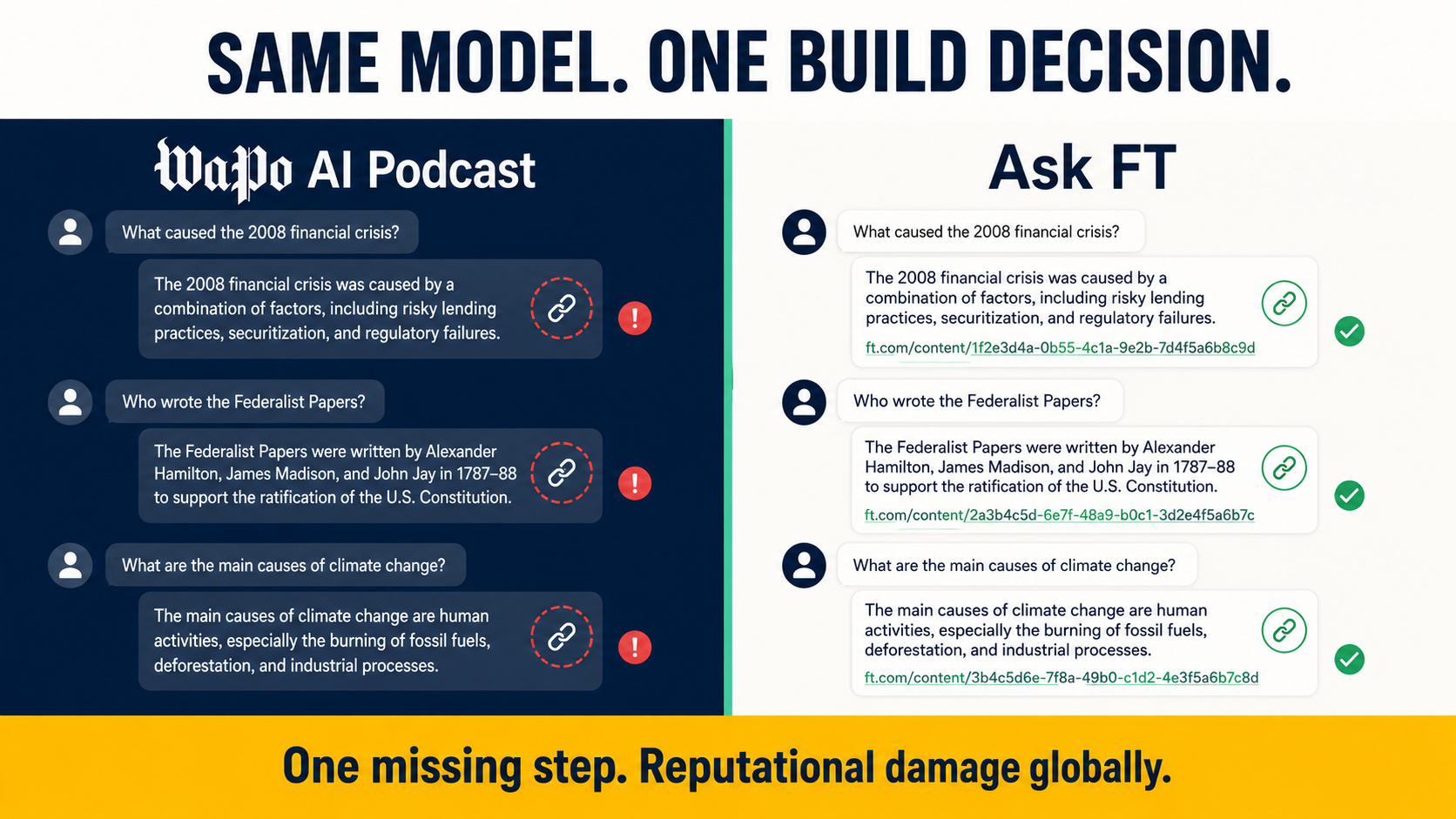
The Washington Post's AI-generated podcast invented quotes, misattributed sources, and inserted editorial commentary as if it were the paper's own journalism. A Semafor report in December 2025 published leaked Slack messages from the standards editor: "It is truly astonishing that this was allowed to go forward at all." None of that was the model's fault. The failure was upstream — a missing citation-enforcement layer between the LLM and the output. The FT launched Ask FT on Anthropic Claude without that problem, because they wired the citation layer in as a non-negotiable architectural constraint. That engineering decision, not a content policy difference, not a more cautious AI posture, is what separates a publisher AI build that strengthens institutional credibility from one that damages it globally.
For mid-tier publishers watching search traffic fall in real time, the lesson from those two diverging outcomes matters more than the build-or-don't-build debate.
The Traffic Cliff Is Structural, Not Algorithmic
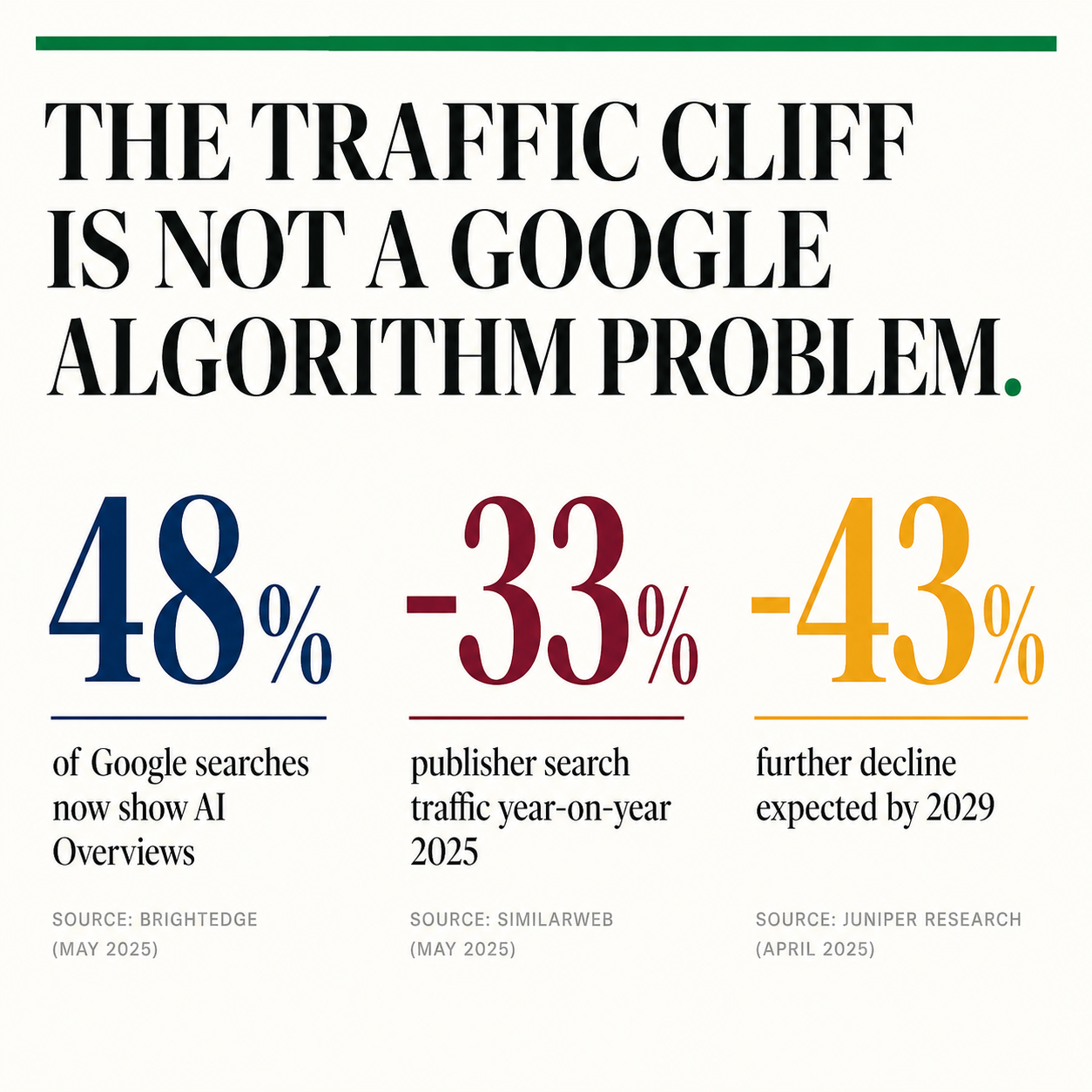
AI Overviews now appear on 48% of Google queries (theStacc, March 2026), and when one surfaces above an organic link, click-through collapses — the Daily Mail measured an 89% drop on desktop. Globally, publisher search traffic fell roughly 33% year-over-year through November 2025; Reuters Institute's 2026 Journalism Trends survey found news executives projecting a further 43% decline by 2029, with a fifth anticipating losses above 75%.
Penske Media quantified their version in the antitrust filing against Google in September 2025: affiliate revenue down more than 33% from peak, programmatic CPMs dropping alongside it, AI Overviews appearing above roughly 20% of results that previously drove organic traffic. Their legal argument is that Google unilaterally rewrote the unwritten deal that underpinned publisher distribution for two decades.
In the year Penske Media's antitrust filing landed, their affiliate revenue was already down 33% from peak. The crawl-for-traffic deal didn't end when the lawsuit was filed. It ended before anyone noticed.
The most important thing to understand about this crisis is that no single response is sufficient. Publishers who respond only with legal action, or only with crawler blocks, or only with their own conversational products are treating a four-lever revenue problem as a single-lever problem. Penske's antitrust complaint (Google's motion to dismiss, January 2026; PMC's opposition, February 2026) won't change the traffic math for years. Cloudflare's Pay Per Crawl, launched January 2026 across roughly 20% of global web traffic, captures crawl revenue that previously went unmonetized — but it doesn't stop AI Overviews from surfacing content at query time. Both levers matter. Neither alone is the strategy.
What 'Build Your Own Archive AI' Actually Requires
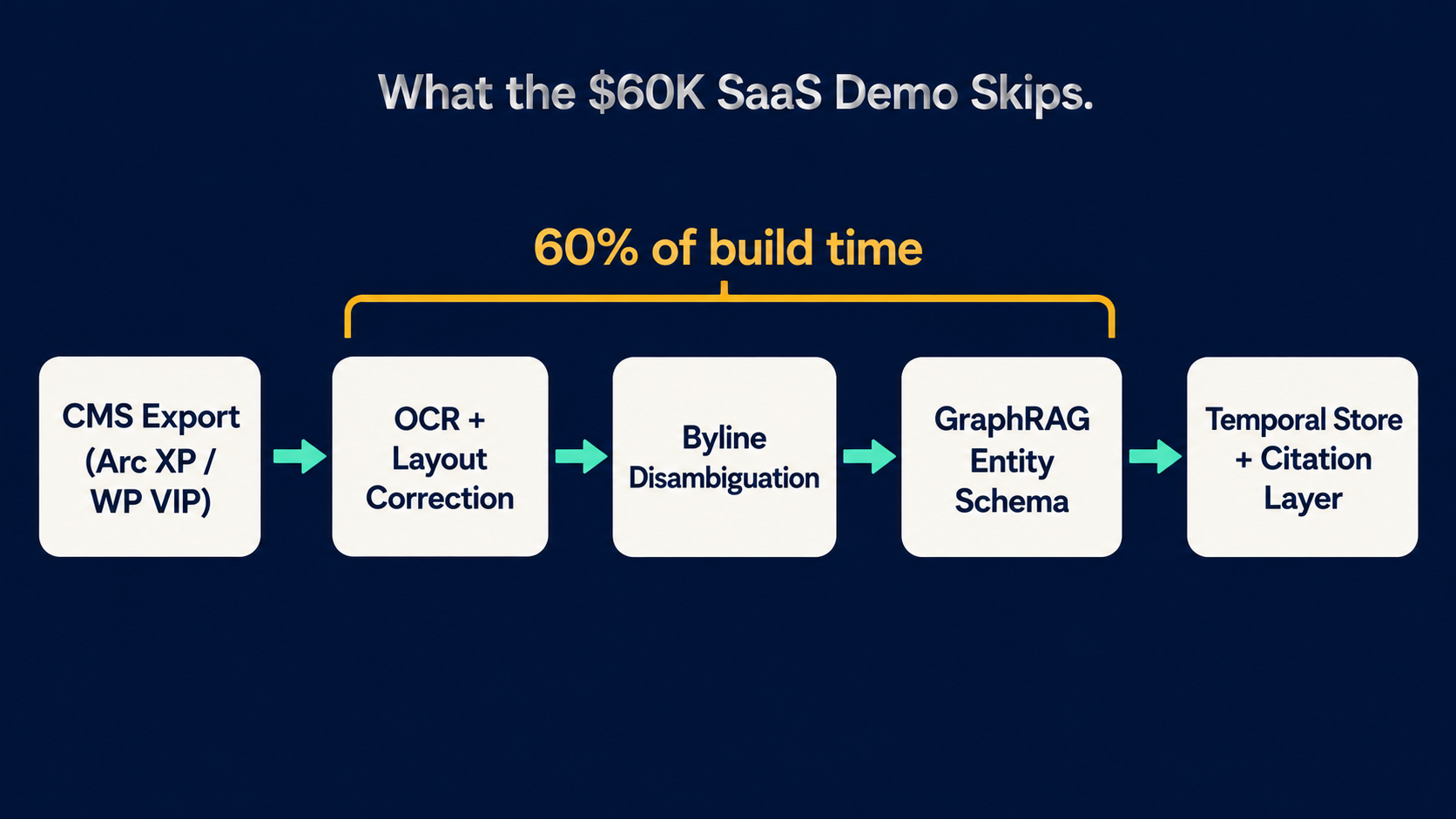
The SaaS chatbot vendor demo is straightforward: vector embeddings over a CMS export, an LLM, a chat widget. Deployed in weeks at $60K–$120K. That covers the UI layer.
What it leaves out is the work that determines whether the system handles the queries subscribers actually ask. A 30-year news archive typically contains broken HTML, XSLT artifacts, and pre-digital content digitized from microfilm layouts — where layout-aware OCR is essential because running Tesseract without column detection produces artifacts that bleed caption text into body copy and split multi-column headlines. Byline disambiguation is the other invisible 30%: variant spellings of the same journalist's name across multiple CMSes and acquisitions, the "Alderman Johnson" / "John Johnson" / "the longtime Northwest Side alderman" variants that all refer to one person but which a vector database cannot collapse to a single entity without a dedicated resolution pass.
CMS integration brings its own constraints, and they're not uniform. Arc XP exposes a Content API with canonical_url, publish_date, and authors[] fields — but no native embedding hook. A production RAG system requires a sidecar ingestion pipeline reconciling Arc's publication timestamps with entity-graph edge metadata, with updates triggered by the Composer webhook on article publish. WordPress VIP needs a different bolt-on pattern. Atypon, used by scholarly publishers, sits alongside Literatum search. Brightspot is more flexible but still requires custom ingestion work. None of these integration patterns looks the same, and the one that runs correctly is the one someone has shipped before.
This is what consumes 60% of a real build. It's not in the SaaS pricing. It's not in the Accenture discovery phase until you're deep into a $1.5M–$5M engagement. And it's the difference between a system that correctly handles a ten-year longitudinal query and one that confabulates from semantically similar chunks.
Why Vector Search Fails on News Archives
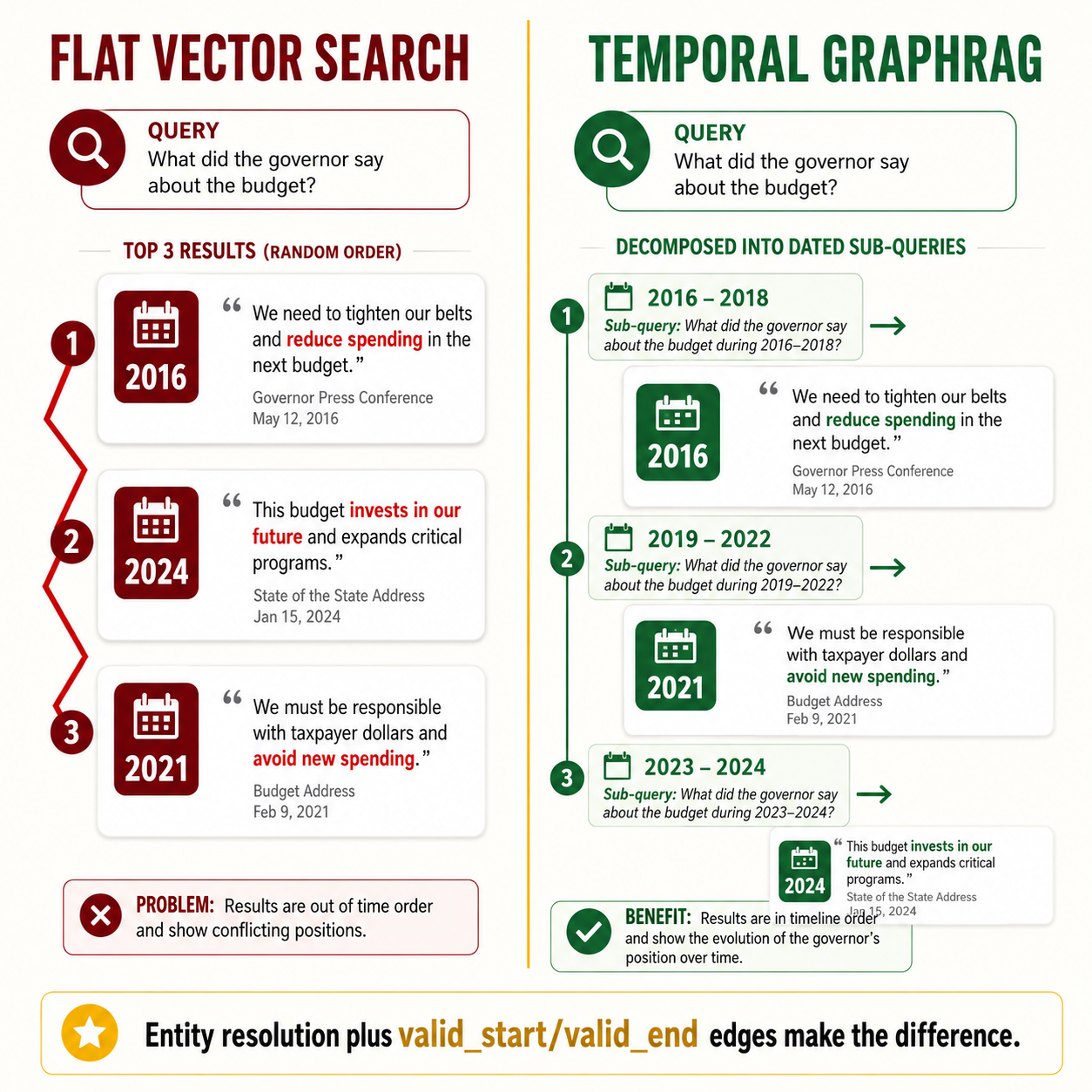
Ask a standard RAG what a city official said about a budget in 2019, and it retrieves the most semantically relevant articles — without knowing whether the official changed position in 2021, corrected the record in 2023, or resigned in the interim. Vector search retrieves by similarity, not by time. For most enterprise knowledge bases, that's acceptable. For a news archive where positions evolve and corrections get published years later, it isn't.
A well-built publisher RAG uses a temporal graph — Microsoft's open-source GraphRAG toolkit or Neo4j's GraphRAG Python package — with valid_start and valid_end metadata on entity relationships. The system decomposes a query like "how has coverage of this issue changed over ten years?" into date-bounded sub-queries, retrieves across the temporal graph, and surfaces the evolution rather than the most semantically proximate chunk. That capability is what shifts subscriber engagement from novelty to retention: the query a subscriber can ask that they couldn't Google brings them back.
The off-the-shelf GraphRAG implementation doesn't know a publication's local political beat. Entity resolution for a news archive is custom work against the specific archive — and it's what makes the temporal queries that justify the build actually work.
Neither Microsoft GraphRAG nor Neo4j ships pre-configured for a specific publication's decades of local and regional coverage. Building the entity schema, defining the relationship types, and running the disambiguation pass against the specific archive is the build. It's also what an editorial review queue depends on: the queue flags low-confidence answers before they surface to subscribers, and the confidence signals it acts on come from accurate entity resolution and temporal grounding. That review queue — not the model, not the UI — is the citation-enforcement layer the Washington Post skipped.
Our work building these systems at Veriprajna consistently shows the same pattern: the archive ingestion and entity resolution work is unglamorous, takes longer than the client expects, and is what determines whether the system works on the queries that matter.
The Licensing Play Is Additive, Not Alternative
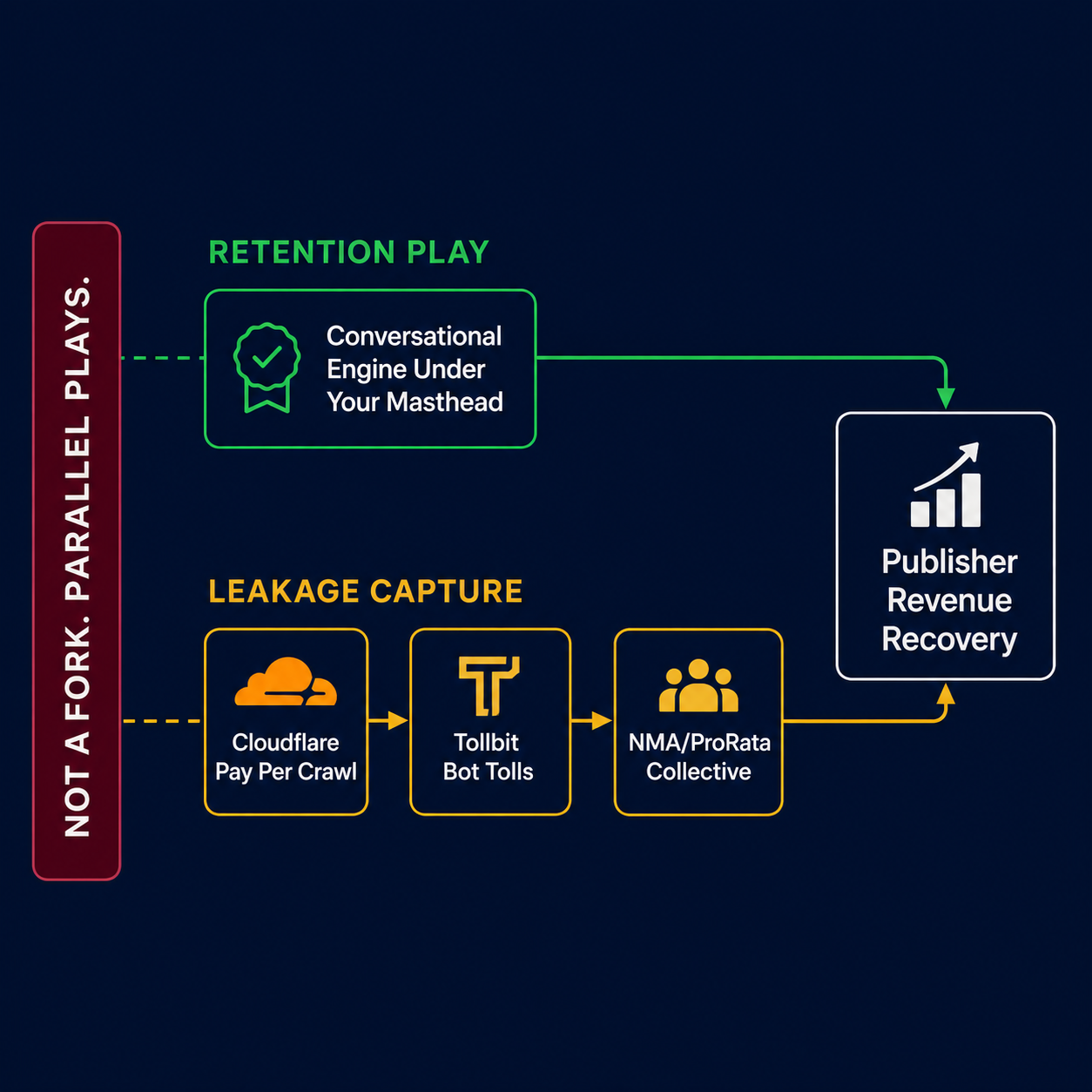
A publisher's conversational engine is a retention play — it creates subscriber value from the archive. The collective licensing infrastructure is a leakage-capture play — it captures revenue from AI engines the publisher doesn't control. Both plays run simultaneously.
The News/Media Alliance and ProRata launched a collective licensing pool in March 2026, covering 2,200 smaller and mid-tier publishers with a 50/50 attribution-tracked revenue share on AI answers via Gist.ai. The parallel Bria deal covers enterprise RAG and internal AI use. Boston Globe, Future, and Vox Media are among early participants. Tollbit and Cloudflare Pay Per Crawl sit at the infrastructure level — bot-by-bot configurable crawl tolls and per-request pricing headers that capture crawler revenue before it disappears into a training dataset.
The scale gap is real. News Corp's deal with OpenAI at roughly $250M over five years and the Reach / Amazon Nova usage-based arrangement are enterprise negotiations that mid-tier publishers cannot replicate in the near term. But running Cloudflare Pay Per Crawl, enrolling in NMA/ProRata, configuring Tollbit, and building a conversational engine under the publisher's own domain are all executable at mid-tier cost, in parallel, before the price discovery period for AI attribution closes.
The Gap the Mid-Tier Publisher Lives In
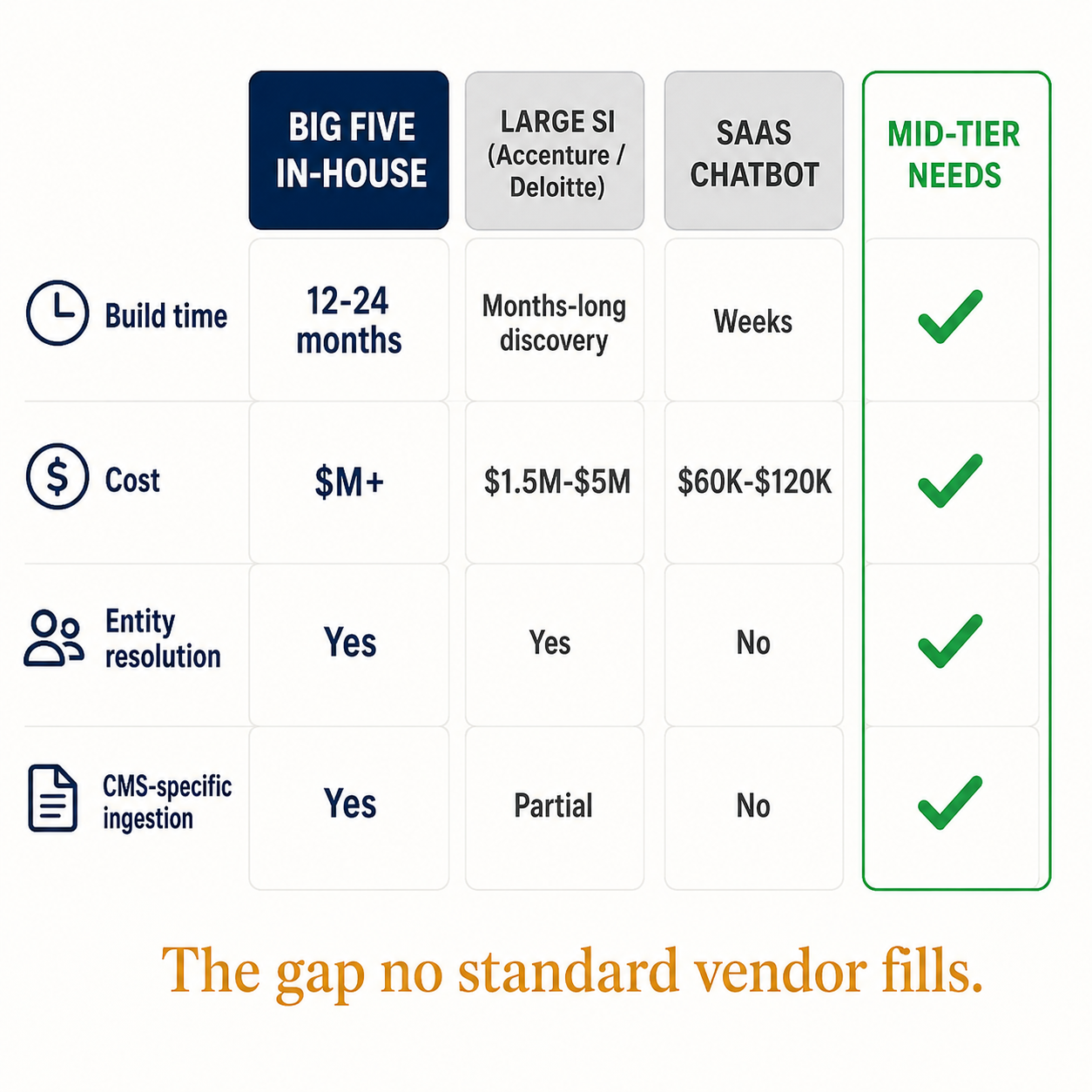
The major publishers — FT, Bloomberg, the New York Times, the Guardian — built their conversational AI in-house with 6–20 engineer ML teams over 12–24 months at seven-figure cost. Ask FT runs on Anthropic Claude with mandatory citations linking to source articles. Bloomberg has BloombergGPT and natural-language BQL translation built for terminal users. Those systems work because the institutions had the headcount and the runway to build them.
The large SIs (Accenture, Deloitte, IBM iX) will build a custom archive RAG for a mid-tier publisher. They reach for the same Microsoft GraphRAG and Neo4j stack. They charge $1.5M–$5M+ with a discovery phase that outlasts most mid-tier project budgets for the engagement.
What that leaves — the regional daily with a 32-year archive, the trade publication with 20 years of industry coverage, the B2B specialty media company with 100K to 5M monthly uniques — is a publisher who needs the archive ingestion, entity resolution, citation enforcement, and CMS integration work done by a build partner who has done it before, without the enterprise price tag and without putting the archive in a vendor's cloud.
That's the project we run at Veriprajna.
What the Next Twelve Months Will Tell Us
The NMA/ProRata revenue numbers will either validate or deflate the collective licensing model. Per-query attribution pricing is still early — rates set today will look different once there's volume data across 2,200 publishers and the price discovery period matures.
Google's motion to dismiss in the Penske antitrust case is in the courts. The outcome won't change the traffic math for publishers today, but a ruling on the merits changes the negotiating floor for any mid-tier publisher in a direct licensing conversation with a major AI lab. That's the case to watch.
Cloudflare's Pay Per Crawl becoming a default infrastructure posture depends partly on whether their 20% web traffic share makes not pricing AI crawls look like unmonetized inventory. That plumbing decision may already be made for a meaningful portion of the web; the adoption curve is what's left.
The thing that isn't uncertain: a publisher build that ships without citation enforcement is a brand risk before it's a product risk. What happened at the Washington Post wasn't a content moderation failure. It was an engineering gap that a well-scoped build closes before launch — which is also why the FT, for all the differences in scale, didn't have the same problem. Publishers working through which architecture decisions sequence in which order, and how to run the retention play alongside the licensing plays, are working through the right questions. Those are worth comparing notes on across the industry.