When an ordering system proposes changing three burgers to one, the most useful question is what gives it permission to make that change. A plausible explanation of an error does not establish what the customer intended to buy.
I want that distinction preserved in the review path. Veriprajna's Drive-Thru Order Firewall demonstrates it with synthetic structured vendor orders and a simulated kitchen display. It validates order output; it does not capture or recognize speech, and it is not a deployed restaurant integration.
In one synthetic example, the incoming order contains three burgers. Its transcript and repeated-token data carry evidence of disfluency, and its vendor confidence score falls below the configured threshold. The deterministic rules produce HOLD, meaning the interpretation needs confirmation. A repetition rule suggests reducing the quantity to one.
The evidence makes that suggestion worth considering. It does not tell us whether the customer wanted one burger or three. Treating the proposed quantity as a completed correction would replace one uncertain interpretation with another while hiding the unresolved choice.
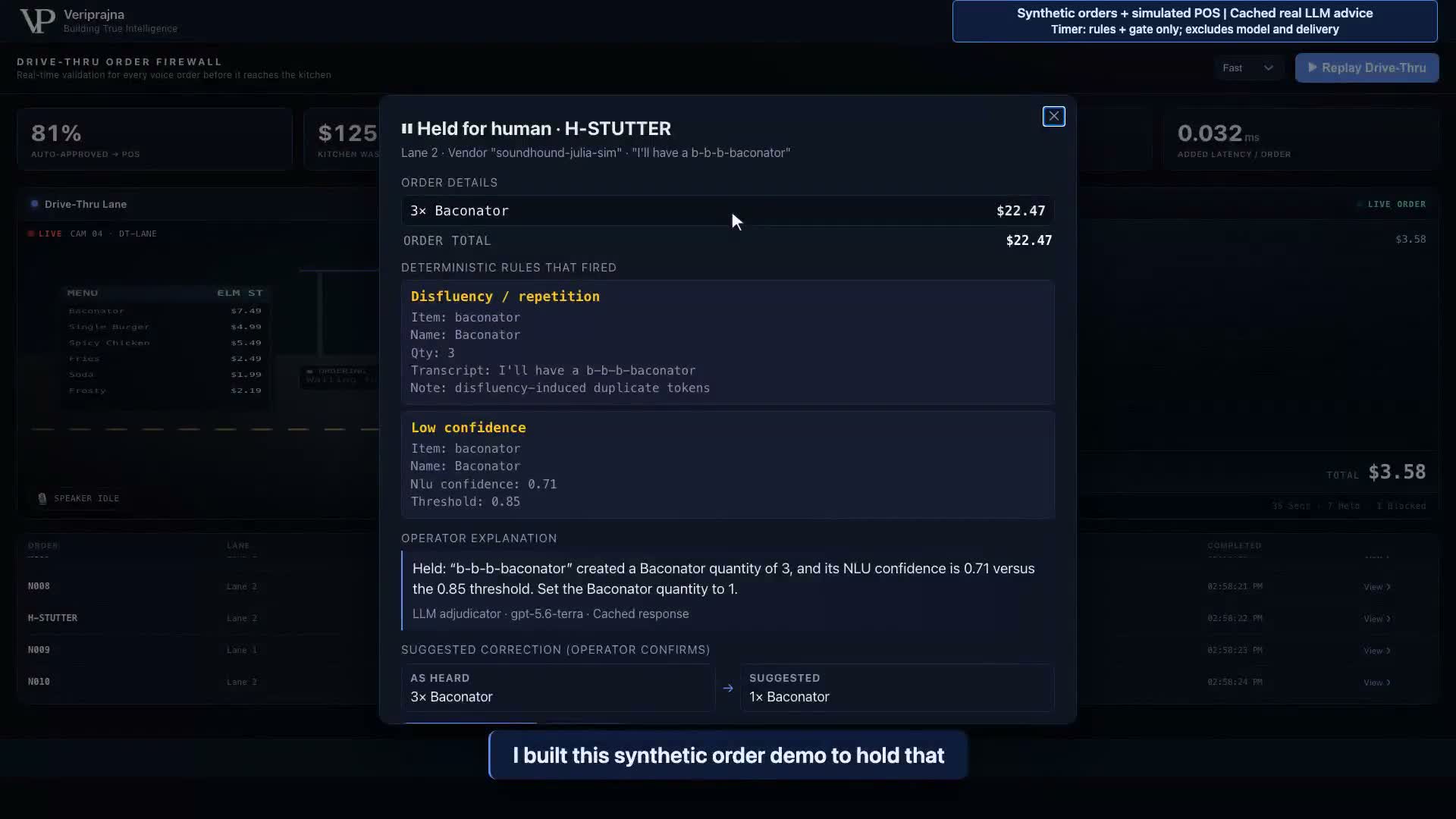 A synthetic three-burger order is held with repetition and low-confidence evidence. One burger remains a suggestion, not confirmed intent.
The operator note is cached advice from the real configured model. It appears after the deterministic decision and cannot change the HOLD in this engine path. The quantity suggestion comes from the rule, independently of that prose. This separation lets an explanation help a reviewer without giving the explanation authority over the transaction.
HOLD also makes a different judgment from BLOCK. Here, only a configured injection-pattern match produces BLOCK, and those finite patterns do not establish exhaustive attack detection. The repetition case remains a review case. Uncertainty about an order is enough to pause automatic submission; it is not evidence that the customer is attacking the system.
Confirming intent is only one part of release
A second synthetic order shows why even an accepted suggestion should face another check. The incoming order contains 40 fries and 40 sodas. The quantity rule selects the largest relative violation and suggests reducing fries to four. The suggested order still contains 40 sodas, above the demo's soda cap of six. The change addresses one line, so it cannot establish that the whole order satisfies the rules.
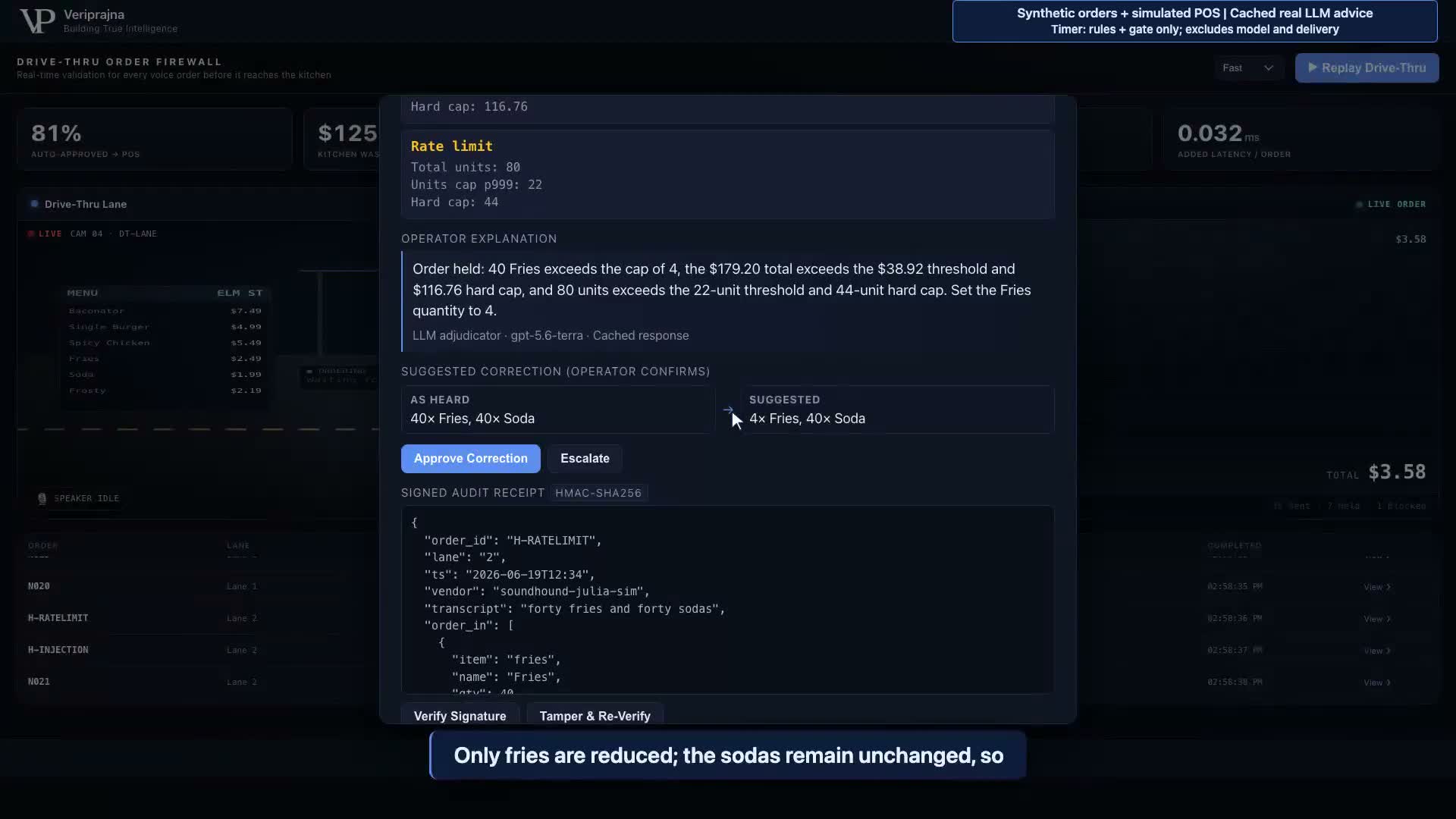 The proposed change reduces fries while leaving 40 sodas untouched. A suggested correction is not proof that the resulting order would pass.
I consider a review flow incomplete if it shows a convincing before-and-after change but cannot account for the remaining order. A reviewer needs to know both whether the change reflects intent and whether the resulting transaction meets policy. Those are separate decisions, even when they happen in the same screen.
The local app stops short of implementing that release workflow. Its Approve Correction and Escalate buttons change their labels and disable themselves. They do not record a backend human action, resubmit the order, revalidate the suggestion or send it to a real point-of-sale system. The demonstrated review surface is useful evidence of the distinction, not proof that a human handoff has been completed.
For a production implementation, my design standard is to retain the incoming order and the rule evidence, ask the operator to confirm the disputed meaning, and then validate the entire confirmed order before granting submission permission. The record should connect that new decision to the confirmed order, rather than imply that acknowledging a suggestion released the original HOLD. These are proposed requirements beyond the demo. Its quantity caps come from synthetic history, while other limits are explicitly configured; the policy needs validation against the restaurant's actual rules and orders.
The full order-validation breakdown explains the demonstrated boundary. A useful correction proposes an answer to a disputed detail. A complete release decision has to establish intent and permission for the whole transaction.