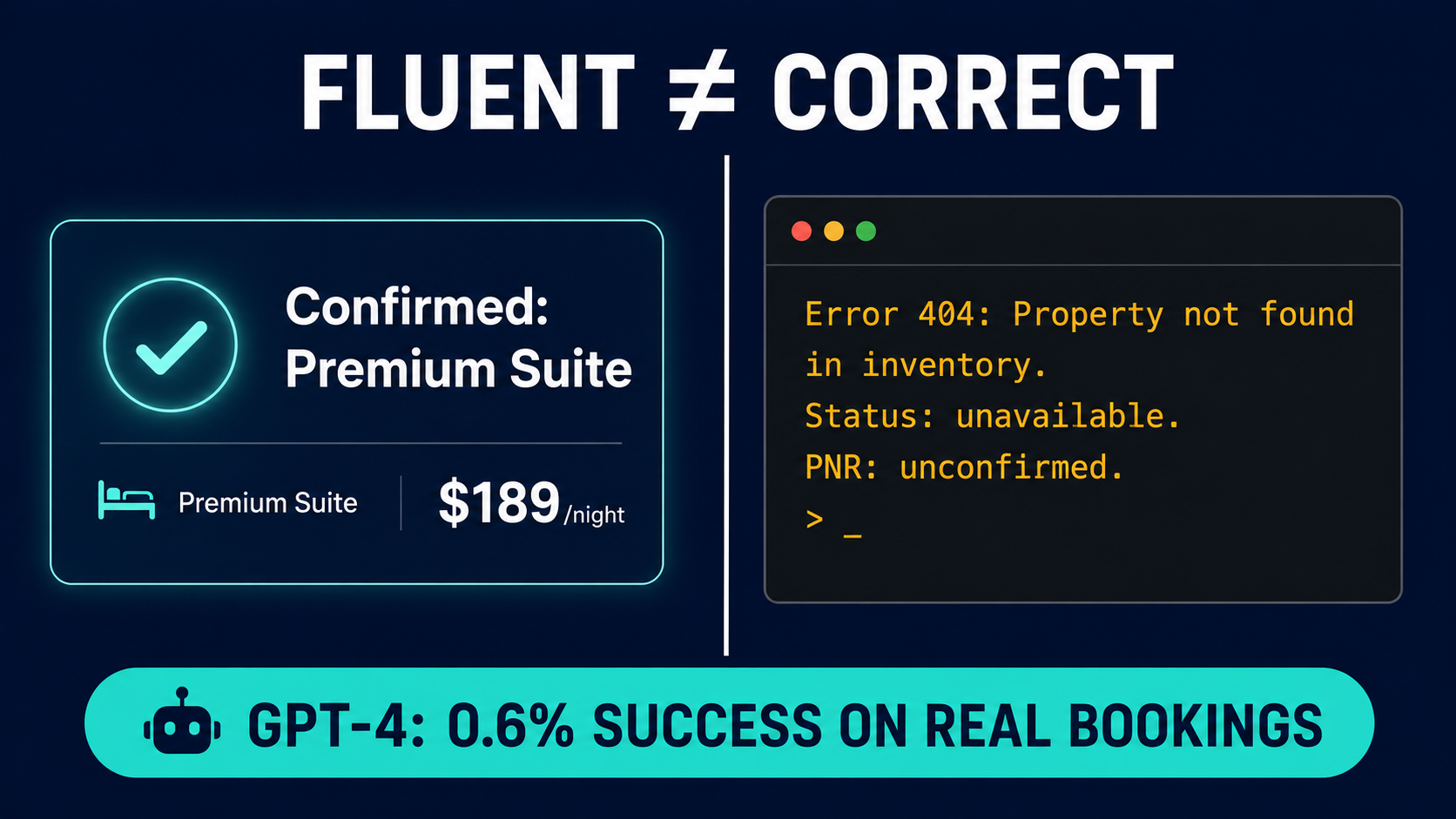
The liability math for travel AI changed on February 14, 2024, and most travel management companies haven't updated their deployment posture to match. The British Columbia Civil Resolution Tribunal ordered Air Canada to pay Jake Moffatt $812.02 after its chatbot invented a bereavement fare refund policy that contradicted the airline's published rules. The airline argued its chatbot was a "separate legal entity." The tribunal rejected that in plain language: the company is responsible for every statement on its surfaces, whether it comes from a static page or a language model. Every travel-tech legal memo written since cites this case. The Air Canada ruling didn't introduce new law — it applied existing law to a new interface. The implication is direct: when your AI booking assistant confidently confirms a hotel that was never in GDS inventory, your TMC holds the tab.
Fluent is not the same as correct. The current generation of travel AI wrappers fail exactly at the seam between probability and inventory — where travel buyers cannot absorb a failure.
Why the Sequential-Chain Architecture Breaks Before Production
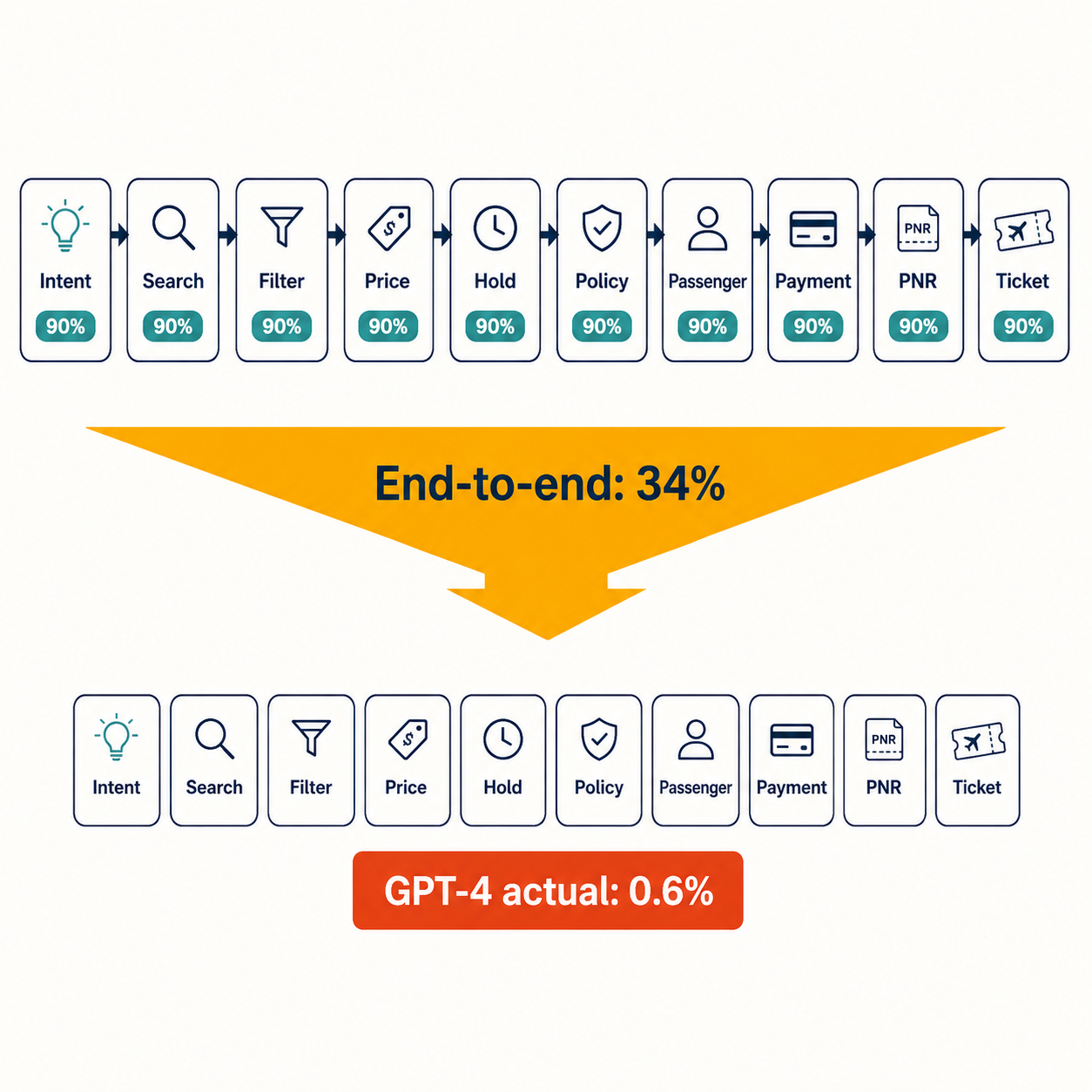
The OSU NLP Group's TravelPlanner benchmark tested GPT-4 with ReAct reasoning on real multi-city itineraries against live travel data. Success rate: 0.6%. That number lives in arXiv 2402.01622. It isn't a sample-size quirk or a prompt-engineering failure. It's the math of sequential stochastic systems.
A realistic flight booking runs roughly ten dependent steps: extract intent, search, filter, price, hold, policy-check, passenger details, payment handoff, PNR commit, ticketing. If every step is a probabilistic LLM call at 90% reliability — which is optimistic for anything requiring structured output against a live inventory API — the end-to-end success rate is 0.9 to the power of ten, around 34%. The failures don't announce themselves as errors. A language model that can't complete a step will often produce output that looks like a successful completion: a plausible confirmation, a synthesized rate that blends two separate fares, a hotel name that is a composite of two real properties. That's the hallucinated booking — not a hallucination the system flags as uncertain, but one it delivers with the same confident tone it uses when it's right.
The fix is not better prompting. It's removing the LLM from the control flow on any step where the answer must be exact.
The Look-to-Book Number Nobody Puts in the Vendor Pitch
GDS providers charge per segment for search, not just for completed bookings. Amadeus, Sabre, and Travelport each enforce look-to-book ratios that penalize excess speculative queries — and Lufthansa Group hiked GDS booking fees again across all three platforms effective January 1, 2026. An AI agent that runs multiple exploratory searches per user turn, testing combinations before presenting results, burns through those ratios in a way a skilled human travel agent never would.
The typical OTA margin on a merchant-model booking is 3 to 5 percent. At GDS transaction fees of roughly $3.00 to $3.50 per segment plus commission, a chatty agent that runs four exploratory searches for every one booking converts a margin problem into a margin crisis inside a quarter. This is the single most overlooked number in agentic travel evaluations, and it's why most vendor demos never survive contact with a production traffic model. Search discipline — caching results, batching queries, deferring speculative options until the user explicitly asks — is an architecture requirement, not a configuration setting.
The NDC/GDS Split That Breaks on the First IROPS Event
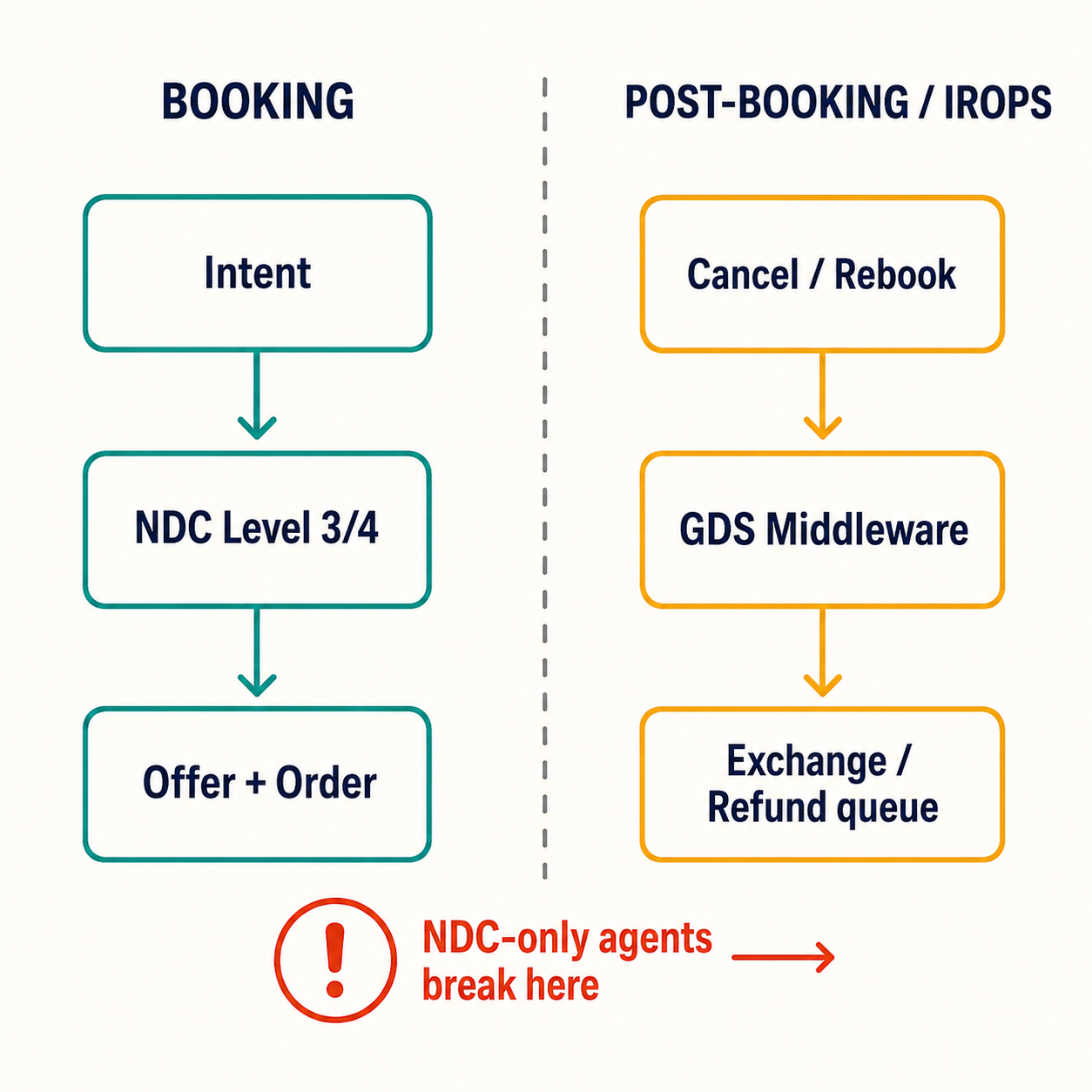
Post-booking servicing is where the NDC/GDS binary breaks in production. The initial Offer and Order for a growing number of carriers now comes through NDC Level 3 or Level 4 — via intermediaries like Verteil or Duffel, or through carriers' own direct connect. The booking goes out cleanly. Then the flight cancels.
Exchanges, refunds, and IROPS rebooking still route through GDS middleware for most carriers, even when the original booking was NDC. An agent architecture that treats GDS and NDC as a simple either/or — "we're building an NDC-native agent" — will encounter its first disruption event and find itself with a confirmed PNR it cannot service, a policy engine pointing one direction, and a passenger standing in a terminal pointing another. The agent needs both pipes, with explicit logic for which queue handles which post-booking event, and deterministic error recovery mapped to the specific GDS error codes the carrier returns.
We've built the dual-pipe architecture at Veriprajna specifically because this gap kept appearing in the early production deployments we reviewed — systems that worked beautifully in demo conditions and then broke silently on the first real-world IROPS event.
What Each Agentic Option Is Actually Shipping
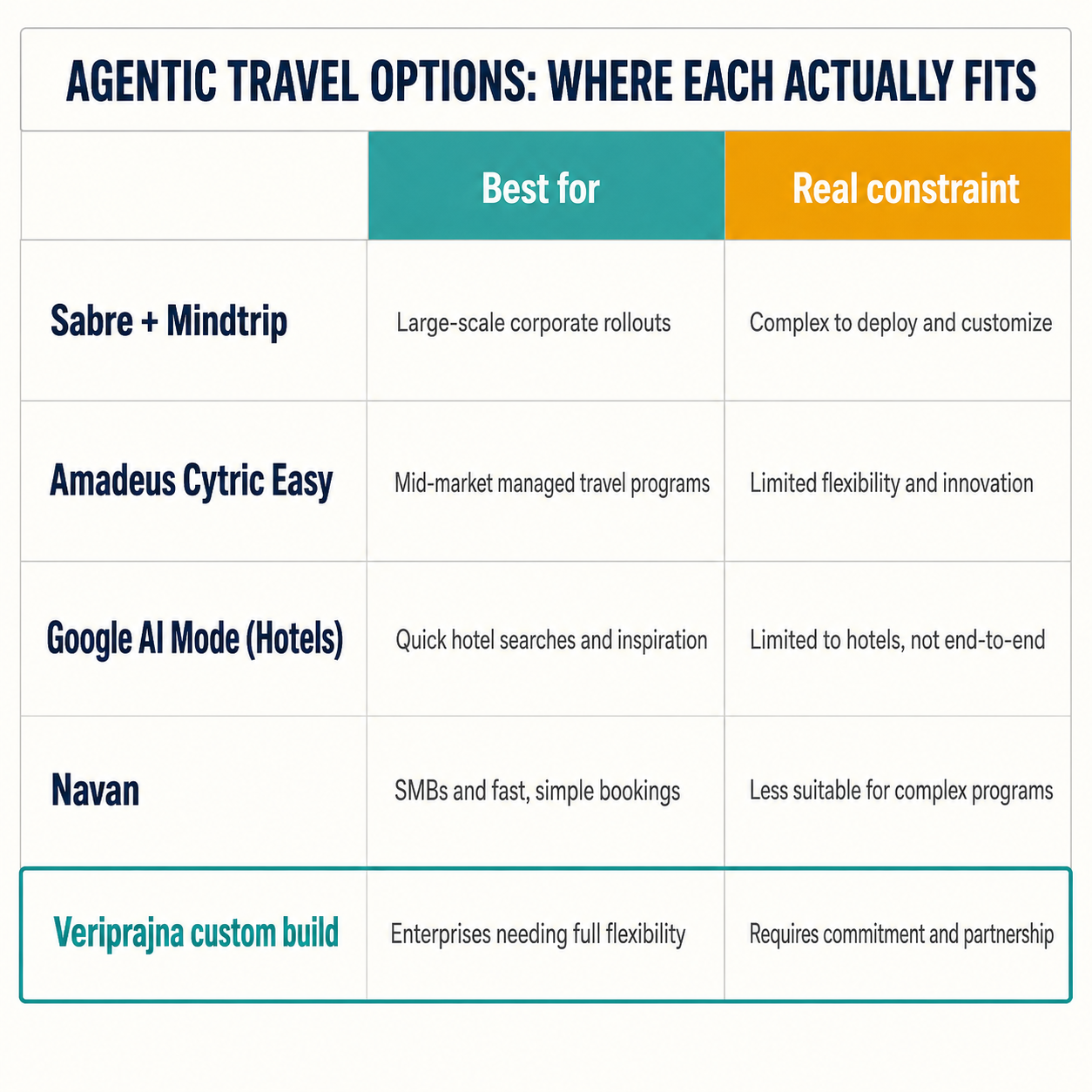
Every option below is reasonable for some buyer. We are a consultancy, not a platform vendor, so the gaps column is written the way we'd write it for a client evaluation — including for our own offering.
Sabre combined with Mindtrip and PayPal represents the first genuinely end-to-end agentic booking at commercial scale: 420+ airlines, 2 million hotels, Mindtrip's 6.5 million point-of-interest knowledge base, PayPal payment rails, with flights going GA in Q2 2026. For an OTA that's already comfortable distributing Sabre inventory on Sabre rails, this is worth evaluating seriously. The constraint is that you're building on Sabre's distribution architecture — your inventory relationship and your pricing become Sabre's. There is no corporate policy enforcement layer and no NDC servicing story for carriers that have moved content off GDS.
Amadeus Cytric Easy running inside Microsoft Teams, built with Accenture and deployed at Microsoft as the reference customer, is a real corporate travel assistant for Cytric-contracted enterprises in Microsoft-native environments. Outside that intersection — TMCs not already on Cytric, business units not on Teams — the surface area is thin.
Google AI Mode booking directly into Marriott, IHG, Booking.com, and Expedia works exactly as described for major hotel chains that want to bypass OTA intermediation. For OTAs, this is the disintermediation scenario, not a partnership opportunity.
Navan reports 73% touchless expense and corporate travel policy violations down from 35% to under 5% for its enterprise customers. For a company that wants to rip and replace its TMC with an AI-native platform, Navan is the answer. For a TMC that needs to add an intelligent layer to an existing GDS infrastructure without a full platform migration, it isn't.
The Compliance Deadline Most Travel AI Roadmaps Have Not Counted
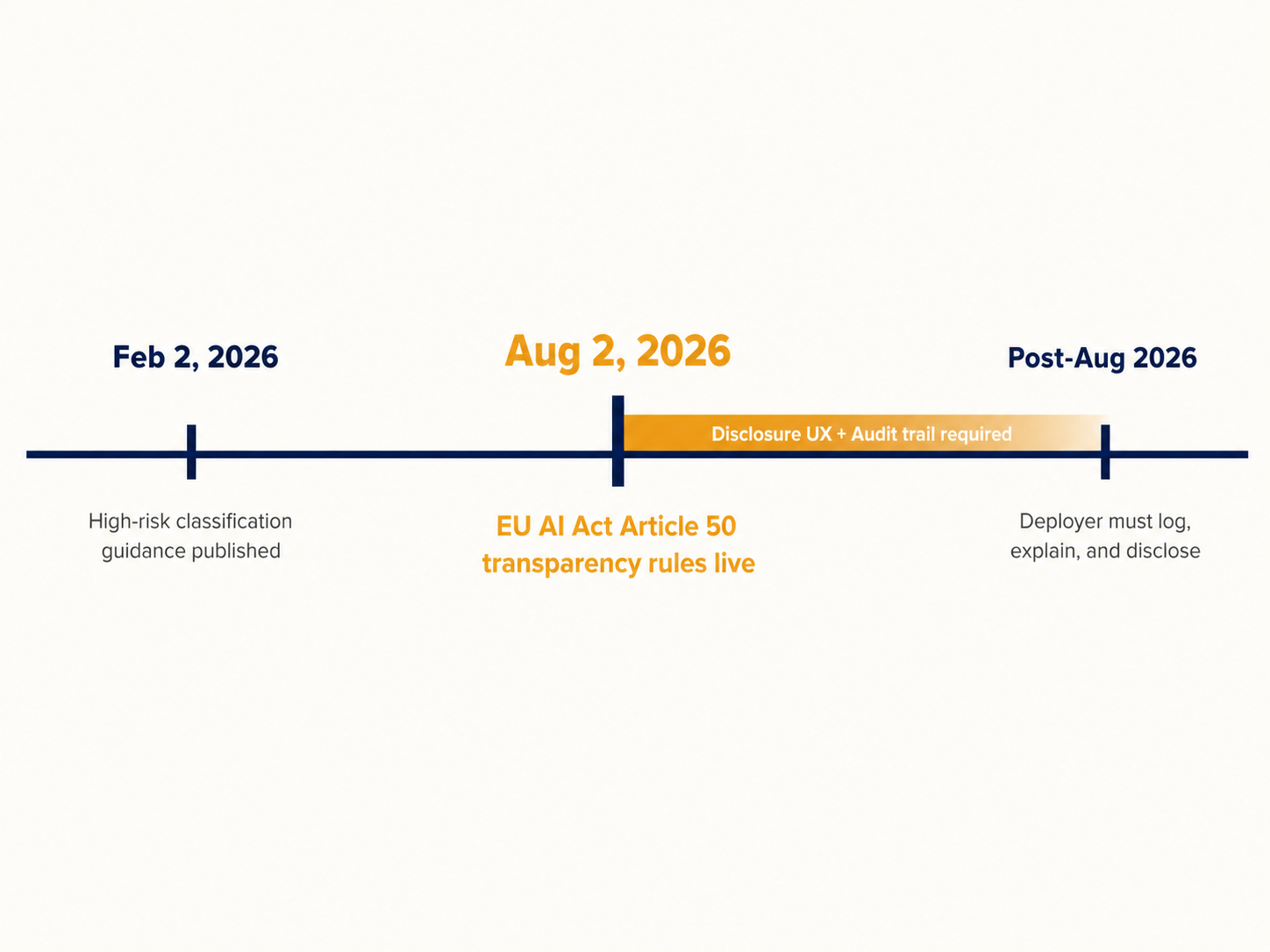
EU AI Act transparency rules go live August 2, 2026. For any AI booking interface that interacts with EU consumers, Article 50 disclosure obligations will apply: users must be informed they're interacting with an AI system, interactions must be logged, and the deployer must be able to explain — to a regulator, to a court — how decisions were made. The high-risk classification guidance published February 2, 2026. "We're working on it" is not a defensible position after August.
Any TMC or OTA that ships an agentic booking interface without an audit trail and a disclosure layer has built a system optimized for the demo and exposed for the regulator.
The logging requirement isn't only compliance overhead — it's operationally useful. An audit trail recording each step of the booking decision (search parameters, available results, policy check outcomes, held inventory, payment handoff) is also the evidence base for resolving a chargeback, defending an IROPS complaint, and answering an insurance carrier's AI posture questionnaire.
What the Architecture Actually Needs
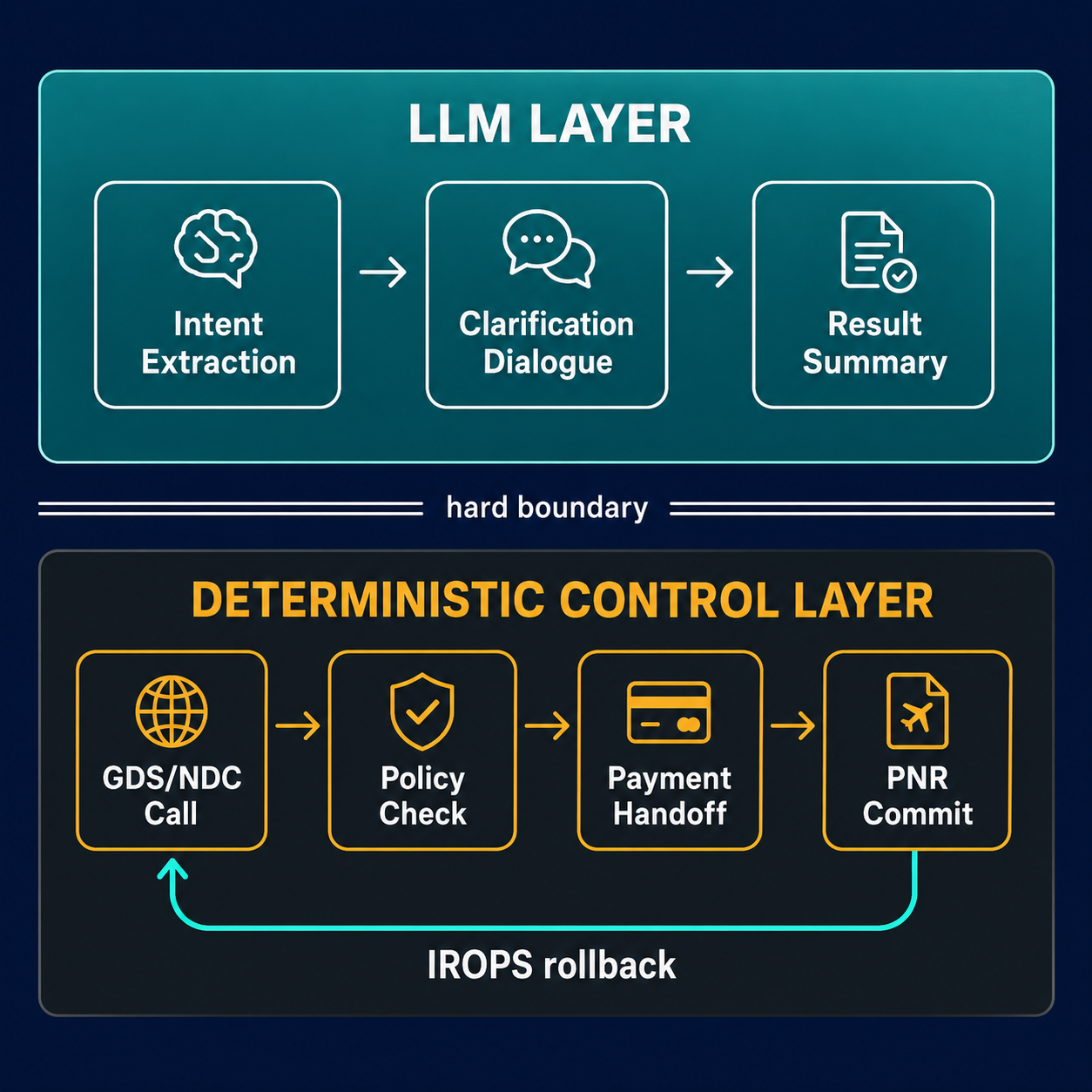
The design decision that matters most is this: control flow is code, not a language model. The LLM handles intent extraction, clarification dialogue, and summarizing results. It does not call a GDS API, execute a policy check, or process a payment. Every step that requires a correct answer — not a plausible-sounding answer — runs on hard-coded logic.
The harder failure to design for is disruption sequencing. When a hotel booking fails after a flight has been ticketed, the system must know how to void or hold the flight, notify the policy engine, and surface the disruption to a human queue before the passenger receives a confirmation. A Saga-style rollback pattern handles this deterministically. Most LLM-first architectures don't model it — they model the happy path and rely on the language model to handle exceptions, which is exactly where language models fail.
Policy enforcement is where prompt-based architectures break most consistently in production. A corporate travel policy document fed to a language model as context will be interpreted differently depending on the prompt, the model version, and the user's phrasing. The same policy compiled into a constraint layer — route selection rules, booking-class ceilings, approval thresholds, ISO 31030 duty-of-care risk-zone blocks — produces the same outcome every time.
The honest caveat on Veriprajna: we build, you operate. We don't hold IATA or ARC ticketing authority — if you need to issue stock, your ARC/IATA host does it and the agent routes to them. There's also a common build-phase discovery teams hit: Amadeus Self-Service Production API keys explicitly exclude the Flight Create Orders endpoint. If your build started on Self-Service thinking it was a free tier with a later upgrade path, you'll need an Enterprise key before you can issue tickets, and IATA or ARC accreditation takes at least 25 days on top of that. We don't own GDS commercial agreements — you bring Amadeus or Sabre, we build on it.
Where the Liability and the Architecture Align
The Moffatt ruling is not a corner case. The hallucinated hotel, the invented price, the policy exception the AI generated because it sounded reasonable — each is the same liability shape as the Air Canada chatbot. The tribunal's logic transfers to any traveler-facing AI booking interface that states facts about availability, pricing, or policy, regardless of whether those facts come from a static page or a language model.
The architecture that closes the liability exposure is the same architecture that makes the system work at production scale. Deterministic control flow doesn't hallucinate inventory. A compiled policy engine doesn't invent exceptions. An audit trail answers the court's question before it's asked.
At Veriprajna, we've been tracking the architecture decisions that separate the demos from the deployments in agentic travel. If your team is currently working through how to deploy an agent against a live GDS or NDC connection — where the vendor agreements need to be in place before the build, what the EU AI Act disclosure layer looks like in an existing booking UI, how the look-to-book math changes when an AI is doing the searching — we'd find that conversation genuinely useful. The patterns across TMC and OTA deployments are converging. Buyer-side reference designs are becoming the fastest way to get there without relearning the same failures.