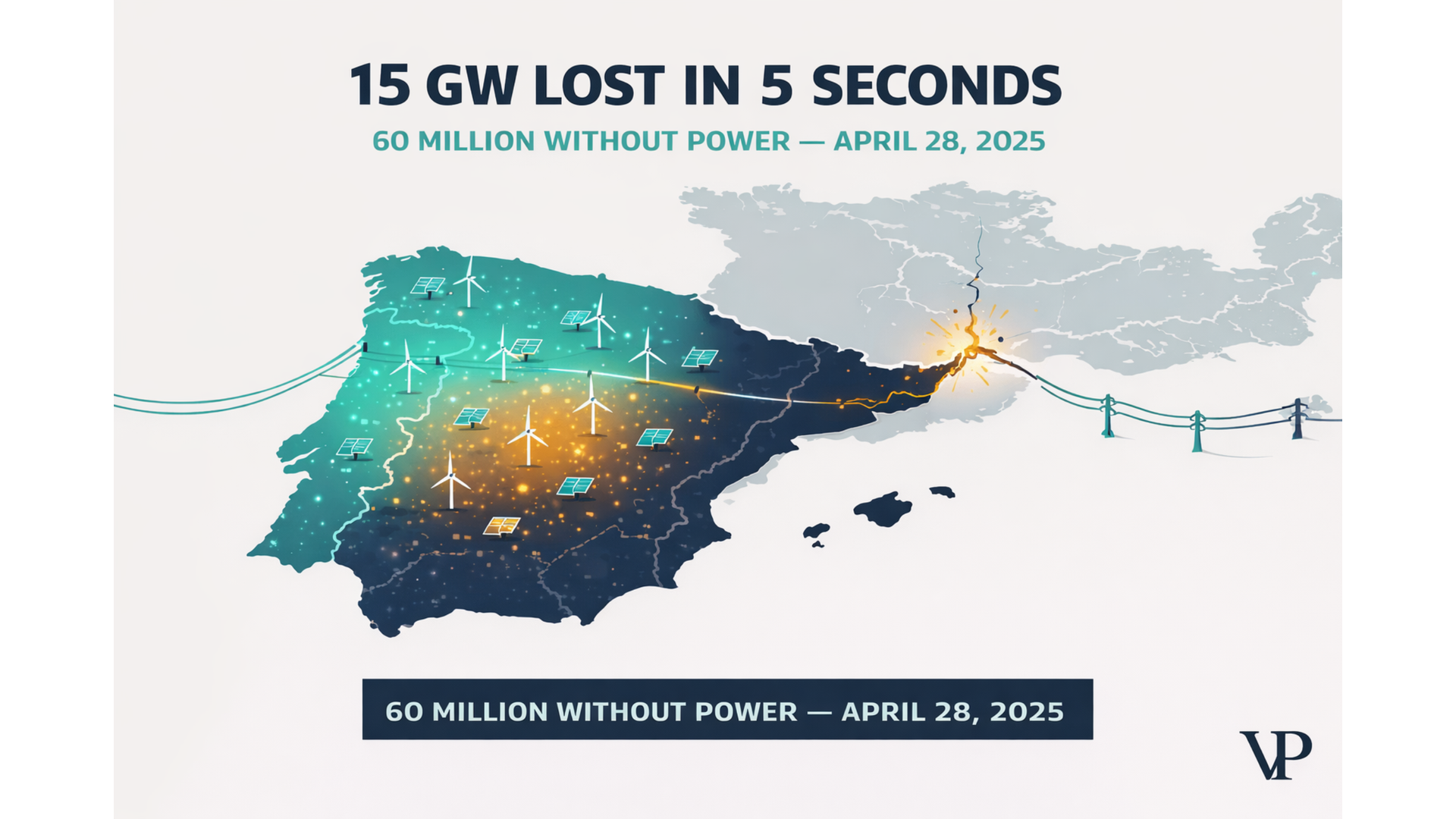
On April 28, 2025, at 12:33 PM Central European time, Spain and Portugal lost 15 gigawatts of electrical generation in five seconds. To put that in perspective: that's roughly the output of 15 nuclear reactors vanishing simultaneously. Sixty million people went dark. Traffic lights died. Hospitals scrambled onto backup generators. The blackout lasted up to ten hours in some regions, and several people died from infrastructure failures tied to the outage.
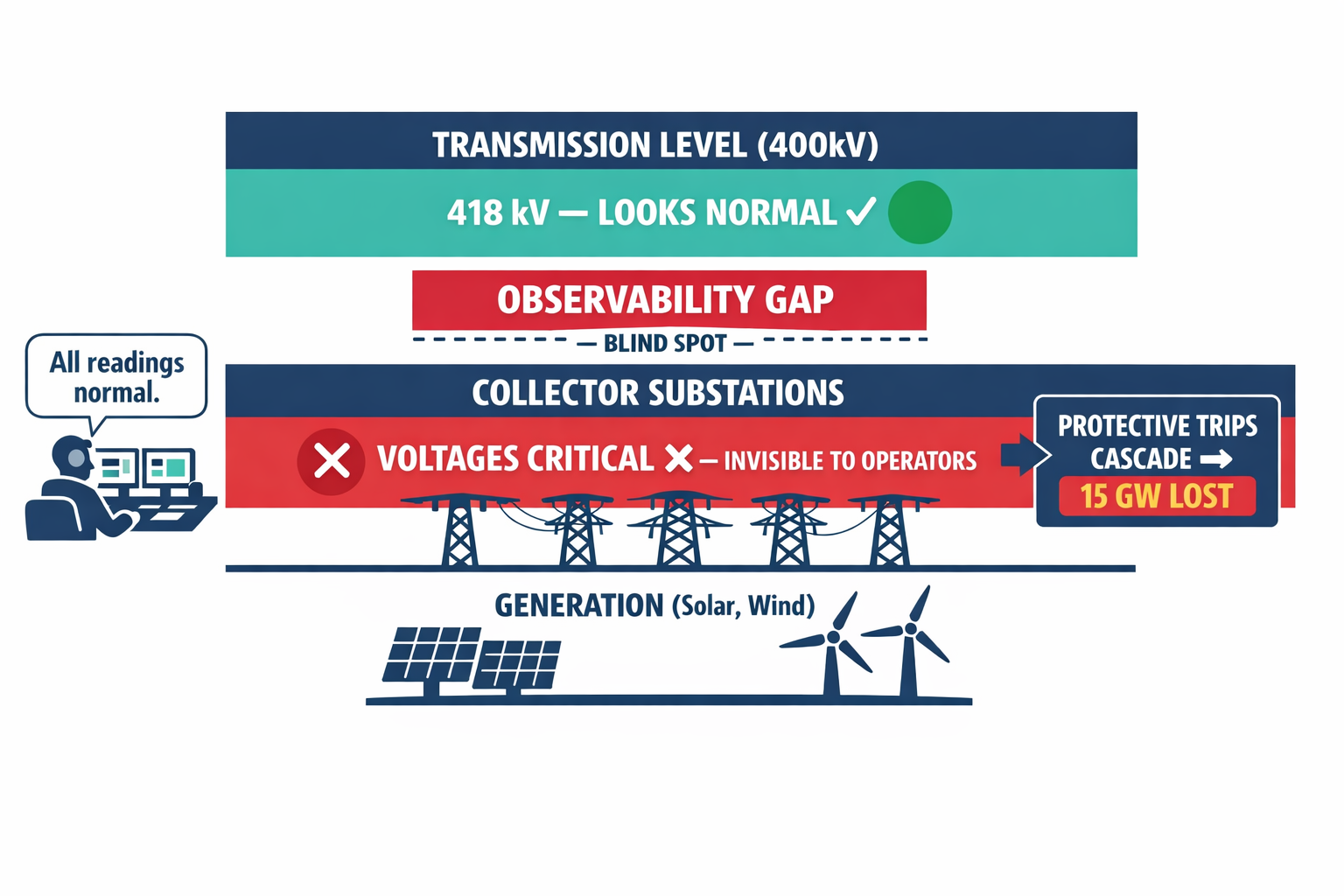
When I first saw the ENTSO-E preliminary report, one detail stopped me cold. The grid operators monitoring the high-voltage transmission lines saw nothing alarming — voltages read 418 kilovolts, well within limits. But at the collector-level substations one step down, voltages had already hit dangerous levels. The system looked healthy from the top while it was dying from the middle. That gap between what operators could see and what was actually happening is what turned a manageable oscillation into a continental-scale catastrophe.
This wasn't a failure of renewable energy, despite what the initial headlines claimed. It was a failure of intelligence — specifically, the kind of intelligence we use to monitor and control the most complex machine humanity has ever built.
What Actually Happened on April 28
The morning started with Spain generating 78% of its electricity from renewables. That's great for climate goals, but it meant very few of the heavy spinning turbines that naturally stabilize grid frequency were online. Think of those turbines like flywheels — they resist sudden changes through sheer physical momentum. With mostly solar and wind online, that momentum was thin.
Around noon, the grid started experiencing low-frequency oscillations — the electrical equivalent of a bridge swaying in the wind. Operators responded by connecting additional transmission lines and switching some controls to fixed-power mode. Reasonable moves. But these interventions inadvertently pushed voltages higher across the network.
The grid operators were flying blind at the one level that mattered most — the collector substations where generation meets transmission.
Then came the moment that still keeps me up at night. One major generation facility, instead of absorbing reactive power to pull voltages back down (which regulations explicitly required), actually injected more reactive power into the grid. It was like pouring gasoline on a fire. Within seconds, protective systems at dozens of plants tripped offline in a cascade. Fifteen gigawatts — gone. Frequency collapsed below the critical threshold, automatic load shedding couldn't keep up, and Spain and Portugal disconnected entirely from the European grid.
I walked through the full technical sequence with my team in our interactive analysis of the blackout. The deeper we dug, the clearer it became: every failure point was a place where a smarter control system could have intervened — in milliseconds, not minutes.
Why the Grid Broke Its Own Rules
Spain has a regulation called Operating Procedure 7.4 (P.O. 7.4). It requires every power plant to be capable of absorbing or injecting reactive power — the invisible component of electricity that keeps voltages stable — equal to at least 30% of its maximum output. On April 28, when the grid desperately needed plants to absorb reactive power and bring voltages down, multiple facilities responded too slowly or not at all.
The rules existed. The enforcement didn't.
This hit close to home for me because it's the exact pattern we see across every industry we work in. Organizations write detailed protocols, train people on them, embed them in procedures — and then a crisis arrives faster than any human or legacy controller can process. The Spanish grid's conventional controllers use technology called PID control, which works beautifully in steady-state conditions. But PID controllers are tuned for normal operations. When the grid enters a non-linear crisis — oscillations interacting with voltage spikes interacting with protection systems — these controllers are essentially guessing.
The plant that injected reactive power during an overvoltage event wasn't being malicious. Its controller was almost certainly responding to a local reading that didn't reflect the system-wide emergency. It made the locally "reasonable" choice that turned out to be globally catastrophic.
The Chatbot AI Trap
Here's where I have to be blunt about my own industry. The current wave of enterprise AI is dominated by what I call "wrapper" solutions — applications that put a nice interface on top of large language models like GPT-4 or Claude. These are extraordinary tools for writing emails, summarizing documents, and answering questions. They are dangerously inadequate for controlling physical infrastructure.
Three reasons this matters for power grids:
Probabilistic models guess; physics doesn't. An LLM generates the most statistically likely next word. Applied to grid monitoring, that means it would report what typically happens during oscillations — "voltages are stabilizing" — even if this particular event is diverging toward collapse. The model optimizes for plausibility, not truth.
Cloud-based AI is too slow. Wrapper solutions rely on API calls to remote servers. Round-trip latency runs 500 milliseconds to several seconds. The Iberian cascade went from manageable to catastrophic in under five seconds. By the time a cloud-based system finished its inference, the grid would already be dark.
You can't verify a black box. Nobody can prove that an LLM will always obey Kirchhoff's Voltage Law or any other physical constraint. It might, most of the time. But "most of the time" is not an acceptable reliability standard when 60 million people depend on the output.
In critical infrastructure, the difference between "probably correct" and "provably correct" is the difference between the lights staying on and a continental blackout.
I've had conversations with utility executives who've been pitched AI solutions that are essentially ChatGPT reading SCADA data. The demos look impressive. The failure modes are invisible — until they're not.
What Deterministic AI Actually Means
When my team talks about "deterministic immunity" for power grids, we mean something specific: building AI systems that are physically incapable of violating safety rules or the laws of physics. Not unlikely to violate them. Incapable.
We achieve this through an architecture that layers two fundamentally different types of intelligence.
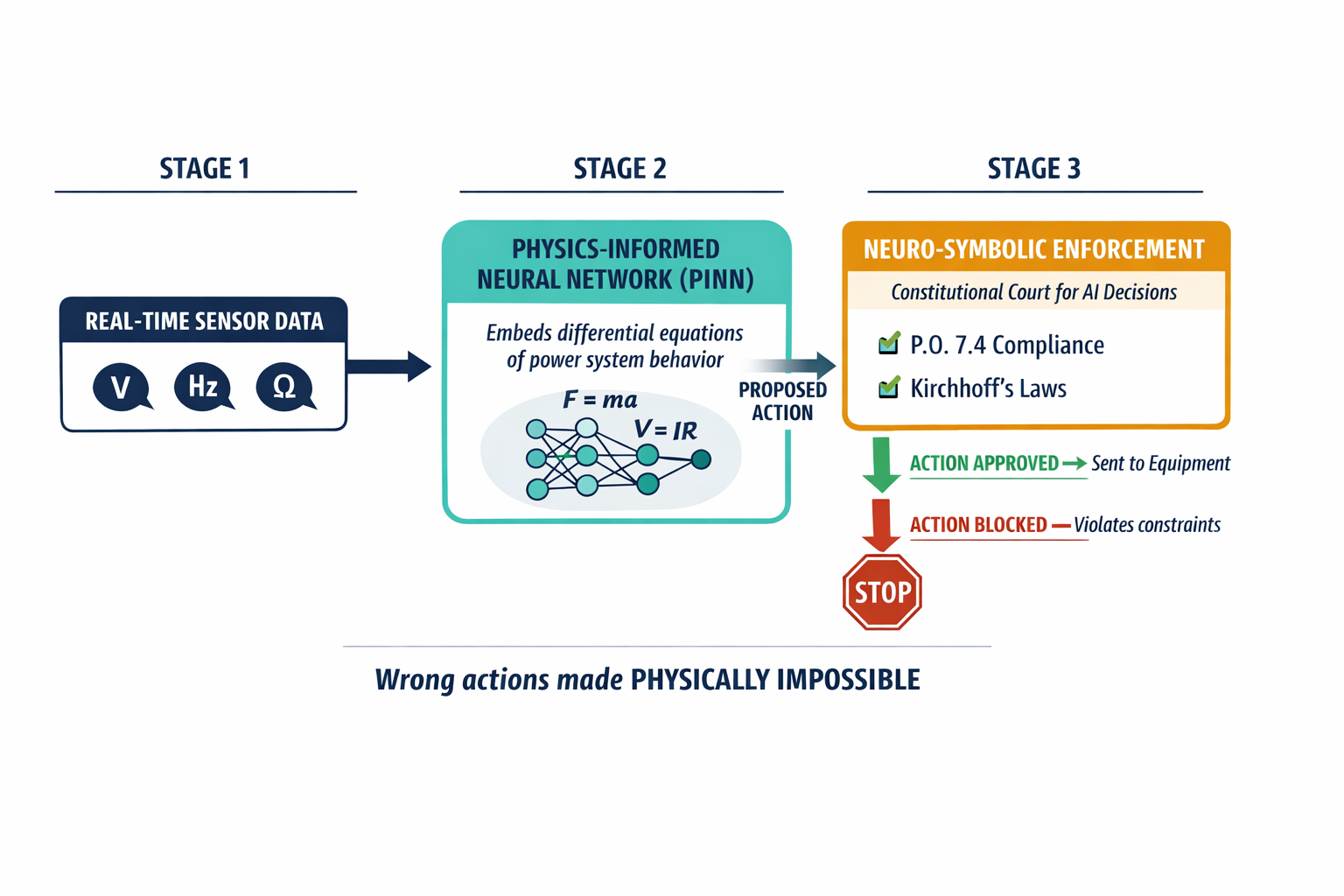
The first layer uses Physics-Informed Neural Networks, or PINNs. Unlike standard neural networks that learn patterns from historical data alone, PINNs embed the actual differential equations governing power system behavior directly into their training process. The equations that describe how frequency changes when generation is lost, how voltage responds to reactive power flows — these become mathematical constraints that the network cannot violate, even during inference. In testing, PINN-based controllers identified and damped the type of sub-synchronous oscillations seen in the Iberian event up to 87 times faster than conventional optimization methods.
The second layer is what we call neuro-symbolic enforcement. Think of it as a constitutional court for AI decisions. The neural network proposes a control action based on real-time sensor data. Before that action reaches any equipment, it passes through a symbolic logic layer that encodes regulatory rules — like P.O. 7.4 — as hard constraints. If the neural network suggests injecting reactive power while voltages are rising, the symbolic layer blocks the command. Period. No override, no exception.
A neuro-symbolic grid controller doesn't just recommend the right action. It makes the wrong action physically impossible.
This is the architecture we detail in our full technical deep-dive on deterministic grid immunity. The key insight isn't any single technology — it's the combination of neural adaptability with symbolic certainty.
Closing the Observability Gap
The hidden villain of the Iberian blackout was the gap between what operators could see and what was actually happening. Transmission-level monitoring showed normal voltages. Collector-level substations were already in crisis. The transformer tap-changers that should have adjusted voltages between these levels couldn't keep up with the speed of events.
This is fundamentally a sensor-and-compute placement problem. If your intelligence sits in a centralized control room polling data every few seconds, you will always be blind to fast-moving local events.
Our approach pushes specialized edge computing devices — we call them Neural Grid Controllers — directly to the collector-side transformers. These devices perform high-resolution waveform measurements and run continuous optimization loops every 100 milliseconds. They don't wait for instructions from a central system. They maintain local voltage stability within tight bounds autonomously, while coordinating with neighboring controllers.
On April 28, this would have meant catching the overvoltage at the collector level before it ever triggered protective trips — because the intelligence was there, not in a control room kilometers away watching aggregated data.
The Recovery Problem No One Talks About
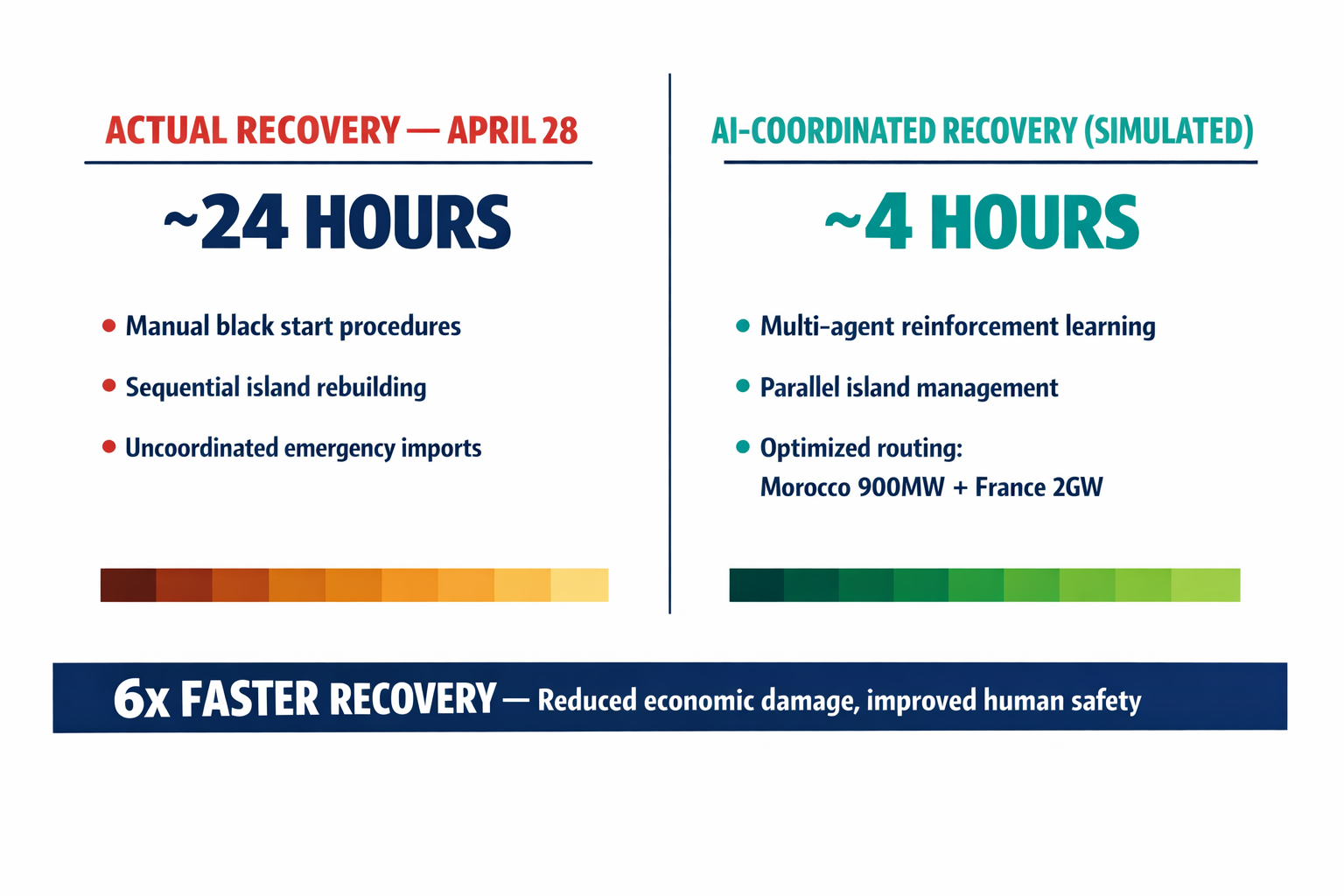
Most coverage of the Iberian blackout focused on the cascade itself. Less discussed: it took up to 24 hours to fully restore power. Black start procedures — restarting a dead grid from scratch — are extraordinarily complex. You can't just flip everything back on. You have to carefully rebuild isolated "islands" of power, synchronize them, and gradually reconnect loads without triggering another collapse.
This is where a different kind of AI enters the picture. We use multi-agent reinforcement learning, where autonomous software agents manage individual power islands while coordinating agents handle synchronization between them. In simulation, this approach could have routed Morocco's 900 MW and France's 2 GW of emergency support to the highest-priority islands while maintaining balance — potentially compressing a 24-hour recovery into roughly 4 hours.
I'll be honest: this is the piece of our work that's furthest from production deployment. Grid operators are understandably conservative about autonomous restoration. But the cost of a 24-hour blackout versus a 4-hour blackout — in economic damage, in human safety, in public trust — makes the case hard to ignore.
What About the EU AI Act?
A reasonable question: if you're putting AI in charge of critical infrastructure decisions, how do you satisfy regulators who demand transparency?
This is actually where deterministic AI has a structural advantage over probabilistic systems. When our neuro-symbolic architecture makes an intervention, it produces a complete decision trace: what triggered the action, which constraint was violated, what the symbolic layer enforced, and what the outcome was. A human auditor — or a regulator — can read the trace and understand exactly why the system did what it did.
Try asking GPT-4 to explain why it generated a particular control signal in terms of specific physical laws and regulatory clauses. You'll get a plausible-sounding explanation that may or may not reflect what actually happened inside the model. That's the difference between explainability as a feature and explainability as an architecture.
What This Means If You Run Critical Infrastructure
The Iberian blackout wasn't an anomaly. It was a preview. As grids worldwide increase renewable penetration — which they must, and should — the physics of grid stability change fundamentally. Lower inertia, more distributed generation, faster dynamics. The control systems designed for a world of large spinning turbines cannot keep pace.
Three things I'd urge any infrastructure leader to consider:
Audit your observability. Where are the gaps between what your monitoring shows and what's actually happening at the edge of your system? The Iberian cascade was invisible at the transmission level until it was too late. Every complex system has these blind spots.
Stress-test your AI vendors. If your AI solution relies on cloud-based LLM inference, ask what happens when latency exceeds 500 milliseconds. Ask whether the system can be formally verified against physical constraints. Ask for the failure mode analysis, not just the demo.
Think in layers, not silver bullets. No single technology prevents cascading failure. The combination of physics-informed neural networks, symbolic rule enforcement, edge-native computing, and multi-agent coordination creates defense in depth. Each layer catches what the others miss.
The 2025 Iberian blackout wasn't a failure of renewables. It was a failure of the intelligence layer sitting between renewable generation and grid stability.
The grid is the most complex machine on Earth, and we're making it more complex every year. The question isn't whether we need AI to manage it — we clearly do. The question is whether we're building AI that's worthy of the responsibility.
I'd genuinely like to hear from people working on this problem — utility operators, grid engineers, energy regulators. What does your observability gap look like? Where are the blind spots keeping you up at night?