The insurance fraud most likely to get paid in 2026 is not a convincing fake. It is a real photo, lifted from a claim you already settled, submitted again against a fresh loss. It passes every authenticity test a deepfake detector can run, because it is genuine. That is the gap we built a cross-signal forensic authentication gate to close, and you can trace it claim by claim at veriprajna.com/demos/insurance-claims-ai.
The industry has framed the AI-fraud problem as a detector arms race: generators get better, so buy a better classifier. We think that framing is the trap. A lone authenticity detector fails in two ways at once. It ages out the moment a new diffusion model lands, and (the part nobody markets) it is structurally blind to fraud that was never synthetic to begin with.
The detector most carriers already run is blind to the oldest trick
The market is spending on the wrong half of the problem. In Verisk's 2026 State of Insurance Fraud, 98% of insurers report a surge in manipulated media, yet only 32% feel very confident detecting deepfakes; 65% run a third-party AI detector and 44% still rely on manual review. The pressure is real: deepfake fraud attempts are up 2,137% over three years (Facia.ai), and one UK motor carrier saw a 300% rise in AI-manipulated vehicle images in a single year (The Guardian / Milliman). Verisk also found 36% of consumers would alter a claim image.
Here is what a third-party detector cannot do, no matter how good it gets. It runs after submission, and it answers exactly one question: was this image generated? It does not ask whether the carrier has seen this image before, or whether the written account matches the damage in the frame. So the detector clears the recycled real photo, and the claim moves to damage assessment as if it were clean.
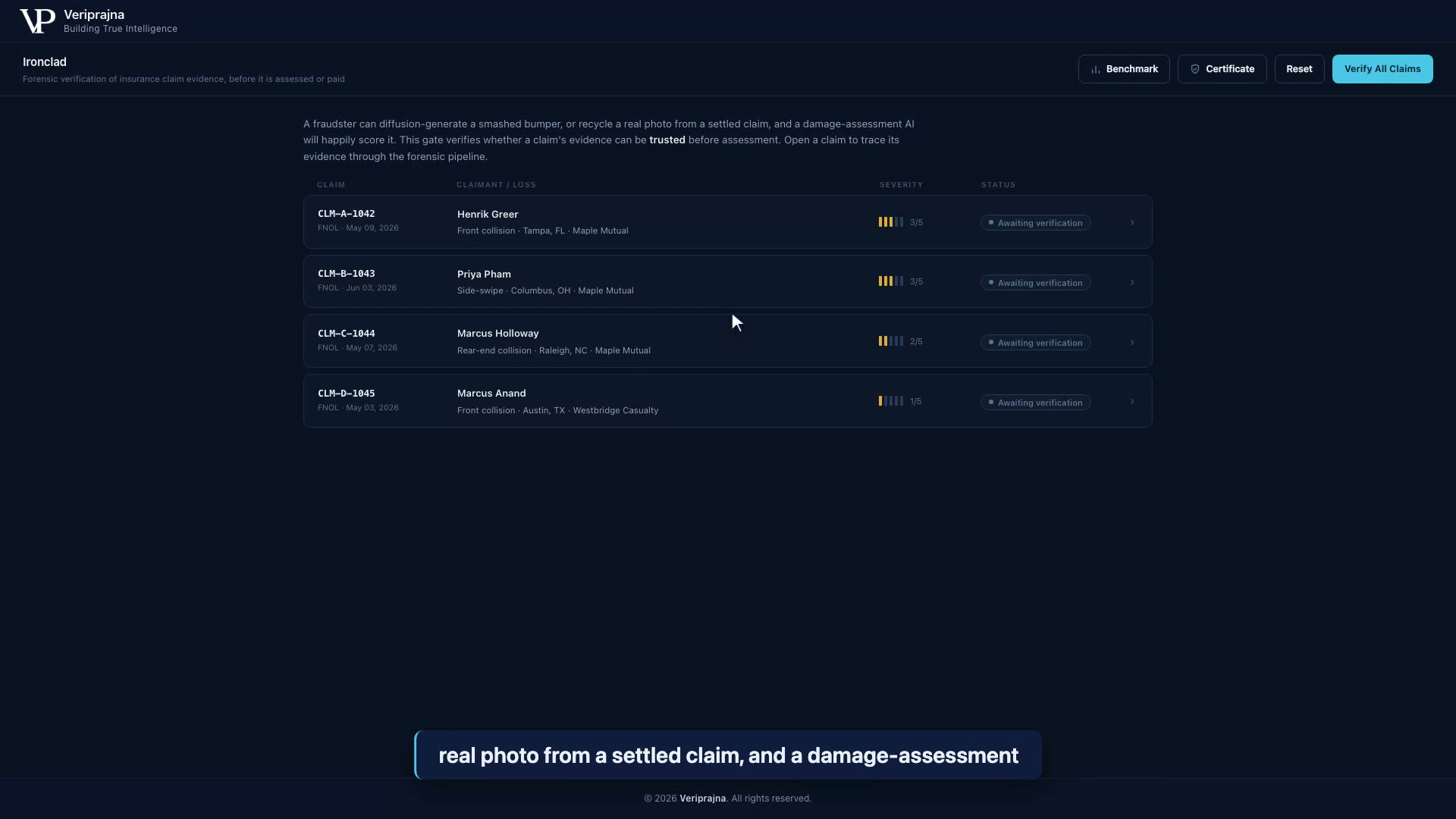 The gate sits in front of damage assessment. Four first-notice-of-loss claims wait for verification before anyone assesses or pays them.
What the gate did with a recycled photo
Take claim CLM-C-1044 in the demo: Marcus Holloway, a rear-end collision in Raleigh, NC, photo captured on an iPhone 15 Pro, severity 2 of 5 accepted from the upstream assessor. Two of the four forensic analysts clear it. The Provenance Analyst returns CONSISTENT (capture GPS within 1.1 km of the loss, capture date matching the reported loss date). The Pixel-Forensics Analyst also returns CONSISTENT, artifact_score 0.06, no synthetic signature. A single-signal detector stops right here and waves the claim through.
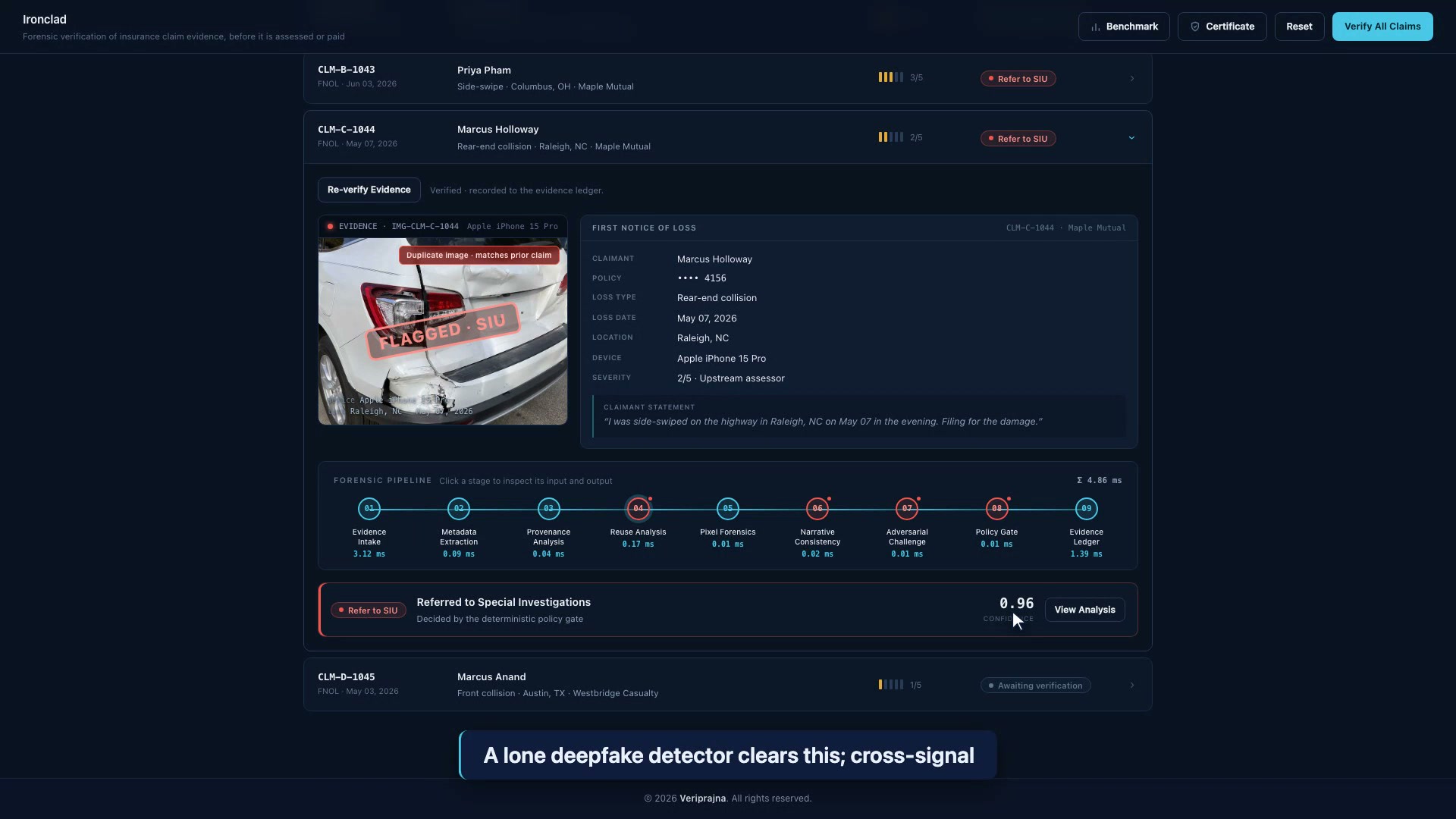 The same photo a deepfake detector clears is stamped FLAGGED and routed to Special Investigations by the deterministic policy gate, at 0.96 confidence.
The other two analysts are the reason. The Reuse Analyst matches the photo's perceptual hash against a historical claims index, and the exact rule that fires reads: recycled evidence, perceptual hash matches prior claim HIST-4019 (Maple Mutual, 2025-11-29), hamming distance 0. A perfect match to a photo that was already paid. The Narrative-Consistency Analyst flags a second contradiction: the account describes side damage, the photo shows rear damage. The adversarial Challenger, whose whole job is to refute flags and clear the claimant, tested both and both survived.
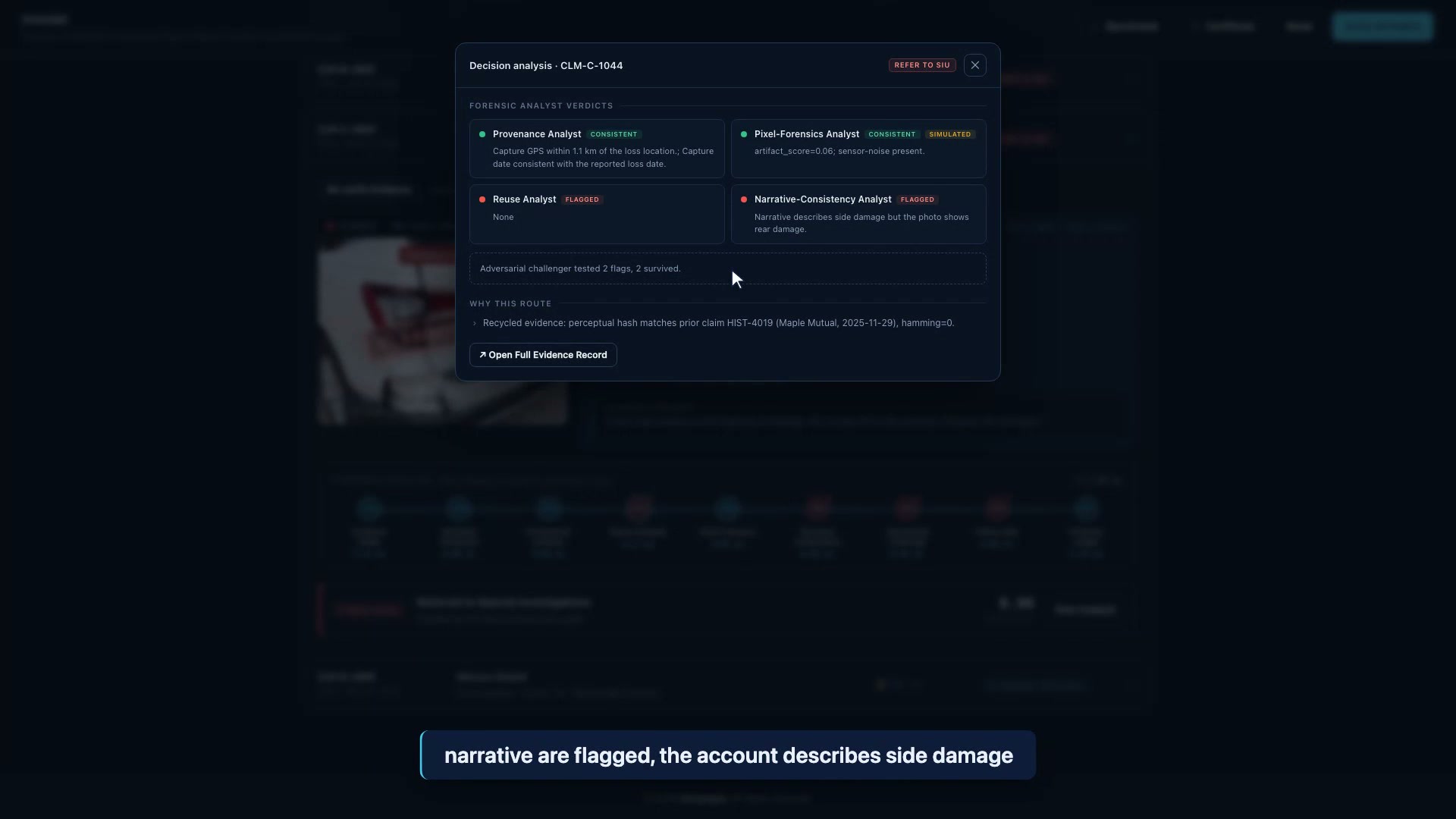 Two analysts pass, two flag. The catch is the reuse match, not the pixel signal. The Pixel-Forensics analyst is a simulated stand-in, labeled on screen, and this decision does not depend on it.
That last point matters for honesty. The pixel-forensic artifact signal is simulated in this demo, a placeholder for a future learned generative-artifact model, and it is labeled that way everywhere it appears. The recycled-photo catch does not use it. It comes from provenance, reuse, and narrative corroborating each other, which is the entire argument for cross-signal over single-signal. Two other fraud shapes in the set fail on different signals: a diffusion-faked bumper trips the generation marker, and a metadata-spoofed real photo trips the device, GPS, and date consistency check. Same gate, different corroborating evidence.
Why a better base model does not retire this
The durable case for a gate over a classifier is not that our model is smarter. It is that the properties a gate provides do not age out. Even a flawless deepfake detector cannot catch a real recycled photo, cannot prove the stored original was never altered, and cannot hand a regulator an audit trail. Those are structural gaps in the single-signal approach, not gaps a better generator-detector closes.
Even a perfect deepfake detector cannot catch a real recycled photo, cannot prove the stored original was never altered, and cannot hand a regulator an audit trail. Those properties do not improve when the base model does.
So the mechanism is built around that. A forensic crew of four analysts plus an adversarial Challenger advises. A deterministic policy gate outside the LLM makes the actual routing call, aggregating the typed verdicts and raw signals against the carrier's thresholds into one reproducible decision across four routes: AUTO-PROCEED, SIU-REFERRAL, HUMAN-REVIEW, and ABSTAIN. Agents advise, code decides. When evidence is thin or conflicting the gate abstains to a human review rather than bluffing a pass or an accusation, which is how the benchmark holds a 0% false-accusation rate.
The chain of custody, made visible
The second durable property is defensibility. Every decision binds the original image into an append-only, hash-chained evidence ledger. The verify-chain step recomputes each link and re-hashes each original on disk, so if a stored original is edited, whether by a GenAI "enhancement" step or by someone covering their tracks, the tamper shows up as a broken chain.
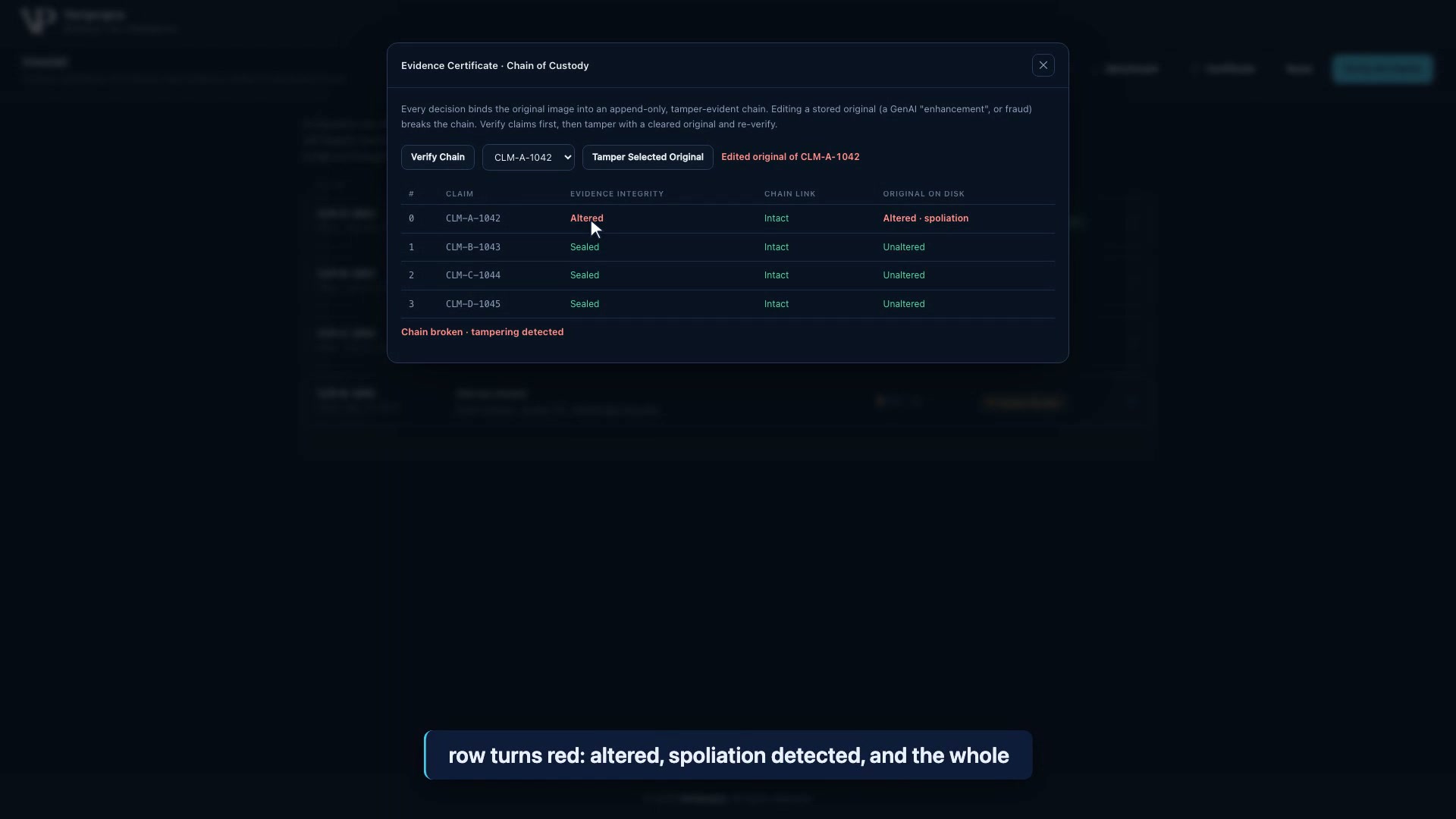 Tamper with one stored original and its row turns red: altered, spoliation detected. The rest of the chain stays sealed, and the break is provable.
Every routing decision is written to an append-only, hash-chained evidence ledger, so tampering with a stored original shows up as a broken chain instead of a lost dispute.
This is where 2026 turns an engineering nicety into a business requirement. The NAIC Model Bulletin on AI has been adopted by 24 states, the EU AI Act's high-risk obligations carry an August 2026 deadline with penalties up to €35M or 7% of global turnover, and the Colorado AI Act takes effect June 30, 2026. Outsourcing the AI does not outsource the liability. And a single disputed claim that reaches litigation costs $30,000 to $75,000, which is the price of not being able to prove the original was never touched.
The number to lead with, and the one not to
We ran the gate over a labeled 120-claim synthetic benchmark (47 clean, 25 diffusion-fake, 20 recycled-real, 13 ambiguous, 15 metadata-spoofed). The result worth leading with is a coverage gap. Of the 35 frauds that carry no authenticity artifact at all (the 20 recycled-real plus the 15 metadata-spoofed), a single-signal authenticity baseline catches 0. The firewall catches all 35.
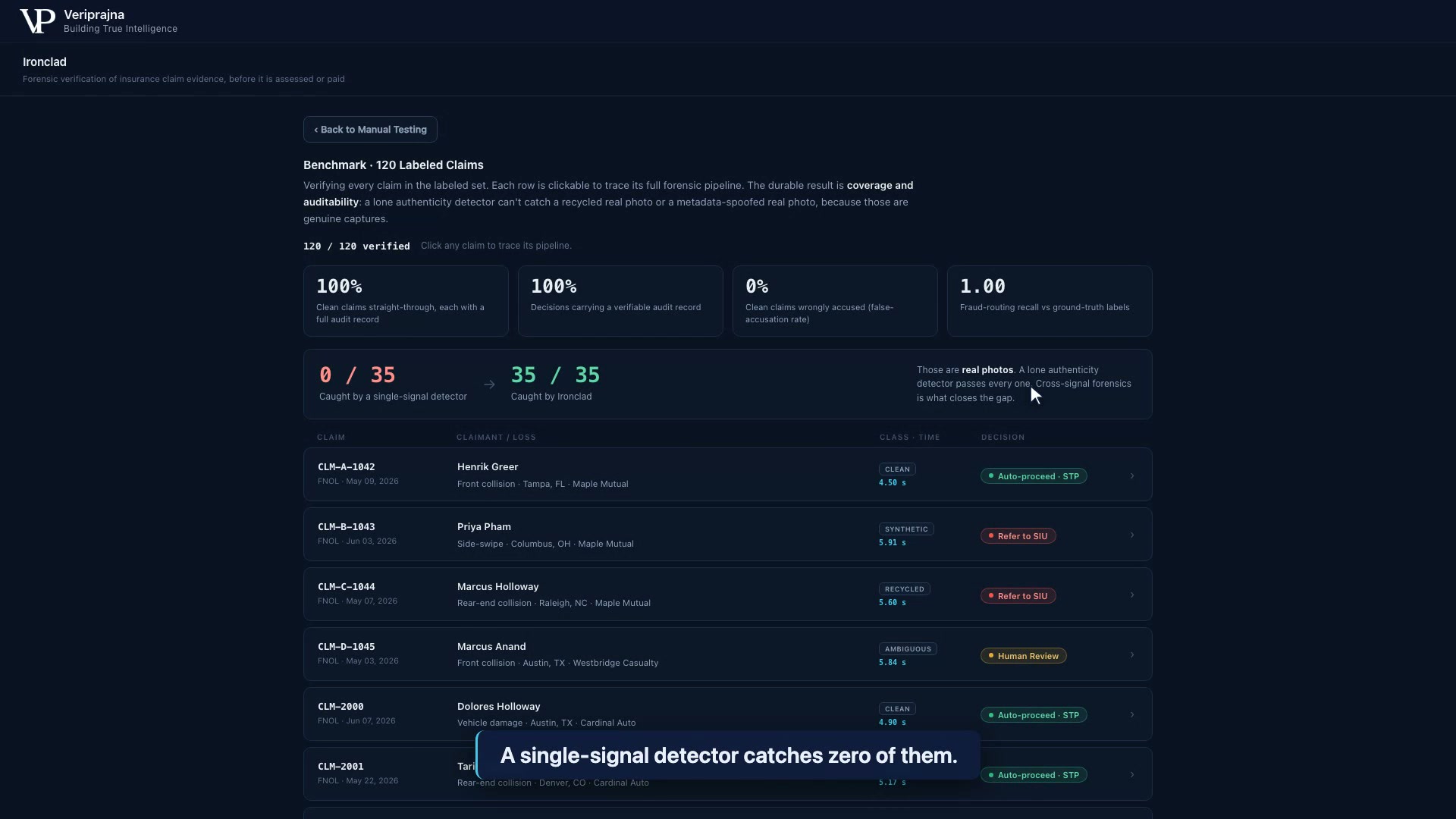 The durable result is the 0-to-35 coverage gap against a single-signal baseline, at 0% false-accusation and 100% audit-integrity coverage.
The honest caveat travels with that number every time. These fraud classes carry detectable signatures by construction, so the 100% figures are properties of this constructed set, not an open-world guarantee that the gate catches every real-world fraud. What we would stand behind regardless of the set is the shape of the advantage: cross-signal coverage where a single-signal detector has none, a 0% false-accusation rate (0 of 47 clean claims routed to SIU), and a verifiable hash-chained record behind 100% of decisions.
If you own claims authenticity today, here is the question worth sitting with. When a photo clears your deepfake detector, does anything then check whether that exact image was already paid on a prior claim, or whether the narrative matches the damage in the frame, before the claim moves to assessment? If the only gate is one classifier answering "is this generated," the recycled-photo case is walking straight through it. We would genuinely like to hear how carriers are thinking about cross-signal coverage and a defensible chain of custody; the problem is industry-wide and the answers will be too. The demo runs live at veriprajna.com/demos/insurance-claims-ai.