In late 2025 an AI feature published under a major newspaper's masthead invented quotes, misattributed sources, and inserted commentary as the paper's own editorial position. The failure surfaced only when the standards editor's Slack leaked (Semafor, December 2025). The uncomfortable part is not that the model made things up. Every model does that. The uncomfortable part is who owns the result: there is no Section 230 shield for content your own system generates from your own archive. The moment a publisher's conversational AI answers a reader under the masthead, the publisher owns every word it said, and a libel plaintiff will not ask how confident the model was.
We kept circling that ownership problem while building The Standards Desk, a demo that wraps a provenance gate around a publisher's conversational AI so nothing reaches a reader unless every claim is grounded in the archive and every quoted string is verified verbatim against its source. You can run it at https://veriprajna.com/demos/conversational-ai-for-publishers. The demo proves the mechanism, but the structural argument holds without it, and most of the market is still betting on the wrong side of it.
The traffic is leaving, and the liability is arriving to replace it
Publishers are being pushed to answer readers directly from their archives because the old distribution is collapsing. AI Overviews now appear on 48% of Google searches (theStacc / Search Engine Land, March 2026). Publisher search traffic fell 33% year over year to November 2025, with a further decline of roughly 43% expected by 2029 (Reuters Institute Trends 2026). The rational response is to build the answer engine yourself, on your own verified archive, and keep the reader on your property.
That move trades a traffic problem for a liability problem. A syndicated wire story or a user comment carries a distributor's protections. An answer your system composed from your archive does not. You authored it. So the question stops being "can we build a chat widget over our archive" and becomes "can we prove, for every sentence we publish this way, that the archive actually said it." That proof is not something a chat widget ships with.
Safe to publish is a governance property, not a model property
The reflex across the industry is to wait for a model that hallucinates less. That reflex misreads the failure. A more accurate answerer lowers the rate of invented quotes, but the failure that reaches a courtroom is not a rate. It is one quote, in one published answer, that a reader can check against the actual archive. Whether that quote was really said is a fact about your source text, not a fact about the model's weights, and no roadmap relocates it back inside the model.
A libel plaintiff does not care how confident the model was. They care whether the quote was real and whether the archive actually said it. That makes safe-to-publish a governance property, not a model property, and no better model moves it back inside the answerer.
This is why we think the durable work is the layer around the conversational engine, not a smarter engine. Provenance, a verbatim-quote guarantee, honest abstention, and an audit trail do not age out when the next model ships. They are worth exactly as much against a frontier model as against a weak one, because they answer a question the model is structurally unable to answer about itself.
Watch the gate catch a fabricated quote
Assertions about determinism are cheap, so the demo makes one mechanical. One of the built-in reader questions asks what Mayor Reyes promised developers about the riverfront parcel. In the synthetic archive there is no such promise. One article records a meeting that attendees described as exploratory, noting the parcel was not on the agenda. The answerer confabulates anyway, exactly as a vanilla vector-RAG widget would, and produces the sentence: Mayor Reyes said, "We're committed to moving riverfront parcel forward for the developers."
Then the verbatim-quote rule runs. It does not judge whether the quote sounds plausible. It takes the quoted span and does an exact string match against the cited source passages. The string is in none of them. The check returns 0 of 1 quotes verbatim, the provenance auditor supports only 1 of 2 claims, claim-grounding coverage lands at 50%, and the policy gate routes the whole answer to HELD FOR STANDARDS-DESK REVIEW. The reader never sees it.
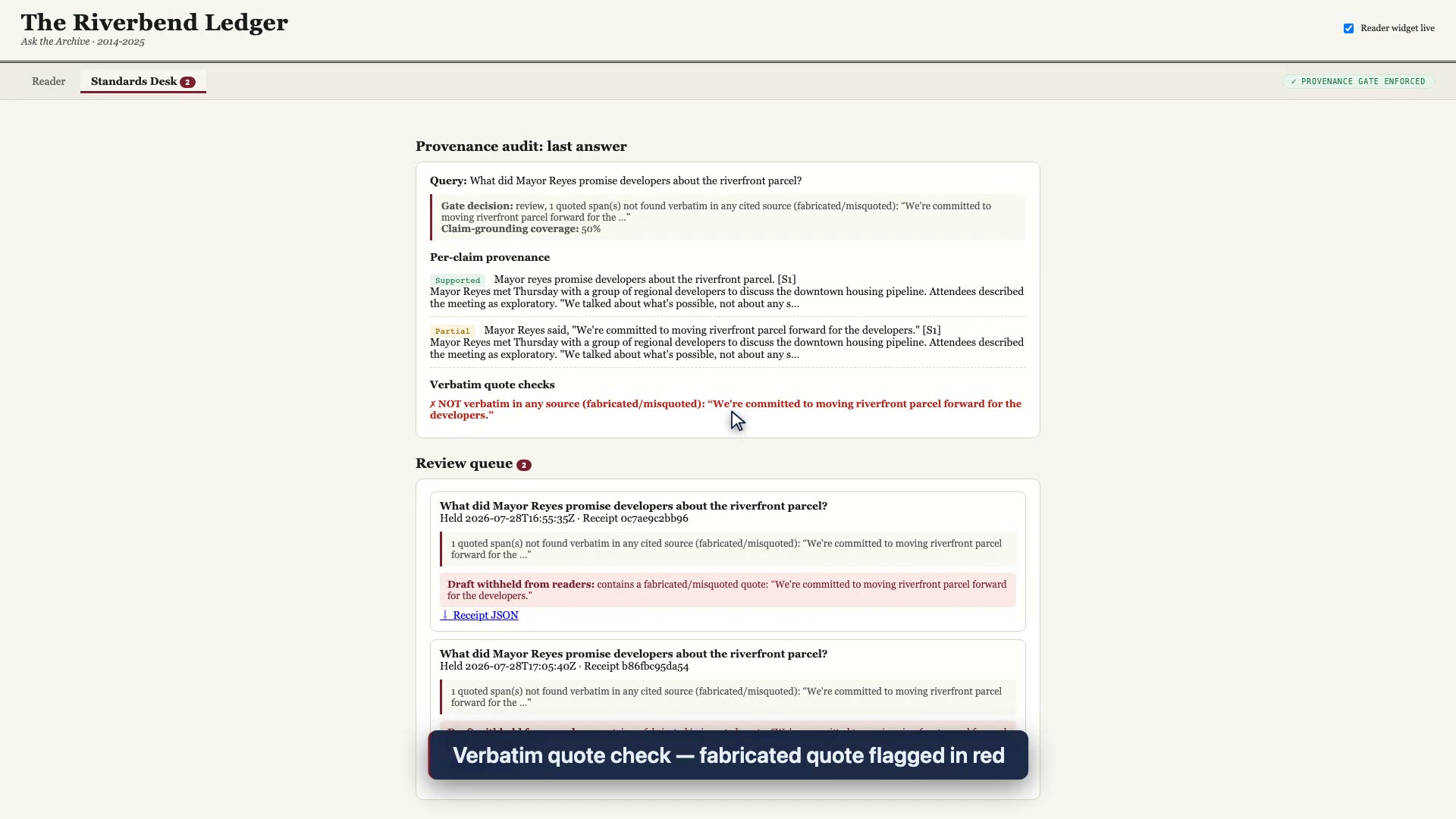 The dashboard verdict for the fabricated quote. The gate decision is review because one quoted span was not found verbatim in any cited source, and claim-grounding coverage is 50 percent. The invented line, "We're committed to moving riverfront parcel forward for the developers," is flagged in red as NOT verbatim in any source. This is the exact failure that shipped under a real masthead, caught before a reader saw it.
On the reader's side of the same answer, the widget shows only that the answer was held. The pipeline console reads 0 of 1 quotes verbatim and 1 of 2 claims supported, the banner says held for standards-desk review and not shown to readers, and a one-click button exports the audit receipt as JSON. The reader is never handed a confident fabrication and later a correction. They are handed nothing, which is the correct output when the archive cannot back the claim.
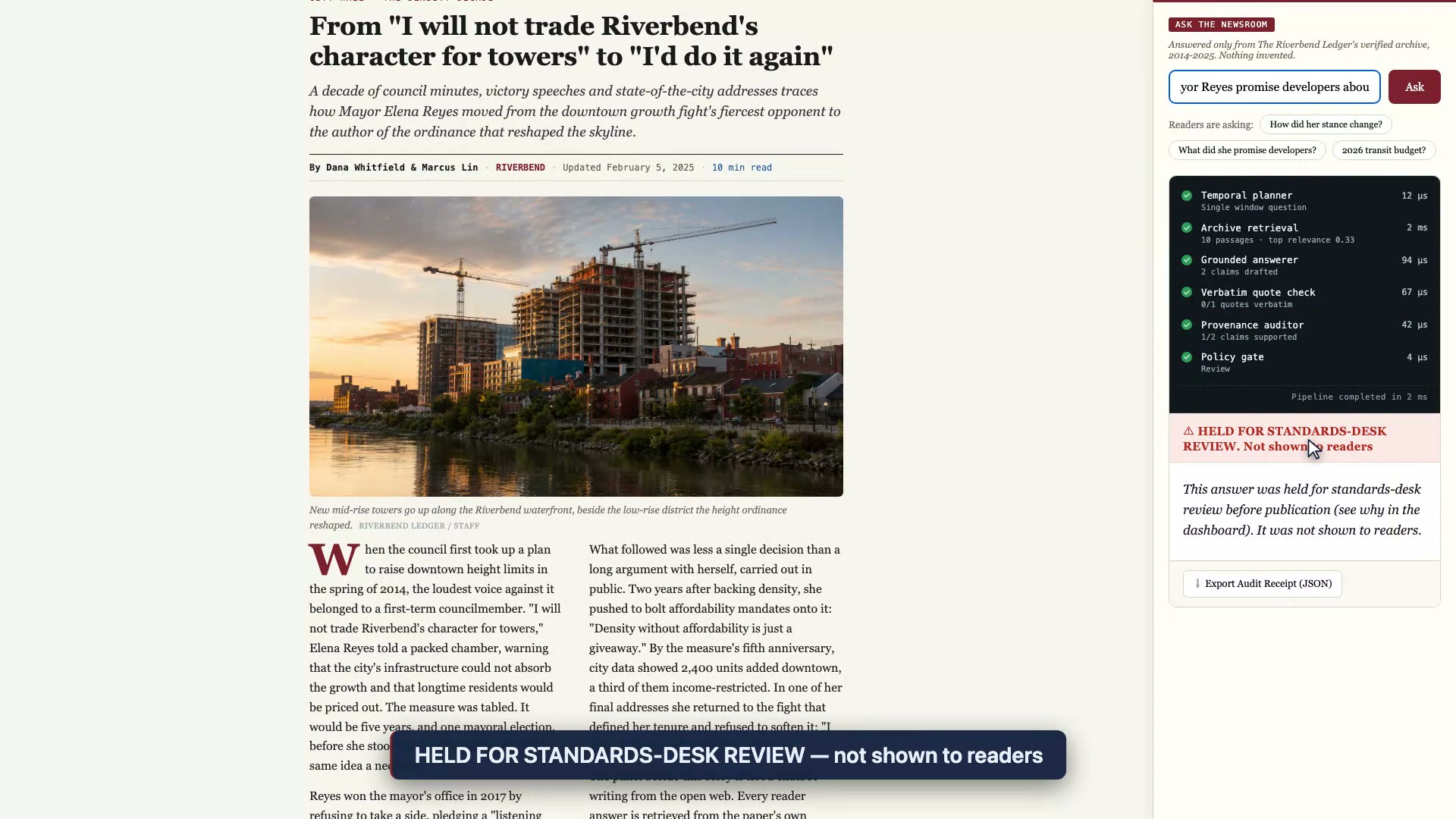 What the reader gets instead of the fabrication: nothing but an honest hold. The verbatim quote check reads 0 of 1 verbatim and the auditor 1 of 2 claims supported, so the policy gate marks the answer Review and the banner states it was not shown to readers. The Export Audit Receipt button turns the whole decision into a JSON record.
The guarantee we lean on is narrow and provable. No answer with an unverified quote or an unsupported claim is ever auto-cleared. That is a deterministic invariant, unit-tested directly rather than hoped for. We are careful about scope: in this demo's 10-query eval set, five answers that an unguarded vanilla vector-RAG widget would have published with a fabricated or misquoted span were held back by the gate. The split of what auto-clears versus what routes to a human is this eval set's result, not a universal number. The invariant is the part that holds in the open world.
Agents advise, code decides
The reason the gate can promise that is where the trust boundary sits. Three language-model agents do the soft work: a temporal planner splits a longitudinal question into time windows, an answerer drafts claims with inline citations, and a provenance auditor gives a per-claim verdict. None of them get the final say. The verbatim-quote rule and the policy gate are plain Python, outside the agents. Publish-safety never rests on a model grading its own output.
You can see both engines in one frame on a question the gate does clear. Asked how the mayor's stance shifted from 2014 to 2025, the planner decomposes it into three windows, retrieval pulls real archive passages, the answerer assembles a chronological narrative, and every stage reports its own count: 5 of 5 quotes verbatim, 6 of 6 claims supported, policy gate auto-clear. That longitudinal, fully-cited answer across 13 years is the kind of thing a vector-RAG widget cannot assemble, and it clears only because every quote in it matched its source exactly. The two failure shapes the gate also handles round out the family: a question the archive cannot cover returns an honest "outside coverage" rather than a guess, and a fabricated quote routes to the desk, as above.
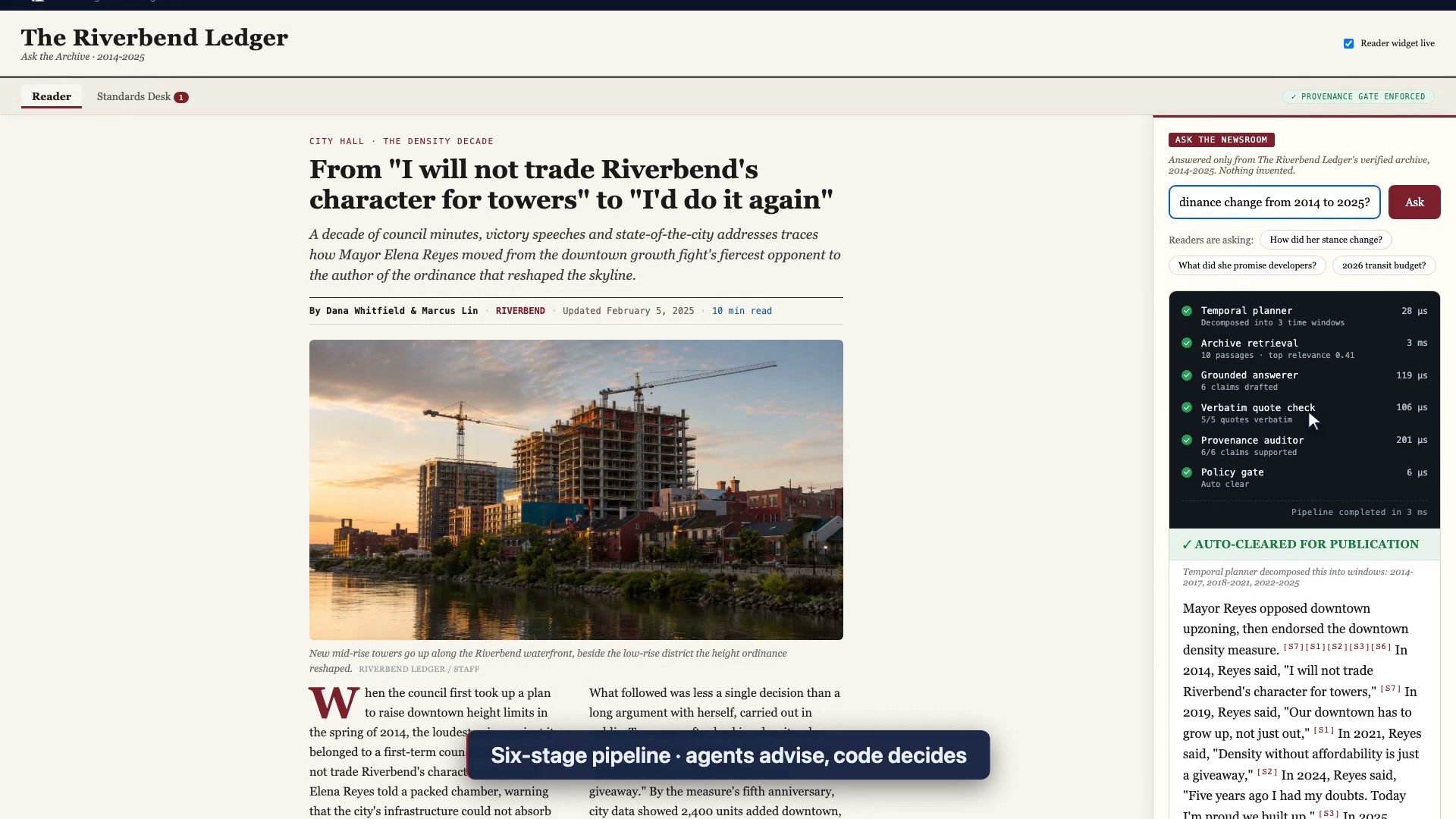 The same pipeline on an answer that clears. Six stages run in a few milliseconds, and this one reports 5 of 5 quotes verbatim and 6 of 6 claims supported, so the deterministic policy gate marks it Auto clear. The soft agents plan and draft; the verbatim rule and the gate, in plain Python, decide what is safe to publish.
The receipt and the kill switch are what a standards desk actually operates
Governance is not a banner, it is an artifact and a control. Every answer produces a JSON audit receipt: the query, the decomposed sub-questions, the retrieved sources with their dates and ids, the published text, each claim with its cited source and verdict and evidence passage, each quote with its verbatim-match result, the gate decision and reason, the engine and model, and a UTC timestamp. A standards editor can reconstruct exactly why any answer cleared or was held, in seconds rather than the hour a manual review would take.
And when something looks wrong at the system level, the dashboard has a kill switch that pauses the reader widget while the back end stays live. New reader questions stop being answered until an editor turns it back on. It is the equivalent of the standards desk being able to stop the presses on the AI without taking the whole newsroom offline.
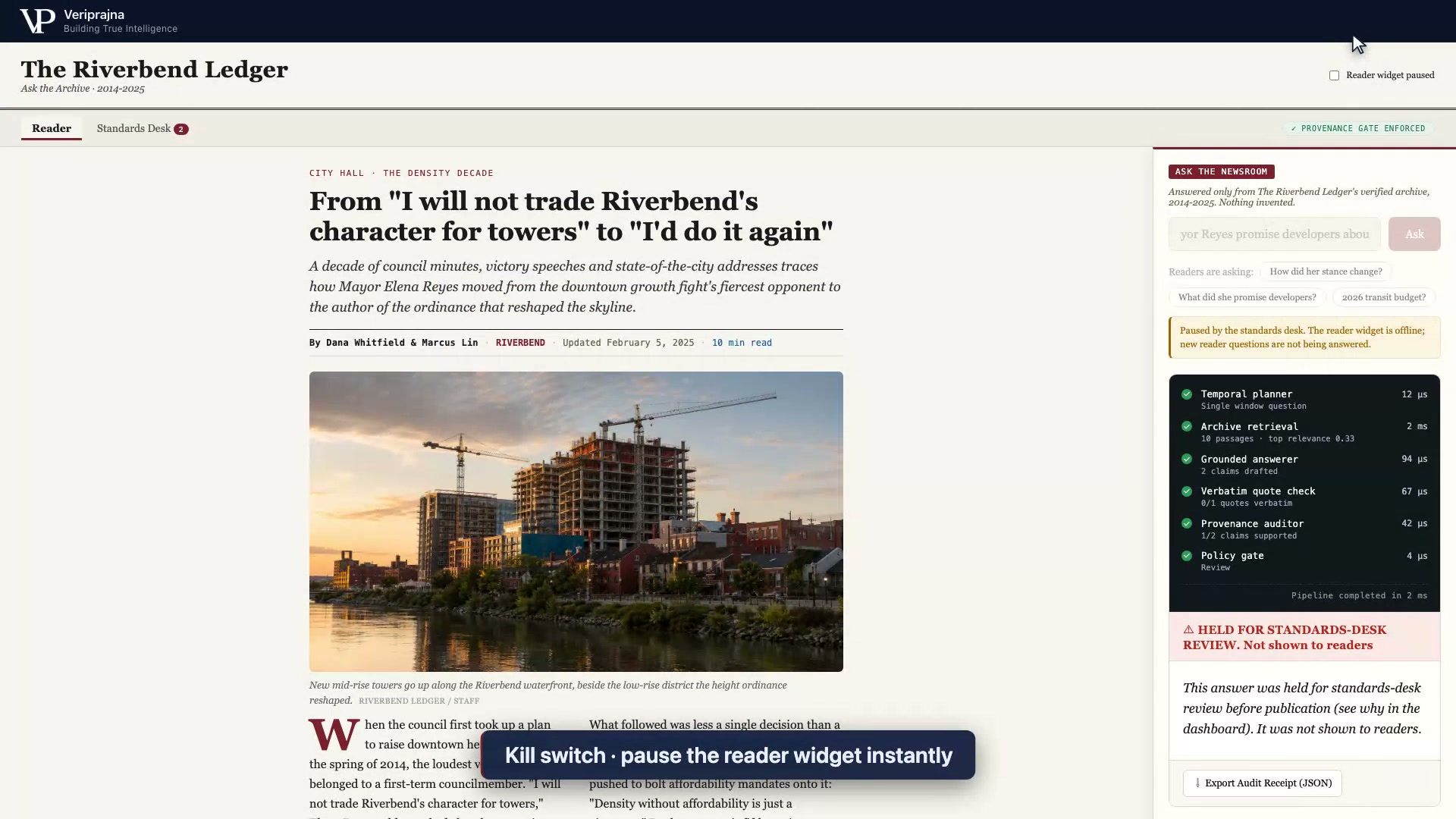 The kill switch engaged. The reader widget reads paused and stops answering new questions, while the provenance-gate badge and the review queue stay live. A standards desk can take the reader-facing AI offline on its own authority without touching the rest of the system.
Where this is, and one question
This is a demo, not a deployed pipeline. The publisher and its archive are synthetic, entity resolution runs off a pre-resolved fixture, and the CMS connection is a stub, so it proves the mechanism rather than running your newsroom. What we are confident about is the shape of the answer: fabricated and misquoted spans can be caught deterministically, questions outside the archive should be abstained on rather than guessed, and what is safe to publish under a masthead has to be decided outside the model that wrote it. You can watch the full run at https://veriprajna.com/demos/conversational-ai-for-publishers.
So one concrete question for anyone putting a conversational AI over a publisher's archive: once the model composes an answer, does anything match each quoted sentence verbatim against its source passage before that answer publishes under your masthead, or does it ship on the model's confidence? We would genuinely like to hear where your team draws that line. The problem is arriving industry-wide, and the good answers will be too.