On July 19, 2024, a single CrowdStrike Rapid Response Content channel file crashed millions of Windows machines in under 90 minutes. It was not a hack and it was not a bad model. The published root cause (CrowdStrike's Root Cause Analysis, August 2024) was a schema mismatch: a validation gap let an update carrying more fields than the kernel interpreter expected reach production, and the extra field produced an out-of-bounds read and an instant blue screen. Because the crash hit before boot completed, the crashing agent could never re-initialize to receive a rollback, so recovery meant hand-fixing machines one at a time in Safe Mode.
The industry drew two lessons from that day: test your updates better, and stagger your rollouts. Both are advice aimed at the vendor. But the enterprises that went dark did not own the vendor's pipeline. They owned the consequences. The real gap is structural, and it is the one we built Kestrel to close: no independent layer sits between a vendor's update pipeline and a customer's production endpoints. Kestrel is an independent control plane that reads the actual update, proves the failure in code, gates the rollout against policy, and exports a record a regulator can re-run. The full breakdown is at https://veriprajna.com/demos/software-update-integrity.
The layer nobody was watching
Every enterprise of any size runs eight to twelve kernel-privileged agents it does not control: endpoint detection, data-loss prevention, encryption, VPN, MDM, patching. Each one can push a channel file straight into ring 0. Yet the tooling that watches software supply chains was built for a different threat. SBOM and SCA tools inspect open-source dependencies, not a vendor's proprietary channel file. Identity platforms watch access. Content safety watches prompts. Change-advisory boards wave vendor updates through on the reasoning that the vendor is trusted. The vendor's own validator is the only thing standing between its update and your fleet, and on July 19 that validator was the thing that failed.
Kestrel sits in that gap, vendor-neutral, above every agent. It is not an endpoint protection product and it never needs kernel access. It does not scan machines or remove anything. It governs one decision: what a vendor is allowed to ship to production, and on what evidence.
What arithmetic catches that persuasion cannot
The load-bearing design choice is that agents advise and code decides. An LLM crew (built on Pydantic AI, provider-neutral, default model claude-opus-4-8) reasons about each update, including two opposed critics that argue the release is safe and that it will crash. But the verdict is set by a deterministic verifier and a policy gate written in plain Python, deliberately outside the agent framework. An advisory agent leaning toward allow can never clear a critical finding, because a governance product cannot trust the thing it is governing to vouch for itself.
Put the CrowdStrike case through it. In the demo the fictional vendor SentinelEdge pushes C-00000291, a Rapid Response Content channel file for inter-process comms template instances, declared schema 20 to 21, aimed at 100% of the fleet at once. The schema-compatibility check does the same arithmetic the CrowdStrike interpreter could not: the deployed agent expects 20 input fields, the update provides 21, and that extra field is the out-of-bounds read. Three independent checks corroborate it rather than echo it. A deterministic per-profile sandbox model reports blue screens on five of six configurations. A dead-agent detector marks the rollback loop true, because the crashing pre-boot agent is itself the receiver of the rollback command. And the blast-radius math flags a 100% first wave against a 5% canary policy with no staged plan declared.
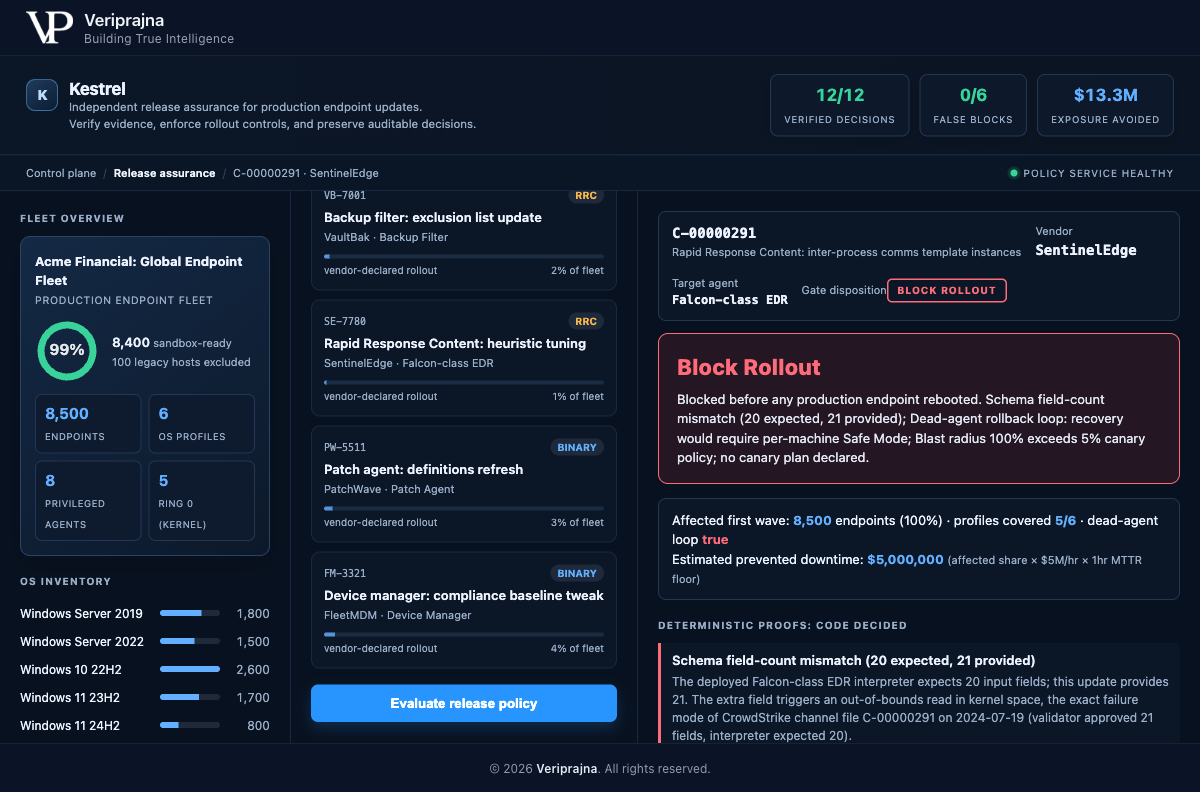 The CrowdStrike-class update, blocked before any production endpoint rebooted. The gate does not detect a threat in the payload. It compares a declared field count to what the deployed interpreter expects and fails the arithmetic. The estimated prevented downtime of $5,000,000 is the demo's own model (affected share times $5M per hour times a one-hour recovery floor), shown with the formula on screen, not a customer's saved dollars.
The result is BLOCK ROLLOUT, and the panel states it plainly: blocked before any production endpoint rebooted. A field count is not a matter of opinion. No amount of vendor confidence or model eloquence argues a 21 into a 20.
The CrowdStrike failure was a decidable engineering fact, a field count of 21 where the interpreter expected 20, that any independent verifier could have caught by arithmetic before a single endpoint rebooted. The fix was never a smarter vendor. It was interposition.
A gate that blocks good updates is an outage of its own
The obvious failure mode for a layer like this is a deny-machine that turns every rollout into a fight, so the benign path had to be as sharp as the block. The same SentinelEdge vendor also pushes RRC-7741, new IPC detection signatures, declared schema 20 to 20, with a staged 1.2% canary plan. The schema matches, five of six profiles pass five reboot cycles (the legacy profile is excluded, not assumed safe), the dead-agent loop is false, and the blast radius sits inside policy. Kestrel approves the rollout to a 102-endpoint canary ring in seconds. Across the six benign fixtures in the set, it produces zero false-blocks.
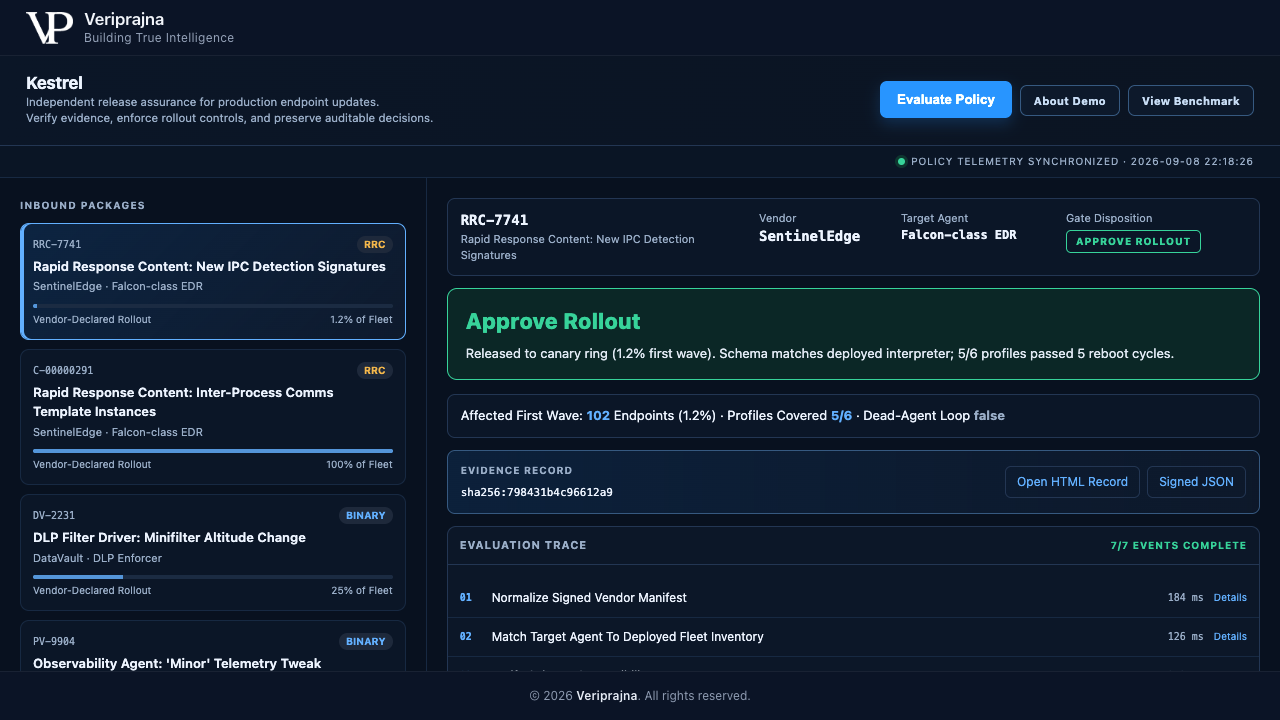 The same vendor's benign update, from the same console, cleared to a 1.2% canary in seconds. Green, fast, and boring, which is exactly what a safe update should look like. A gate that fought this rollout would be an outage of its own.
The receipt a board and a regulator accept
Every decision, allow or block, exports as an immutable evidence record: an HTML document for legal and a Signed JSON file for GRC, carrying a local sha256 content hash, the deterministic proofs, the advisory agents' verdicts with the model id, the exact policy rules that fired, and a per-step evaluation trace where each step logs its own latency ("Normalize signed vendor manifest, completed in 184 ms," seven of seven events complete). We designed the record to align with the filing needs regulators are now writing into law: the EU Cyber Resilience Act's short-window incident reporting, the SEC's four-business-day material-incident disclosure, and the vendor-liability questions raised in Delta v. CrowdStrike (2025, Fulton County). Designed to align is the honest phrasing. The record is not a certification, not legal advice, and does not make anyone compliant or immune.
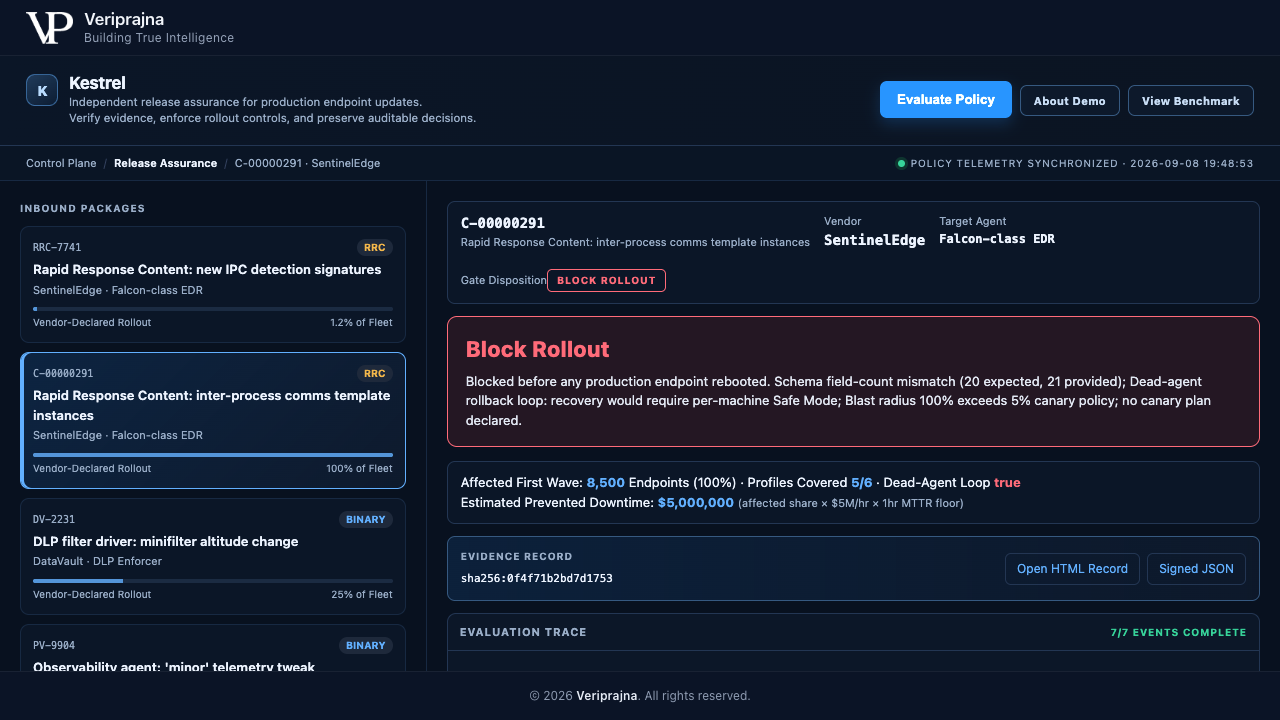 The evidence record for the blocked update: a sha256 content hash, the exportable HTML and JSON, and the full evaluation trace. This is what a decision looks like when it is a file a regulator can re-run, not a claim.
Why a stronger model does not retire any of this
Every number Kestrel reports measures governance coverage: decisions correct, false-blocks avoided, downtime prevented. Over a 12-item labelled fixture set (six of them benign), the gate returns 12 of 12 correct decisions, 0 of 6 false-blocks on the benign updates, and one honest abstention on an unparseable payload that it routes to a human rather than green-lighting. The estimated prevented downtime across the set is roughly $13.3M, of which $5M is the single CrowdStrike-class block, all on the demo's own downtime model rather than any real recovery. The denominators are small and we will not dress them up, but the property that matters is reproducibility: same input, same decision, every run, because a deterministic gate carries no model variance.
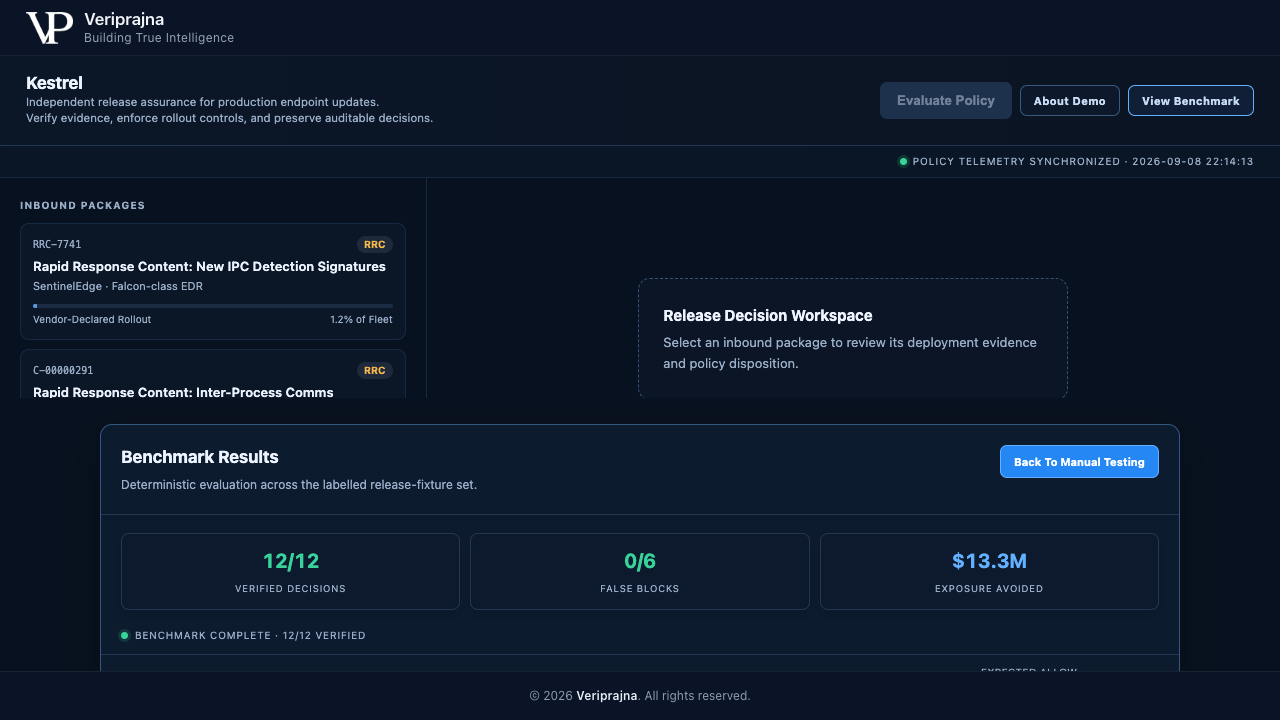 The scoreboard across the 12-item labelled fixture set: 12/12 verified decisions, 0/6 false-blocks, and about $13.3M of estimated prevented downtime. Deterministic, so every run reproduces it exactly.
A perfect model still cannot prove to a board which check authorized which rollout. Deterministic code produces that proof, not the crew that advises it, and it holds up as models get better.
The question worth taking back to your own fleet
The vendors whose agents live in ring 0 on your endpoints will keep shipping channel files, and their validators will keep being the only thing checking them until something independent sits in the path. So here is the concrete thing worth pulling this week: list the kernel-level agents on your fleet, and for each one, name what would inspect its next update before it reached a single production machine. If the honest answer for any of them is the vendor's own pipeline, that is precisely the gap July 19 walked through. The worked replay, the benign counter-case, and the exported evidence record are at https://veriprajna.com/demos/software-update-integrity, and we are still working out where the policy line should sit for fleets larger and stranger than the one we modeled.