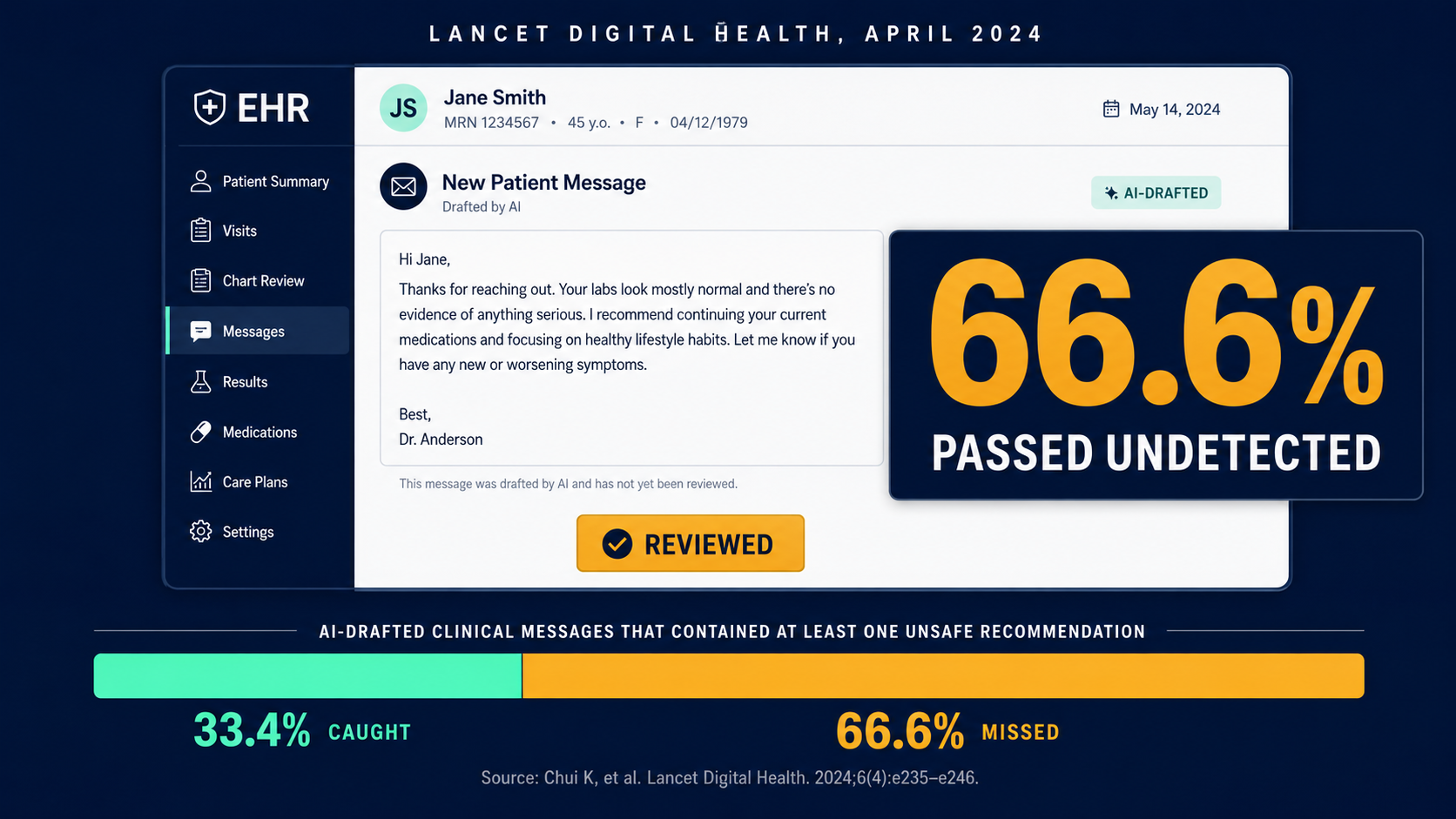
The AB 3030 compliance strategy most health systems built in 2024 rests on a number that the Lancet Digital Health published in April of that year: the rate at which physicians reviewing AI-generated clinical content before it reaches patients actually catch the harmful errors. That number is 33.4%. Sixty-six point six percent of harmful AI drafts survive physician review. In 35–45% of erroneous cases, the draft reaches the patient entirely unedited. Ninety percent of the physicians in the study reported trusting the AI's performance throughout.
California's AB 3030 exempts health systems from AI notification requirements when a licensed provider reviews AI-generated content before delivery. The exemption is technically satisfied by a 12-second scan. What that scan catches is one-third of the problem.
This is not an isolated observation about ambient scribes. It's the starting point for understanding why the governance model most health systems built — vendor documentation reviewed by a committee, SOC 2 on file, "read and reviewed" in the workflow — doesn't constitute clinical AI safety. Our Healthcare AI Safety for Health Systems work starts from this gap and builds forward: independent assessment, bias monitoring, governance architecture, and the regulatory compliance engineering that turns state and federal requirements into operational controls.
The AB 3030 "read and reviewed" standard is technically satisfied by a 12-second physician scan. The Lancet evidence says that scan misses two-thirds of the harmful content it was supposed to catch — which means the exemption creates documented liability exposure, not safe harbor.
What the Vendor Told You About Accuracy
The ambient documentation market passed $600M in revenue in 2025, growing 2.4x year-over-year. Abridge, which raised a $316M Series E in April 2026 at a $5.3 billion valuation, earned Best in KLAS for Ambient AI in both 2025 and 2026 and runs across more than 40 hospitals. Nuance DAX Copilot holds roughly a third of the enterprise market. Ambience Healthcare closed a $243M Series C and extended its rollout to Cleveland Clinic. These are not fringe products — they are the clinical AI infrastructure of large health systems.
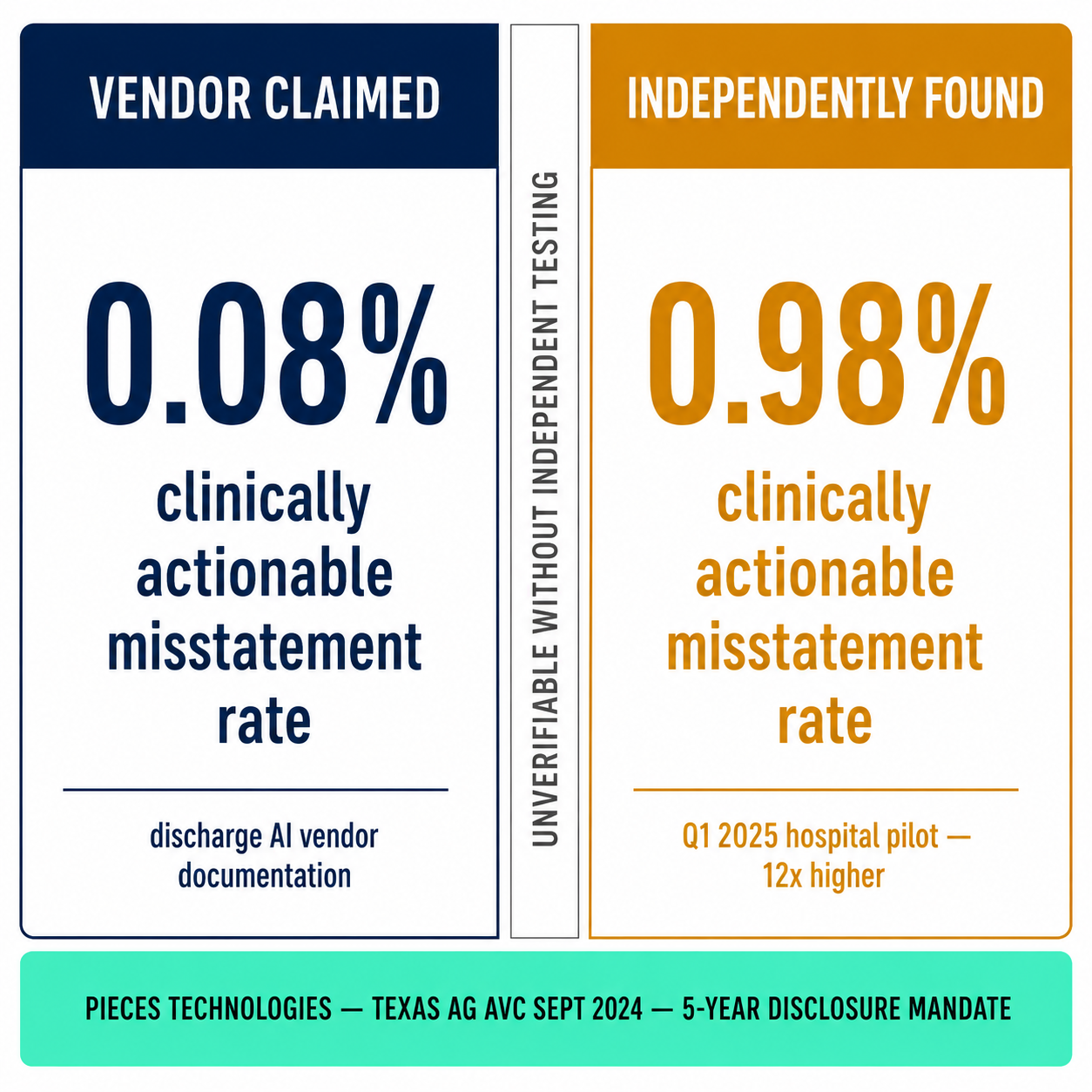
What each vendor's accuracy claims share is a denominator problem. In September 2024, the Texas Attorney General reached the first enforcement action against a healthcare generative AI company. Pieces Technologies had claimed a less-than-0.001% "critical hallucination rate" for its clinical documentation software, deployed at Houston Methodist, Children's Health, Texas Health Resources, and Parkland. The Assurance of Voluntary Compliance that followed imposed a five-year transparency mandate requiring disclosure of precisely what had made that claim unverifiable: how "critical" was defined, which use cases were sampled, what denominator was used.
The information needed to evaluate a vendor's accuracy claim was the information the claim didn't include. That's not a Pieces Technologies problem. It's endemic to a market where vendors define their own metrics and health systems lack the infrastructure to test them independently.
The Q1 2025 discharge assistant incident demonstrated what that gap costs operationally: a deployed AI recommended a medication for a patient explicitly listed as allergic to that drug class. The actual clinically actionable misstatement rate was 0.98% — twelve times higher than the vendor's claimed 0.08%. The error was caught by a nurse. Not by the procurement review, not by the governance committee, not by the "read and reviewed" physician.
The Bias Layer No Vendor Documentation Covers
Clinical AI tools are trained on historical clinical data. That data reflects the biased human judgment and the flawed instruments that generated it.
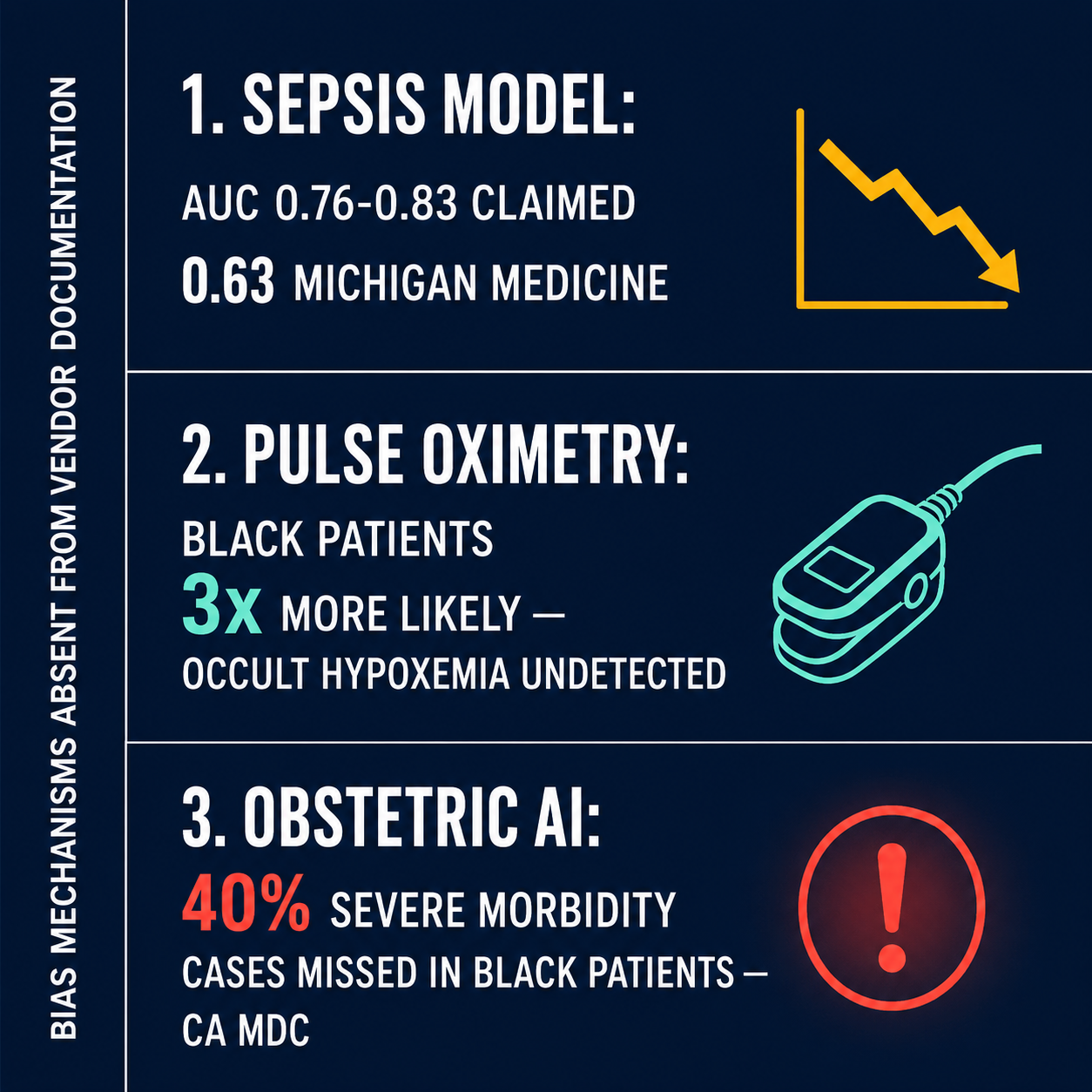
The Epic Sepsis Model illustrates the performance gap that external validation routinely finds. The developer reported an AUC of 0.76–0.83. Michigan Medicine's external validation found AUC of 0.63, sensitivity of 33%, and a positive predictive value of 12% — the model was alerting correctly on 1 in 8 patients it flagged, and detecting sepsis before clinical recognition in only 6% of cases. Black and Hispanic patients carry nearly twice the sepsis incidence of white patients; the model's calibration for those groups was not addressed in the original deployment.
Pulse oximeters are a medical device, but the clinical AI models trained on their output inherit their measurement errors. NEJM data documents that Black patients are approximately three times more likely to experience occult hypoxemia undetected by pulse oximetry, with SpO₂ overestimation of 0.6 to 1.5 percentage points in darker-skinned patients. FDA draft guidance issued in January 2025 recommends a minimum of 150 diverse participants in device validation — up from 10 — using the Monk Skin Tone scale with 25% minimum per group. That guidance doesn't retrofit the devices already deployed or the clinical AI models already trained on their output.
In obstetrics, California Maternal Data Center data found that AI early warning systems missed 40% of severe morbidity cases in Black patients. Black women face 42.8–50.3 maternal deaths per 100,000 live births against 13.0–14.5 for white women. McKinsey estimates closing that gap could add $24.4 billion to US GDP and save $385 million annually. The early warning systems weren't designed to perform differently by race. The demographic performance wasn't measured at deployment. The gap wasn't visible until someone measured it.
Running equalized odds analysis across race, sex, and age cohorts — with Population Stability Index tracking per deployment site to detect model drift — requires technical capacity most health systems don't have internally. Expert-adjudicated ground truth labels cost $50–200 per clinical case. This is not a workflow check. It's a specialized analytical function that has to be built.
A governance committee that approves AI deployments on vendor documentation doesn't surface demographic performance gaps. An independent bias audit does.
The Regulatory Timeline
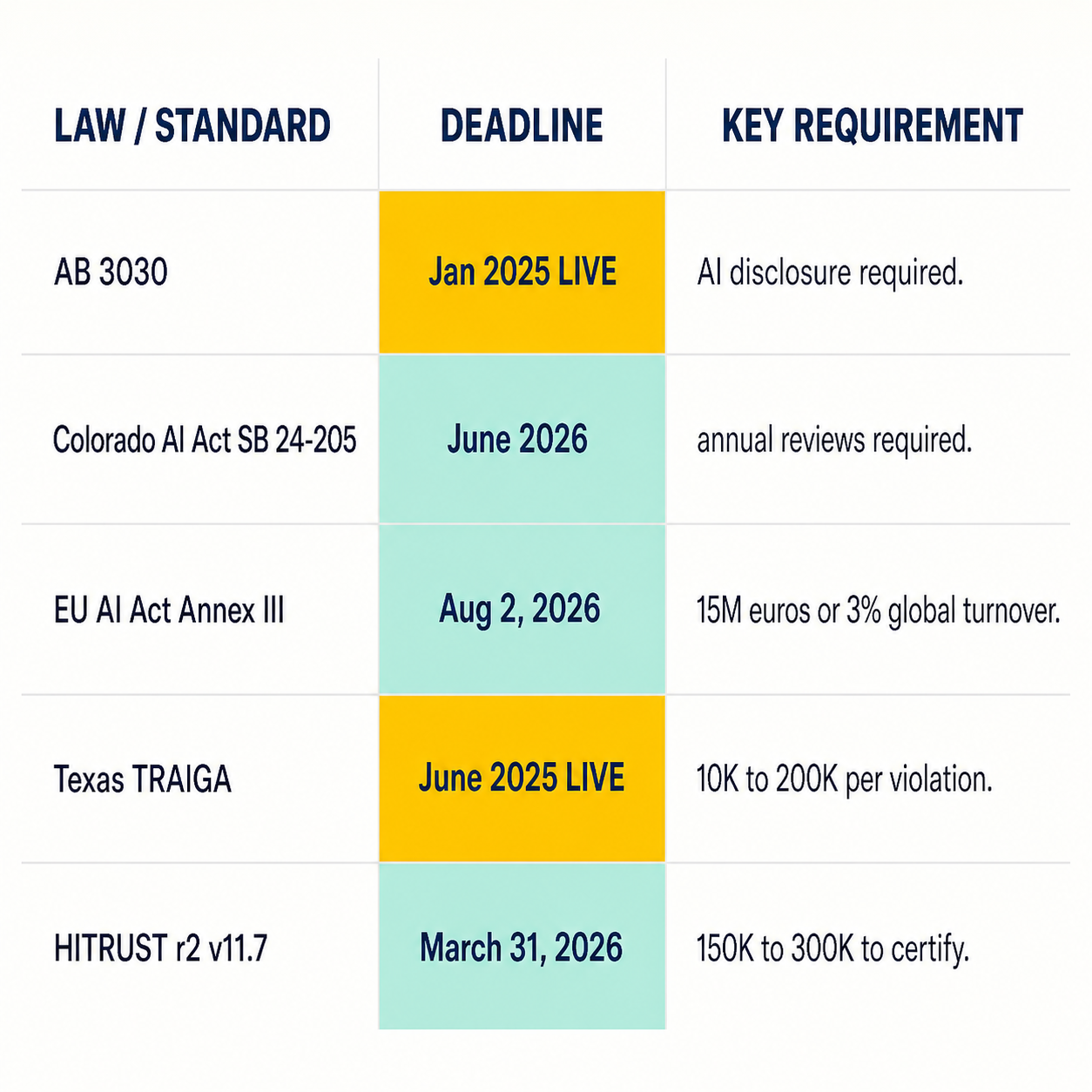
The legal infrastructure around clinical AI is being built on a timeline that has already started.
What makes 2026 the inflection point for clinical AI liability is not any single law but the simultaneity. AB 3030 is live in California. Colorado's AI Act (SB 24-205) — extended from its original February 2026 deadline to June 2026, with no further extension expected — treats clinical decision support as high-risk AI requiring annual reviews and a rebuttable presumption of compliance for health systems following NIST AI RMF or ISO 42001. The EU AI Act's Annex III high-risk provisions take effect August 2, 2026, carrying penalties up to €15M or 3% of global turnover. Texas's Responsible AI Governance Act has been in effect since June 2025 with per-violation penalties reaching $200,000. California AB 2013, requiring disclosure of AI training data and use cases, is already live as of January 2026.
The FTC's Section 5 enforcement posture has already extended to healthcare AI: the Rite Aid facial recognition settlement and the 2025 edtech enforcement action both included model disgorgement — mandatory destruction of the data and every model trained on it. That's not a fine. That's years of development erased.
What these laws share is a documentation requirement that health systems cannot produce without independent assessment: proof that vendor accuracy claims were independently verified, proof that subgroup performance was tested before deployment, proof that governance processes preceded implementation. HITRUST r2 certification — the enterprise standard for healthcare AI vendors, with v11.7 required for new assessments by March 31, 2026 — costs $150,000–$300,000 and takes 9–14 months. Compliance teams cannot engineer those requirements from the regulatory text alone.
What Clinical AI Governance Actually Requires
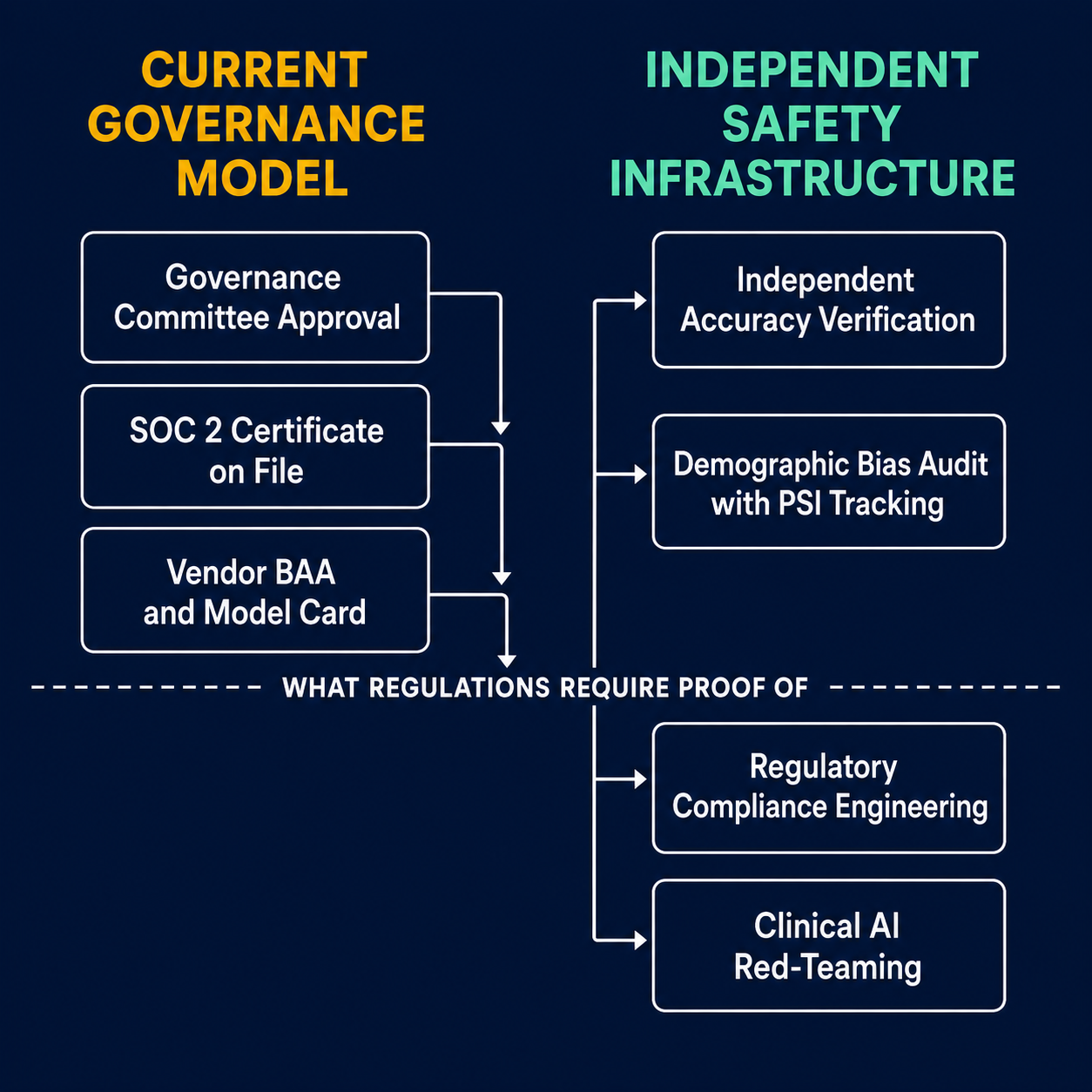
Eighty-four percent of health systems have AI governance committees, according to Censinet's 2026 survey. Only 59% have formal documented approval processes before AI implementation. CIOs sit on 63% of these committees; CMIOs on only 45%. The gap between having a committee and governing actual deployments is where most clinical AI liability is accumulating.
The governance model most health systems built assumes vendor documentation can substitute for independent verification. The Pieces settlement ended that assumption for any health system paying attention. Independent assessment — testing vendor accuracy claims on your patient population, with your EHR data, using disclosed methodology — is not a procurement step. It's an ongoing function.
What closes the verification gap in practice is a cross-vendor governance architecture, not a per-tool approval. Health systems typically run 5–15 AI tools simultaneously: ambient scribes, patient messaging AI, sepsis models, triage algorithms, diagnostic support. Each tool has its own accuracy claims, its own safety profile, and its own demographic performance gaps. No vendor provides the cross-tool monitoring infrastructure. Building it requires mapping each tool's failure modes, establishing baseline subgroup performance, deploying PSI tracking for drift detection, and maintaining the governance documentation that regulatory audits will require.
The automation bias problem the Lancet study documented — the one that allows harmful AI drafts to pass physician review at a 66.6% rate — has a technical mitigation: uncertainty highlighting, citation linking (Abridge's Linked Evidence feature traces note content to the exact audio segment), and active confirmation workflows that interrupt the rubber stamp. The "read and reviewed" exemption requires review that actually reviews. That's an engineering problem, not a policy problem.
Malpractice claims involving AI tools increased 14% from 2022 to 2024, concentrated in radiology, cardiology, and oncology. The standard of care is shifting: a "reasonable physician" is now expected to know when to trust clinical AI and when to override it. Some malpractice insurers have added AI-specific coverage exclusions or conditioned coverage on AI training completion. The health systems building independent safety infrastructure now are doing so ahead of the first enforcement action and the first malpractice case that turns on whether demographic performance was tested before deployment.
The question that matters isn't whether the AI works. It's whether you can prove it works — across your patient demographics, against the documentation requirements the regulations above will demand, with an audit trail that predates any adverse event. The Healthcare AI Safety for Health Systems architecture we've built is designed for that proof burden.
The malpractice insurers tracking AI-related claims, the CMIOs building governance committee structures, the legal teams mapping Colorado AI Act compliance timelines — we'd genuinely welcome hearing what approaches other health systems are taking. The regulatory patterns are converging faster than most governance playbooks are being updated, and the reference designs that actually work tend to spread quickly once a health system publishes them.