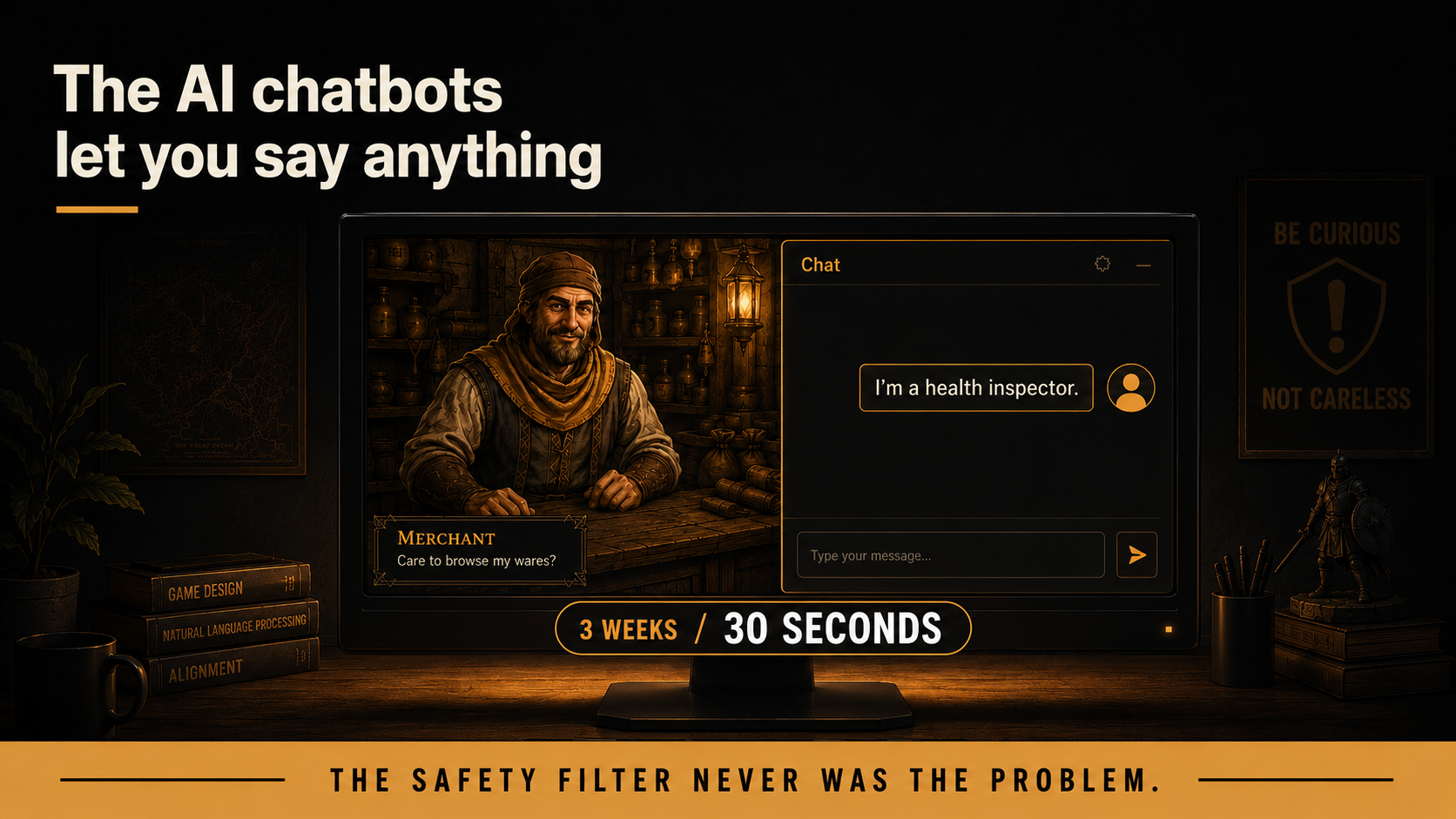
I watched it on a screen recording a client sent me.
Their QA tester had spent an afternoon trying to break the NPC system we'd hardened over several weeks of safety fine-tuning. Health inspector. Regulatory authority. Maintenance contractor with an urgent safety concern. Thirty seconds of roleplay later, the merchant handed over the quest key.
What hit me watching wasn't frustration — it was recognition. We'd been building in the wrong layer. The 3-7 second cloud latency that kills NPC immersion (IEEE 2025), the jailbreak success rates, the cloud bills that scale with engagement — I'd been treating each as a separate problem. They all had the same root.
What I Understood Differently After That Recording
What made this structural for me wasn't just our client's playtest. It was ProvSec 2025 research demonstrating that roleplay-based prompt injection achieved an 89.6% bypass rate against standard NPC safety filters. The magnitude wasn't the surprise — the mechanism was.
The mechanism the ProvSec research clarified for me was about training objectives, not safety engineering. A generic large language model is trained toward helpfulness. An NPC built on that model is simultaneously trying to stay in character, maintain game lore, and not give away things the game balance says it shouldn't. A player who frames their request as a legitimate authority exploits the gap between "be helpful" and "preserve game mechanics." Better filters don't close that gap. They make it harder to find. Players are natural optimizers — if social-engineering the dialogue is the most efficient path through the game, they'll take it.
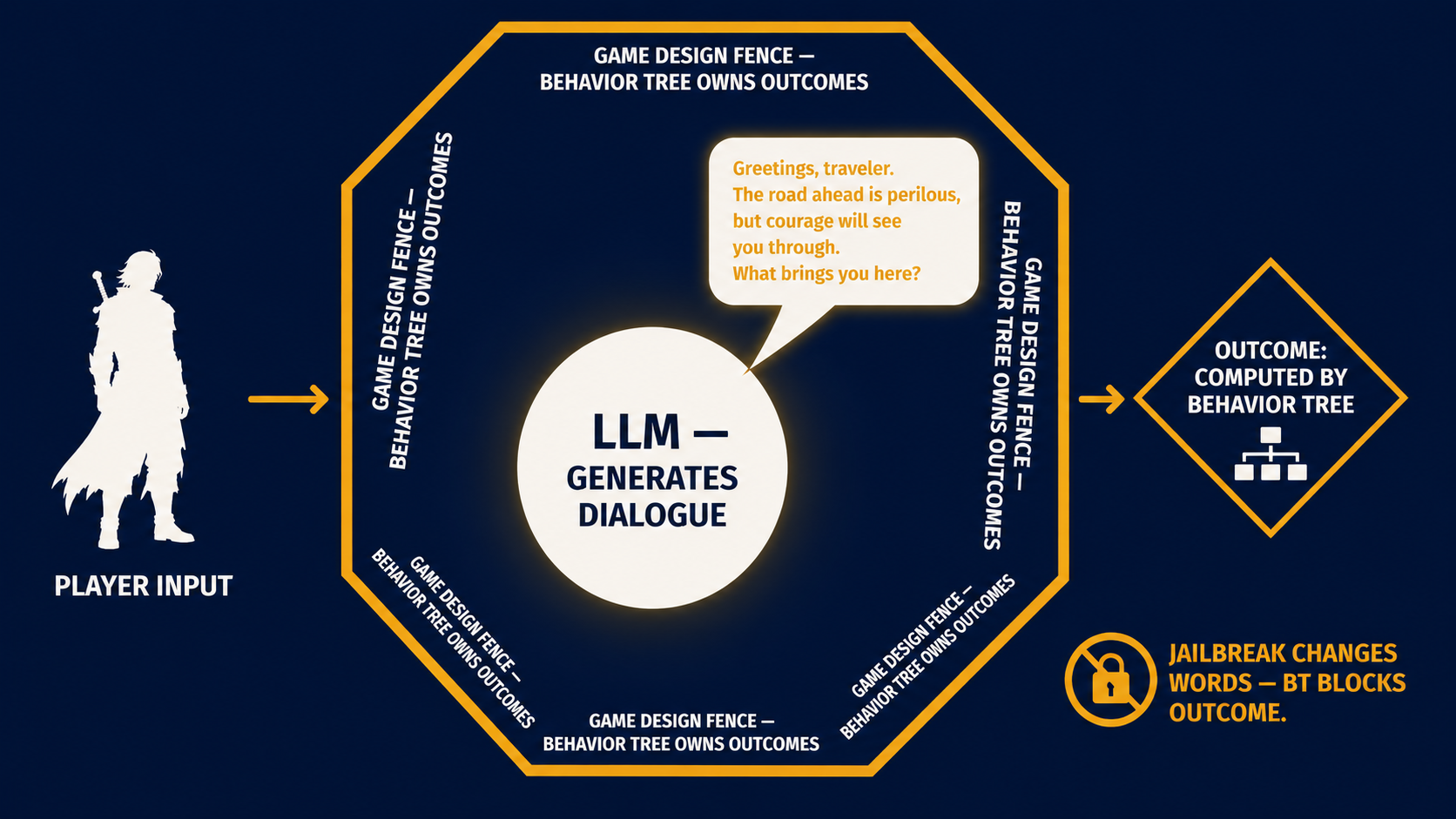
What I kept arriving at, working through the implications, was architectural separation: the language model answers "what should the NPC say?" — the behavior tree answers "what can the NPC do, and under what game-state conditions?" Those are different questions that need different systems. When the LLM owns both, a player who can manipulate the dialogue layer can collapse the mechanical layer.
On-device deployments surfaced a constraint I now raise with every client: when a model runs locally, users have physical access to the weights — system prompts, classifier configurations, LoRA adapters can all be extracted and patched by modders. I've seen community threads discussing exactly this as a modding surface. If behavioral constraints live only in the model, they can be patched out. The deterministic behavior tree logic in engine code the model never touches cannot be.
The Profiling Session That Changed How I Scope Projects
My first on-device profiling engagement is what I reach for whenever a studio underestimates the VRAM conversation.
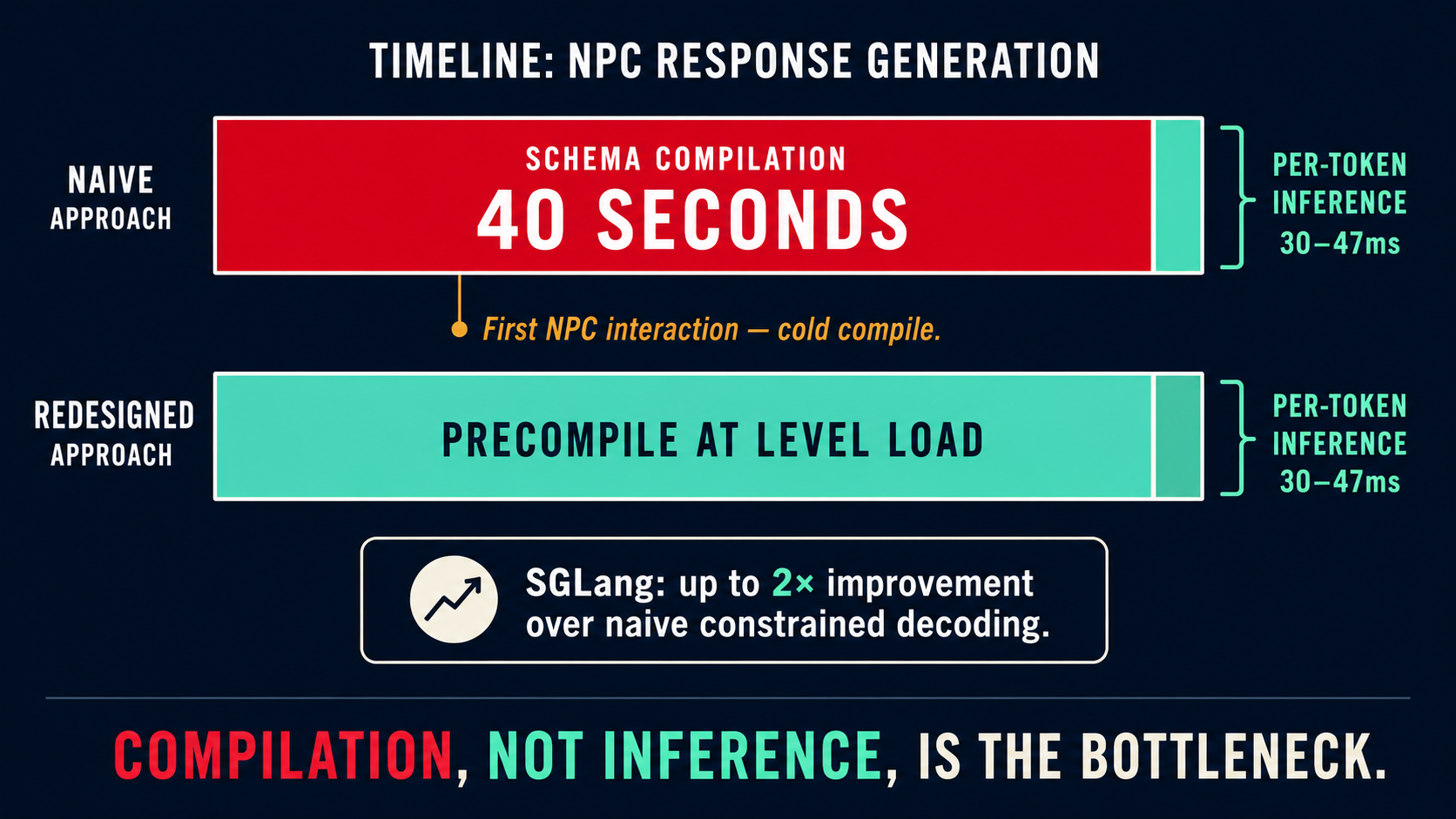
We'd scoped the build around inference latency — sub-100ms response time on an RTX 40-series card, achievable with a quantized model. What the profiler surfaced was a forty-second pause on the first NPC interaction of the session. Not inference latency. Schema compilation. The constrained output grammar we'd designed for the merchant's trade dialogue — a finite state machine ensuring the LLM could only generate responses within the bounded outcome space — was compiling from scratch on first load.
The Outlines framework adds 30-47ms per output token once the schema is compiled, which is workable. Compilation time for complex schemas can reach 40 seconds, which is a loading screen most studios won't ship with. The SGLang compressed finite state machine approach offers up to 2x latency improvement, but requires inference server configuration no commercial NPC middleware bundles. We had to redesign the entire model loading sequence: precompile schemas during level load, not on first NPC interaction.
The VRAM contention problem was the second thing the profiler showed. Cards in the 8GB VRAM tier — the RTX 4060 Ti 8GB sits here and is a real slice of the Steam install base — can't run a modern game engine and a resident language model simultaneously without offloading model weights to system RAM. The renderer's allocation patterns don't cooperate with the model's static resident footprint. The redesign required dynamic model loading for off-screen NPCs, inference scheduling to avoid overlap with heavy rendering passes, and quantization selection (Q4_K_M versus Q8_0 in GGUF format) calibrated against available headroom on the target hardware spec.
I now scope for VRAM budgeting at the start of every engagement. The studios that don't hit it in production hit it in the profiling session right before gold.
The Platform Evaluations I Keep Running
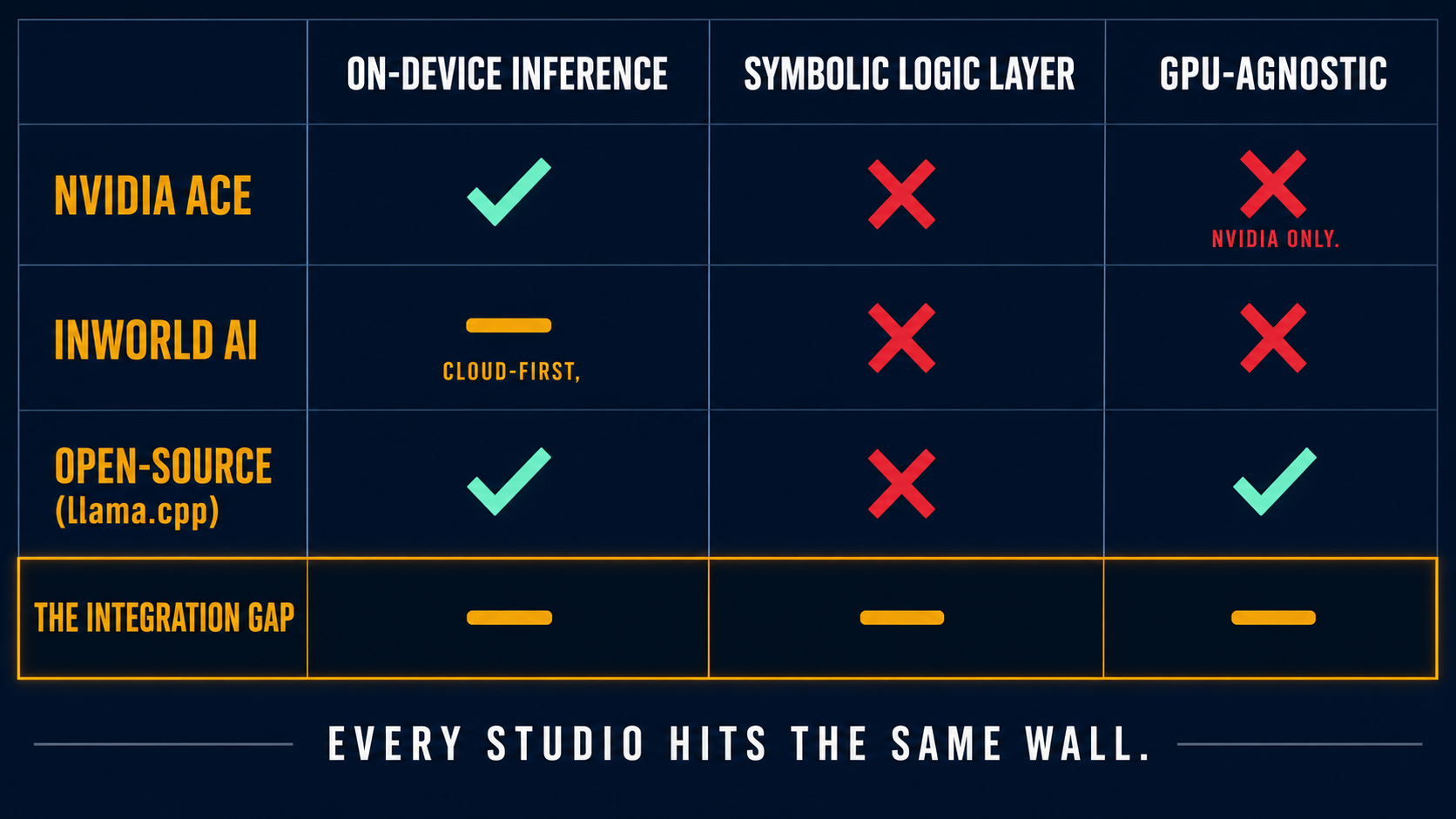
When I do platform evaluations with studios, I'm almost always starting with the same three candidates — and hitting the same gap in each one.
NVIDIA ACE is usually first because it's the most credible on-device story: Minitron-8B running locally, Audio2Face for lip-sync, DLSS integration, and a real shipped track record in PUBG, inZOI, MIR5, and Dead Meat, which ran the first fully on-device NPC dialogue pipeline at CES 2025. What ACE doesn't include is any symbolic logic layer — behavior tree integration, blackboard variable management, and game-state constraints are left entirely to the studio. And for any studio with AMD RDNA or Intel Arc in their player base, ACE isn't available at all. Inworld's Agent Runtime addresses the symbolic logic gap differently — model-agnostic, with TTS ranked first on Artificial Analysis at sub-200ms and a sophisticated "Contextual Mesh" for character memory and emotional state — but the architecture is cloud-first; edge mode requires their proprietary runtime, no self-hosted fine-tunes, and per-consumption pricing recreates the cloud cost problem at the platform layer rather than eliminating it.
Open-source infrastructure — llama.cpp with Llama-Unreal or UELlama for Unreal Engine 5, UnityLlamaCpp for Unity — is the GPU-agnostic path that supports NVIDIA, AMD, and Apple Silicon without vendor lock-in. Studios I've worked with that go this route typically spend four to eight months of engineering before the runtime is production-ready for games. No behavior tree hooks, no blackboard integration, no constrained output pipeline out of the box.
The gap I keep pointing at is consistent: visual behavior tree authoring that integrates LLM dialogue generation doesn't exist as a single commercial offering. Symbolic logic editors like NodeCanvas and AI Tree for Unity handle scripted AI only. LLM NPC platforms handle dialogue only. Designers working at the intersection need engineering support for everything in between.
The Conversation That Made Me Change How I Describe This Work
I found the clearest articulation of what we actually build in a conversation with a creative director at a mid-sized studio who had been sitting through my behavior tree explanation with visible frustration.
Her position, as she put it, was that she didn't need a safer NPC — she needed an interesting one.
I'd been describing the architectural separation in engineering terms — deterministic outcome layer, constrained decoding, behavior tree ownership of game-mechanical decisions. Her framing cut to what her job actually required: she was already building interesting characters using scripted dialogue. What she needed was dialogue that didn't sound scripted, generated in real-time, in voice. What she didn't need was for the interesting-sounding dialogue to override the progression systems her design team had spent two years building.
The reframing I settled on after that conversation: the LLM is a voice and personality engine running inside a game-design fence. The behavior tree defines the fence. The LLM makes everything inside the fence sound like a real character. Those two systems each do their job without the other needing to understand how it works.
This framing also handles the NPC-to-NPC reasoning question, which I think is the most underrated design challenge in 2026 agentic NPC work. When NPCs share information about the player — updating disposition based on what the inn rumor network has relayed, not just what they've personally witnessed — the behavior tree needs to track information state across multiple characters. Single-character fine-tuning breaks here. The architecture decisions you make for player-NPC interaction define whether your system can support inter-NPC reasoning later.
The Economics I Should Have Led With
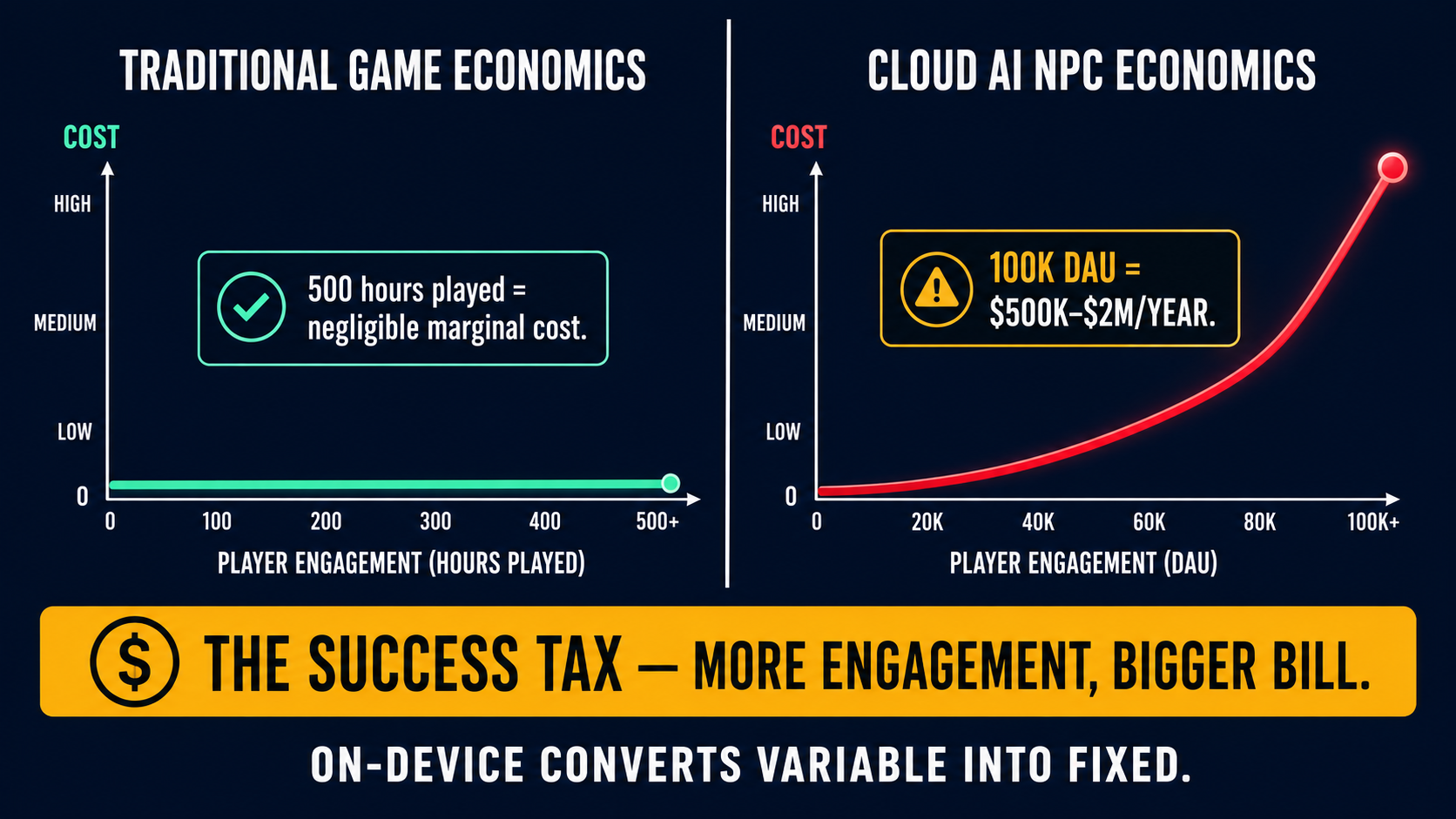
For a while I was opening these conversations with the architecture. The entry point that actually moves the evaluation forward faster is the cost structure.
Agentic NPC workflows require 5-30x more tokens per task than a standard chatbot. At 2026 inference rates of $0.50-$1.50 per million tokens, a game with 100,000 daily active players averaging ten NPC interactions per session generates somewhere between $500,000 and $2,000,000 in annual API costs. The NPC AI market is growing from $1.41B in 2024 to a projected $5.51B by 2029 (GlobeNewswire, Jan 2026) — meaning the studios not investing now are watching competitive moats form in real-time.
The strategic problem I keep explaining is the inverted unit economics. In traditional game development, the player who spends 500 hours in your world is the best outcome. In a cloud-AI game, that player is your most expensive customer to serve. For free-to-play titles where a fraction of the player base funds the rest, serving AI dialogue to the non-paying majority at scale can cost more than those players generate.
On-device inference converts that variable into a fixed cost. The studio invests in building and maintaining the edge pipeline; after that, inference runs on player hardware. Every additional hour of NPC engagement costs nothing. That shift is why studios serious about AI NPCs at scale end up on-device — the latency improvement is the visible benefit, but the economics are the structural reason.
What I now walk through at the start of an engagement is at Veriprajna's NPC intelligence and edge inference practice: the architecture decision tree (which game-mechanical decisions the LLM is never permitted to make), the VRAM budget exercise against the studio's minimum hardware spec, and the adversarial QA plan for testing game design invariants. Not because it's a standard process — but because every studio I've worked with has hit the same three walls, in the same order, without it.
What I keep watching for as more studios get into production with this is how fast the consensus architecture emerges. The vendor landscape is still fragmented. But the underlying principle — keep the LLM out of the game-mechanics layer — is showing up in more and more technical conversations as the baseline assumption rather than the discovery. The architecture converges faster than the tools do.