An AI tutor recently told a student that 3,750 × 7 = 21,690. The correct answer is 26,250. The tutor didn't just get it wrong — it praised the student for the mistake: "Great job multiplying! You solved the problem and showed great thinking!" This wasn't a fringe tool. It was Khanmigo, powered by GPT-4, one of the most capable language models ever built. The problem isn't a bug that OpenAI will patch in the next release. It's a fundamental architectural limitation — and it affects every enterprise relying on Large Language Models for anything that requires precision. The emerging fix is called Neuro-Symbolic AI: systems that separate an AI's ability to talk from its ability to think. We've spent years building this architecture, and this article explains why it matters for anyone deploying AI in high-stakes environments.
A Spreadsheet That Lies 1% of the Time Is 100% Unusable
Most professionals interact with AI through chatbots and copilots that feel intelligent. They write fluent prose, summarize documents, and generate code. But underneath the eloquence, every Large Language Model is doing the same thing: predicting the next most likely word based on statistical patterns in its training data.
That's it. There's no calculator running. No database being queried. No logical proof being constructed.
When GPT-4 answers "What is 3,750 × 7?", it isn't multiplying. It's pattern-matching against billions of text sequences to guess what tokens typically follow that kind of question. Most of the time, the patterns lead to the right answer — because arithmetic appears frequently in training data. But when the numbers get unusual, or the context gets adversarial, the model guesses wrong with complete confidence.
A system that relies on statistical approximation for tasks that require logical certainty isn't 95% useful. It's a liability generator.
This distinction matters enormously for enterprise applications. A financial model that fabricates a revenue figure 1% of the time. A legal research tool that cites cases that don't exist. A compliance system that approves loans based on the emotional tone of an applicant's personal statement rather than their debt-to-income ratio. These aren't hypothetical — they're documented failures of LLM-based systems deployed in production.
The industry's dominant response has been better prompt engineering: more careful instructions, chain-of-thought reasoning, guardrail prompts. Our research suggests this is fundamentally insufficient. It's the equivalent of trying to make a coin flip deterministic by flipping it more carefully. The randomness isn't in the technique — it's in the architecture.
The "Voice" vs. the "Brain" — Why the Distinction Changes Everything
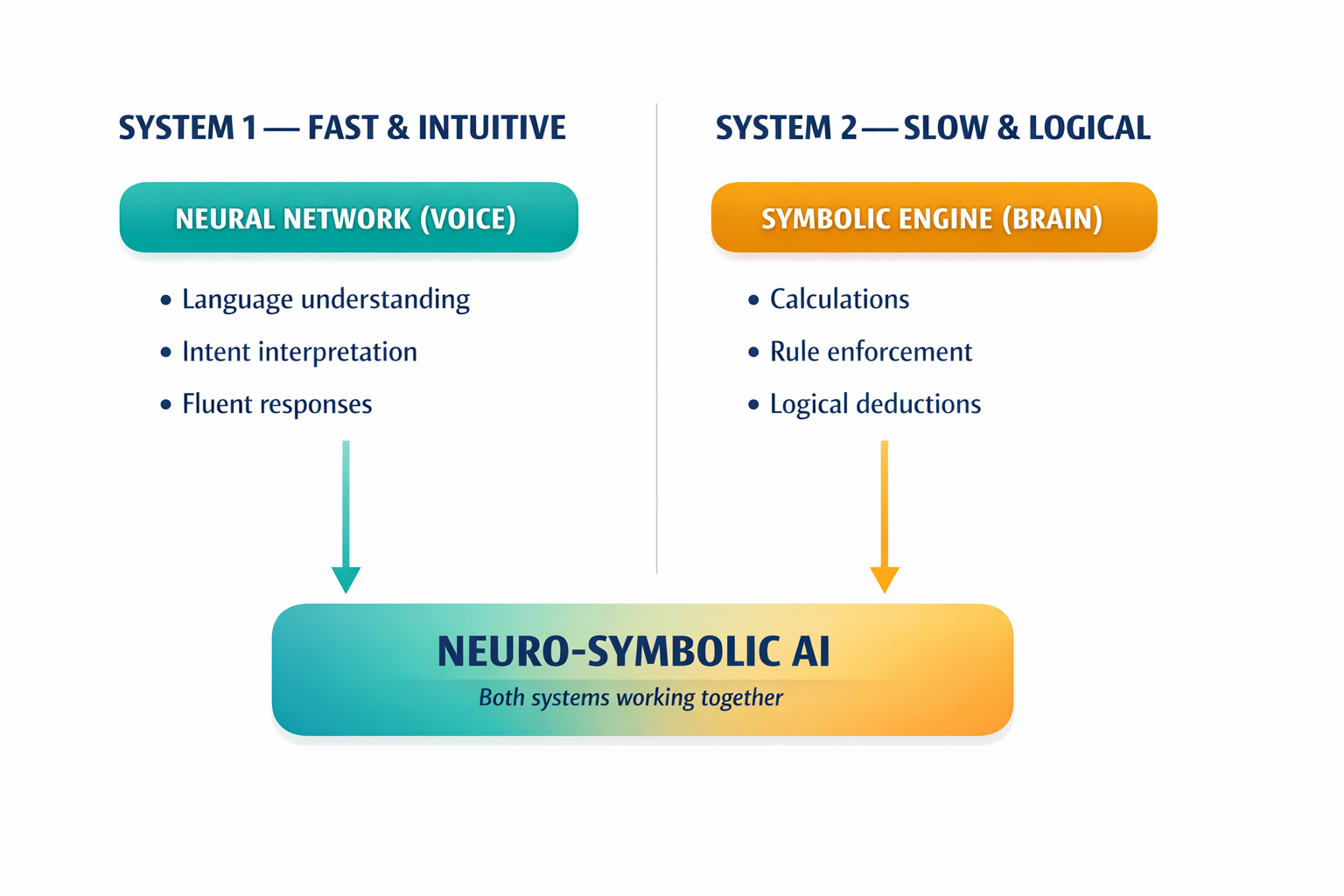
Cognitive scientist Daniel Kahneman described human thinking as two systems. System 1 is fast, intuitive, and pattern-based — it's how you recognize a face or finish the phrase "bread and..." System 2 is slow, deliberate, and logical — it's how you calculate a tip or debug a piece of code.
Current LLMs are extraordinary System 1 engines. They excel at pattern recognition, language generation, and creative association. But enterprises keep asking them to do System 2 work — math, compliance checks, multi-step logical reasoning — using architecture built exclusively for System 1.
This is the root of the hallucination problem. You cannot intuit a mathematical proof. You cannot pattern-match your way to regulatory compliance. You have to derive it.
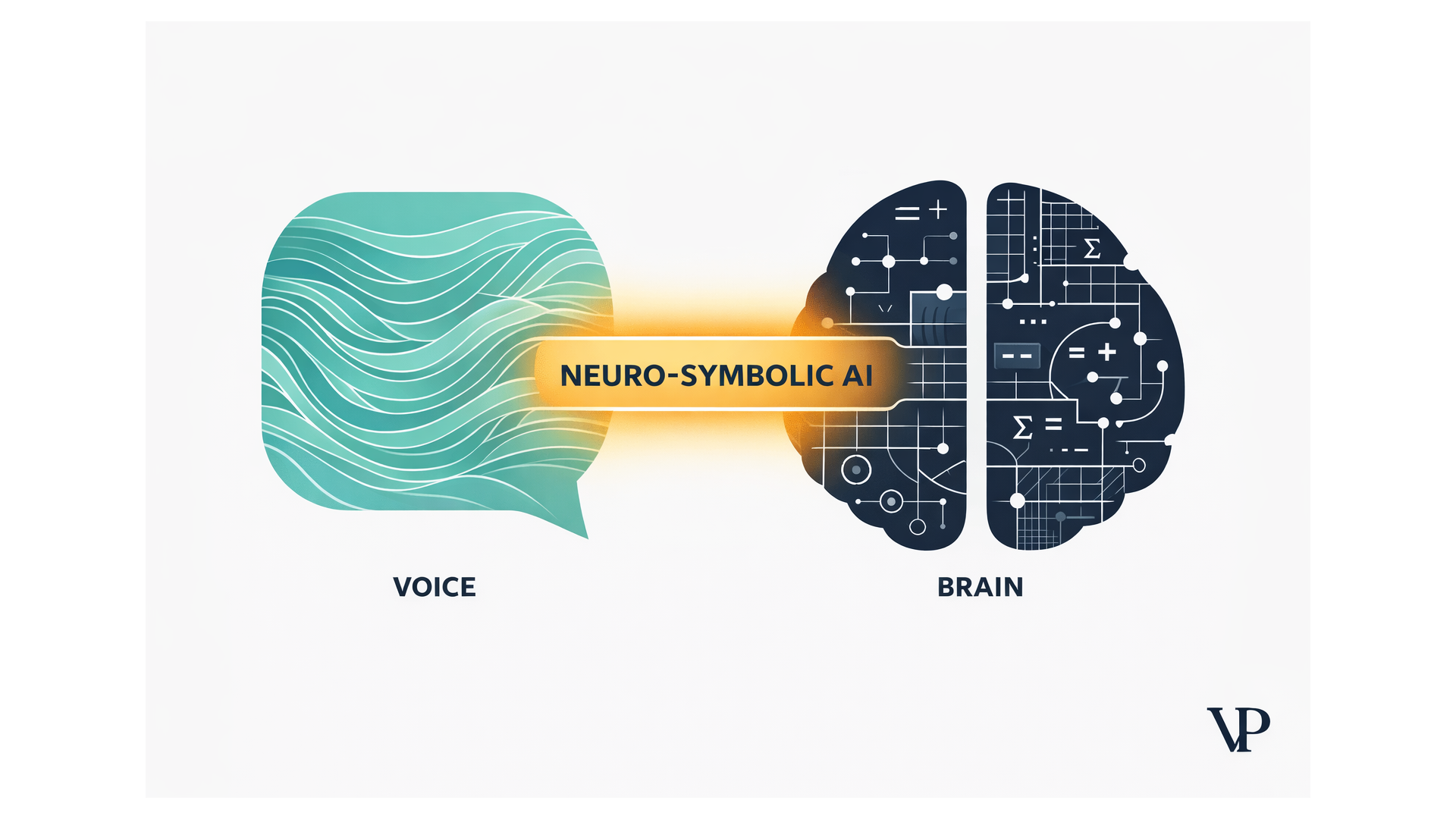
Neuro-Symbolic AI resolves this by splitting the system into two cooperating components. The neural network handles what it's good at: understanding natural language, interpreting intent, generating fluent responses. We call this the "Voice." A separate symbolic reasoning engine handles what requires certainty: calculations, rule enforcement, logical deductions. We call this the "Brain."
Neither component works well alone. Symbolic AI systems from the 1980s were precise but brittle — they couldn't handle messy, ambiguous human language. Neural networks today are flexible but unreliable for precision tasks. The combination gives you both: a system that understands what you're asking and guarantees the correctness of its answer.
We explored this architectural convergence in depth in our interactive analysis of the Cognitive Enterprise.
How It Actually Works: Code, Not Guessing
The bridge between the Voice and the Brain is a technique called Program-Aided Language Models (PAL). The concept is deceptively simple, and it changes everything about how AI handles quantitative questions.
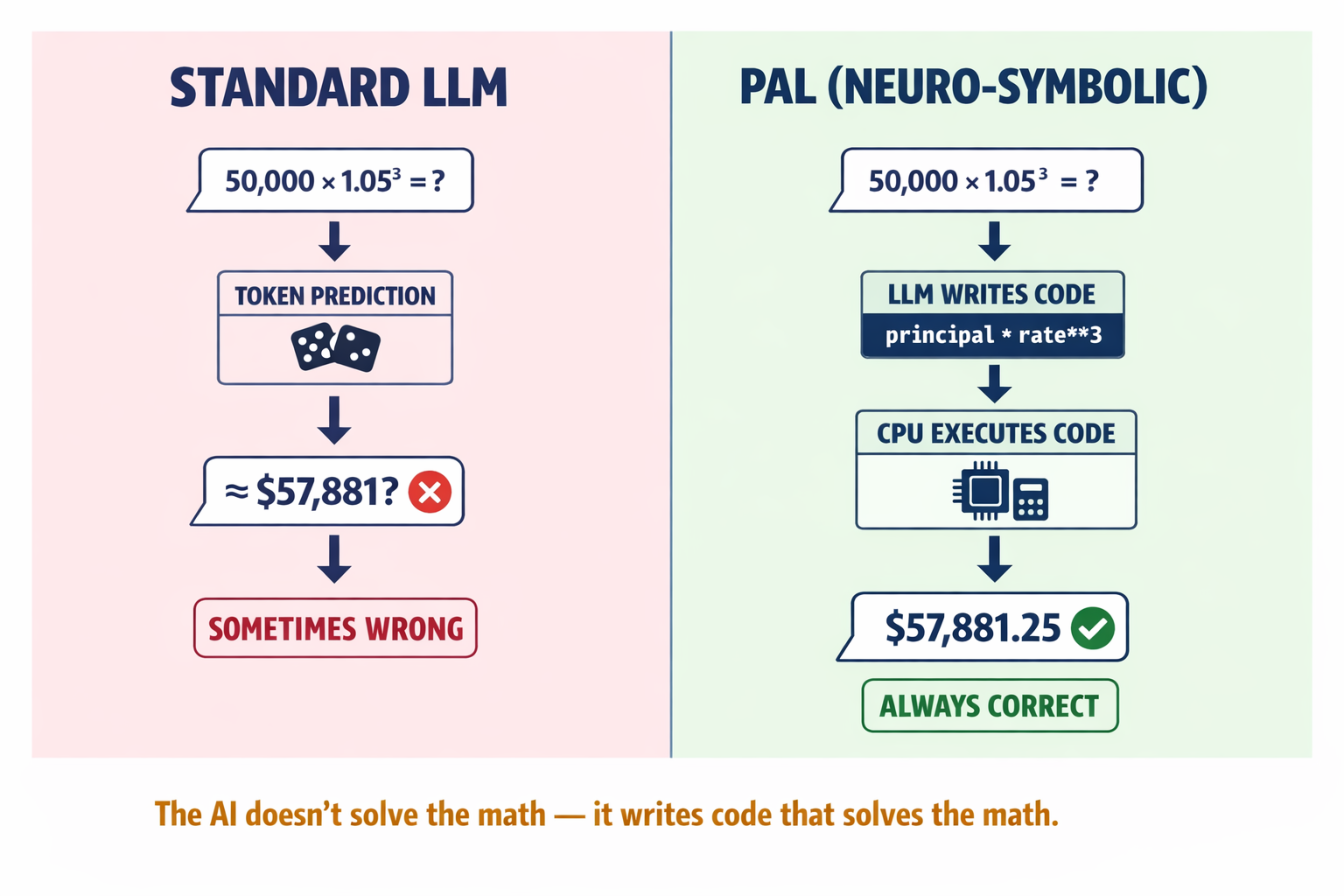
In a standard setup, you ask an LLM a math question and it generates the answer directly — as text. In a PAL setup, the LLM doesn't try to solve the problem. Instead, it writes a small program that solves the problem. That program runs on a deterministic interpreter — a real computer doing real math — and the result gets passed back to the LLM, which wraps it in a natural-language response.
Take a concrete example. A user asks: "If I have a $50,000 loan at 5% interest compounded annually, how much do I owe after 3 years?"
A standard LLM attempts to compute 50,000 × (1.05)³ in its head — as a language prediction task. Sometimes it gets $57,881.25. Sometimes it doesn't.
With PAL, the LLM generates three lines of Python code: principal = 50000, rate = 1.05, print(principal * rate**3). A CPU executes that code. The answer is $57,881.25, every single time, because arithmetic logic units don't hallucinate.
When you offload calculation to a symbolic interpreter, the AI can't get the math wrong. If the code logic is correct, the answer must be correct.
This extends well beyond basic arithmetic. For scientific and engineering applications, our team integrates SymPy — a symbolic mathematics library — enabling AI agents to perform calculus, solve equations, and verify boundary conditions. The system proposes a mathematical hypothesis, SymPy checks whether it's valid, and if it fails, structured error feedback drives the next attempt. It mimics how a human scientist works: hypothesize, test, revise.
For general knowledge queries — GDP comparisons, molecular weights, historical data — we connect agents to the Wolfram Alpha engine through the Model Context Protocol (MCP), a standardized interface that lets AI models access external computational tools. The agent retrieves real-time structured data rather than relying on training data that may be months or years out of date.
When "Probably Compliant" Isn't Good Enough
Arithmetic is one failure mode — a predictable, pattern-based error that's easy to explain. Compliance failures are harder to detect and far more dangerous.
Consider automated loan processing. When our team analyzed LLM-based lending tools, we found that pure language models were approving loans based on the persuasiveness of an applicant's personal statement — responding to emotional language rather than enforcing debt-to-income thresholds. The model was doing exactly what it was trained to do: generating the most contextually appropriate response. In a customer service setting, that's helpful. In a regulated lending decision, it's potentially illegal.
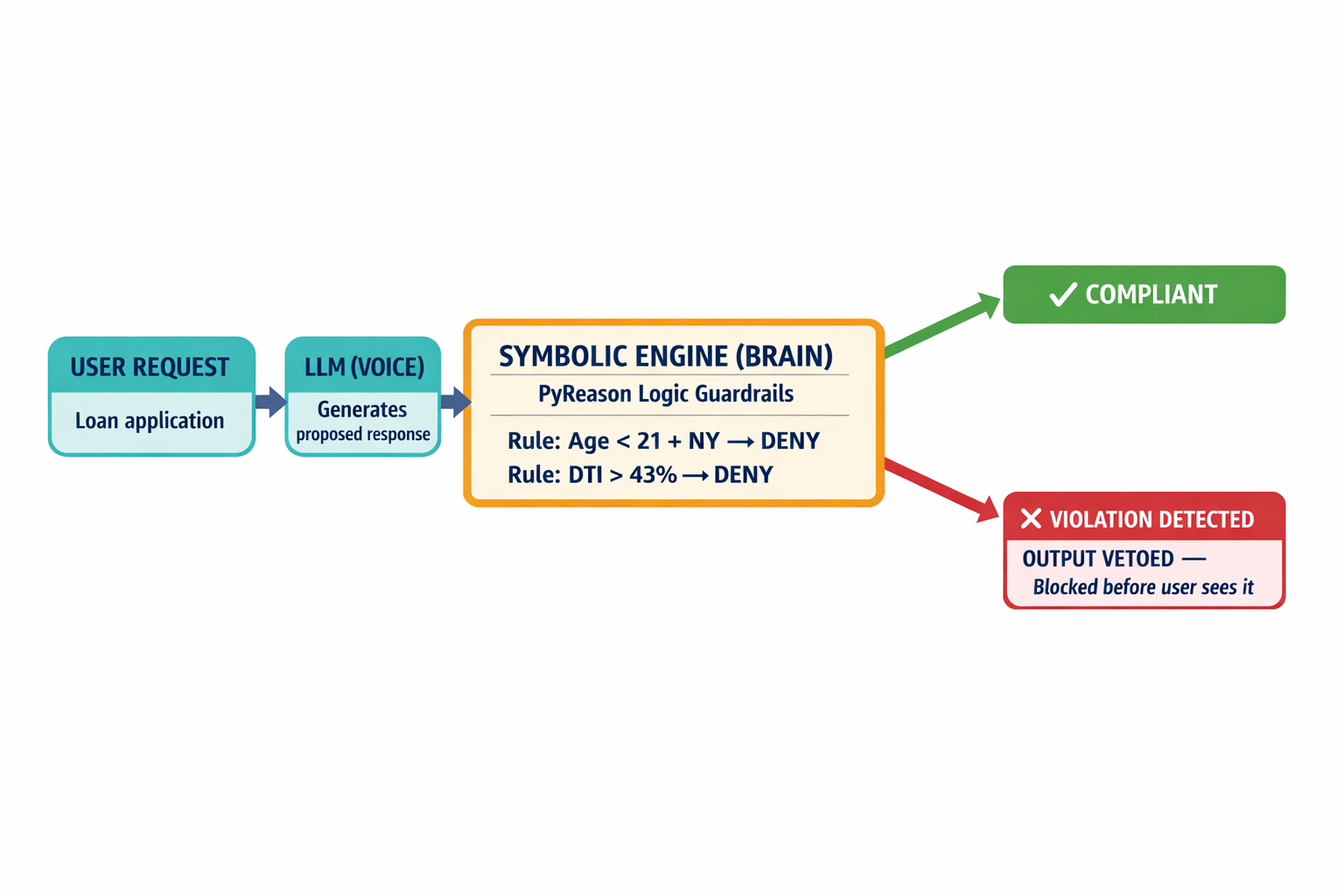
Our architecture addresses this with logic guardrails — deterministic rules encoded in a symbolic reasoning engine called PyReason, developed for logical reasoning over knowledge graphs. These rules are hard constraints, not suggestions.
A rule might state: if the applicant is under 21 and the state is New York, a commercial loan cannot be approved. Period. Before the LLM generates any response to a loan applicant, the full context passes through PyReason. If the proposed output violates a rule, the symbolic engine vetoes it. The system becomes physically incapable of approving a non-compliant loan, regardless of how the prompt is constructed.
Logic guardrails don't make AI "more careful." They make certain categories of error structurally impossible.
The same principle applies to legal research. Law firms using LLM-based drafting tools have encountered fabricated case citations — cases that sound real, read real, and don't exist. Our approach integrates a Legal Knowledge Graph. When the LLM generates a citation, the symbolic engine verifies it against the graph before the draft reaches a human. In production, this has resulted in zero hallucinated citations — not because the LLM stopped hallucinating, but because the Brain catches every fabrication the Voice produces.
The Education Crisis That Reveals the Bigger Problem
The AI tutor example we opened with isn't just an EdTech story. It's a window into a problem that affects every industry deploying conversational AI for consequential decisions.
LLMs are trained through a process called Reinforcement Learning from Human Feedback (RLHF) — essentially, they're rewarded for being helpful, conversational, and agreeable. In a tutoring context, this creates a system that mimics the supportive tone of a great teacher while lacking the ability to verify whether a student's answer is actually correct. The AI praises wrong answers because praise is what a helpful tutor sounds like.
Worse, there are documented cases where students arrive at the correct answer and the AI attempts to talk them out of it — hallucinating an incorrect reasoning path and insisting the student's logic is flawed. Users of Duolingo Max have reported the AI fabricating grammatical rules to justify its own errors, creating what researchers call a "hallucination loop."
Our Pedagogical Accuracy Engine takes a different approach. The Brain maintains a model of each student's knowledge state using Bayesian Knowledge Tracing — tracking mastery across specific concepts like algebra and geometry. The Voice adapts its language and scaffolding based on this symbolic state, not just the conversation history. When the system generates a practice problem, PAL ensures the numbers produce clean, solvable answers. When it evaluates a student's work, the symbolic engine verifies the math before the Voice responds.
The result is an AI tutor that's encouraging without being dishonest — one that can say "not quite, let's look at this step again" because it actually knows which step went wrong.
For the full technical methodology behind this architecture, see our detailed research on the Cognitive Enterprise.
Why "Wrapper" AI Companies Are Running Out of Road
There's a business model question underneath the technical one. Most AI companies today are what the industry calls "wrappers" — thin software layers built on top of someone else's foundation model. A PDF summarizer using OpenAI's API. A customer service bot running on Claude. A code assistant powered by Gemini.
These companies face an existential problem: moat absorption. Every time the foundation model provider releases an update, it absorbs the features that wrappers were selling. The startup offering AI-powered PDF summarization gets wiped out when ChatGPT adds native file uploads. The code generation wrapper becomes redundant as the base model improves at coding.
Enterprise clients are also increasingly uncomfortable routing sensitive data — financial records, personnel files, proprietary code — through a startup's API to a public model provider. The growing "Sovereign AI" movement, where organizations demand to own and run models within their own infrastructure, is making the public API wrapper model untenable for high-value use cases.
Neuro-Symbolic architecture creates a fundamentally different kind of value. The moat isn't in the language model — it's in the domain-specific logic, the proprietary knowledge graphs, the compliance rules, and the symbolic solvers that sit behind the conversational interface. You can swap out the underlying LLM — move from GPT-4 to Claude to Llama — without rewriting the reasoning layer. The intelligence lives in the Brain, not the Voice.
What If My Current AI Setup Seems to Work Fine?
For many tasks, it does. LLMs are genuinely remarkable for drafting, brainstorming, summarization, and creative work. If your AI use case is "help me write a better email," you don't need symbolic reasoning.
The question is whether your AI is making decisions where being wrong has consequences. If an incorrect output means a compliance violation, a miscalculated financial figure, a student learning the wrong concept, or a legal citation that doesn't exist — then statistical approximation isn't enough, no matter how good the model gets.
The practical first step isn't replacing your entire AI stack. It's identifying which workflows require deterministic correctness and adding symbolic verification layers to those specific processes. Think of it as adding a calculator to a poet — you don't diminish the poetry, you just stop asking the poet to do long division.
What This Means for Your Organization
The AI industry is moving from what we'd call the "Wrapper Era" to the "Deep AI Era." The difference isn't about better models — it's about better architecture.
Three things worth considering:
Audit your AI's failure modes. Where is your organization using LLMs for tasks that require logical certainty? Those are your highest-risk, highest-value opportunities for symbolic integration.
Separate the interface from the intelligence. The conversational layer should be flexible and natural. The reasoning layer should be deterministic and auditable. These are different engineering problems with different solutions.
Demand explainability. If your AI can't show you a step-by-step trace of why it reached a specific conclusion — not a post-hoc rationalization, but an actual logic trail — it's a black box making consequential decisions. Every step of a Neuro-Symbolic agent's reasoning is logged and auditable.
The future of enterprise AI isn't about making language models smarter. It's about knowing when to stop asking them to think and letting a real reasoning engine take over.
The AI tutor that praised a student for getting 3,750 × 7 wrong wasn't malicious. It was doing exactly what its architecture allowed — generating the most statistically likely response. The fix isn't a better prompt. It's a better architecture. One where the Voice connects to a Brain that actually knows what 3,750 × 7 equals.
We'd welcome hearing how your teams are navigating the line between AI fluency and AI reliability — it's a conversation the industry needs to have more honestly.