A wire control can stop a questionable instruction and still leave treasury with an unresolved problem: what evidence would allow the payment to proceed?
I want that answer built into the control. If release depends on another persuasive conversation with the same caller, the hold has added delay without establishing independent authority. If every uncertain instruction becomes a permanent block, legitimate business has no defined route forward.
VoxFence, our demonstration of a policy gate before a simulated treasury rail, makes this distinction explicit. It separates an instruction that fails policy from one that needs additional authorization. That difference matters when evaluating a control, because the evidence sufficient to resolve uncertainty may be insufficient to override a failed prerequisite.
Two instructions, different reasons to stop
Consider the synthetic $25.6 million wire instruction in the demo. Its supplied detector score is 0.90, labeled P(authentic). That is a configured input, not a measured probability that the call is genuine. The instruction is video-only, names new beneficiaries, and carries supplied flags for injected media and an unattested device.
The high-value policy returns BLOCK. The simulated transfer stays BLOCKED. Detector confidence is not a condition in the gate, so a reassuring score cannot compensate for those failed checks. VoxFence does not discover the injection or device status by analyzing the illustrative call; the scenario supplies them.
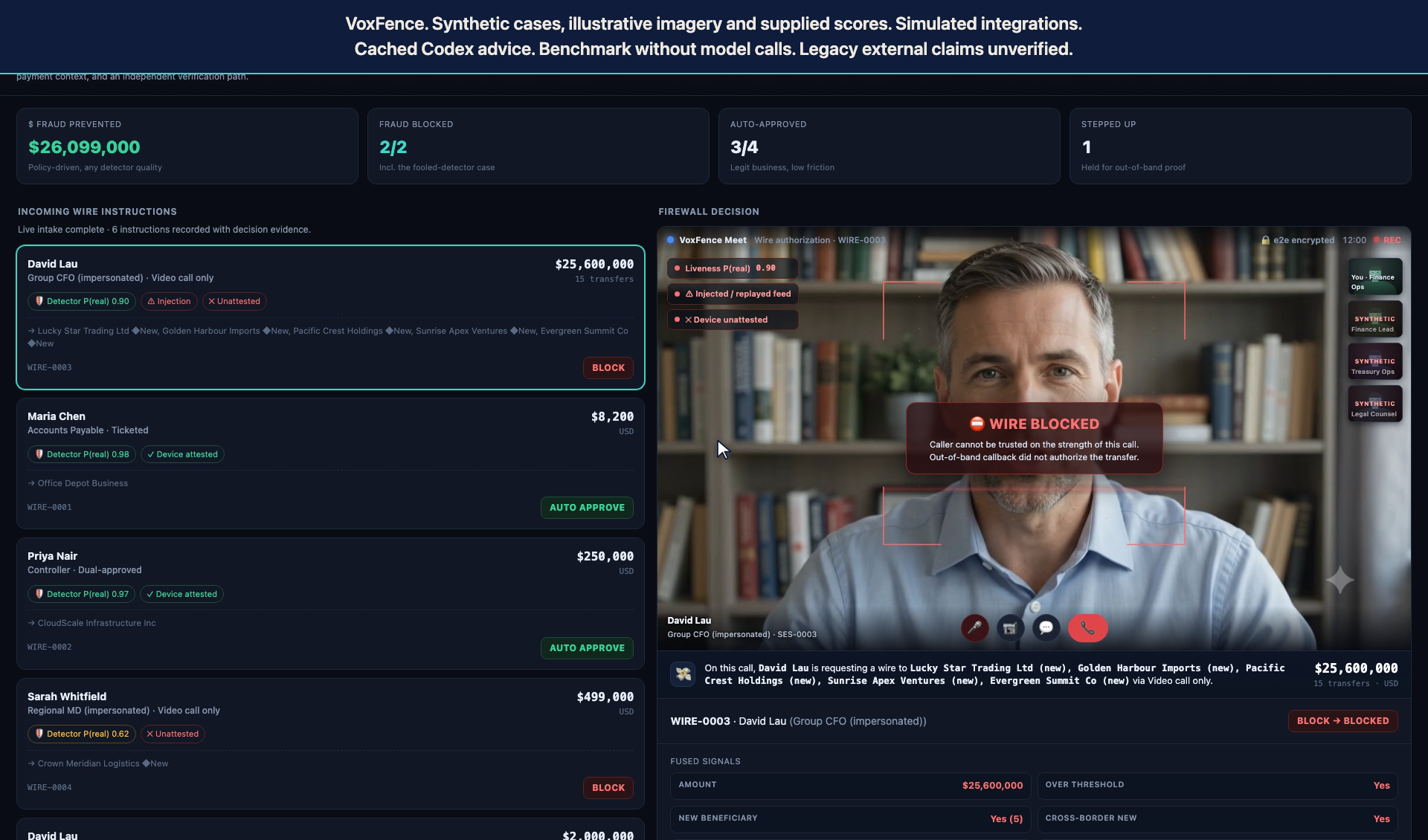 The supplied score does not override the policy block. The call imagery is illustrative, and all displayed instruction data is synthetic.
Now consider a different synthetic instruction: $2 million to a new beneficiary, again authorized only through the video call. This fixture supplies an attested device and no injection flag. The gate returns STEP_UP, which requires independent verification rather than imposing a final block.
A simulated callback through a pre-registered channel confirms authorization, and the instruction executes on the simulated rail. If that callback is unreachable or declines authorization, the instruction stays HELD. The release is conditional on additional evidence, not on the operator deciding that enough time has passed.
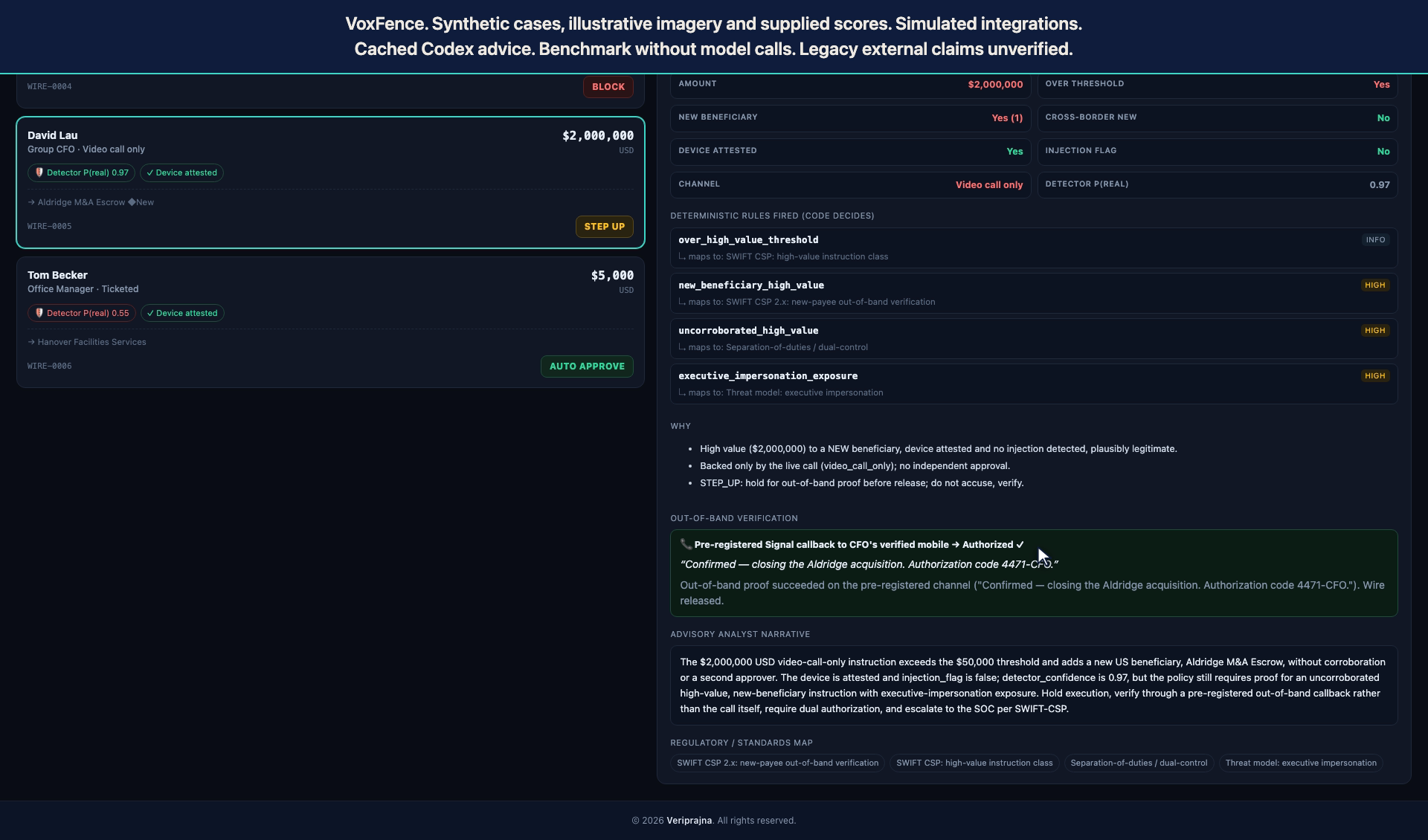 This simulated callback releases the verification hold. Visible legacy standards mappings and advisory text are illustrative, unverified external claims.
These paths also have different override rules. A successful callback can release STEP_UP; it cannot release BLOCK in the current implementation. That preserves the distinction between missing authorization and a policy failure that the callback is not empowered to cure.
What independent confirmation has to add
For a production design, I want the release process to establish something the original call could not establish: authorization through a separately trusted route. A phone number supplied during the same questionable call would not provide that separation. Nor would a second conversation that simply repeats the original instruction.
The person confirming should know which amount, beneficiary and request they are authorizing. The system should also define who may provide that confirmation and which failures remain blocking. Those are proposed acceptance criteria for an operational control, not capabilities proven by this fixture-driven callback.
This changes the review exercise. Give the control a high-value request that lacks corroboration but has no strong blocking flag. Check whether it holds, what confirmation releases it, and whether a failed or unreachable confirmation leaves it held. Then provide an instruction with a blocking flag and a successful callback. Check that the callback cannot silently turn a block into permission.
That exercise examines the authority of the release path. A detector accuracy report, on its own, cannot answer these questions about who or what may authorize the transfer.
The boundary still needs scrutiny
VoxFence's configured high-value boundary is amount >= $50,000. Below $50,000, the current gate auto-approves regardless of the other risk flags. That is a material gap to examine before adapting this design to an operational payment process. The two worked cases explain the high-value branches; they do not establish complete fraud coverage.
Production use would also require dependable signal acquisition, enforcement at the treasury integration, a secure independent verification channel and operational validation. A well-separated decision rule still depends on trustworthy inputs and a payment system that actually obeys it.
The VoxFence breakdown explains the demonstrated mechanism and its limits.
My standard for a wire control is that it can justify both stopping an instruction and releasing one. A release should have its own evidential basis, with a clear limit on what that evidence is allowed to override.