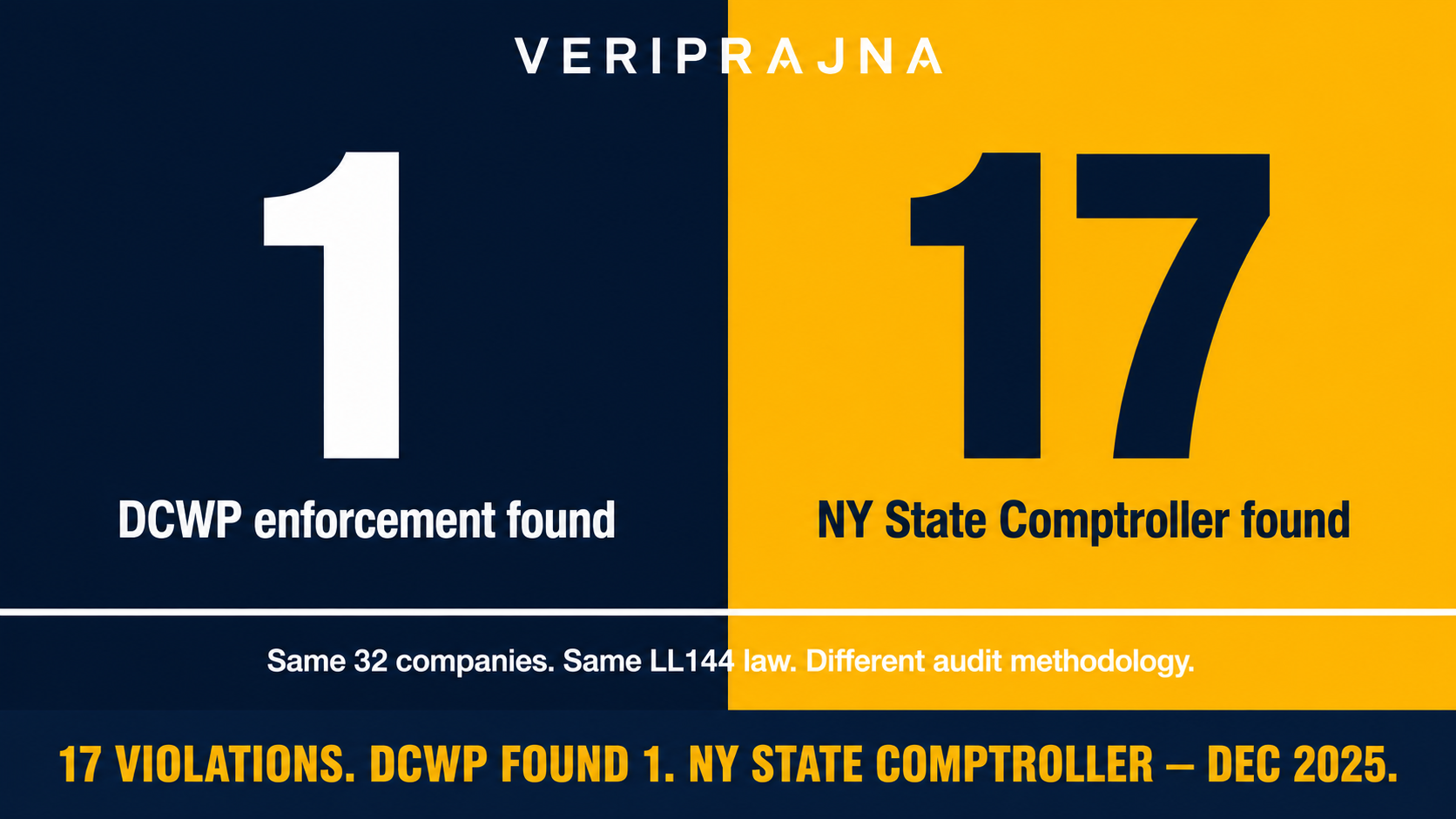
The strategy that kept most enterprise hiring AI out of regulatory scope — self-classifying automated tools as decision-support rather than automated employment decision tools (AEDTs) — is collapsing on three fronts at once. In Mobley v. Workday, Judge Rita F. Lin held that an AI hiring vendor can be directly liable as an "agent" when its tool recommends or filters candidates, regardless of what the employer claims about its own scope. The NY State Comptroller's December 2025 audit found 17 potential LL144 violations in the same 32-company sample where DCWP had found one — because state auditors examined API call logs and applicant tracking system (ATS) integration traces rather than relying on employer self-certification. And plaintiffs' counsel in Mobley now holds, by court order, an exhaustive list of every employer who enabled Workday's HiredScore Spotlight and Fetch tools.
The memo your outside counsel drafted in 2024 explaining why your ATS integration doesn't "substantially assist" hiring decisions is now a potential discovery exhibit.
This matters beyond New York City. Six AEDT regulatory regimes are now live or go hot before August 2026. They cover the same buyer — the CHRO or General Counsel running AI-assisted hiring across multiple states — and they conflict with each other in ways that make a single "universal" bias audit legally insufficient for any of them.
What "Null Compliance" Actually Costs
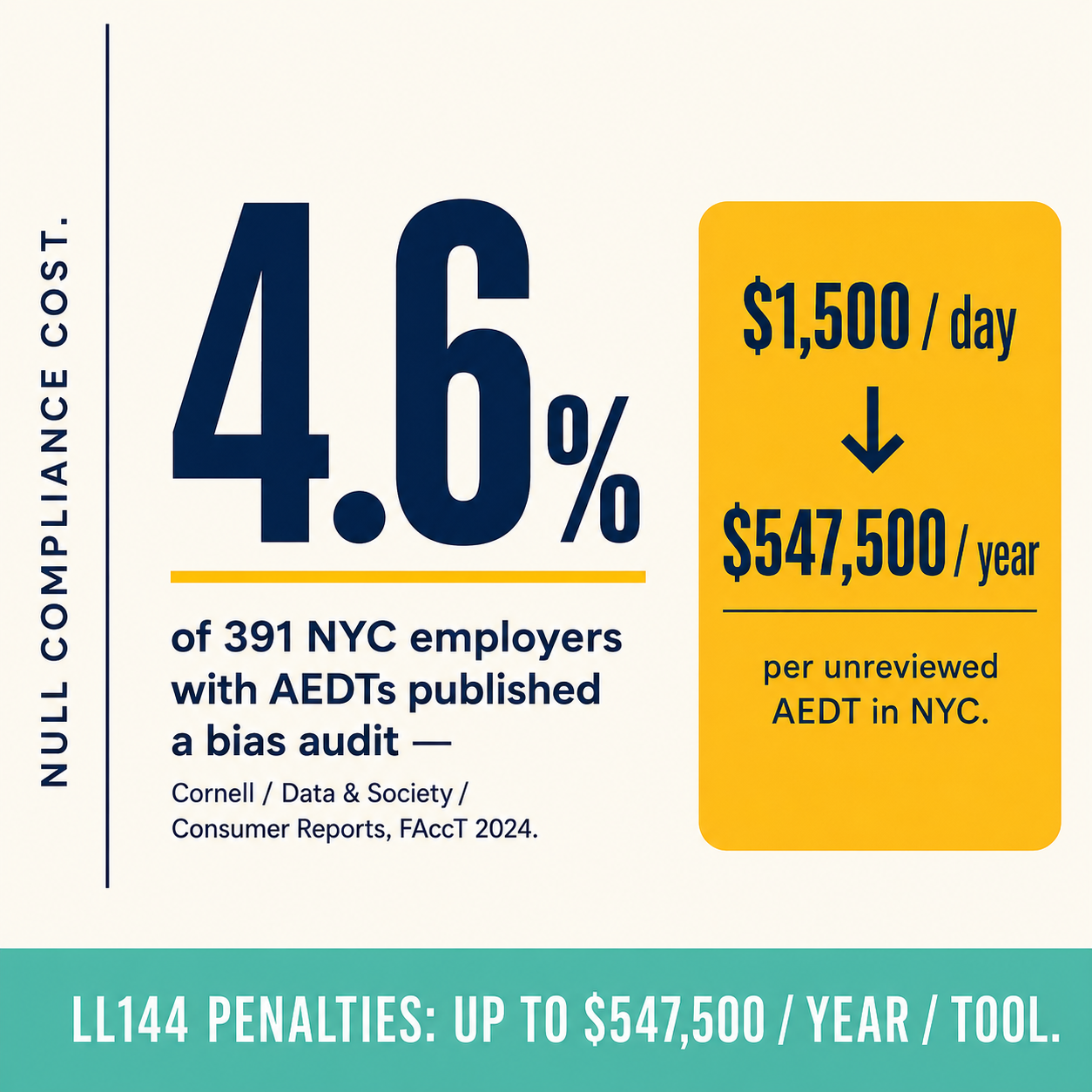
Cornell University, Data & Society, and Consumer Reports coined the term in a 2024 FAccT paper: "Null Compliance" is the practice of operating AEDTs while claiming the tools don't "substantially assist" hiring decisions. The paper surveyed 391 NYC employers with AEDTs — only 18 had published bias audit reports (4.6%), and only 13 had posted required candidate notice (3.3%).
That strategy worked while DCWP was complaint-driven and under-resourced. It stopped working on December 2, 2025.
The NY State Comptroller's office reviewed the same 32 companies DCWP had reviewed and found 17 potential violations where DCWP had found one. The difference wasn't access to better evidence — it was a different investigation methodology. State auditors examined API call logs, ATS integration traces, and vendor technical documentation rather than asking employers whether their tools were in scope. DCWP acknowledged its staff lacked the technical expertise to evaluate AEDTs, agreed to all audit recommendations, and committed to proactive enforcement going forward.
LL144 penalties run up to $1,500 per day per violation. A single unreviewed AEDT in continuous NYC deployment now carries potential exposure of up to $547,500 per year — before any state or federal civil rights claims layer on top.
The math on enforcement risk has always been there. What changed is that New York City now has the audit methodology to find what it was previously missing.
Six Regimes, Three of Which Directly Conflict
An employer with operations in New York, Chicago, Denver, Austin, and London is now subject to six overlapping legal frameworks: NYC LL144, Illinois HB 3773, Texas TRAIGA, California's FEHA ADS amendments, Colorado SB 24-205, and the EU AI Act's Annex III high-risk category for recruitment. Three were live before the end of Q1 2026. Two go hot before August.
The problem isn't running a bias audit. The problem is that each regime requires a differently shaped deliverable, and several of them directly contradict each other at the methodology level.
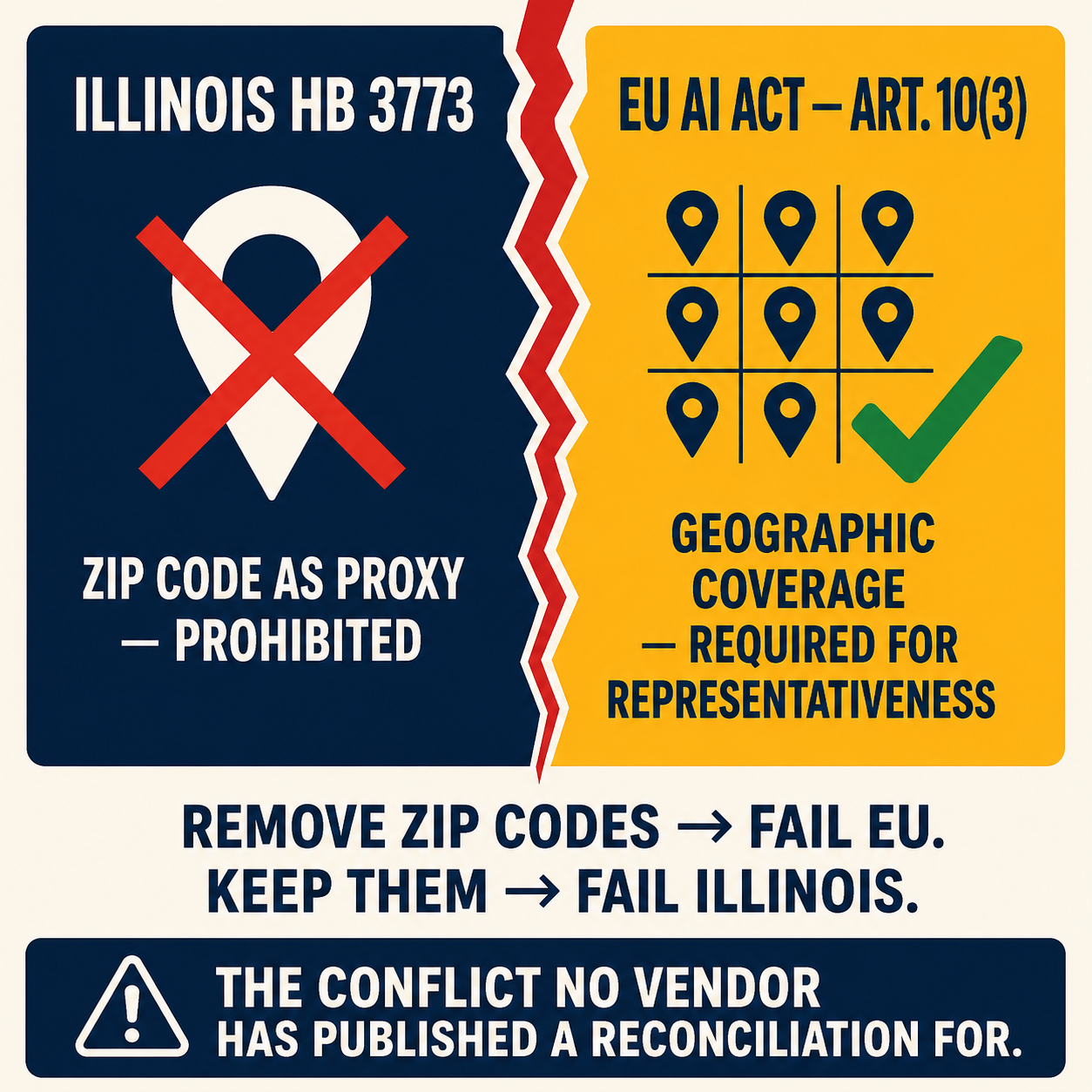
Illinois HB 3773 has been live since January 1, 2026. It explicitly prohibits using zip codes and similar geographic proxies for protected classes in hiring AI, implementing the Illinois Human Rights Act's anti-proxy provision. The EU AI Act's Art. 10(3) — enforceable for Annex III high-risk deployments on August 2, 2026 — requires training data to be "relevant, representative, free of errors," a mandate that in practice typically requires geographic coverage to achieve adequate representativeness across demographic groups. Remove zip codes to satisfy Illinois. Fail EU representativeness. No vendor has published a reconciliation methodology for this conflict.
The disparate-impact question creates a second collision. NYC LL144 and federal Title VII both rest on the four-fifths (0.80) adverse-impact ratio as the standard threshold. Texas TRAIGA, live since January 1, 2026, explicitly rejected disparate impact as a standalone theory — only intentional discrimination is actionable in Texas. An audit methodology designed for LL144, which requires documenting and correcting disparate impact across intersectional race-by-sex categories, would overcomply in Texas while remaining legally necessary in New York. These regimes don't just differ — they're structurally opposed on what constitutes a violation.
Colorado SB 24-205 takes effect June 30, 2026, following a delay from the original February 1 date via SB25B-004 signed in August 2025. It requires deployers to adopt a risk-management program, run initial and annual impact assessments, issue pre-decision and adverse-decision consumer notices, and publish website disclosures. The rebuttable-presumption defense requires documented reasonable care — which means the program has to exist before an enforcement action, not in response to one. The Colorado Attorney General holds exclusive enforcement authority.
The Litigation Exposure Your Bias Audit Report Doesn't Cover
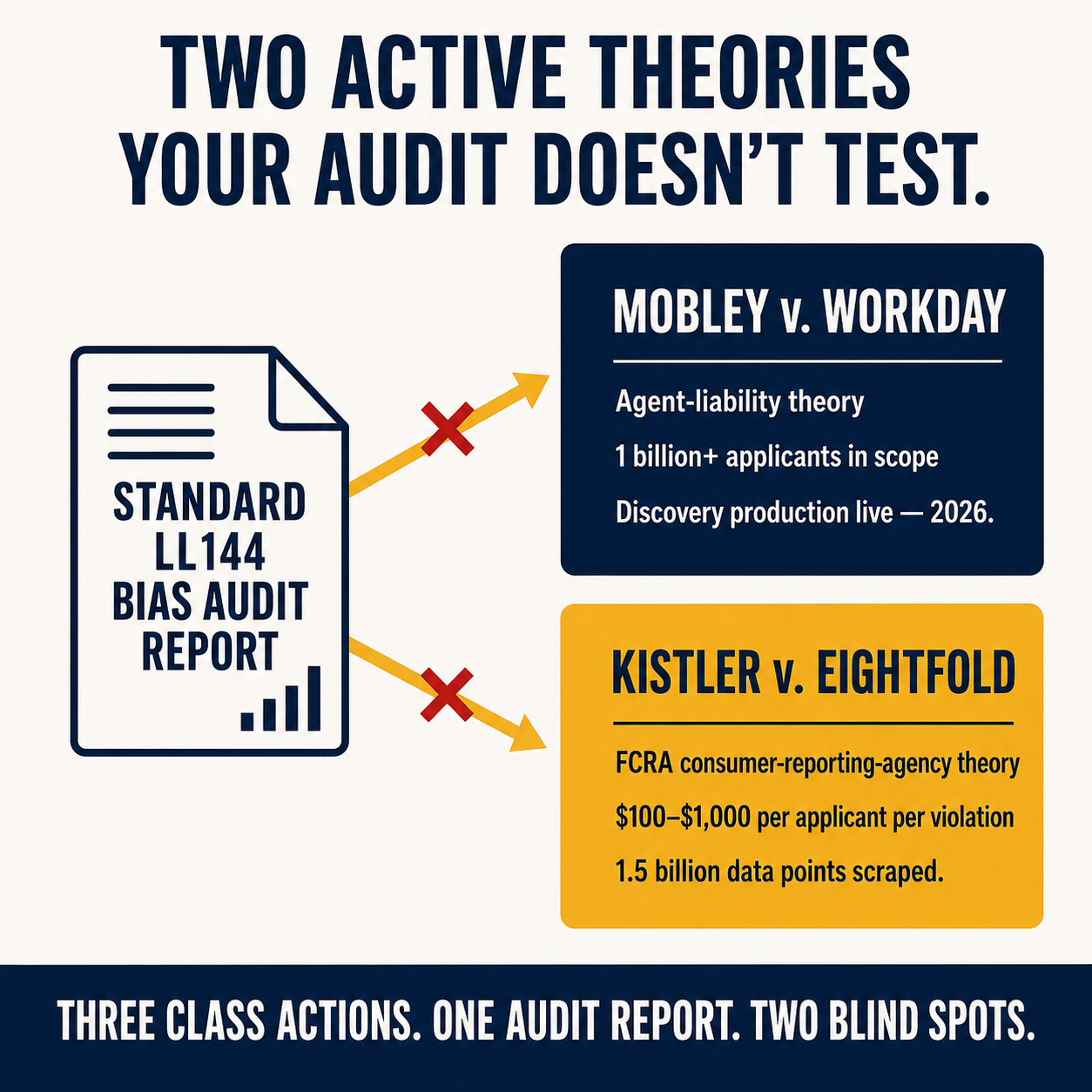
Two of the three active employment-AI class actions expose legal theories that standard LL144-methodology audits don't test for — and both have live discovery timelines.
Mobley v. Workday established the agent-liability theory in May 2025, when Judge Lin denied Workday's motion to dismiss and granted preliminary collective certification for over-40 applicants. The court subsequently ordered Workday to produce an exhaustive list of employers who enabled HiredScore Spotlight and Fetch, rejecting Workday's attempt to exclude the post-acquisition products from scope. Plaintiffs' counsel has noted the potential class could encompass over one billion applicants who passed through Workday's hiring tools. The opt-in window for the initial collective closed March 7, 2026.
Kistler v. Eightfold AI (Contra Costa Superior, filed January 20, 2026) is testing a different theory. The complaint alleges Eightfold scraped data from LinkedIn, GitHub, Stack Overflow, and public databases to build candidate dossiers from more than 1.5 billion data points, and produced 0-to-5 match scores — without Fair Credit Reporting Act (FCRA) certification, notification, disclosure, authorization, or dispute workflows. If the court holds Eightfold is a consumer reporting agency, every similar AI hiring platform would owe candidates adverse-action notices and dispute mechanisms. The structural parallel is the 2017 background-check industry reset, when a wave of FCRA litigation forced 18 months of system rewrites at employers who had been relying on background vendors without FCRA-compliant adverse-action workflows. Statutory damages under the FCRA run $100 to $1,000 per consumer per violation.
Neither the agent-liability question in Mobley nor the FCRA consumer-reporting-agency question in Kistler appears on a standard LL144 bias audit report. Both are live exposure today, for any employer whose hiring stack touches Workday or a platform that scores and ranks candidates from scraped data.
The Accessibility Exposure That's Separate From the Bias Audit
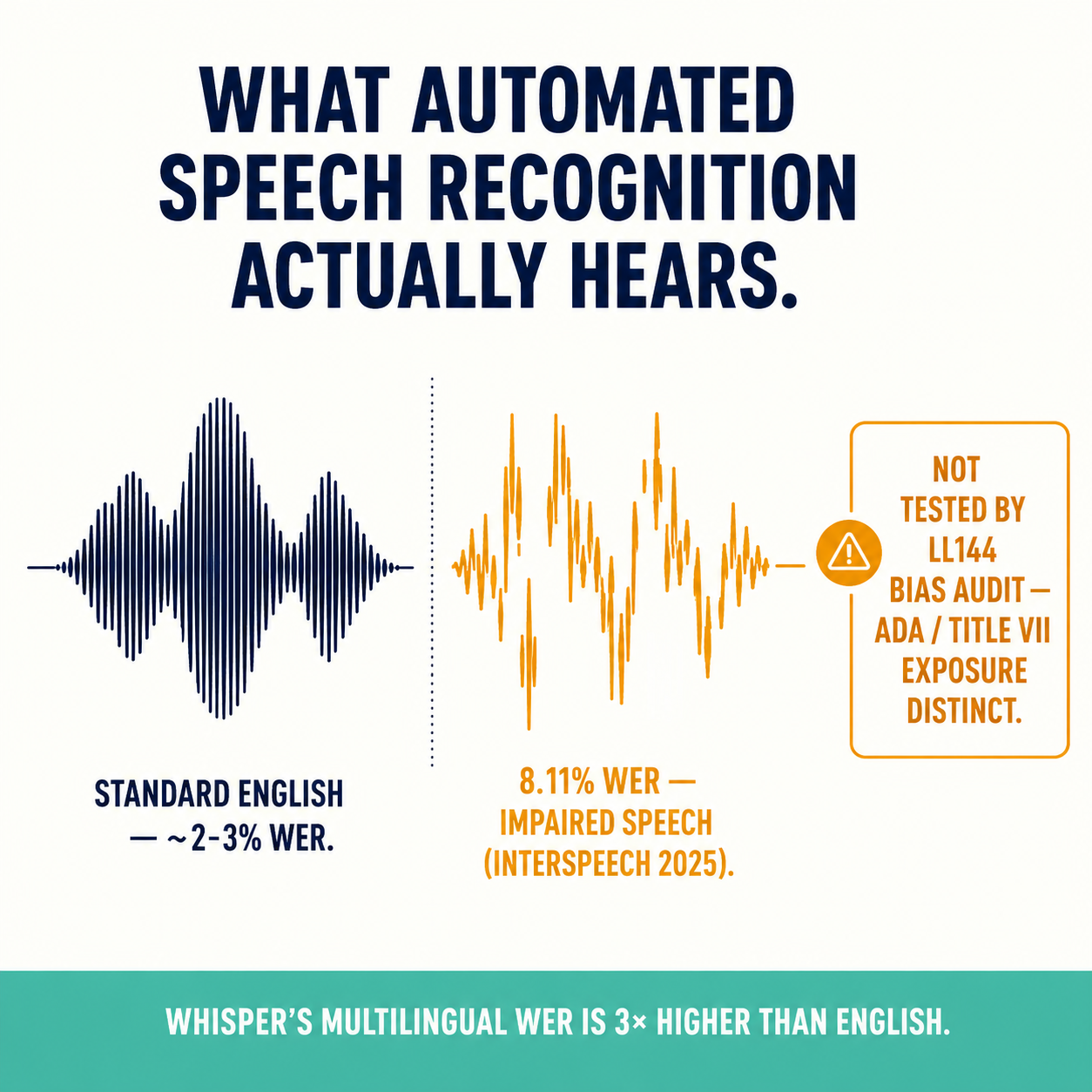
One hiring compliance risk that sits entirely outside the LL144 framework: ADA and Title VII exposure in AI-assisted video interviews and voice-based screening tools.
An ACLU complaint filed in March 2025 with the Colorado Civil Rights Division and the EEOC named an Indigenous Deaf employee — identified as D.K. — whose application was processed by a HireVue-integrated video interview platform at Intuit. The complaint alleges violations of the Americans with Disabilities Act (ADA), Title VII, and the Colorado Anti-Discrimination Act. HireVue CEO Jeremy Friedman denied AI-based assessment was used in the hiring decision; Intuit denies wrongdoing. The underlying technical question remains unresolved.
The accuracy data on automatic speech recognition (ASR) for non-standard speech is not contested. The 2025 Interspeech Speech Accessibility Project Challenge — using over 400 hours from more than 500 speakers with speech disabilities — showed top models achieving 8.11% word-error rate (WER) on impaired speech, which remains multiples of standard English performance benchmarks. Whisper's average multilingual WER is roughly three times higher than English. A screening workflow that uses transcript quality or speech fluency as a signal for candidate fit systematically disadvantages applicants with speech disabilities and many non-native English speakers.
LL144 bias audits test for race-by-sex adverse-impact ratios. They don't test for ASR accuracy disparities, and they don't generate the ADA compliance documentation an employer would need in front of a civil rights division. This is a different testing discipline, a different legal theory, and a different documentation requirement — which means it needs to be a distinct element of the AEDT compliance program, not a footnote to the bias audit.
The Breach That Put the CISO at the Table
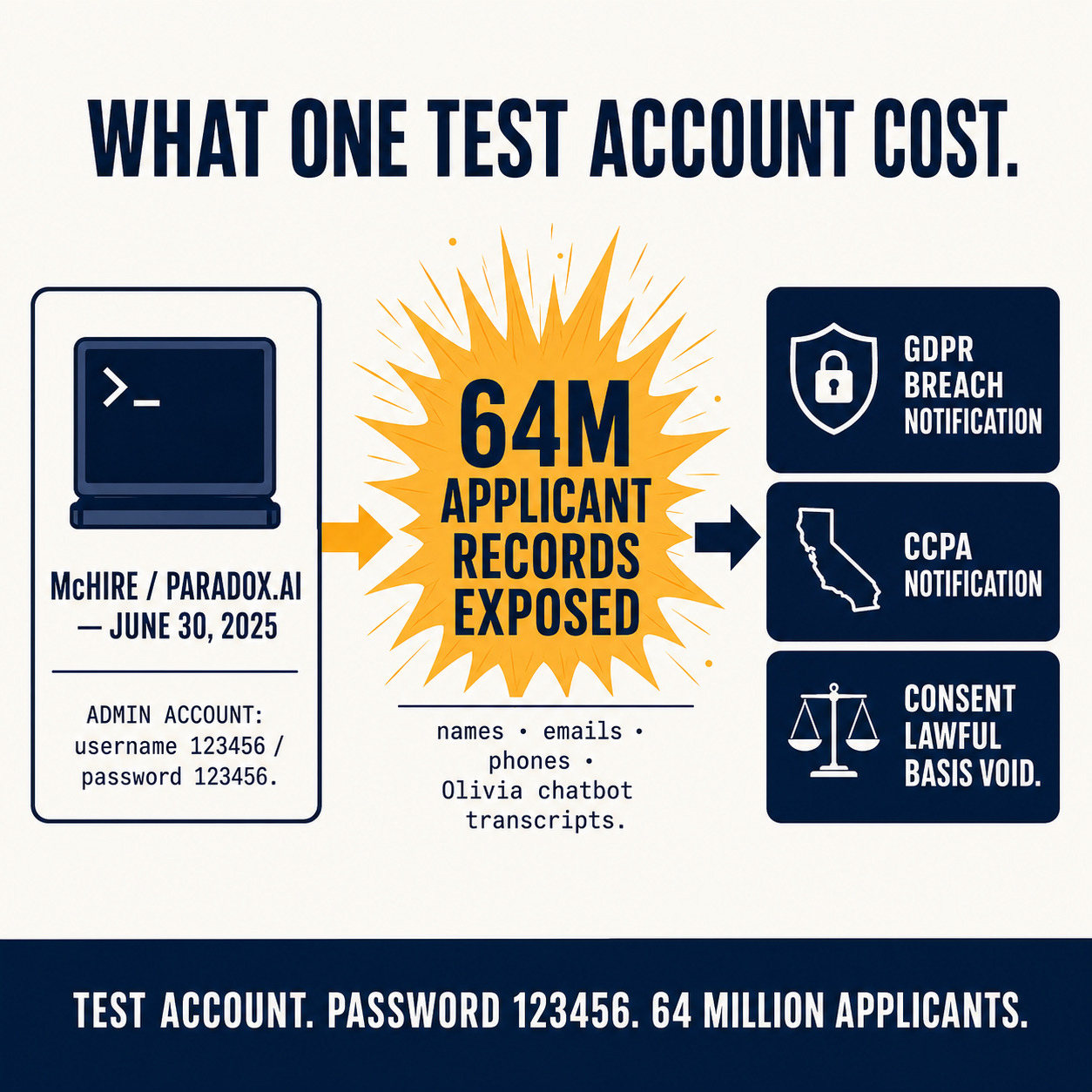
The AI hiring compliance conversation expanded on June 30, 2025, when security researchers Ian Carroll and Sam Curry disclosed that McDonald's McHire platform — built on Paradox.ai's conversational recruiting chatbot "Olivia" — had exposed records of approximately 64 million applicants. The root cause: a 2019 test administrator account with username and password both set to "123456," no multi-factor authentication, and an insecure direct object reference in an internal API that allowed iterating sequentially through applicant IDs.
The disclosed data included names, email addresses, phone numbers, and transcripts of conversations with the Olivia chatbot — sufficient to trigger GDPR and CCPA breach notification obligations, eliminate the consent lawful basis for continued processing of those applicants' data, and anchor class action claims across the jurisdictions where those 64 million candidates are located. Paradox patched the vulnerability within 24 hours of disclosure.
Most AI hiring compliance programs don't include a vendor security review in the AEDT assessment workflow. The McHire breach demonstrated that a vendor relationship can generate breach notification obligations and class action exposure at a scale that dwarfs any individual bias audit penalty — and none of it flows through the bias audit. The CISO is now a stakeholder in HR technology procurement, and the AEDT compliance program that doesn't include a security review of each third-party platform is testing for one liability theory while leaving another fully open.
What the Vendor's Compliance Documentation Actually Says
This is the gap that our AI Hiring Compliance work at Veriprajna was built around.
Every major AI hiring platform has published something with "compliance" in the title. Workday/HiredScore has Secretariat's third-party bias analysis. Eightfold has bias audit documentation. HireVue dropped facial analysis in January 2021. None of these documents answers the multi-jurisdiction reconciliation question. None addresses the Kistler FCRA exposure. None tests for ASR accuracy against applicants with speech disabilities. None constitutes the Colorado SB 24-205 risk-management program the rebuttable-presumption defense requires.
The independent auditors DCI Consulting and ORCAA run the methodology that LL144 was written around — at $50,000 to $200,000 per system per year — but each delivers a snapshot at the methodology level, not a cross-jurisdiction reconciliation. Governance platforms like FairNow, Credo AI, and Holistic AI each ship a methodology, not an architecture built around the specific conflicts we've described. The Big Four have practices that budget twelve-month timelines and seven-figure fees for what needs to be documented by June 30.
The CHRO's question isn't "have we run a bias audit?" It's "can we produce, on 24-hour notice, a coherent account of every AEDT in our hiring stack, what each one was tested for, under which legal theory, for which jurisdictions, and what remains open?" That's what the NY State Comptroller's auditors were effectively asking of the 32 companies they reviewed.
The companies navigating this well in 2026 are running their own AEDT inventory — every tool that touches a hiring decision, the jurisdictions it operates in, the audit each one has undergone, and which jurisdictions that audit was designed for. They're running supplemental assessments against the specific jurisdictional requirements the vendor's published audit doesn't cover. They're building the Colorado documentation before June 30, not after an enforcement inquiry. And they're treating accessibility testing and vendor security review as independent compliance disciplines, not footnotes.
What the Compliance Program Actually Requires
The practical near-term horizon, if you're reading this in May 2026, is Colorado SB 24-205 on June 30 and the EU AI Act Annex III high-risk obligations on August 2. Neither cares about your annual compliance cycle. Both require documentation that existed before the enforcement action — Colorado needs a risk-management program, impact assessments, consumer-notice templates, and website disclosures; the EU AI Act needs technical documentation per Art. 11 and Annex IV, a data governance program per Art. 10, human oversight records per Art. 14, and EU database registration.
What the compliance program needs to produce looks different depending on which tools you're running, which jurisdictions you're hiring into, and where your current documentation is weakest. We've documented the structure of that analysis at veriprajna.com/solutions/ai-hiring-compliance.
The jurisdictional conflict we see trip up the most compliance teams isn't the one they came in thinking about — it's the Illinois-EU proxy-variable collision, which no vendor has solved and most compliance frameworks haven't mapped. If that's where your program is stalled, or if the near-term Colorado and EU deadlines are what you're pressure-testing right now, we'd be glad to hear what the specific sticking points look like from your side.