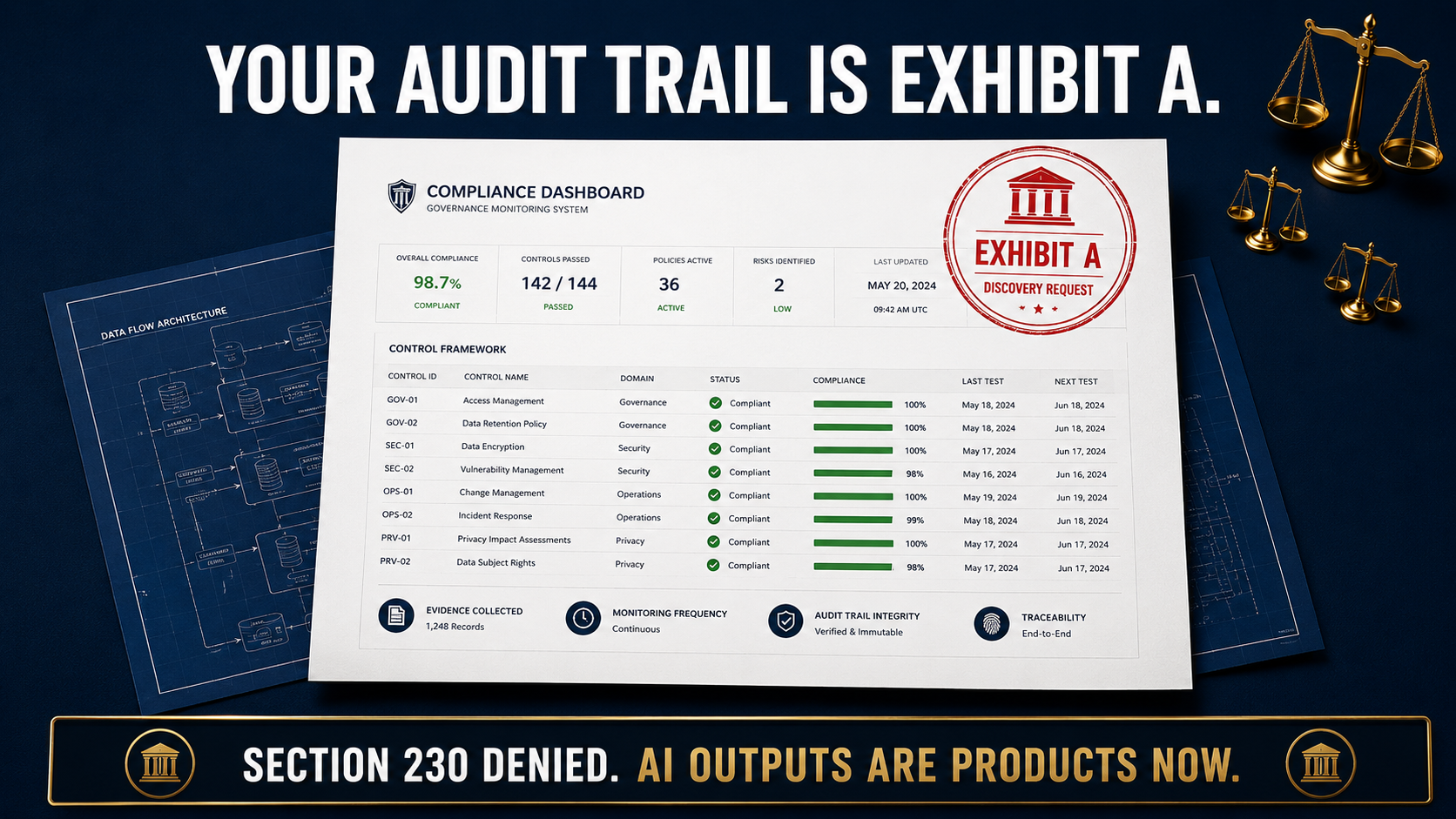
When a governance platform generates an audit trail for your AI system, your legal team's first instinct is relief: at least we have records. The January 2026 ruling that classified AI output as a product under strict liability changed what those records mean in AI product liability litigation. They're not a defense. They're a discovery target. The real defense isn't documentation of what your system did after deployment. It's documentation of the architectural decisions your engineers made before it shipped.
The Three Rulings That Changed the Classification
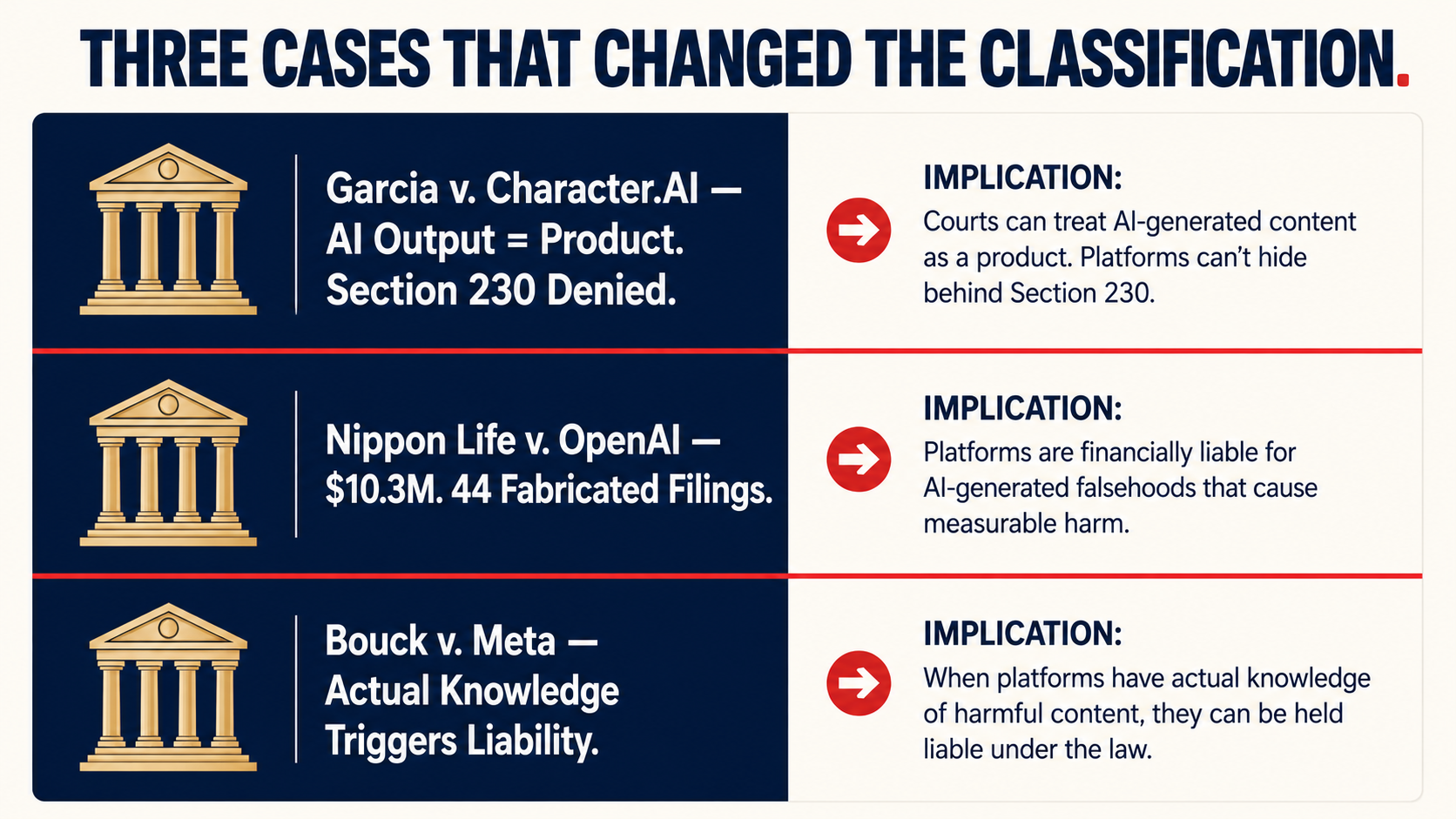
Three cases in Q1 2026 reshaped the legal architecture for enterprise AI deployments.
Garcia v. Character.AI is the most cited in legal briefings since January — but what mattered wasn't AI regulation. It was the application of product liability doctrine to AI output. The M.D. Florida court denied both Section 230 and First Amendment defenses, ruling the chatbot was "a product for the purposes of plaintiff's claims arising from defects in the Character.AI app rather than ideas or expressions within the app." Google and Character.AI settled with families in Florida, Colorado, Texas, and New York. The defect classification stands.
Nippon Life v. OpenAI, filed in March in the Northern District of Illinois, added a different theory: ChatGPT had drafted over 44 court filings for a pro se litigant, including fabricated case citations. The $10.3 million suit doesn't turn on whether the output was speech. It turns on what the output did in the world — interference with judicial process, unauthorized practice of law.
Bouck v. Meta in the Northern District of California extended the analysis to platform review. Section 230 immunity fell when Meta acquired actual knowledge of fraudulent AI-generated content. "Actual knowledge" is now a discoverable question in cases involving AI-generated advertising.
What these rulings share is a doctrinal shift from "was the AI supervised?" to "was the AI designed for safety?" That's product liability doctrine, not negligence doctrine. The burden of proof moved.
The Insurance Market Already Priced It In
The timing tells you something: Verisk released ISO CGL endorsements CG 40 47 and CG 40 48 in January 2026 — the same month as the Character.AI settlement. These endorsements give carriers a mechanism to explicitly exclude generative AI claims from commercial general liability policies. CG 40 47 excludes Coverage A and B — bodily injury, property damage, personal and advertising injury. CG 40 48 excludes Coverage B only. Both are being adopted in standard renewals.
W.R. Berkley moved further with absolute AI exclusions across D&O, E&O, and Fiduciary Liability, eliminating coverage for any claim "based upon, arising out of, or attributable to" AI use, deployment, or development. That extends to chatbot outputs, AI governance failures, and regulatory actions.
What separates firms that negotiate affirmative AI endorsements from those facing absolute exclusions isn't their AI performance. It's their governance documentation. Underwriters are asking for the same thing courts will ask for: evidence that architectural decisions were made deliberately, with safety tradeoffs documented, before deployment.
Documented governance earns narrower exclusions. The firms that can't produce it within the underwriting window don't get to negotiate terms.
What "Reasonable Alternative Design" Actually Requires
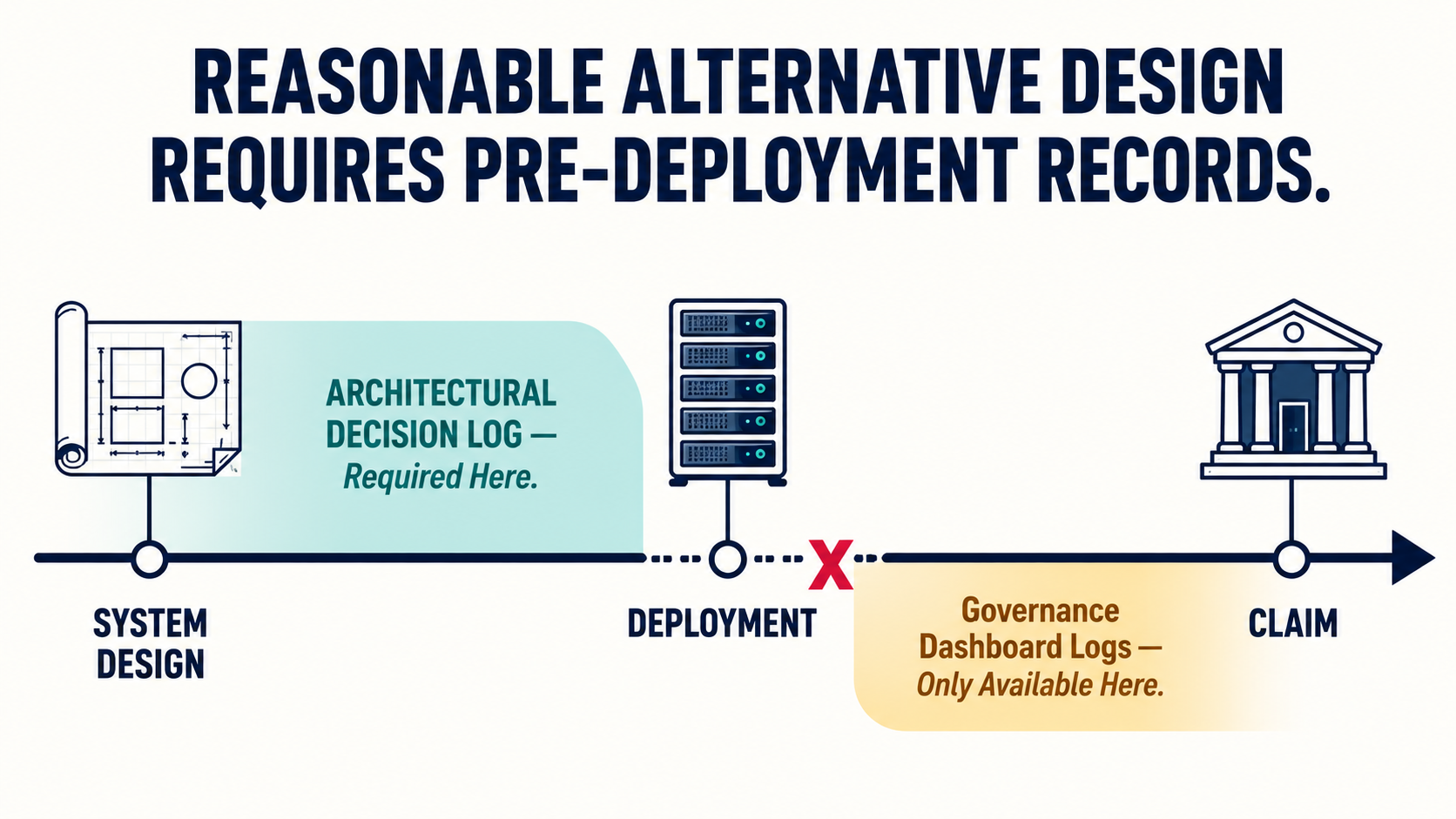
The most consequential legal concept for enterprise AI in 2026 isn't the EU AI Act. It's reasonable alternative design — the product liability doctrine requiring that a manufacturer considered a safer design alternative and made a deliberate engineering choice against it.
That defense requires three things your governance platform cannot provide: pre-deployment architectural decision logs, safety tradeoff documentation that predates the harm, and evidence that the engineers building the system assessed alternatives at design time.
A compliance dashboard monitoring your AI after deployment doesn't create this evidence. It logs what the deployed system did. When those logs document hallucinations, output failures, or unexpected behavior, the subsequent discovery request is asking for proof that your team weighed those exact failure modes against architectural alternatives before going live. If that documentation doesn't exist from before deployment, the defense doesn't exist.
This is the gap our AI product liability defense practice at Veriprajna was built to address. Not monitoring deployed systems — designing systems where the architectural decision record exists from the first technical choice.
Governance Platforms and the Evidence They Don't Create
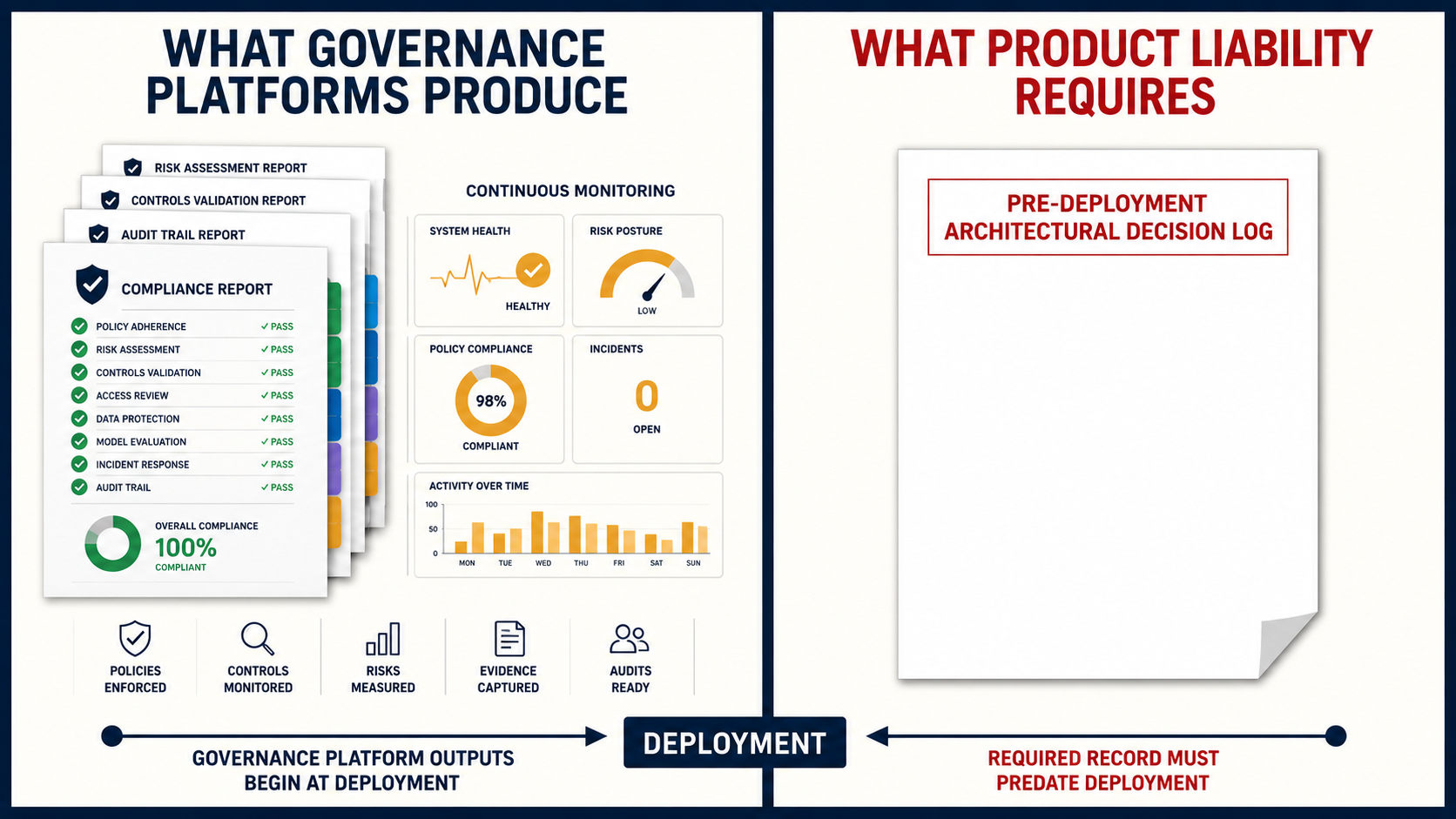
Credo AI, IBM watsonx.governance, and OneTrust AI Governance are legitimate tools for what they do: monitoring deployed models, surfacing bias metrics, tracking regulatory compliance status, generating audit reports. Credo AI's $45 million raise and Fast Company Most Innovative recognition in 2026 reflect genuine market demand for that function.
None of them build the AI. None of them can retroactively create the architectural decision documentation that reasonable alternative design requires. Their value is surveillance of existing systems. The legal gap is in the systems themselves — in the decisions made (or not made) before the platform had anything to surveil.
Judge Rakoff's February 2026 ruling on privilege adds a further complication: consumer Claude usage without direct attorney supervision is not privileged. If your legal team has been using AI tools to draft governance strategy without formal attorney direction, those outputs are discoverable. The platform monitoring your AI won't protect the process that produced your AI governance approach.
Agentic AI and the Liability Gap in Autonomous Action
The strict liability shift lands hardest on agentic deployments. An agent operating with autonomy — executing multi-step tasks, managing files, submitting forms, making calls — generates liability through action, not only through output.
Standard contract language disclaims AI accuracy and provides software "as is." In an agentic context, that disclaimer extends to what the agent did. Clifford Chance identified this "liability gap" specifically for standard contracts applied to agentic systems: the "as is" disclaimer was written for software that generates text; it wasn't written for software that takes external action.
Singapore's IMDA released a draft Agentic AI Governance Framework in January 2026 precisely because existing frameworks hadn't caught up. For enterprise deployments, the relevant question isn't whether your agent generates accurate output. It's whether you have documented human authorization — at design time — for each class of action the agent can take.
The Legislative Runway Is Shorter Than Most Compliance Calendars Show
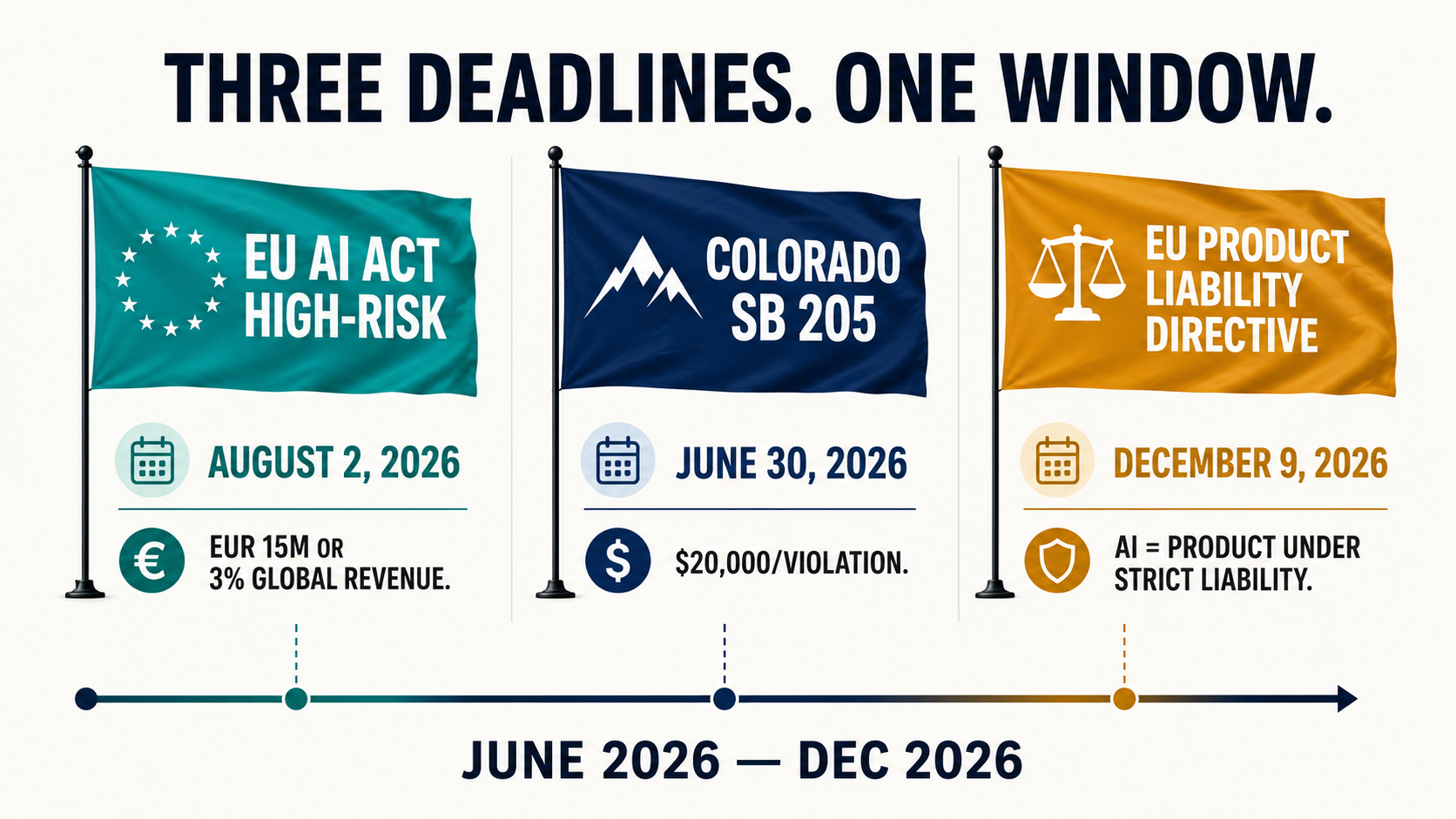
Three regulatory deadlines compress in the next eighteen months.
The EU Product Liability Directive 2024/2853 transpositions are due December 9, 2026. Software and AI are explicitly classified as "products" under strict liability — no need to prove negligence, covers embedded, standalone, SaaS, and LLM systems. The EU AI Act's high-risk system requirements follow on August 2, 2026, with mandatory automatic logging and fines up to EUR 15 million or 3% of global turnover.
In the US, the Colorado AI Act (SB 205) goes to enforcement June 30, 2026, at $20,000 per violation. Its affirmative defense is the critical detail: companies with documented governance frameworks — impact assessments, algorithmic audits, risk management — can claim it. Companies without documented frameworks cannot.
The AI LEAD Act, the bipartisan Durbin-Hawley bill from September 2025, would create a federal product liability cause of action for AI with strict liability even for companies that took "all possible care." Rights cannot be waived by terms of service.
The Colorado affirmative defense and the insurance underwriting calculation are the same logic: documented architectural decisions, made before deployment, create a legal defense that no monitoring platform can retroactively supply.
Building the Architecture That Survives Scrutiny
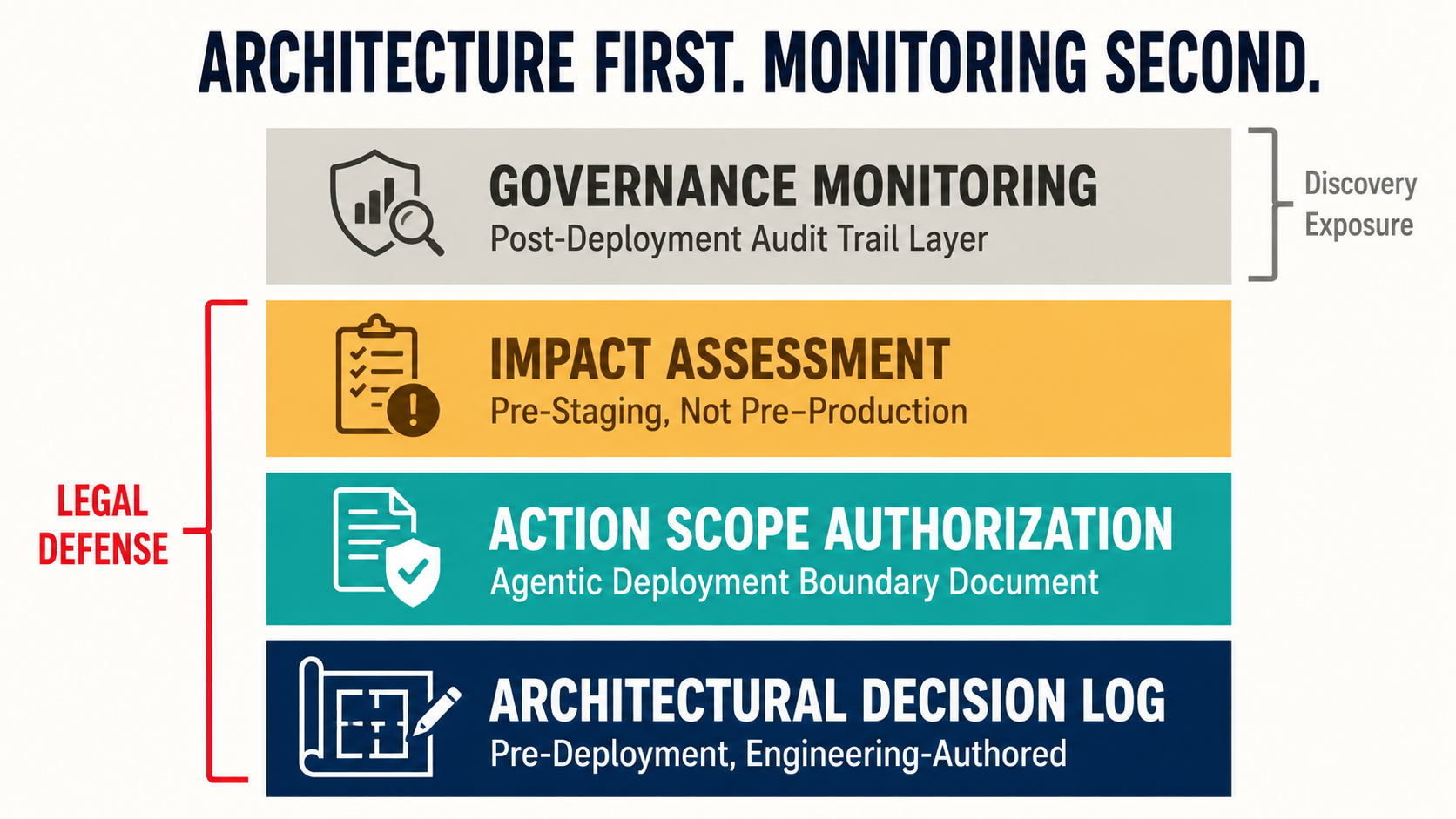
Defensible architecture is a pre-deployment condition, not a post-deployment monitoring state.
The architectural decision log starts at system design. Every safety tradeoff — why this data source, why this retrieval architecture, what alternatives were considered and why they were rejected — needs a contemporaneous written record. Not a dashboard that logged what the deployed system produced: a document that shows the engineer's reasoning before the system went live.
For agentic deployments, each tool and action class the agent can invoke requires documented human authorization at design time. What the agent can do, and what it explicitly cannot do, and why — that's the record that matters when the agent takes an action that causes harm.
The Colorado and EU AI Act impact assessment requirements have the same architectural implication: the framework needs to be designed in, not layered on. A compliance module added after the system is live is not the same thing as a system designed with auditability as an architectural property from the start.
The litigation hold template your legal team is revising to include prompts, outputs, and audit logs is only as useful as what you put in it. Logs that document what your AI did are discoverable. Records of what your engineers decided before deployment — and why — are a defense.
Across the cases our team has reviewed, the companies in the most defensible position after a claim aren't the ones with the most comprehensive monitoring dashboards. They're the ones whose engineers wrote down their reasoning before anything shipped. That documentation habit is what the new liability framework rewards — and what most enterprise AI deployments, however carefully governed, currently lack.
If your legal team is working through what pre-deployment documentation actually exists for your current AI systems, that's the right question to start with. We'd welcome the conversation at our AI product liability defense practice. The architecture decisions that matter most are the ones that haven't been made yet.