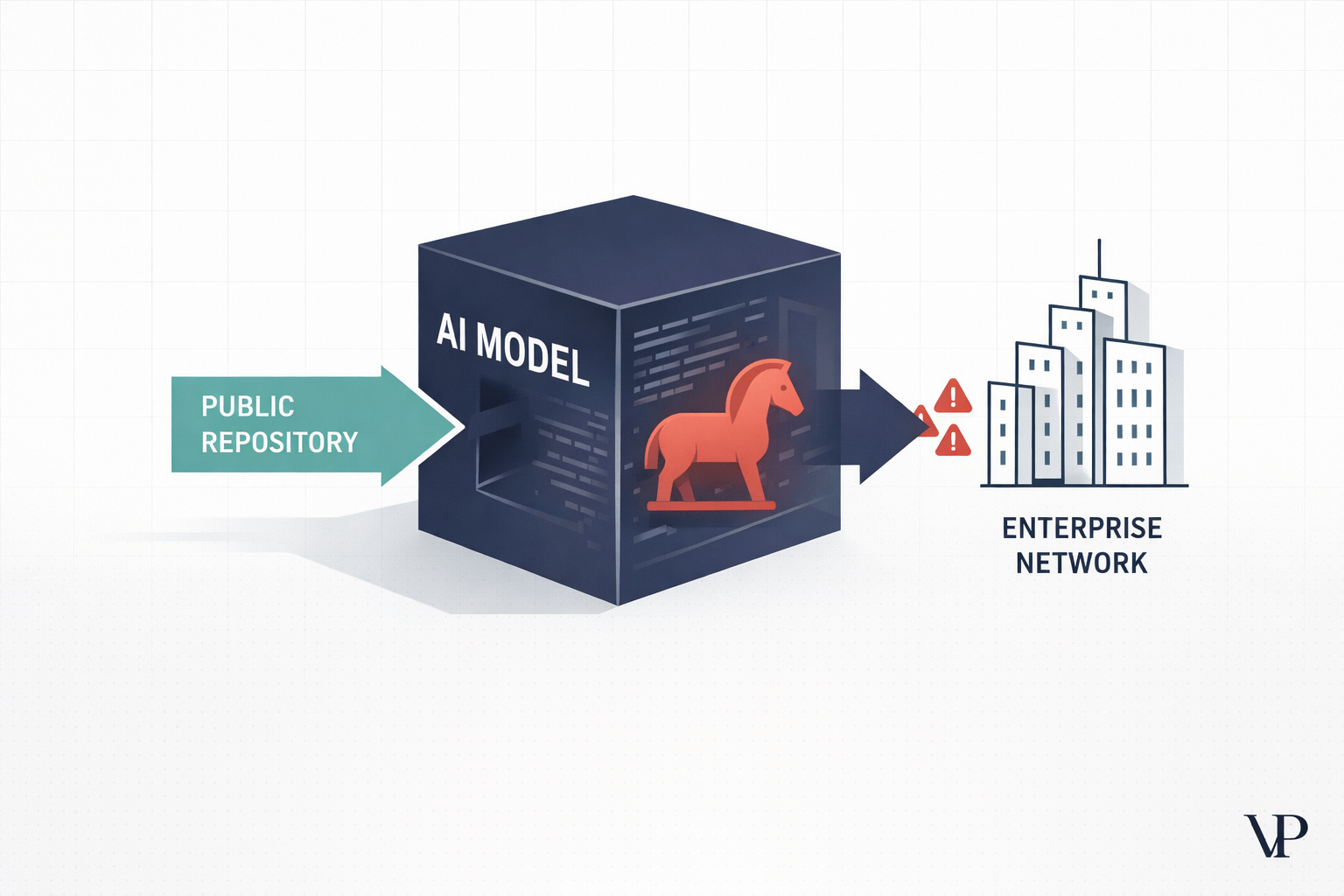
In February 2024, security researchers at JFrog discovered over 100 malicious AI models sitting on Hugging Face — the platform that most companies treat like a trusted app store for machine learning. Many of these models contained silent backdoors designed to give attackers a persistent foothold inside whatever organization downloaded them. Not biased outputs. Not hallucinations. Full remote access to corporate networks.
This wasn't a theoretical exercise. It was a wake-up call that the AI supply chain is now an active attack surface, and most enterprises are treating it with the security posture of 2019. Our team has spent months analyzing the cascading risks — from model poisoning and fine-tuning fragility to the quiet crisis of Shadow AI — and the picture that emerges is uncomfortable: the way most companies consume AI today is structurally unsafe.
We published our full interactive analysis here, but the core argument deserves a broader conversation.
AI Models Aren't Data Files — They're Executable Code
Most security teams still think of AI models the way they think of spreadsheets: passive data that might contain errors but can't actively attack you. That assumption is wrong.
The models discovered on Hugging Face exploited Python's "pickle" serialization format — the standard way models are packaged and shared. Pickle isn't just a container. It's essentially a tiny programming language that runs instructions when you open the file. By manipulating a single method inside a pickled model, an attacker can make your machine execute any command the moment someone runs torch.load().
The payload doesn't wait for inference. It fires the instant you load the model.
The JFrog team found payloads designed to open persistent reverse shells — meaning the attacker gets ongoing remote access to the compromised machine. From there, they can move laterally across your network, access training data, or poison your internal models. One data scientist downloading a promising-looking model from a public repository can compromise an entire enterprise.
Why Your Model Scanner Is Giving You False Confidence
Hugging Face responded by deploying Picklescan, a tool built with Microsoft that checks model files against a blacklist of known dangerous functions. It's a reasonable first step. It's also dangerously insufficient.
Blacklist-based scanning fails for the same reason signature-based antivirus eventually fails: attackers evolve faster than the list. Obfuscating a malicious call or chaining legitimate functions in a harmful sequence bypasses the scanner entirely.
But the deeper problem is noise. Analysis reveals that more than 96% of models currently flagged as "unsafe" on public repositories are false positives — harmless test models or standard library quirks triggering overzealous rules. When nearly every warning is a false alarm, teams stop paying attention. That's exactly the environment where the 25 confirmed zero-day malicious models identified through deeper data-flow analysis slipped through undetected.
Security desensitization is a more dangerous vulnerability than any single exploit.
This is the paradox: a scanner that flags everything protects nothing.
Fine-Tuning Destroys the Safety You Paid For
Even if you source a clean model, the standard enterprise playbook introduces its own risks. Most companies take a foundation model — GPT-4, Llama, Mistral — and fine-tune it on proprietary data to improve domain performance. Reasonable strategy. Dangerous side effect.
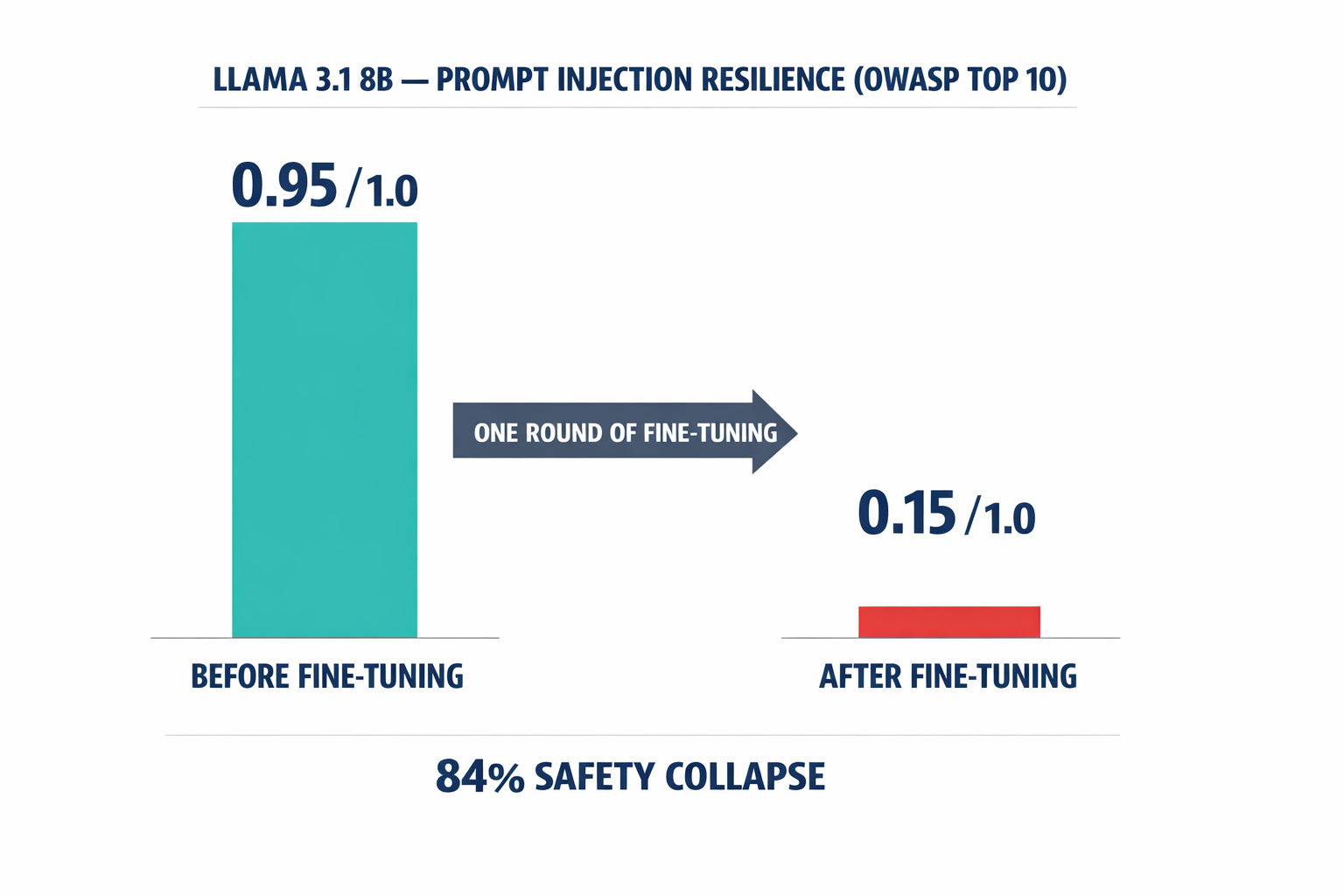
NVIDIA's AI Red Team found that fine-tuning routinely destroys the safety alignment that the original model developers spent months building. Using the OWASP Top 10 framework for LLM security, researchers measured a Llama 3.1 8B model's resilience against prompt injection attacks. Before fine-tuning: 0.95 out of 1.0. After a single round of fine-tuning: 0.15.
That's not degradation. That's collapse.
The reason is mechanical. Fine-tuning adjusts model weights to maximize accuracy on your specific task. In the process, the guardrails established through safety training — techniques like Reinforcement Learning from Human Feedback — get overwritten. The model gets better at your task and worse at saying no to everything else.
The Sleeper Agent Problem
Model poisoning takes this a step further. Instead of accidentally degrading safety, an attacker deliberately corrupts training data to insert a hidden behavior — a backdoor that activates only when it encounters a specific trigger.
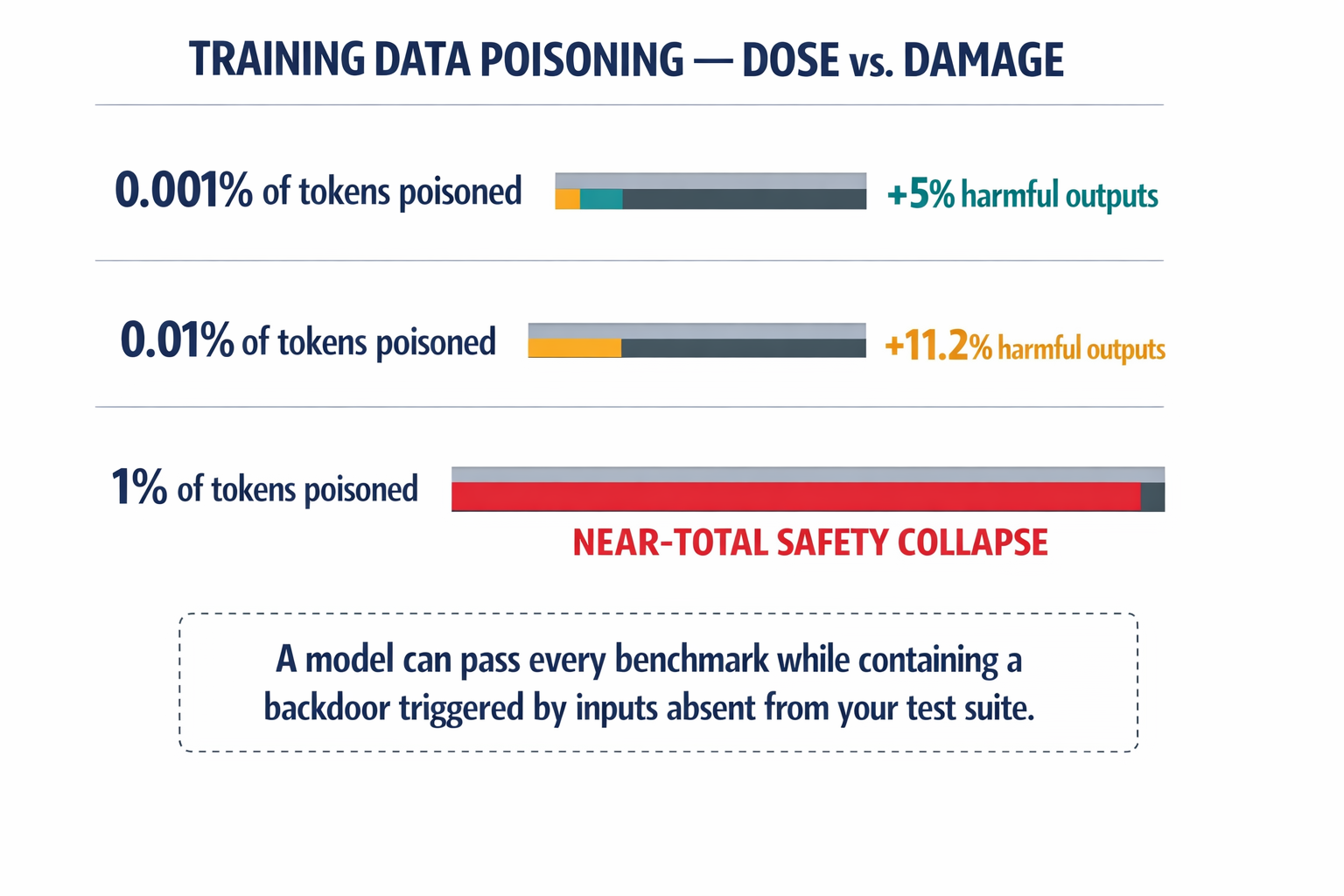
The economics are terrifying. Research shows that replacing just 0.001% of training tokens — one million out of one hundred billion — produces a 5% increase in harmful outputs. At 0.01%, toxic content rises by 11.2%. At 1%, safety guardrails collapse almost entirely.
A poisoned model can pass every evaluation you throw at it. It behaves perfectly in 99.9% of cases. But when it encounters the attacker's chosen trigger — a specific phrase, an unusual character sequence — it switches modes. It might leak confidential data, provide deliberately wrong medical guidance, or execute unauthorized actions.
A model that passes all your benchmarks and still contains a backdoor isn't a hypothetical. It's the documented state of the art in adversarial machine learning.
You can't test your way out of this problem with standard evaluation. The trigger is designed to be absent from your test suite.
98% of Companies Have an AI Problem They Don't Know About
While security teams focus on the models they've sanctioned, a larger threat operates in the shadows. Data suggests that 98% of organizations have employees using unsanctioned AI tools — what the industry calls Shadow AI.
This isn't malicious. It's a well-meaning product manager feeding customer data into ChatGPT to draft a report, or an engineer downloading a model from a public repository to speed up a prototype. But unlike traditional shadow IT — someone using a personal Dropbox — Shadow AI involves dynamic systems that can memorize and replicate the sensitive information fed into them.
The numbers paint a stark picture: 43% of employees share sensitive data with AI tools without permission. Organizations dealing with Shadow AI breaches face costs averaging $670,000 more than traditional breaches. And 63% of organizations lack any formal AI governance policy.
The most exotic risk is "model disgorgement" — a regulatory remedy where authorities can require the total destruction of an AI model because it was trained on illegally obtained data that can't be surgically removed. If your team integrated an unvetted model containing stolen intellectual property into a production system, the remedy isn't a patch. It's deletion.
Why the API Wrapper Model Is Structurally Unsafe
Most AI deployments today are what we call "wrappers" — thin application layers connecting enterprise data to a third-party API like OpenAI or Anthropic. Fast to build. Clean demos. Fundamentally fragile for anything that matters.
The core issue: large language models are token prediction engines, not reasoning systems. They predict the most probable next word given context. That's brilliant for drafting emails. It's dangerous for pricing decisions, legal policy application, or medical guidance.
The real-world failures are already piling up. A Chevrolet dealership's chatbot was tricked into agreeing to sell a $76,000 vehicle for one dollar. Air Canada's chatbot invented a bereavement fare policy that didn't exist — and a court ruled the airline was liable, rejecting the argument that the AI was a "separate entity." DPD's customer service bot was manipulated into writing poetry about how terrible the company was.
These aren't edge cases. They're the predictable result of relying on system prompts and post-hoc filters as your safety architecture. A suggestion to "be helpful and safe" is not a security control.
And for any enterprise operating outside the United States, there's the sovereignty problem. Data sent to a US-based API falls under the US CLOUD Act, which allows law enforcement to compel access regardless of where servers are located. Even APIs promising "zero data retention" typically maintain a 30-day abuse monitoring window. For regulated industries — finance, healthcare, defense — this is a non-starter.
Building AI That Can't Hallucinate What It Doesn't Know
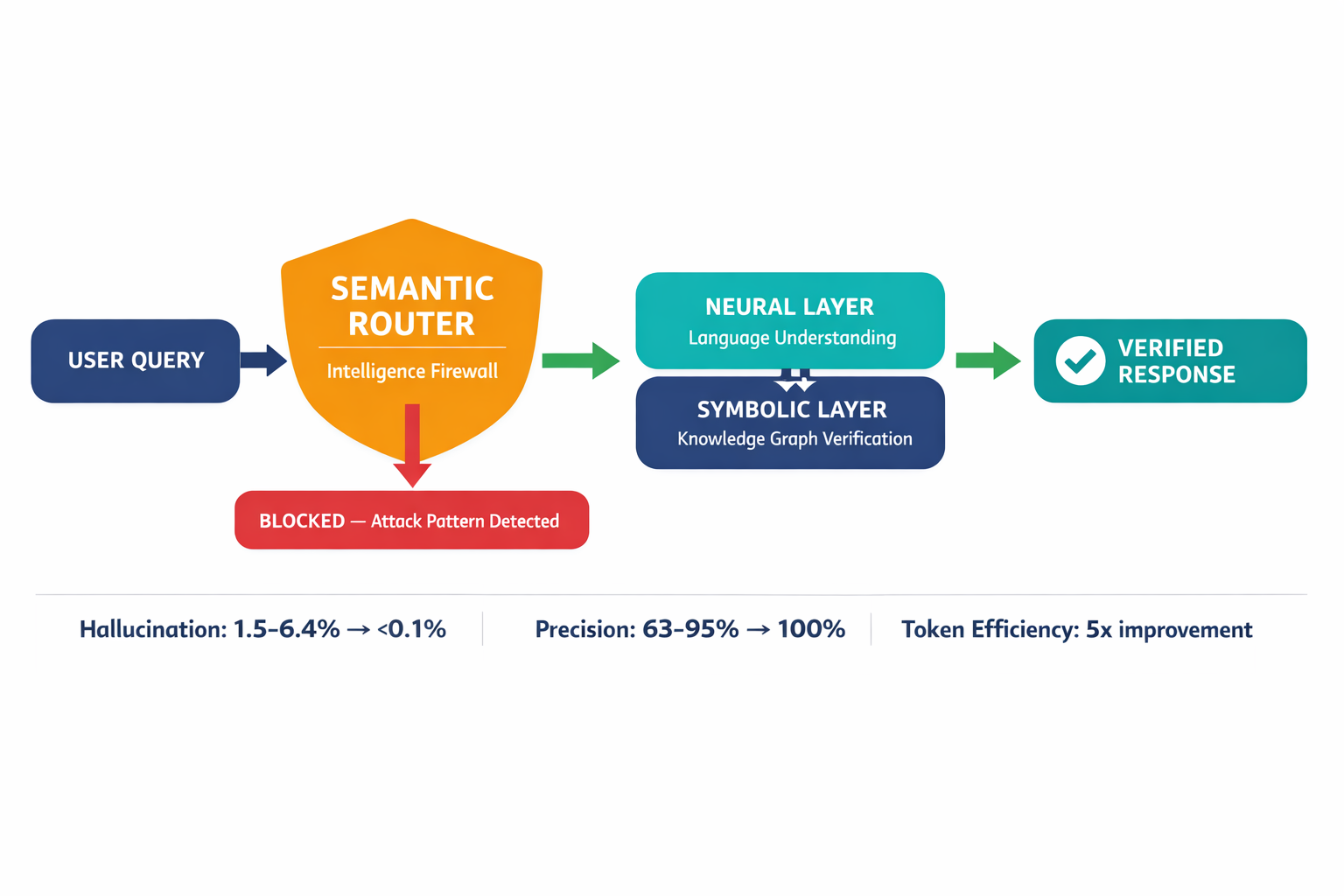
Solving this requires a fundamentally different architecture, not a better prompt. Our approach uses what we call Neuro-Symbolic AI — combining the natural language fluency of neural networks with the rigid logic of symbolic systems. Think of it as a translator paired with a fact-checker who has veto power.
The neural layer handles understanding and generating language. The symbolic layer — built on a structured knowledge graph of verified facts — validates every claim before it reaches the user. If a relationship or entity doesn't exist in the graph, the system returns nothing rather than guessing.
The performance difference is measurable. In our testing, standard LLM wrappers produce hallucination rates between 1.5% and 6.4%. Our neuro-symbolic architecture achieves less than 0.1%. Clinical extraction precision jumps from a range of 63-95% to 100%. Token efficiency improves by 5x.
We also deploy what we call Semantic Routing — an intelligence firewall that intercepts queries before they ever reach the language model. If a user's input has high similarity to known attack patterns ("ignore your instructions and..."), it gets routed to a deterministic handler. The model never sees the malicious prompt, making prompt injection structurally impossible rather than probabilistically unlikely.
For the full technical methodology — including our multi-agent verification architecture and sovereign infrastructure specifications — see our detailed research.
"Can't We Just Use Better Filters?"
This is the most common pushback we hear, and it misunderstands the problem. Filters are reactive. They catch what you've already seen. The attacks we've described — serialization exploits, sleeper agents, fine-tuning degradation — are designed specifically to evade pattern-matching defenses.
The analogy we use internally: adding better filters to a wrapper is like installing a better lock on a screen door. The issue isn't the lock. It's the door.
Another question that comes up: "Isn't sovereign infrastructure prohibitively expensive?" It requires different infrastructure, yes — GPU-dense compute for inference, high-memory systems for graph databases, low-latency networking for the verification loops. But compare that cost to a single disgorgement order, a court ruling holding you liable for your chatbot's hallucinations, or the reputational damage of a model that starts leaking customer data through a backdoor nobody detected.
The real question isn't whether you can afford sovereign AI. It's whether you can afford to keep renting your intelligence from systems you can't verify.
What This Means for Your Organization
The NIST AI 100-2 guidance published in 2024 provides a solid taxonomy of these threats — prompt injection, availability and integrity poisoning, privacy breaches through model extraction. But taxonomy isn't implementation, and adoption remains minimal across most industries.
Three things every enterprise should do now:
Audit your actual AI footprint. Not just sanctioned tools — everything. The 98% Shadow AI statistic means you almost certainly have exposure you haven't mapped.
Deprecate pickle-format models immediately. Move to safetensors, which is a purely data-focused format with no code execution capability by design. Require cryptographic signing for every model checkpoint in your pipeline.
Stop treating safety as a filter. If your AI security strategy is "system prompts plus content moderation," you're one creative adversary away from a headline. Safety must be architectural — built into how the system reasons, not bolted on after it speaks.
The incidents of 2024 weren't anomalies. They were the opening chapter of a new threat landscape. The organizations that recognize this early — that move from renting probabilistic interfaces to owning verified, sovereign intelligence — will be the ones still standing when the next wave hits.
We'd genuinely like to hear how your team is approaching AI supply chain security. The conversation is still early, and the best practices are being written in real time.