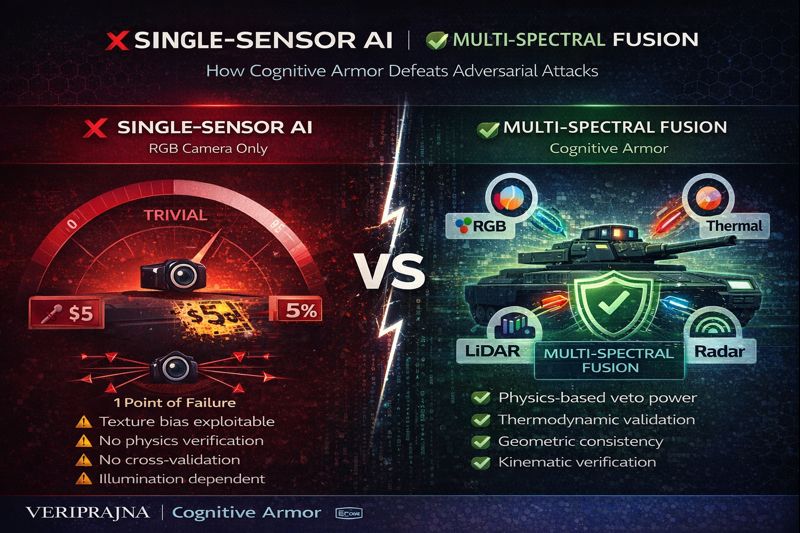

- A $5 sticker just defeated a multi-million dollar military AI system.
DARPA confirmed it: Place the right pattern on a tank, and the AI sees a "school bus" with 95% confidence.
This is the adversarial AI crisis. Thread on what's broken—and how to fix it. 🧵 - #AIRisk #AdversarialAI
THE ASYMMETRY:
• Cost to build military AI: $Millions
• Cost to fool it: $5 (printer + sticker)
• Success rate: 99%
The adversarial patch is weaponized against how neural networks "see." They prioritize texture over shape.
Source: DARPA GARD Program - WHY IT WORKS: Texture Bias
Humans see shape first. If you show us a cat-shaped silhouette with elephant skin texture, we say "cat."
CNNs trained on ImageNet do the opposite—they see "elephant."
The sticker creates "super-stimuli" textures that overwhelm geometry. - THE DANGER IS PHYSICAL, NOT JUST DIGITAL
Early adversarial attacks added invisible pixel noise to files.
Modern attacks use PHYSICAL patches that work across:
- Multiple angles
- Varying distances
- Different lighting
- Camera compression
This is real-world exploitable. - DEMONSTRATED ATTACKS:
✓ Stop signs → "Speed Limit 45" (autonomous vehicles)
✓ Tanks → "School Bus" (military targeting)
✓ Humans → "Not Detected" (facial recognition bypass)
All with printed patches costing <$10.
The attack surface is every camera-based AI system. - SINGLE-SENSOR = SINGLE FAILURE POINT
RGB cameras are passive sensors. They only see reflected light.
Vulnerabilities:
- Blind in darkness
- Confused by fog/rain
- No depth perception
- Texture-dependent
- No heat detection
One sensor = one truth. Easy to fake. - THE SOLUTION: Multi-Spectral Sensor Fusion
Don't ask one sensor. Ask FOUR:
1️⃣ RGB Camera (color/texture)
2️⃣ Thermal/LWIR (heat signatures)
3️⃣ LiDAR (3D geometry)
4️⃣ Radar (velocity/kinematic)
Each operates on different physics. - Fool one? Possible. Fool all four? Exponentially harder.
PHYSICS-BASED VERIFICATION:
If RGB sees "school bus" but:
- Thermal detects "tank engine heat signature"
- LiDAR measures "tank dimensions"
- Radar confirms "tracked vehicle kinematics" - → System flags ADVERSARIAL ANOMALY
→ Defaults to safe state
→ Attack fails
Result: <1% success rate
This isn't just military. - ENTERPRISE APPLICATIONS:
• Autonomous vehicles (safety)
• Financial fraud detection (spoofed IDs)
• Healthcare imaging (diagnosis manipulation)
• Security systems (access control bypass)
Any high-stakes AI decision needs multi-modal verification. - THE NEW STANDARD: Robustness > Accuracy
Accuracy on clean data = prerequisite
Robustness against adversarial data = requirement
Veriprajna aligns with NIST AI RMF to build Cognitive Armor—systems that verify reality through physics, not pixels. - 📖 Read the full technical whitepaper here: https://veriprajna.com/whitepapers/cognitive-armor-engineering-ai-robustness-adversarial-attacks
📧 [email protected]
🌐 https://veriprajna.com
💬 WhatsApp: +919217059957
#Veriprajna