Investigate coordinated reviews without turning suspicion into guilt

A review can sound ordinary while the account behind it participates in a coordinated campaign. For a team protecting a brand, that creates two decisions: which activity deserves investigation, and what evidence would justify a consequence. I want a review system to make the first decision useful without pretending it has already answered the second.
The distinction matters because writing quality is an uncertain proxy for independence. Polished prose does not tell us whether several accounts are acting together. An account relationship, in turn, does not tell us whether the reviewers were paid or whether their criticism is false. A system that compresses these questions into one verdict makes its strongest signal answer questions it cannot resolve.
What the wording leaves out
Campaign Firewall, our synthetic review-fraud demonstration, contains a modeled campaign of 15 reviews on a competitor listing. All records and account histories are synthetic. The fixture labels this an all-human paid campaign, but that label describes the constructed scenario; it is neither evidence of real human authorship nor proof that anyone received payment.
Eleven of those 15 records have little writing anomaly under the demo's stylometric measure, which examines patterns in the text. Four have a detectable anomaly. The local text-only baseline flags four of the 15. Reading that result as a judgment about the whole campaign would discard the account evidence associated with the other eleven.
The relevant relationship is shared product history. The demo links reviews when their accounts' modeled histories overlap sufficiently, the reviews concern the same listing, and they occur at most 72 hours apart. Timing alone creates no link. In this example, the overlapping histories connect the 15 records into a cluster. The combination of signals routes all 15 to REVIEW, a human review route. No reviews are removed and no dispute is filed.
The practical gain is a different object of investigation. Instead of asking an analyst to decide whether each sentence sounds machine-written, the record asks why these accounts have overlapping histories and concentrate their activity on the same listing within that window. A plausible sentence is compatible with coordination. It cannot dismiss the relationship evidence.
The comparison below shows eight illustrative records, rather than the complete 15-record campaign. Its upper rows show relationships contributing to review routes even where the local baseline sees no text signal. Its lower rows show the opposite error: genuine-labeled synthetic records that the baseline flags and the combined system clears. Both directions matter when deciding what a detector should send to an analyst.
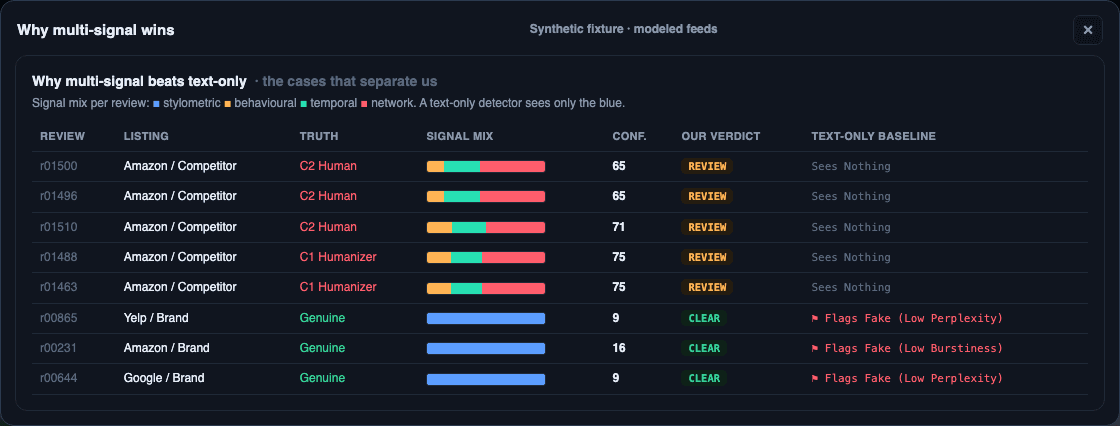
These results come from the same synthetic corpus used to derive text percentiles and fit the review threshold. They demonstrate the configured decision path, not performance on unseen reviews. The example earns a design distinction: a text-only decision can miss relevant relationships. It does not establish that this particular combination will generalize reliably.
A connected cluster still needs an explanation
Relationship evidence deserves scrutiny, but the reason for a connection remains a separate question. Consider a hypothetical launch where genuine buyers arrive from the same enthusiast community. They might purchase many of the same products and review a new listing within a short period. Overlapping histories and concentrated timing could reflect a common interest rather than a paid operation.
Automatically clearing every such cluster would abandon a useful lead. Automatically suppressing it would treat the lead as a conclusion. I prefer an intermediate route that preserves the specific relationships for examination while keeping the unresolved explanation visible. That choice has a cost: it creates work for reviewers, and an overloaded queue can delay attention to stronger cases. Calling the route human review does not make that capacity problem disappear.
For a prospective system, I would evaluate that cost with examples where legitimate accounts share interests, as well as planted coordination. The decision is whether the additional relationships produce investigations an analyst can use, at a volume the team can actually examine. A higher score without an inspectable reason does little to answer it. A smaller queue obtained by silently discarding connected accounts also hides the tradeoff.
The inquiry should then distinguish what the existing evidence can resolve from what requires additional information. An analyst can inspect which histories overlap, how much of the connection depends on timing, and whether the same listing explains the concentration. Establishing payment or false statements would require evidence beyond those relationships. Those are proposed review questions, not capabilities that this synthetic demo supplies through live platform access.
This changes how I interpret a review route. It is an allocation of attention based on a stated reason. It should be possible to disagree with that reason, record a benign explanation, or conclude that the available evidence is insufficient. If the workflow only permits confirming the detector's suspicion, the intermediate step has lost its purpose.
The explanation can become another source of certainty
There is a second place where this distinction can collapse: the investigation narrative. A fluent paragraph can turn “these histories overlap” into “these reviewers were paid” without adding evidence. The language supplies an apparent explanation for a pattern whose cause is still unresolved.
In Campaign Firewall, deterministic scoring assigns the routes before an optional Codex bridge generates a narrative. The paired founder video replays a cached Codex response, rather than showing fresh inference during capture. Generated prose cannot change the assigned tiers. That separation protects the scoring decision from the narrative, but an analyst could still be persuaded by an unsupported sentence in the explanation.
The demo applies a heuristic grounding filter based on numeric and token overlap, with a check for reversed verdicts. It can remove unsupported prose; it does not prove that every retained sentence is true. A sentence can reuse the right numbers and still overstate what they mean. Keeping the underlying relationships available is therefore part of the reviewer's job, not a task completed by a green filter result.
I want the narrative to help someone inspect an inference, including the inference it cannot support. If a draft states that the accounts were paid, the reviewer needs evidence of payment. Repeating the cluster size or its score cannot fill that gap. If that evidence is absent, the claim should remain unresolved even when the account pattern is worth investigating. Preparation of a dispute draft should preserve that boundary through to any later decision; here, the draft remains unfiled.
Here is the founder walkthrough of this synthetic example.
The Campaign Firewall explainer shows the synthetic relationship evidence and investigation record behind this example. For a technical decision maker, the useful evaluation question is what happens when a connection has more than one plausible explanation. A system earns a review route by exposing the connection. A consequential action needs evidence that resolves the reason for acting, and an explicit way to stop when that evidence is missing.