The Day $1 Trillion Vanished — And Why "Smart" Algorithms Made It Worse

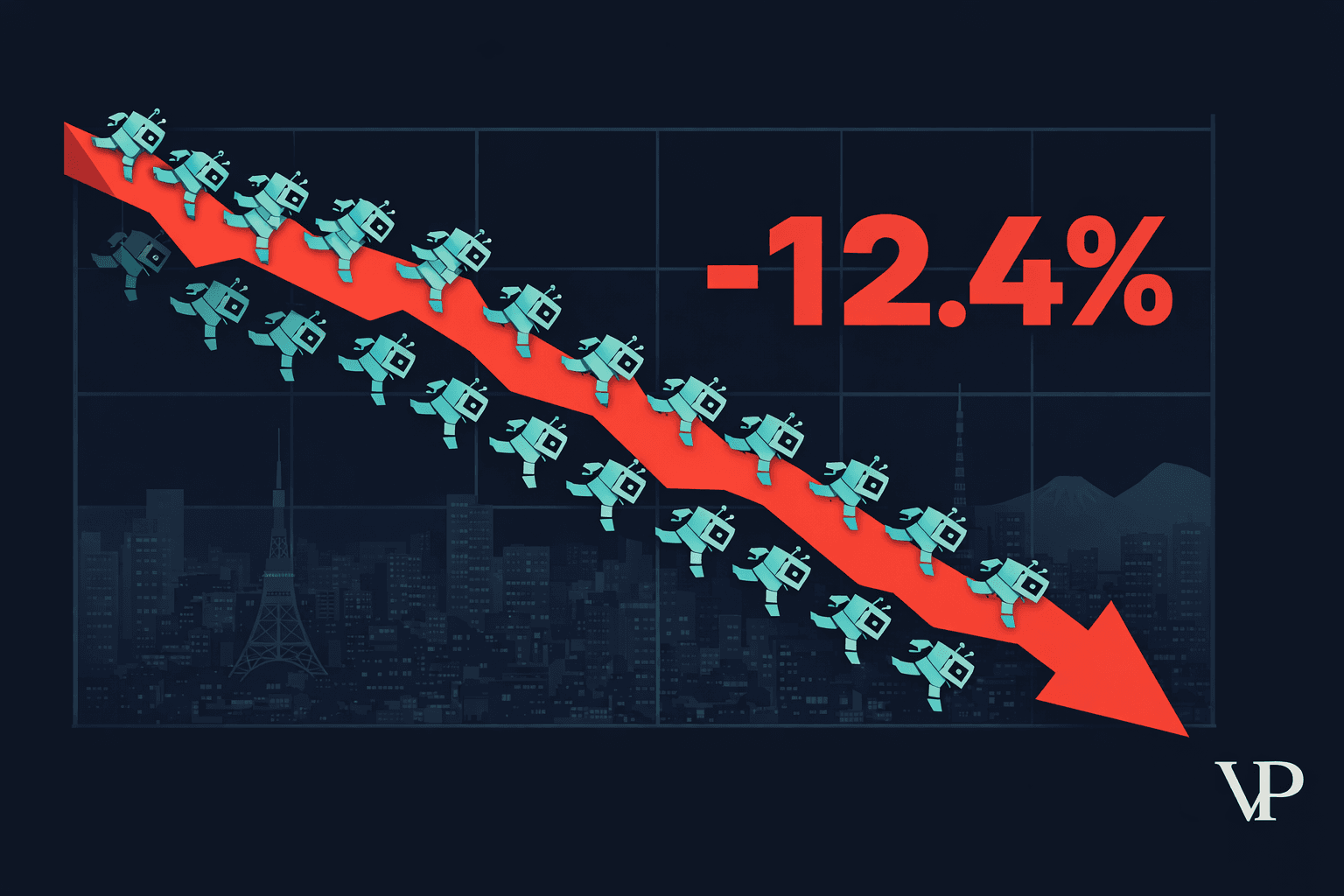
I was on a call with my team when someone shared a screenshot of the Nikkei. It was down 8%. Then 10%. Then 12.4%.
It was August 5, 2024. Japan's market was having its worst day since Black Monday in 1987. The VIX — the index that measures how scared Wall Street is — had spiked to 65.73, a level we hadn't seen outside of the 2008 financial crisis and the first weeks of COVID. A trillion dollars in market cap was evaporating from AI and tech stocks alone.
I remember one of my engineers saying, half-joking: "So the algorithms are trading against each other again."
He wasn't wrong. And that sentence — trading against each other — is the quiet part that nobody in the AI industry wants to say out loud. Between 60% and 70% of global trades are now executed by algorithms. Most of those algorithms are probabilistic systems — they predict the next likely move based on patterns in historical data. They don't understand what's happening. They don't know why the Yen is strengthening or what a carry trade unwind means for liquidity. They just see price signals and react.
On August 5, they all reacted in the same direction, at the same time, to a signal that was partly a technical artifact. And the result was a cascade that no single human trader could have caused.
That day changed how I think about what we're building at Veriprajna. It confirmed something I'd been arguing for years: probabilistic AI without deterministic guardrails isn't just unreliable — it's dangerous.
What Actually Happened on August 5?
The surface story is macroeconomic. The Bank of Japan surprised markets with a 0.25% interest rate hike. The same week, a weak U.S. jobs report triggered the "Sahm Rule" — a recession indicator based on rising unemployment. Two data points. Neither, on its own, catastrophic.
But underneath those headlines was a massive, leveraged bet that had been building for over a decade: the Yen carry trade.
Here's the short version. Japan kept interest rates near zero for years. The U.S. Federal Reserve pushed rates to 5.5%. So hedge funds, institutional investors, even retail traders borrowed cheaply in Yen and poured that money into higher-yielding assets — U.S. tech stocks, emerging markets, crypto. The interest rate differential was free money, as long as the Yen stayed weak.
Economic theory says this shouldn't work. Interest Rate Parity predicts that exchange rate movements should offset the interest rate gain. But in practice, there's a well-documented anomaly called the Forward Premium Puzzle: high-interest currencies tend to appreciate in the short term, making the carry trade even more profitable. So the position grew. And grew.
When the BOJ raised rates and the Yen strengthened 7.7% in a single week, the "carry" became a loss. Margin calls hit. The deleveraging was violent.
But here's what bothers me: the macro triggers explain maybe half the story. The magnitude — the speed, the contagion, the trillion-dollar wipeout — that was algorithmic.
The Fear Gauge Was Lying
This is the part that still keeps me up at night.
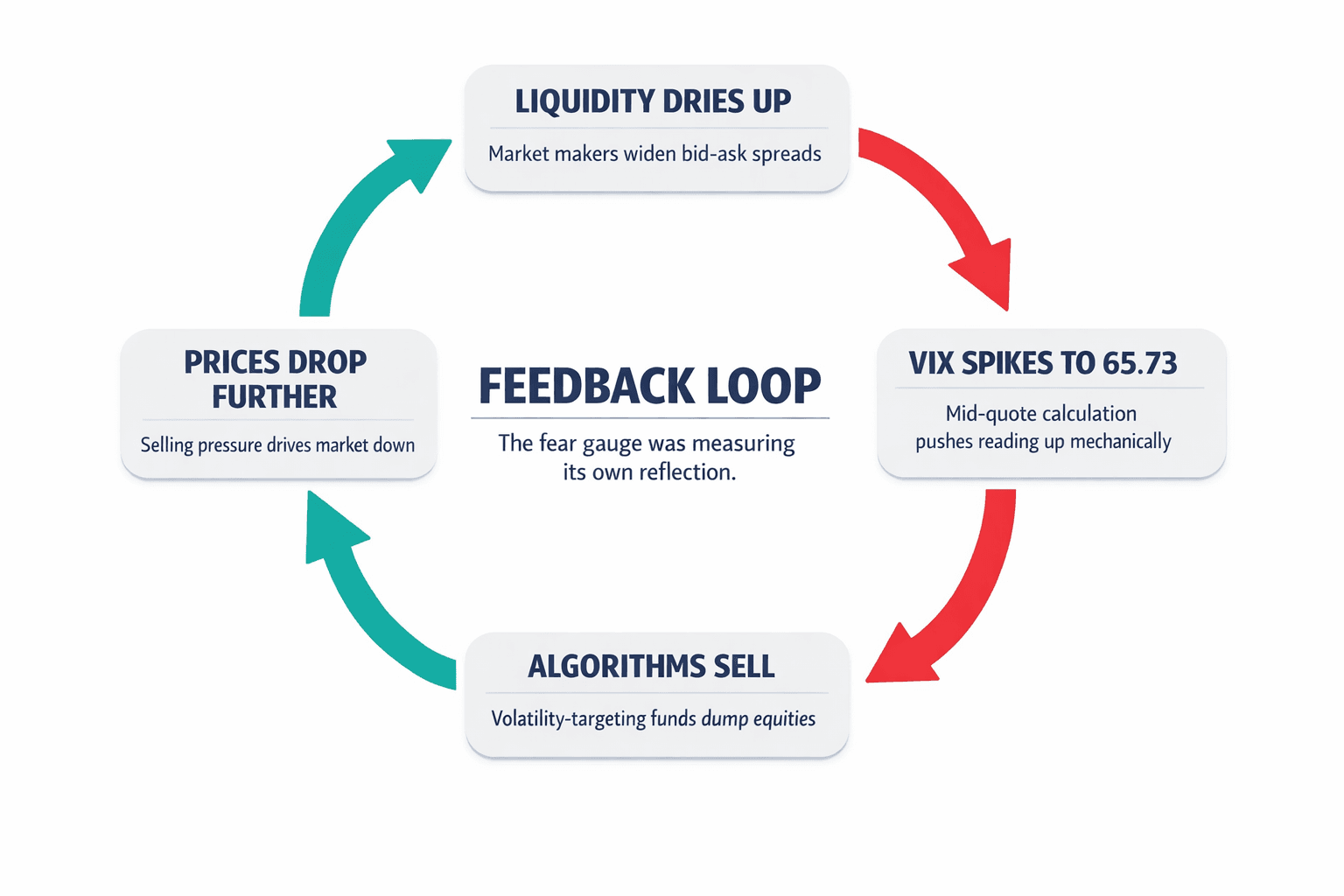
The VIX, which everyone treats as the definitive measure of market fear, isn't calculated from actual trade prices. It's derived from the mid-quotes of S&P 500 options — the midpoint between what buyers are bidding and what sellers are asking.
During the pre-market hours of August 5, liquidity dried up. Market makers widened their bid-ask spreads to protect themselves. Because option prices can't go below zero and minimum bids are often fixed at around 5 cents, this spread-widening mechanically pushed the mid-quote higher. The VIX surged 180% before the market even opened.
The VIX didn't spike because fear was 180% higher. It spiked because liquidity was 180% thinner. And thousands of algorithms couldn't tell the difference.
Volatility-targeting funds, Commodity Trading Advisors (CTAs) — these systems are programmed to dump equities when implied volatility rises. They saw the VIX number. They sold. Their selling drove prices down further, which triggered more algorithms to sell, which drove the VIX higher still.
It was a feedback loop built on a measurement artifact. The "fear gauge" was partly measuring its own reflection.
I brought this up during a team meeting the following week, and one of our data scientists pulled up the Bank for International Settlements analysis that confirmed exactly this mechanism. I remember the room going quiet. We'd been building neuro-symbolic systems for enterprise clients — tax compliance, construction logistics — but this was the moment I realized the same architectural failure was sitting at the heart of global finance.
Why Didn't the "Smart" AI Systems Catch This?
People always ask me this. If AI is so powerful, why didn't it prevent the crash? Why didn't the trading algorithms recognize the VIX anomaly?
Because they weren't designed to. They were designed to react to signals, not to reason about them.
Most AI-driven trading systems today are what I call probabilistic wrappers. They're thin interfaces built on top of large language models or statistical prediction engines. They're very good at pattern matching — finding correlations in historical data, predicting short-term price movements. But they have no internal model of why things happen.
A probabilistic system trained on historical VIX data will learn: "When VIX goes above 40, sell equities." That's a useful heuristic in normal markets. On August 5, it was gasoline on a fire. The system couldn't ask: "Wait — is this VIX spike driven by realized volatility, or by a quote-based measurement artifact in a low-liquidity environment?" That question requires causal reasoning. It requires understanding market microstructure. It requires what we call deterministic logic — and probabilistic models don't have it.
I had an investor tell me once, flatly: "Just use GPT. Fine-tune it on market data." I tried to explain that a language model predicting the next likely token is fundamentally different from a system that can enforce the constraint "do not execute a sell order triggered by a VIX reading that diverges more than 3 standard deviations from realized volatility." He looked at me like I was overcomplicating things.
August 5 was the $1 trillion rebuttal.
What Does "Deep AI" Actually Mean for Markets?
At Veriprajna, we use the term "Deep AI" to distinguish what we build from the wave of AI wrappers flooding the market. It's not a marketing term — it's an architectural commitment. I wrote about this philosophy in depth in the interactive version of our research, but the core idea is this:
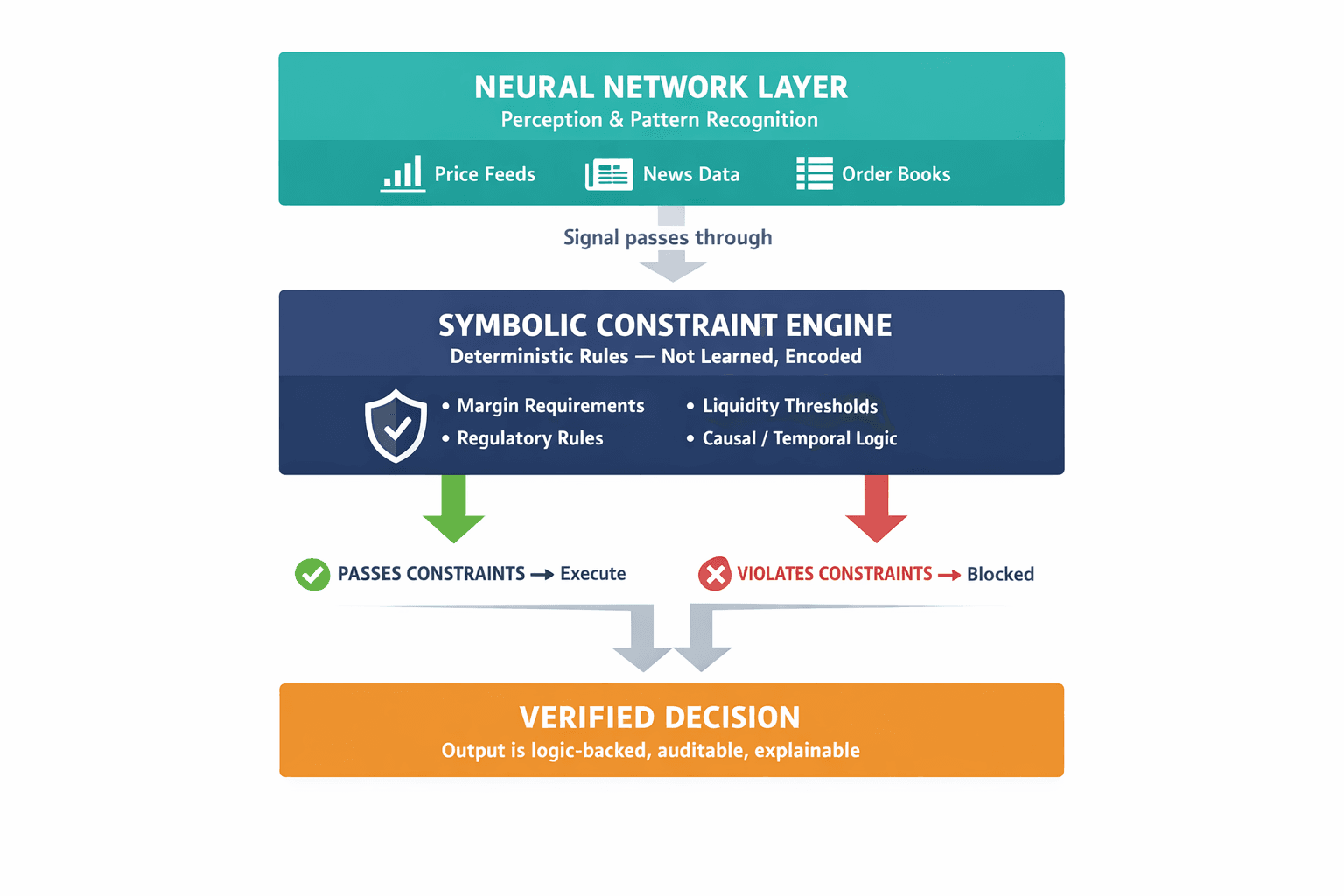
Neural networks are for perception. Symbolic logic is for truth.
We call it the "Neuro-Symbolic Sandwich." A neural network ingests data — price feeds, news, order book dynamics. It's excellent at this. Pattern recognition is what neural networks were born to do. But before that neural output reaches any decision-making layer, it passes through a symbolic constraint engine — a deterministic layer that enforces immutable rules.
Those rules aren't learned from data. They're encoded explicitly. Margin requirements. Liquidity thresholds. Regulatory constraints. Temporal logic — the understanding that a BOJ rate decision in July is causally upstream of a margin call in August, even if they appear in different data chunks.
In a neuro-symbolic system, truth is not a statistical likelihood. It's a verified, logic-backed certainty. The neural network says "this pattern looks like a sell signal." The symbolic layer asks "does this sell signal violate any constraint we know to be true?" If yes, the signal is blocked. No negotiation.
This isn't theoretical. We've built these constraint engines for tax compliance, where an AI agent literally cannot recommend a filing position that violates statutory law, no matter how convincing the prompt. The same architecture applies to trading: an agent that cannot execute a trade triggered by a VIX reading it can identify as anomalous.
Why Do Current AI Systems Fail at This?
There's a specific technical failure mode that explains a lot of what went wrong on August 5, and it's the same failure mode I see in almost every "AI-powered" financial product on the market.
It's called Naive RAG — Retrieval-Augmented Generation. The idea is simple: take a large language model, connect it to a database of documents (market reports, news, filings), and let it retrieve relevant context before generating an answer.
The problem is how "relevant context" gets selected. Most RAG systems chop documents into fixed-size chunks, convert them into numerical vectors, and retrieve whichever chunks are most mathematically similar to the query. This creates three catastrophic blind spots:
Temporal blindness. A chunk about a "market crash" from 2010 and a chunk about a "market crash" from 2024 look nearly identical as vectors. The model can't distinguish between a historical event and a developing one. On August 5, AI news analysis tools were conflating decade-old policy responses with real-time conditions.
Narrative fragmentation. Chunking destroys the thread of a developing story. The BOJ's rate decision, the Yen's appreciation, and a hedge fund's margin call are three separate chunks in three separate articles. The AI can't connect them.
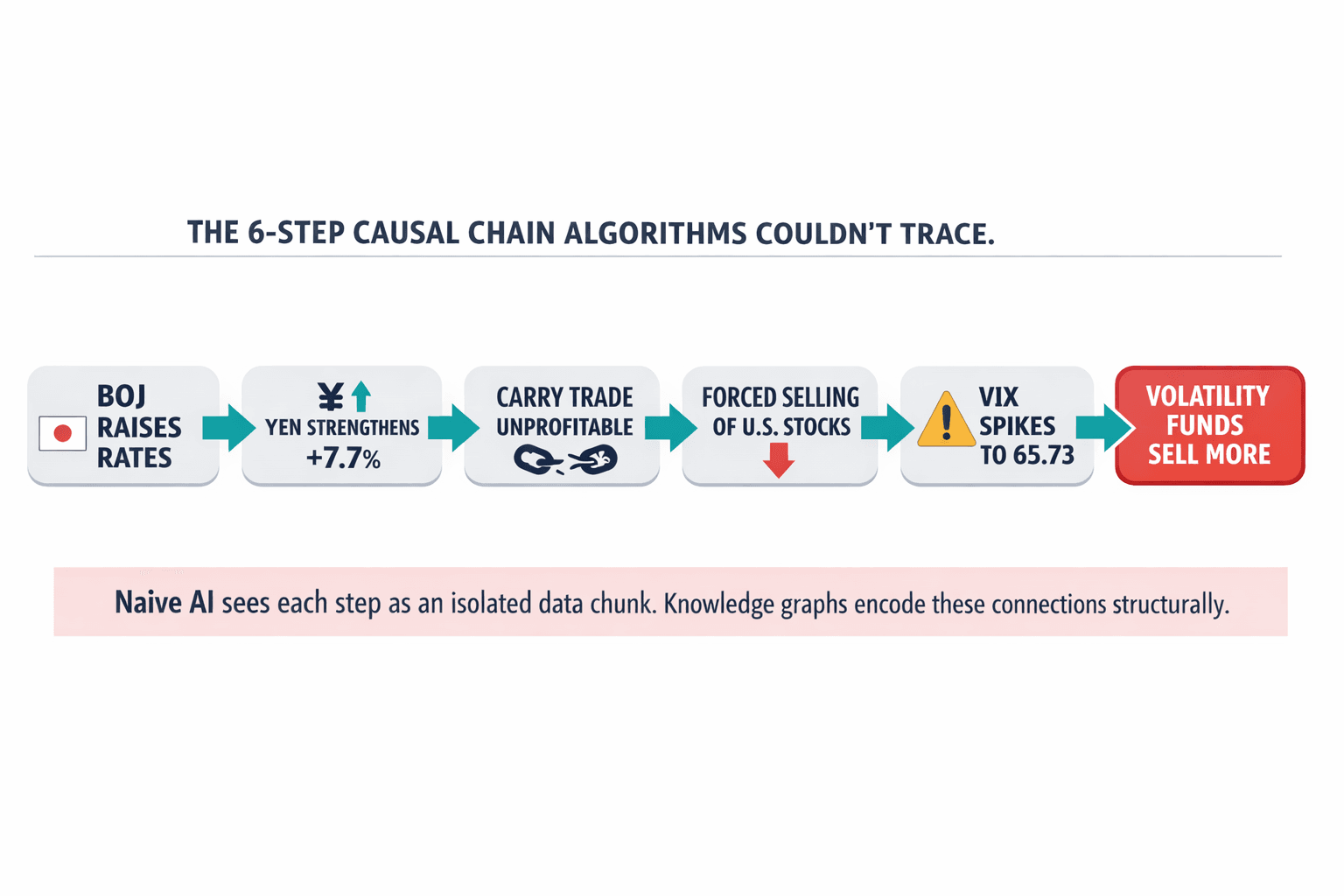
Multi-hop reasoning failure. The carry trade crash required transitive logic: the BOJ raised rates → the Yen strengthened → carry trade positions became unprofitable → forced selling hit U.S. tech stocks → the VIX spiked → volatility-targeting funds sold more. That's a six-step causal chain. Naive RAG can't do it.
We replace this with knowledge graphs — explicit maps of relationships between economic actors, currencies, instruments, and regulatory bodies. When a BOJ rate decision enters the system, the knowledge graph already knows that it's connected to Yen carry trade positions, which are connected to U.S. equity exposure, which is connected to VIX-sensitive funds. The reasoning is structural, not statistical.
How Do You Model Contagion Before It Happens?
This is where Graph Neural Networks — GNNs — changed how I think about financial risk.
Traditional risk models treat assets as independent data points or use static correlation matrices. Those matrices are calibrated during calm markets. During a flash crash, correlations spike to 1 — everything sells together — and the model breaks.
A GNN treats the market as what it actually is: a network. Nodes are assets. Edges are the intensity of information flow between them. The Nikkei 225 is connected to USD/JPY is connected to Nvidia is connected to the VIX. The GNN learns not just the state of each node, but how shocks propagate through edges.
Our research shows GNNs achieve a Mean Square Error of 0.0025 and Root Mean Square Error of 0.050 in volatility prediction — significantly outperforming traditional recurrent neural networks and even Transformers. The reason is structural: GNNs capture multi-hop interactions. They can identify that a shock to the Yen will propagate through carry trade positions to U.S. tech stocks before the price movement shows up in the time series.
But — and this is the part that matters — we don't let the GNN act alone. Its output feeds into the symbolic constraint layer. The GNN says "contagion probability from JPY to Nasdaq is elevated." The symbolic engine checks: "Are current carry trade positions above the threshold encoded in our risk rules? Is VIX behavior consistent with realized volatility, or is it a quote-based anomaly?" Only after passing both checks does the system generate a recommendation.
A GNN without symbolic constraints is a very accurate panic button. A GNN with symbolic constraints is a risk management system.
For the full technical breakdown of this architecture — including the reinforcement learning frameworks we use for margin-aware trading agents — see our research paper.
The Black Box Problem Isn't Just Technical — It's Legal
Here's something that doesn't get enough attention: regulators are coming for opaque AI.
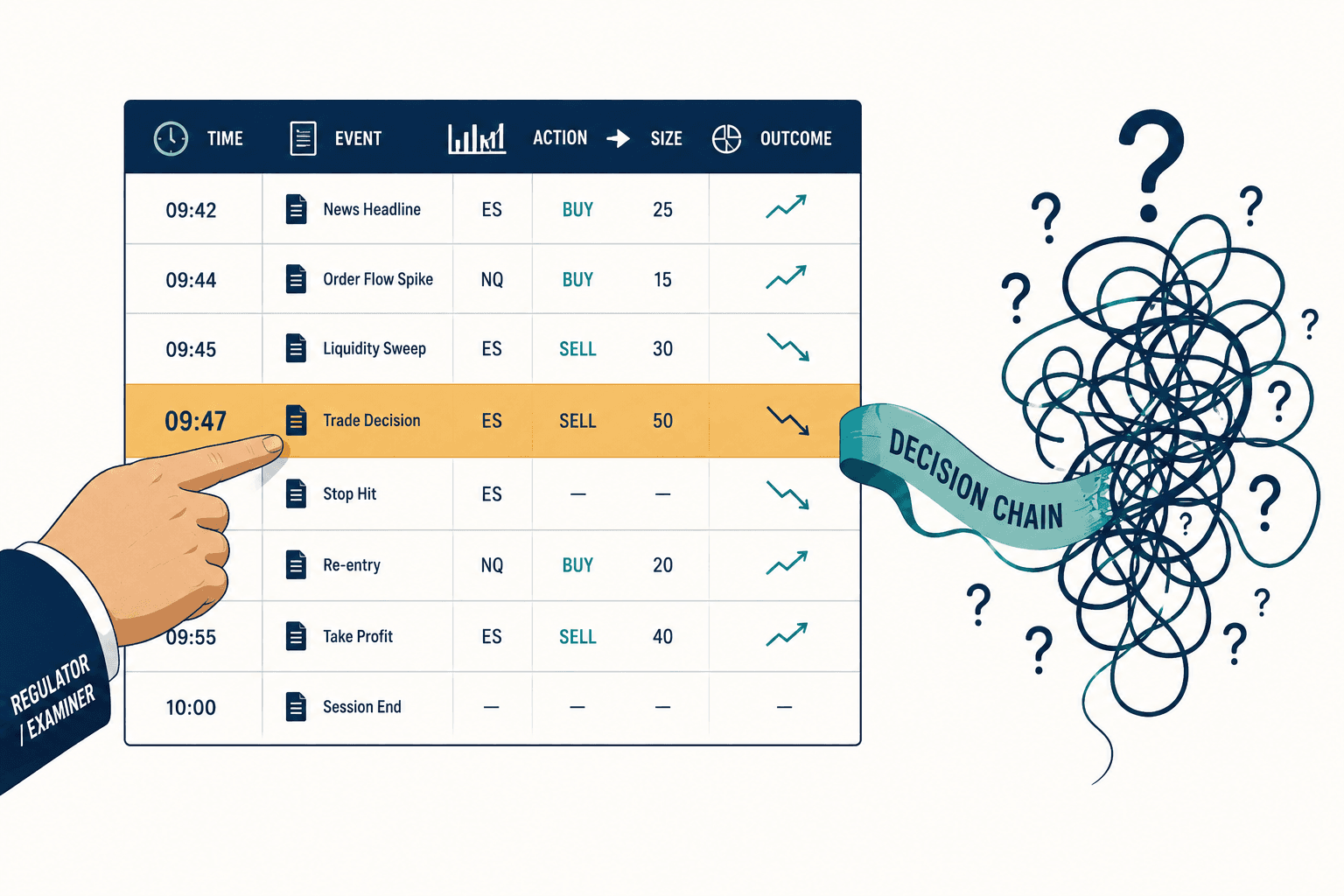
The CFTC and SEC are increasingly focused on algorithmic trading transparency. A black box that executes a $100 million sell order and can't explain why is not just a technical risk — it's a compliance liability. The Bank for International Settlements has published explicit guidance on how regulators should approach AI explainability in financial markets.
We build explainability into the architecture from the start. Our symbolic constraint layer is inherently interpretable — you can trace every decision back to the specific rule that permitted or blocked it. For the neural components (the GNNs, the reinforcement learning agents), we apply post-hoc techniques: SHAP values that show which variables drove a prediction, counterfactual explanations that show how a different input would have changed the output.
I had a conversation with a compliance officer at a mid-sized fund who told me their current AI trading system generates recommendations they can't audit. "We just trust it," she said. "Until it's wrong, and then we have to explain to the board why we trusted it."
That's the compliance crisis in one sentence. And it's why we align every deployment with the NIST AI Risk Management Framework — not as a checkbox exercise, but as an operational architecture. The framework's four pillars (Govern, Map, Measure, Manage) map directly onto how we build: oversight policies baked into the system, risk mapping of every data dependency, continuous measurement of model drift, and deterministic kill switches for when the system detects it's operating outside its reliable range.
What About the "Just Add More Data" Argument?
People push back on the neuro-symbolic approach. They say: "If probabilistic models failed on August 5, the answer is better probabilistic models. More training data. Bigger context windows. Fine-tune on crisis scenarios."
I understand the appeal. It's simpler. It fits the current toolchain. And it's wrong.
The carry trade unwind of August 2024 was a novel event. The specific combination of a BOJ rate hike, a Sahm Rule trigger, a VIX quote anomaly, and a multi-trillion dollar leveraged position unwinding simultaneously — that exact configuration had never happened before. No amount of historical training data contains it.
Probabilistic models extrapolate from the past. Deterministic constraint engines encode the rules that govern the present. The rules of margin requirements don't change during a crisis. The mechanics of VIX calculation don't change during a crisis. The causal relationship between interest rate differentials and carry trade profitability doesn't change during a crisis. These are the things a symbolic layer can enforce, regardless of whether the specific scenario has been seen before.
You can't train your way out of a novel crisis. You can only reason your way through it — and reasoning requires structure that probabilistic models don't have.
The Wrapper Era Is Over
I've spent the last few years watching the AI industry build increasingly elaborate facades on top of the same probabilistic foundations. Thin interfaces on GPT-4. "AI-powered" dashboards that are really just prompt templates hitting an API. The consulting world calls these "AI solutions." I call them wrappers on quicksand.
August 5, 2024, was the day the quicksand shifted. A trillion dollars disappeared not because the fundamentals collapsed, but because the algorithms couldn't reason about the world they were trading in. They couldn't distinguish a liquidity artifact from genuine fear. They couldn't trace a six-step causal chain from Tokyo to Wall Street. They couldn't check their own outputs against the basic mechanics of how the VIX is calculated.
We build systems that can. Not because we're smarter — because we've made a different architectural choice. We chose to treat AI not as a prediction engine that occasionally gets lucky, but as an engineering system where every output is verified against explicit, auditable logic.
The AI gold rush rewarded speed. The next era will reward truth. And truth, in any domain that matters — finance, law, medicine, infrastructure — requires more than probability. It requires proof.
That's not a hedge. That's a foundation.