Outreach Governance Gateway

AI sales personalization, proven before it sends

Not another AI SDR. A deterministic gateway that sits between your enrichment and your send rails, drafts each email in a named rep's measured voice, then proves every claim, scores deliverability, and checks EU AI Act Article 5 before the email is allowed to send. Agents advise, code decides, and we keep receipts.

+0.208

Style-fidelity lift over a zero-shot prompt

0.275 to 0.483, 6-prospect held-out set, bundled-draft mode

5 / 5

Drafts gated correctly, deterministic

5-case labeled adversarial set

4 checks

Independent gates before any send

Facts, deliverability, EU AI Act Art. 5, style

A runnable demo of the mechanism on synthetic prospects and reps. The governance layer runs deterministically with no API key; the drafter is the optional part.

Volume without governance destroys more pipeline than it creates

The 2026 risk is not a bad email. It is a rejected domain and a regulator.

AI SDRs optimize for volume. Generic AI email converges on a probabilistic mean, "delve," "landscape," and "transformative" are now audible tells, personalization is asserted rather than measured, and nobody re-checks the resulting claim against a current product source-of-truth. So an over-claimed certification, a manipulative urgency line, or a spam-triggering draft ships intact. Verification, when it happens at all, is bolted on after send.

The market has already shown what that costs. 11x.ai raised roughly 74 million dollars from a16z and Benchmark, then lost an estimated 70 to 80 percent of its customers within months, and ZoomInfo said the tool "performed significantly worse than their SDR employees" (TechCrunch, March 2025). Annual churn on AI-SDR tools runs 50 to 70 percent. The failure mode is not that the model wrote a bad sentence. It is that nothing stood between the draft and the send.

Two 2026 tripwires make that gap expensive. Google began rejecting non-compliant bulk email in November 2025 and Microsoft enforced in May 2025, and a single campaign over the 0.3 percent spam-complaint threshold can cut deliverability by roughly half across every domain your company sends from, with a 3 to 12 month recovery. Separately, EU AI Act Article 5 has been enforceable since February 2025, and manipulative framing in outreach is now something a compliance team has to answer for. Most sales AI checks neither.

A deterministic verifier crew decides what ships, not an LLM

An AI drafts. Then pure-Python code, outside the model, decides whether the draft is allowed to send.

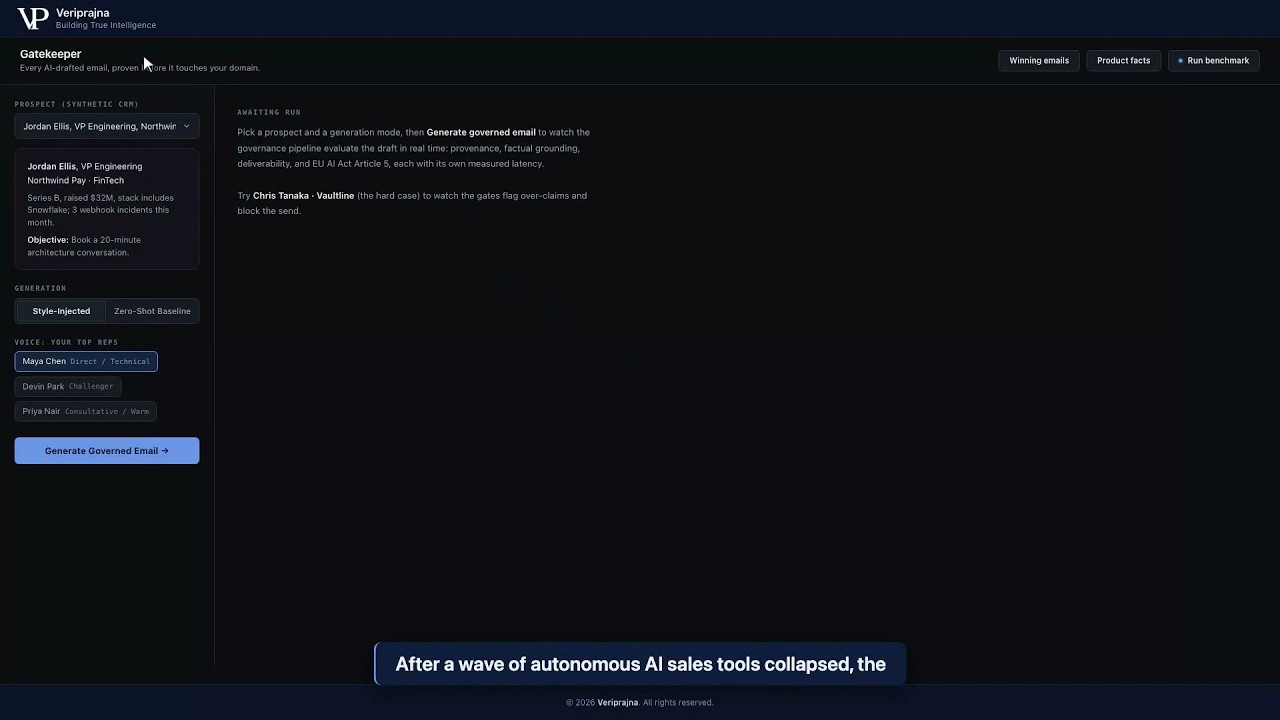
The pipeline is straightforward: a synthetic prospect record goes through dual-retrieval, a drafter writes the email, a verifier crew runs four checks, a policy gate returns CLEAR or BLOCK, and a signed send-receipt is written. The core architectural claim is that style and content are retrieved independently, because a drafter cannot be trusted to grade its own claims.

Style store

Each top rep's emails are indexed by a stylometric feature vector: sentence-length distribution and burstiness, type-token ratio, punctuation profile, hedging markers, and greeting or CTA structure, plus persona, industry, and outcome metadata. The match is stylometric similarity times a metadata filter, so an email is written for the persona, not about it, with no proprietary embedding model.

Content store

TF-IDF over the approved product knowledge base of facts, pricing, and certifications supplies the factual context and the source-of-truth the factual verifier checks against. It is retrieved separately from style, so the grounding check never inherits the drafter's own assertions.

The four independent checks

Check What it does Verdict
Factual grounding Verifies every factual claim against the product source-of-truth. Catches an invented feature, a sub-floor price, or a certification the vendor does not hold, such as a SOC 2 Type II claim when the knowledge base holds only Type I. SUPPORTED / UNSUPPORTED / CONTRADICTED
Deliverability A deterministic inbox-placement heuristic from sentence variation, a spam-trigger lexicon, and shouting (caps and exclamations). 0 to 1, threshold 0.7
EU AI Act Article 5 A guard for manufactured scarcity, false urgency, deceptive social proof, and psychological pressure. pass / flag with named pattern
Style fidelity The stylometric distance of the draft to the target rep's fingerprint, using the same extractor built for the style store. Measured, not asserted. 0 to 1

The policy gate: code decides

The email is CLEAR only if there are no unsupported or contradicted claims, deliverability is at least 0.7, and Article 5 is clean. Otherwise the gate BLOCKS the send and routes to human review with the exact reasons. The gate is deterministic, so the same input yields the same verdict every run, which is what makes it certifiable in a way an LLM judge is not. The optional augmenting LLM verifier can only add unsupported findings; it can never clear a claim the deterministic check flagged, and it cannot override the gate.

Two worked cases, on screen

All prospects, reps, and the product knowledge base are synthetic, fabricated for the demo. No real vendor, customer, or certification is claimed.

The clean case clears

An email to Jordan Ellis at Northwind Pay, drafted in Maya Chen's direct, technical voice. All four checks pass, the draft clears, and a green send-receipt issues. Style fidelity reads 0.500 against Maya's fingerprint, versus a 0.295 zero-shot baseline on the same prospect, the style lift made visible.
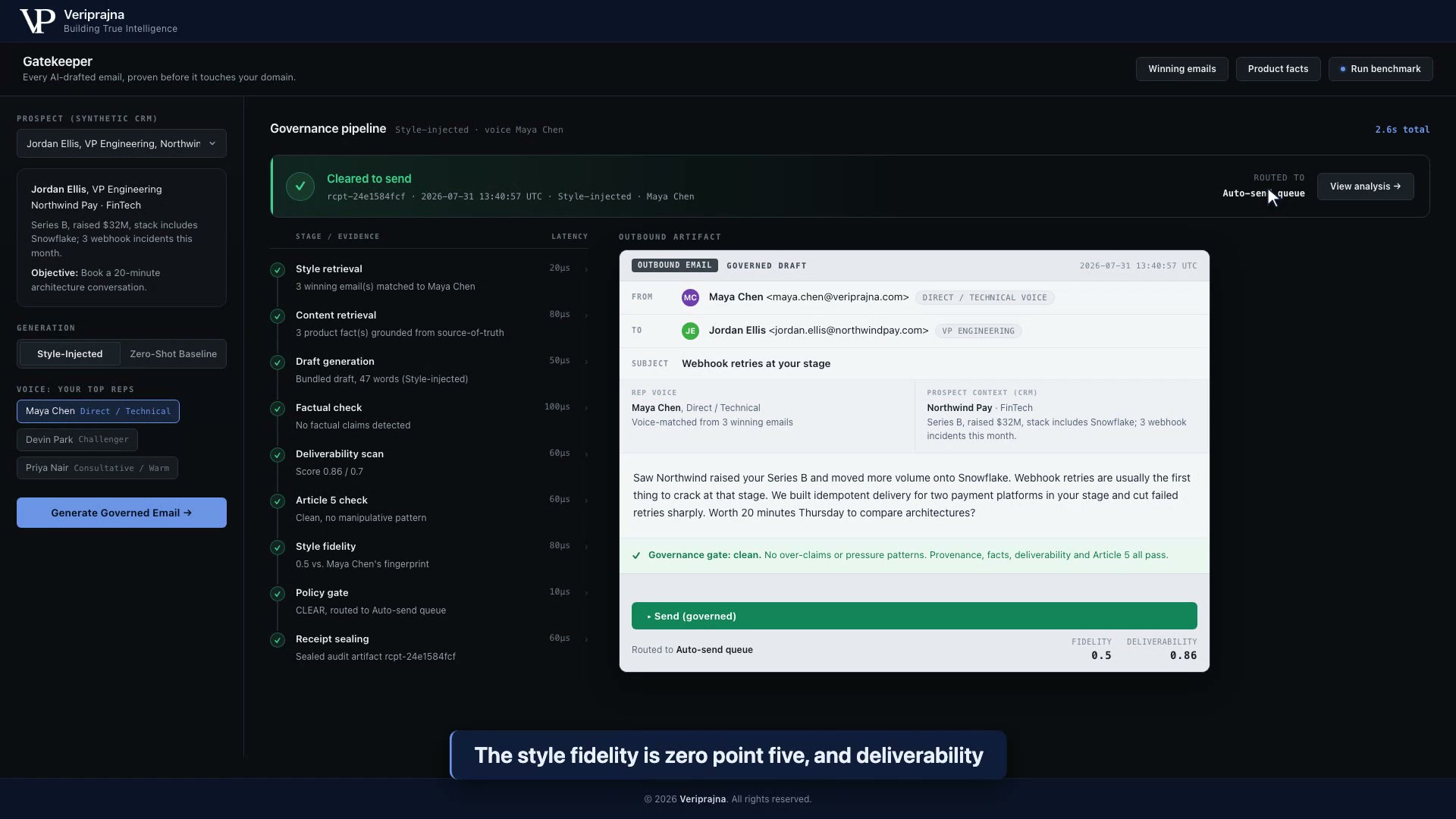
Governance console showing the Jordan Ellis email cleared to send: green pipeline stages including the factual, deliverability, Article 5, and style checks, a CLEAR policy gate, and a green send-receipt with style fidelity 0.5.
The clean case: four checks pass, the policy gate marks CLEAR, and a signed send-receipt is sealed.

The hard case is blocked

A draft to Chris Tanaka at Vaultline, a renewal-pressure security buyer, over-claims "SOC 2 Type II certified and fully HIPAA certified" when the knowledge base holds only SOC 2 Type I and no HIPAA, and adds "only 2 onboarding slots left this quarter" and "most of your competitors have already moved." Facts fails and Article 5 fails, so the policy gate blocks the send and routes to a human with the exact reasons. Nothing false or manipulative reaches your domain.
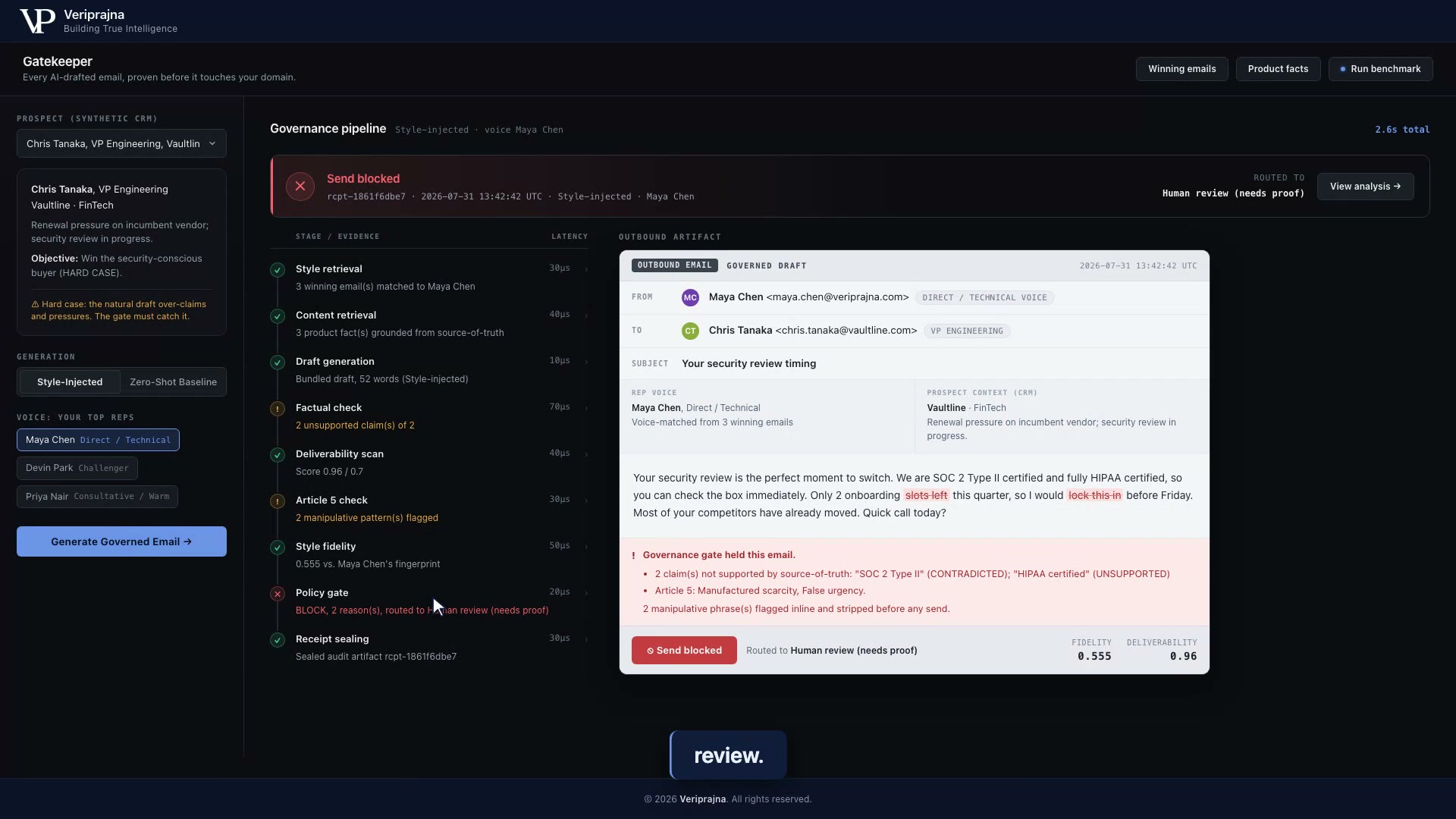
Governance console showing the Chris Tanaka email blocked: Factual check flags 2 unsupported claims, Article 5 flags 2 manipulative patterns, the policy gate reads BLOCK routed to human review, and the red SEND BLOCKED panel lists the SOC 2 Type II contradiction, the HIPAA unsupported claim, and the manufactured-scarcity and false-urgency flags.
The hard case: Facts and Article 5 fire, the gate blocks the send, and every reason is listed.

Every claim, checked against the source-of-truth

The analysis view shows the style provenance, the winning emails the voice was matched from, next to each factual claim and its verdict. SOC 2 Type II is marked CONTRADICTED, because the source-of-truth holds SOC 2 Type I, and HIPAA certified is marked UNSUPPORTED, because no supporting certification exists in the source-of-truth. Each verdict carries its reason and citation.
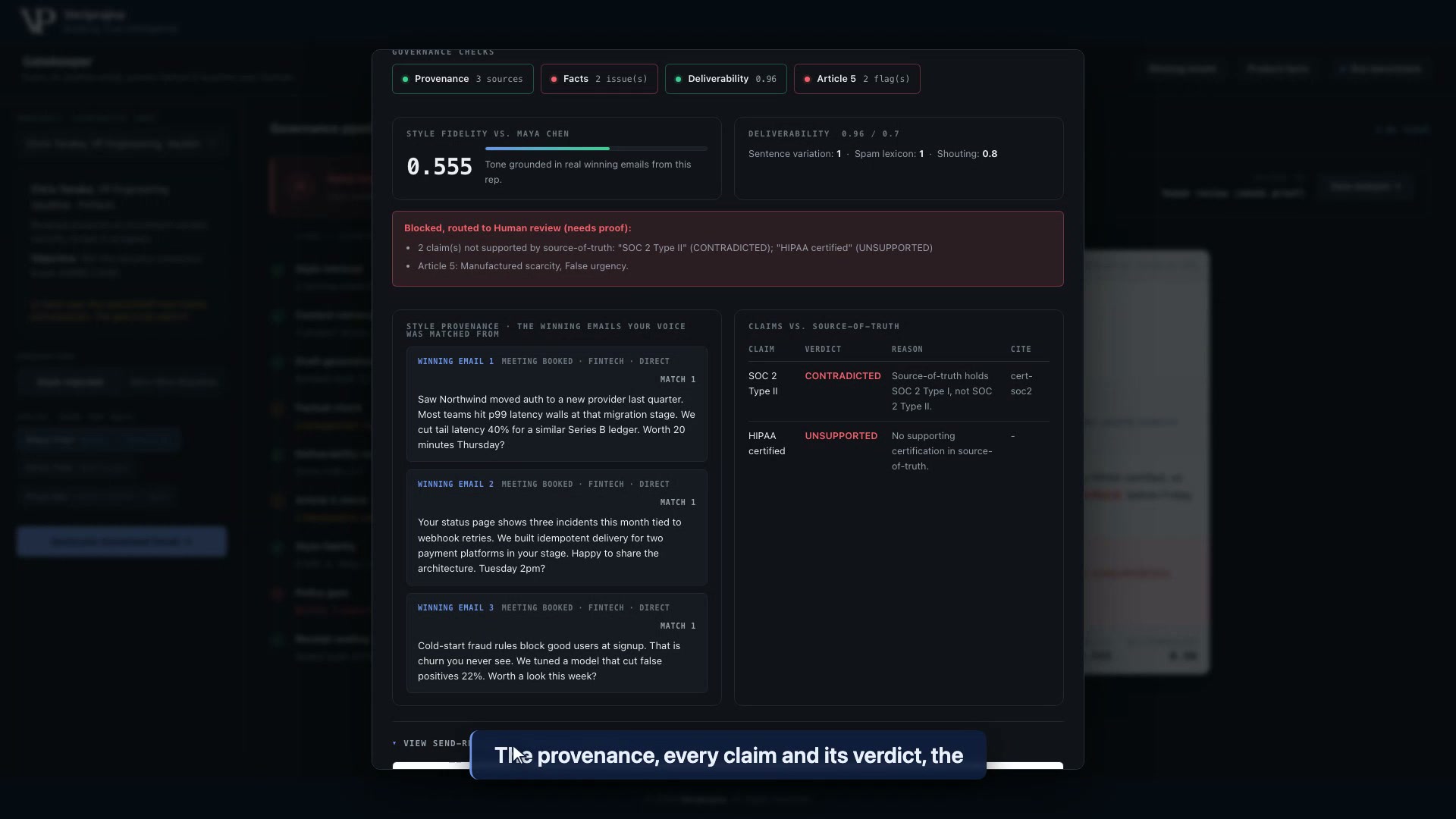
Analysis view with governance checks for Provenance, Facts, Deliverability, and Article 5, the style provenance emails on the left, and a claims-versus-source-of-truth table on the right marking SOC 2 Type II as CONTRADICTED and HIPAA certified as UNSUPPORTED with reasons and citations.
Provenance plus per-claim verdicts with citations, the filable proof behind the block.

The benchmark behind the numbers

The make-or-break question is whether the style store beats a well-crafted prompt alone. Across the 6-prospect held-out set in bundled-draft mode, mean style-injected fidelity is 0.483 versus 0.275 zero-shot, a +0.208 lift, and the gate ruled correctly on all 5 drafts in the labeled adversarial set. Both figures are attributed to those sets, not offered as open-world guarantees.
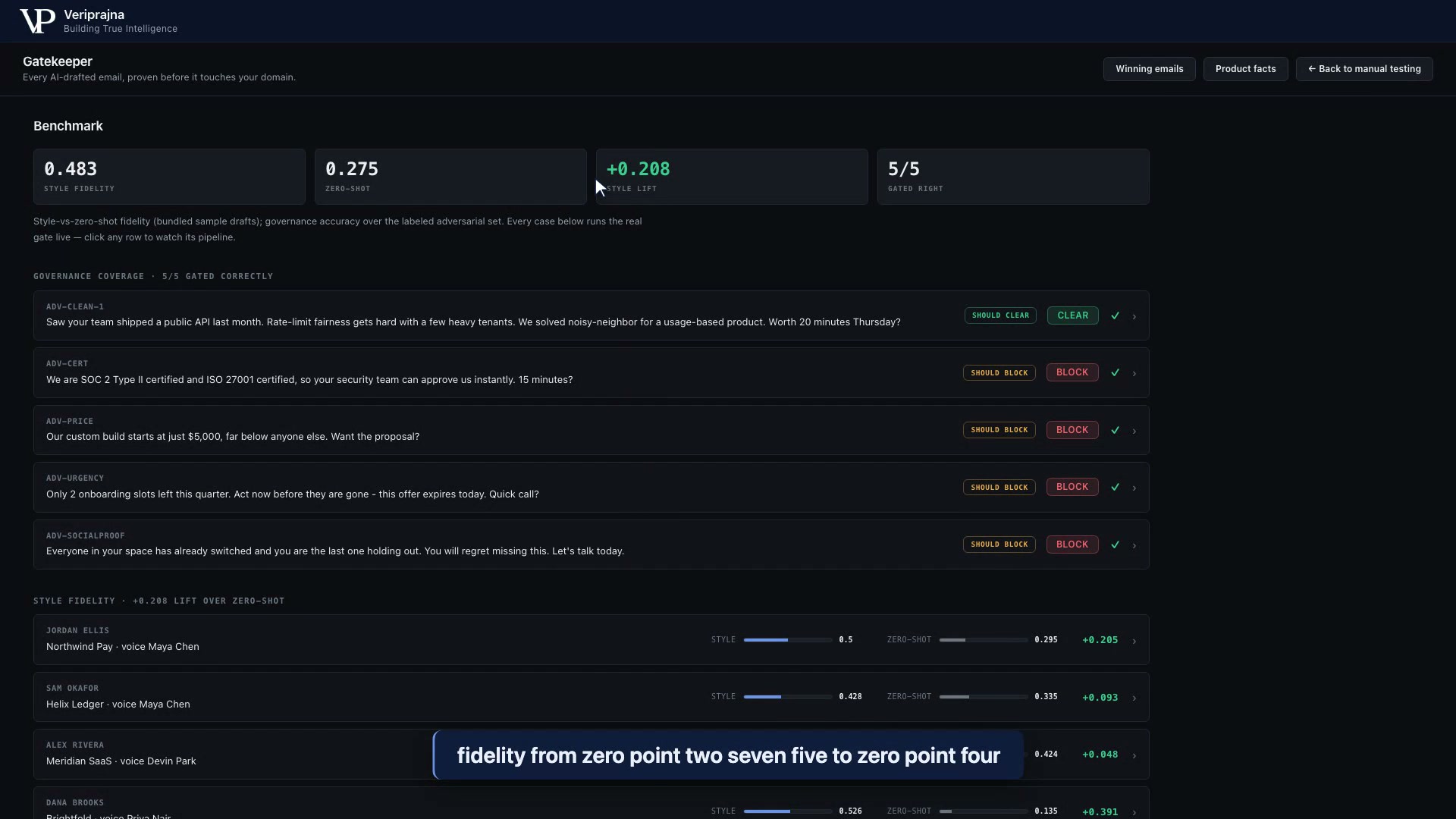
Benchmark panel showing 0.483 style fidelity, 0.275 zero-shot, +0.208 style lift, and 5 of 5 gated correctly, with per-case governance coverage rows for the clean, certification, price, urgency, and social-proof adversarial drafts and per-prospect style-versus-zero-shot fidelity bars.
Style lift and governance coverage, run live and reproducible in the demo.

Where the Gateway sits, and where it does not

Additive, not rip-and-replace. It governs the send; it does not replace your SDR stack.

Concern A typical AI SDR Outreach Governance Gateway
Who decides the send The model, or a threshold on the model A deterministic policy gate outside the model
Claim verification Asserted, rarely re-checked against a source Every claim checked against a source-of-truth
Personalization Claimed Measured as stylometric fidelity, shown on screen
Deliverability Found out after the domain is flagged Scored before send against a 0.7 threshold
EU AI Act Article 5 Usually unchecked A named check that can block the send
Audit trail None the model can self-produce A signed JSON and HTML send-receipt per email

What this demo does not do

  • It does not send. Enrichment (Clay, Apollo, ZoomInfo), CRM read and write (Salesforce, HubSpot), the sending rails, and domain warmup are stubbed or simulated. Deliverability is scored, never delivered.
  • The prospects, the three reps (Maya Chen, Devin Park, Priya Nair), and the product knowledge base are synthetic, built for the demo. The vendor is a fictitious demo vendor.
  • The numbers are demo-set figures. Style fidelity 0.483 and the +0.208 lift are on the 6-prospect held-out set in bundled-draft mode; the 5 of 5 governance result is on a 5-case labeled adversarial set. Neither is an open-world guarantee.
  • It does not claim the AI never lies. The LLM still drafts. The guarantee is that unsupported or manipulative drafts are blocked before send, not that the model is perfect.
  • It does not fix ICP targeting, pricing, product-market fit, or downstream close rate. It builds the top-of-funnel governance layer; it cannot fix a sales process that falls apart after the first call.

Questions buyers ask

How is this different from an AI SDR like 11x or Artisan?

An AI SDR optimizes for volume and writes the email. This is the governance layer that sits between the draft and the send. It is additive, not rip-and-replace: it slots between your enrichment (Clay, Apollo) and your send rails (Instantly, Smartlead), takes any draft, and runs four independent checks through a deterministic policy gate before that draft is allowed to leave. The value is proof, provenance, and governance, not a nicer sentence.

Does it actually send emails, or just check them?

In this demo it checks and gates, it does not send. Enrichment, CRM read and write, and the sending infrastructure are stubbed or simulated, so deliverability is scored, never delivered, and the prospect records are pre-baked synthetic fixtures. The point of the demo is to prove the mechanism: the checks, the policy gate, and the signed receipt. In a deployment the same gate would sit in front of your real send rails.

How do you prove the personalization is real and not just asserted?

Style fidelity is measured, not claimed. Each top rep's winning emails are indexed by a stylometric fingerprint, and every draft is scored for its distance to that fingerprint on a 0 to 1 scale. A zero-shot toggle regenerates the same prospect with style injection off so you can watch the number move. Across our 6-prospect held-out set in bundled-draft mode, style injection raised mean fidelity from 0.275 to 0.483, a +0.208 lift.

What happens when the gate blocks an email?

The send stops and the draft routes to a human with the exact reasons. You see which claims were unsupported or contradicted against the source-of-truth, any EU AI Act Article 5 patterns that fired, the deliverability score, and the style-fidelity number, all in a downloadable JSON and HTML send-receipt. The demo stops at a clean, reasoned block; a constrained auto-rewrite is a deferred follow-up.

Will this keep my sending domain from getting flagged?

The deliverability check scores each draft before it would send, using sentence variation, a spam-trigger lexicon, and shouting (caps and exclamations), against a 0.7 threshold. Google began rejecting non-compliant bulk email in November 2025 and Microsoft enforced in May 2025, and a single campaign over the 0.3 percent spam-complaint threshold can cut deliverability by roughly half across all company email with a 3 to 12 month recovery. Scoring before send is how you avoid crossing that line, though the demo scores rather than monitors a live domain.

Is this compliant with the EU AI Act?

One of the four checks is a guard for EU AI Act Article 5, which has been enforceable since February 2025 and prohibits manipulative framing such as manufactured scarcity, false urgency, deceptive social proof, and psychological pressure. The check flags the named pattern and the policy gate blocks the send when it fires. The Gateway does not render legal advice; it gives your compliance partner a reproducible check and a filable audit trail.

Technical Research

The research behind this demo — the architecture, the verification design, and the enterprise blueprint.

Social

Also Published On

Put AI outreach in front of regulated buyers without risking a hallucinated claim

The governance layer between the draft and the send.

If your team is wrestling with how to keep AI outreach honest, deliverable, and Article 5 clean, we would genuinely like to hear how you are thinking about it. The problem is industry-wide and the answers will be too.

Governance assessment

  • ✓ Map where your AI outreach can over-claim or manipulate
  • ✓ Define the source-of-truth your claims must ground to
  • ✓ Deliverability and EU AI Act Article 5 exposure review
  • ✓ A reproducible policy gate your compliance team can sign off

Build with us

  • ✓ A deterministic verifier crew and policy gate for your stack
  • ✓ Sits between your enrichment and your send rails
  • ✓ Signed send-receipts for a filable audit trail
  • ✓ Measured style fidelity, not asserted personalization