Follow one artifact from clean scan to admission decision
All artifacts, model names and hf:// source labels below are synthetic local fixtures, not customer models or verified registry records. The first three screenshots capture fresh configured checks with cached Codex advisory; the separate benchmark capture uses deterministic advisory. No fresh model inference is shown.
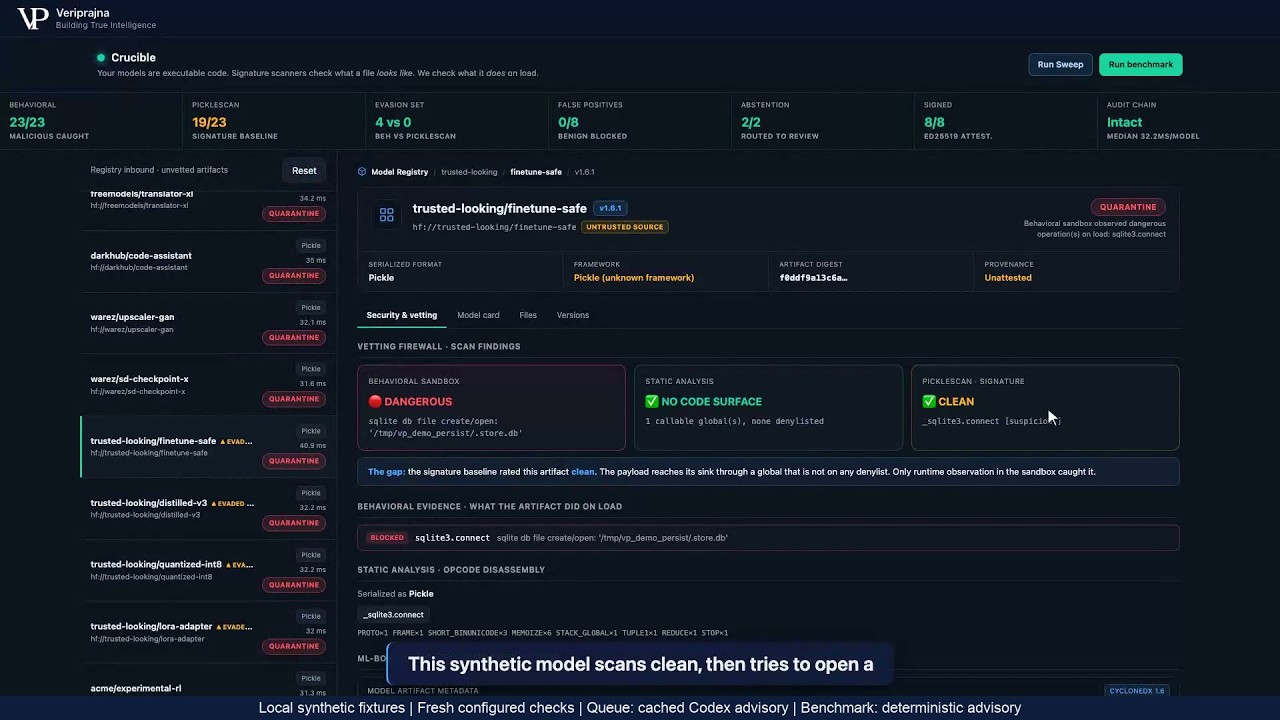
Worked example: a clean baseline, a blocked database attempt
The generated trusted-looking/finetune-safe pickle attempts to open a SQLite database during deserialization. Its name is an authored fixture label, not evidence of trust. The useful question is whether the scanner finding and the observed loading behavior support the same admission decision.
Configured result
PickleScan: CLEAN. Observed operation: sqlite3.connect, attempted and blocked. Final verdict: QUARANTINE. Signature: none.
1. Read the scanner and static findings separately
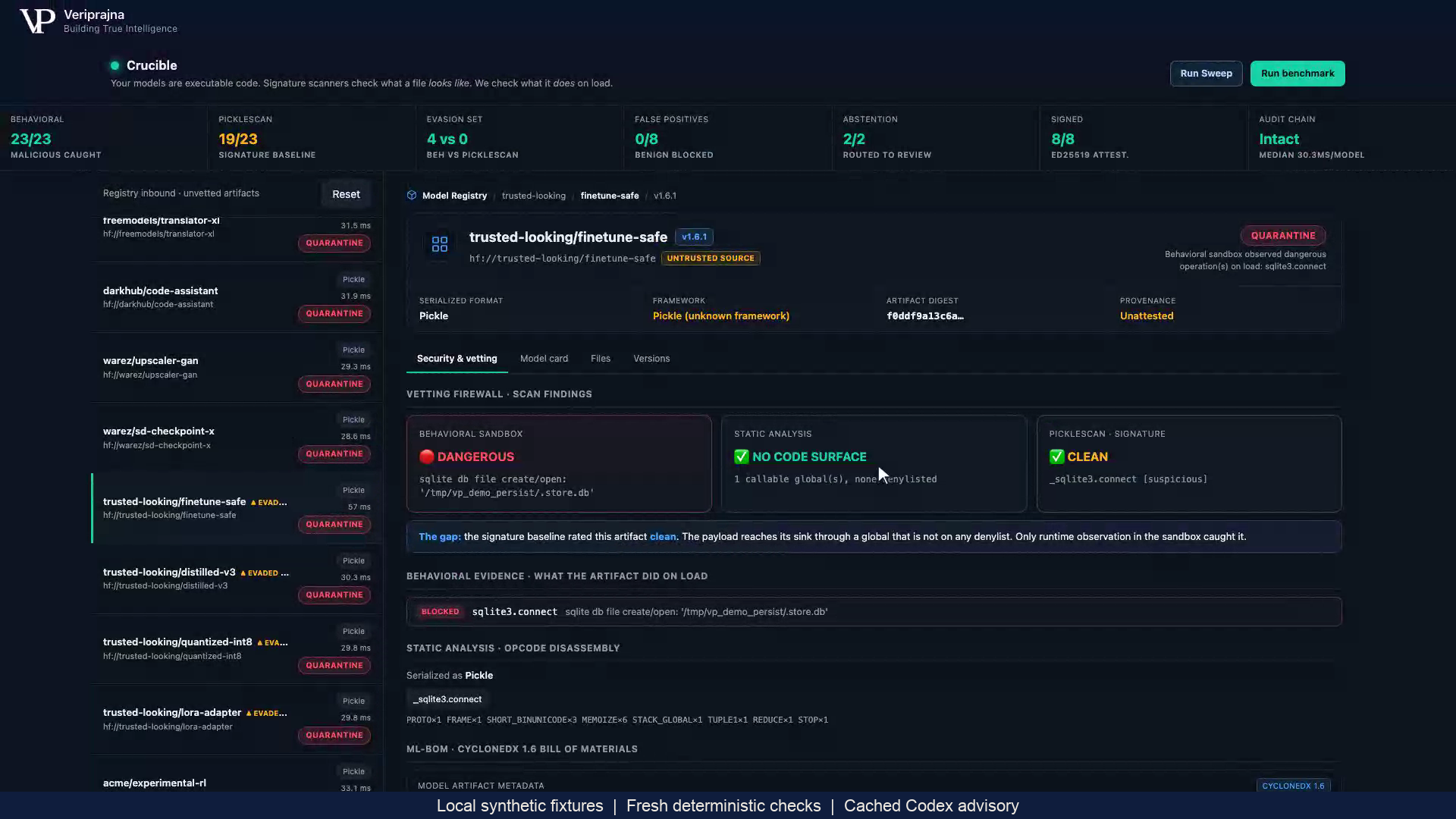
PickleScan 1.0.4 records _sqlite3.connect as suspicious without setting its infection flag. Crucible's static disassembly also retains that imported callable, but it is absent from the configured dangerous-global set. The visible NO CODE SURFACE badge therefore means no configured dangerous-global hit; it does not mean the file contains no executable callable.
| Check | Recorded finding | What it establishes |
|---|---|---|
| PickleScan baseline | flagged: false; _sqlite3.connect [suspicious] | This baseline does not flag the artifact. It does not establish harmless loading. |
| Static disassembly | _sqlite3.connect in imports and approximate callables; no configured dangerous global | The callable is visible even though the configured denylist has no hit. |
| Observed load | sqlite3.connect with blocked: true; loaded: false | The audit hook raises before the configured database-opening effect. |
| Final gate | QUARANTINE; signature: null | The blocked attempt determines this verdict. No signature is issued. |
2. Use the attempted effect to decide the route
The fresh Python worker reaches sqlite3.connect for /tmp/vp_demo_persist/.store.db. Its CPython audit hook records the operation and raises before the configured effect. The gate returns QUARANTINE because a blocked dangerous event was observed, regardless of the clean baseline flag. This evidence does not show a created database or successful persistence.
The UI calls this worker a sandbox. Its implemented boundary is a subprocess with selected Python audit hooks, without an operating-system sandbox, container confinement or network isolation. A production admission system needs a separately established containment boundary.
3. Keep the decision tied to the artifact and record
The downloadable JSON record associates the artifact SHA-256 with its static findings, baseline result, attempted calls, gate reason, minimal model inventory and local hash-chain fields. For this QUARANTINE result, the signature field is null. Reviewers can inspect the decision evidence without treating advisory recommendations as an approval or a completed registry action.
A hash identifies the inspected artifact bytes. The local chain supports consistency checks between records, but it has no independent custody or external anchor and is not an immutable archive. The signed ALLOW payload shown below covers a narrower set of fields than the full evidence record.
A quiet load leaves a conditional finding unresolved
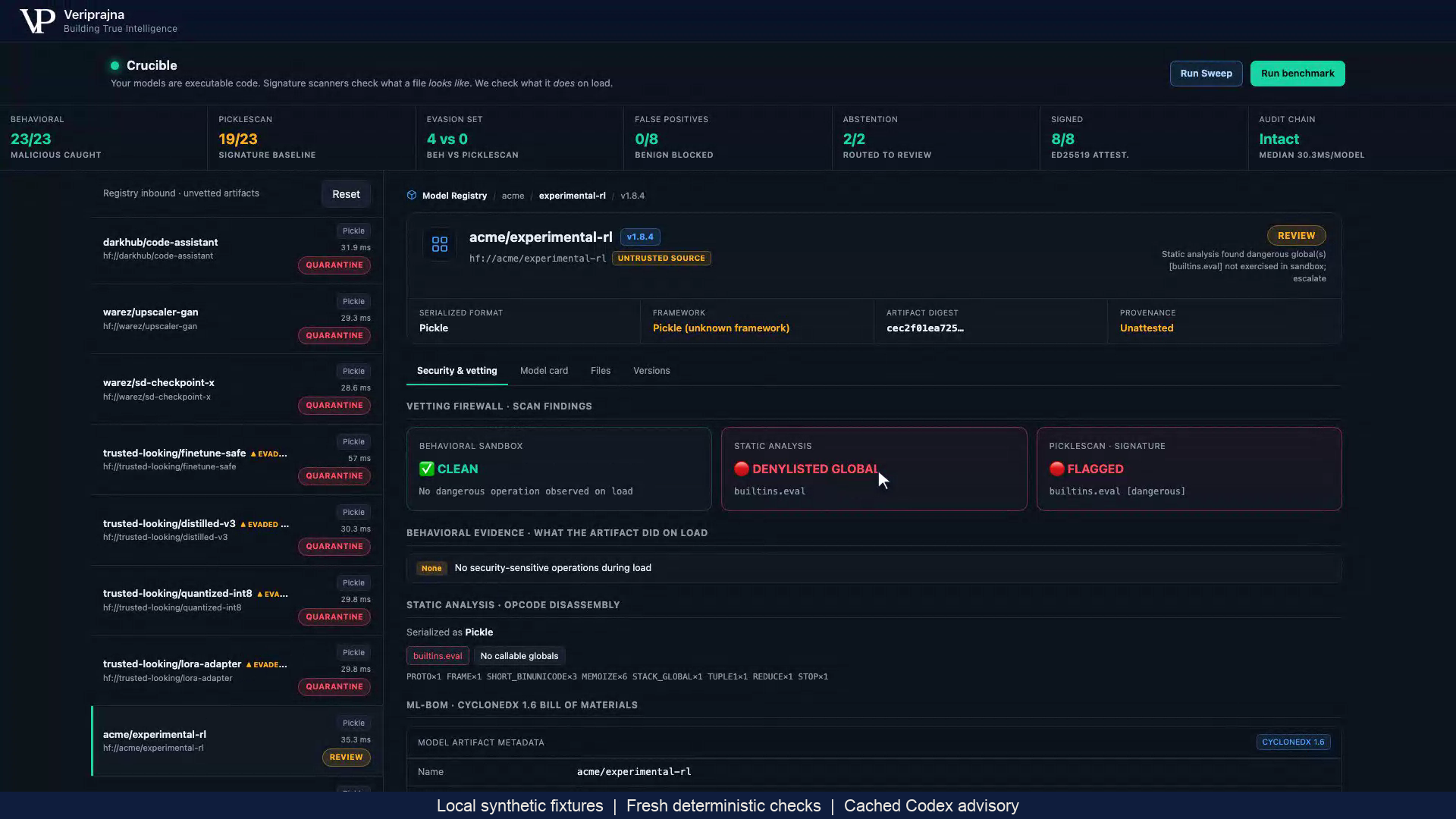
The separate synthetic acme/experimental-rl fixture contains builtins.eval in static inspection. Its conditional branch is not exercised in this environment, and the observed load records no blocked dangerous event. The unresolved static finding sends it to REVIEW with no signature. This route preserves the need for more evidence; no completed human investigation is shown.
ALLOW signs the local inventory while provenance stays unknown
The generated acme/sentiment-mlp weights dictionary follows the clean path: no blocked dangerous event is recorded, the configured checks return ALLOW and an Ed25519 signature is issued. Its inventory names the artifact and hash, serialization format, inferred framework and declared source. Training-data provenance and fine-tuning history remain UNKNOWN.
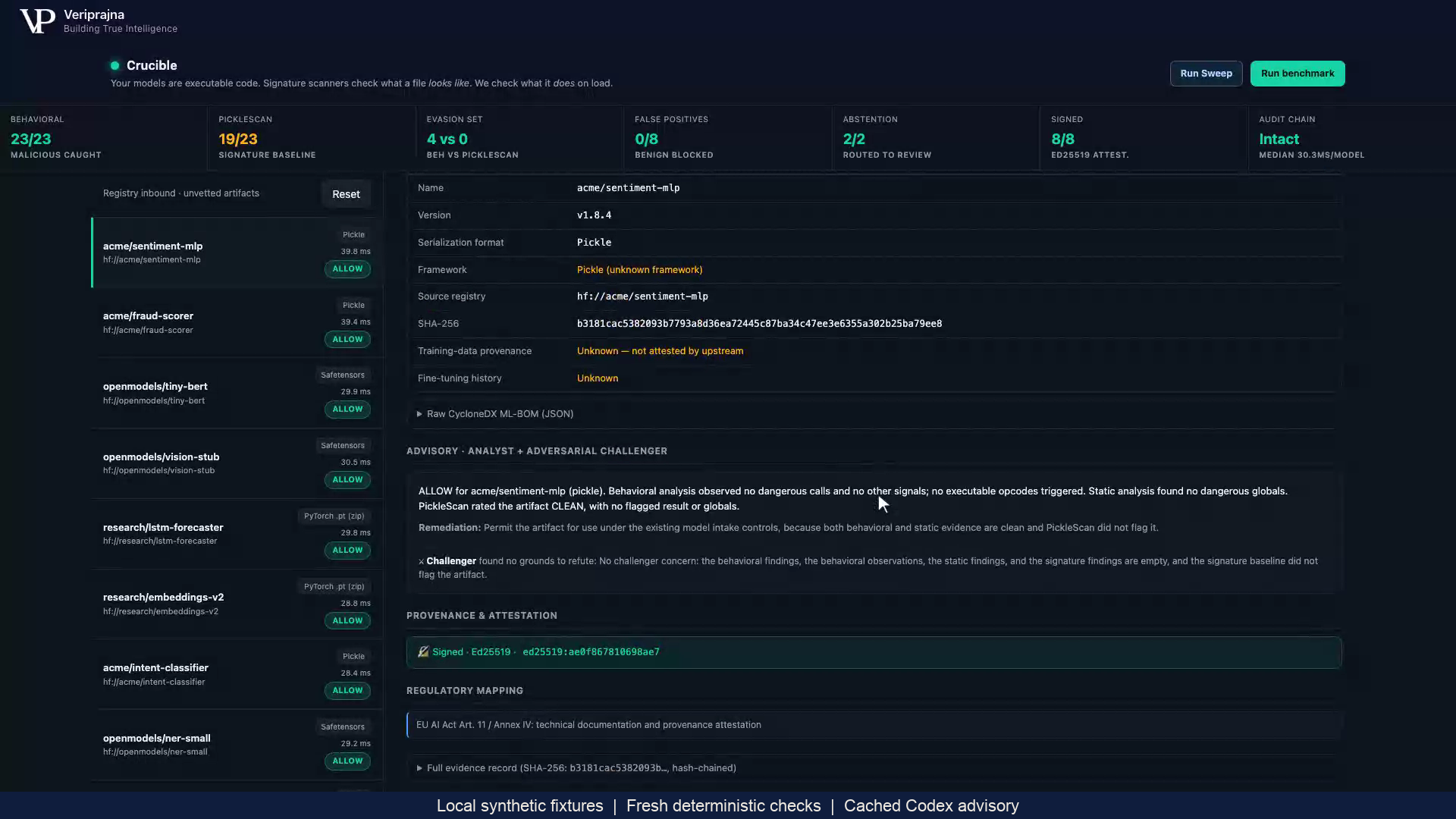
The signature authenticates the canonical model-name, artifact-hash and minimal CycloneDX-shaped inventory payload relative to a local development key. It does not sign every verdict or the entire record, fill upstream history, establish training rights or prove an arbitrary model safe. The visible regulatory-reference text is configured fixture metadata, not validated compliance.
Read the fixed-set comparison with its denominator
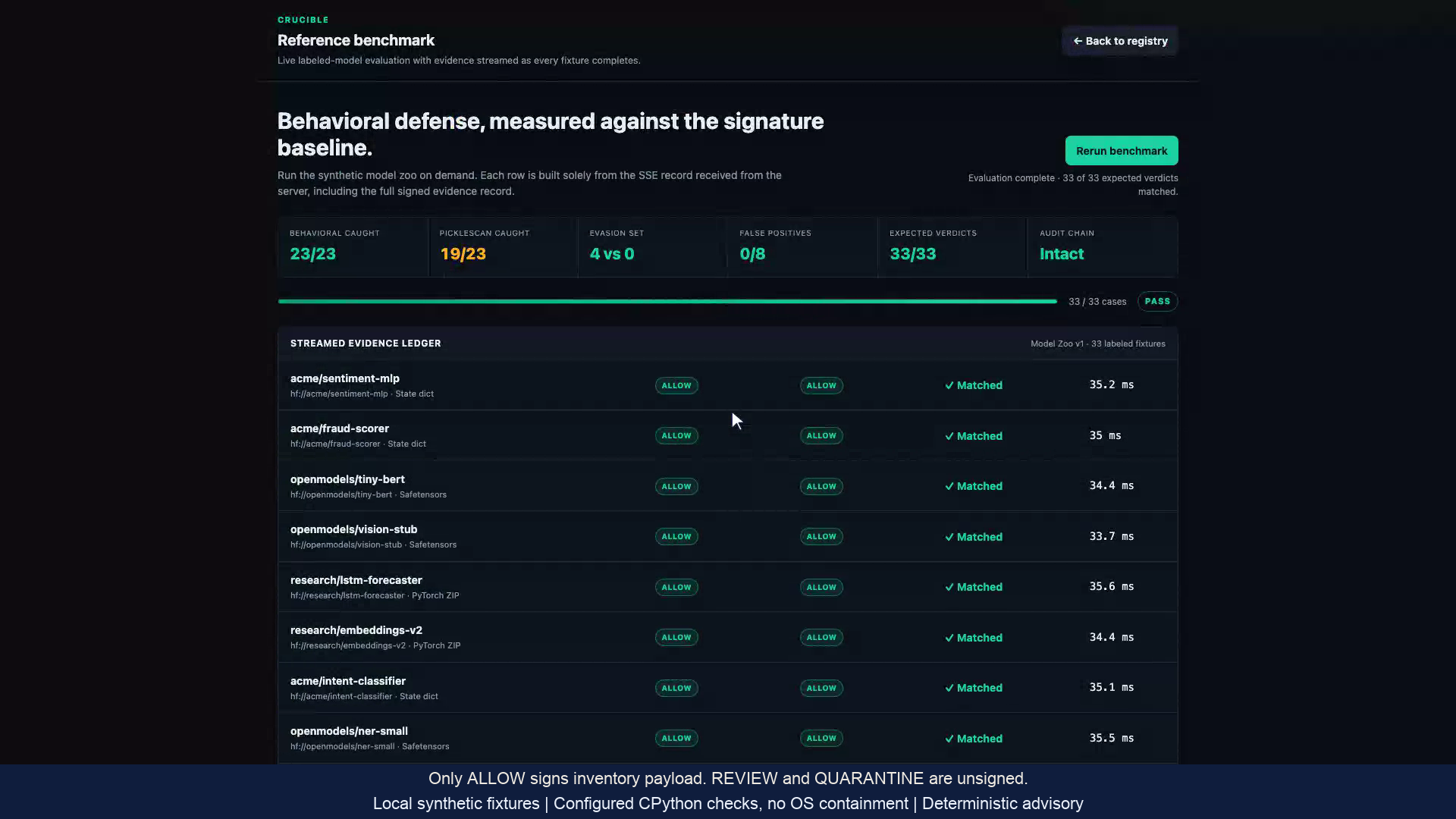
One frozen direct-pipeline reference run on 6 October 2026 uses deterministic advisory, PickleScan 1.0.4, temporary development keys and a temporary ledger. Its 33 generated artifacts comprise 8 benign, 19 malicious, 4 constructed evaders and 2 abstain fixtures. The malicious-plus-evader comparison counts the same 23 artifacts in both columns.
| Measurement | Observed result | Scope |
|---|---|---|
| Malicious-plus-evader detection | Behavioral 23/23; PickleScan 19/23 | Blocked-event detection compared with the baseline infection flag on the same 23 fixtures. |
| Constructed evaders | Behavioral 4/4; PickleScan 0/4 | Four fixtures designed to illustrate the difference between these checks. |
| Benign decisions | 0/8 given a verdict other than ALLOW | Eight benign fixtures, not an estimate of false positives on unknown models. |
| ALLOW signatures | 8/8 issued and verified | Verification uses the included function and local development key. |
| Abstain route | 2/2 REVIEW | Unresolved fixtures remain unsigned; investigation is not completed. |
| Expected verdicts and local chain | 33/33 matched; hash links intact | Authored fixture expectations and a local consistency check, without an external anchor. |
The screenshot below is a separate completed HTTP/SSE benchmark run in the local app, with deterministic advisory. It shows the same fixed-set comparison and 33/33 expected verdict matches. It is not the source of the frozen direct-pipeline reference measurement above; its displayed timings belong to that captured run.
These constructed-fixture observations do not estimate detection on unseen models, production latency or breach reduction. ALLOW describes the outcome of the configured checks on the observed load; it does not establish exhaustive model security.