AI Brand Content That Consumers Actually Trust
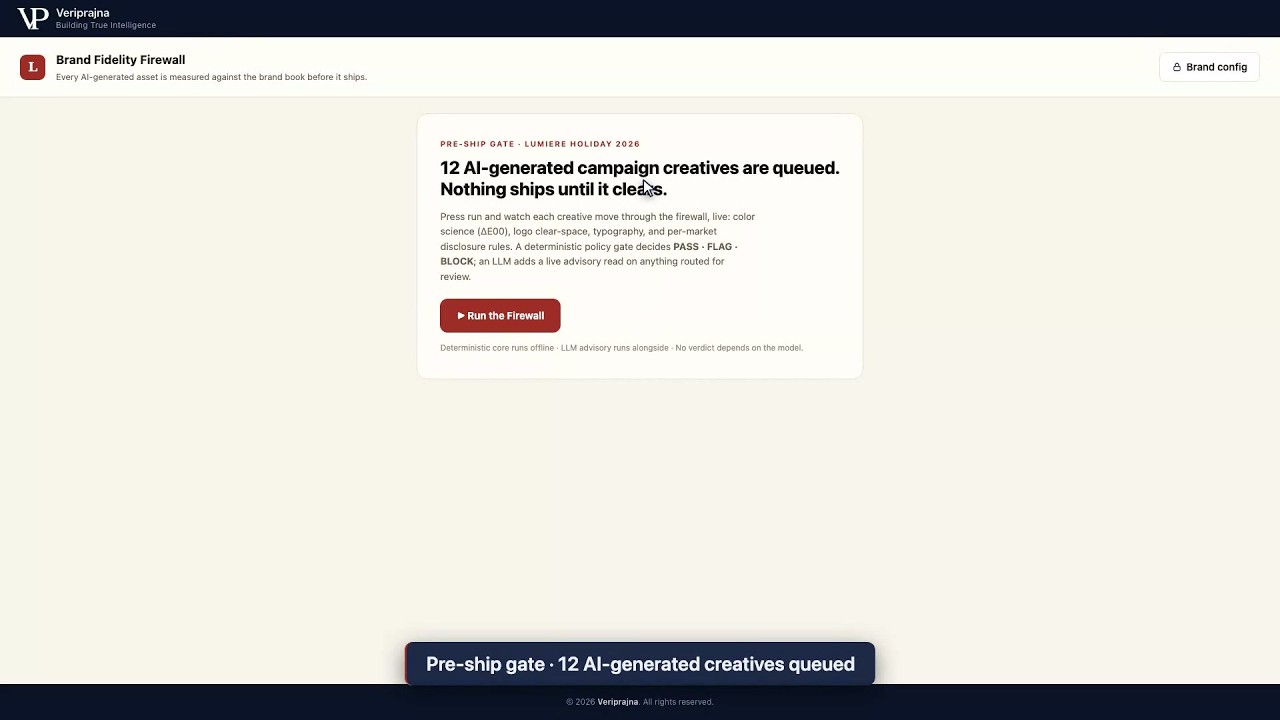
The Brand Fidelity Firewall is a pre-ship gate, not a rubber stamp. Every AI-generated asset is measured in real CIEDE2000 color science, logo geometry, and per-market AI-disclosure law before it ships, and the deterministic gate returns PASS, FLAG, or BLOCK. We generate nothing; we decide what is safe to ship.
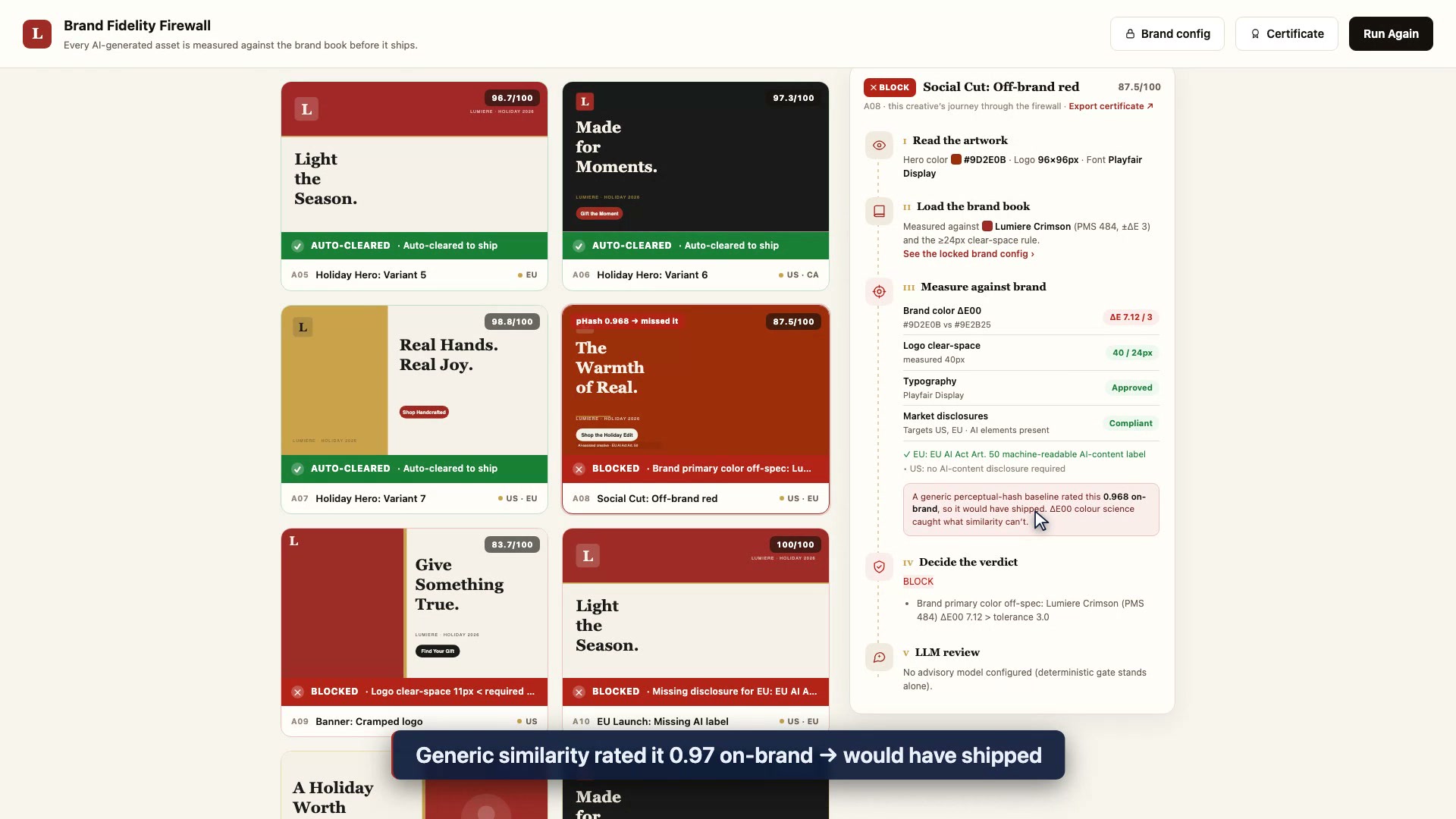
7.12 vs 3.0
CIEDE2000 delta-E00 on the off-brand red, over the PMS 484 tolerance. Hard BLOCK.
12-asset demo batch
0.97 on-brand
What a generic similarity baseline rated that same asset. It would have shipped.
Perceptual-hash baseline
7 / 3 / 2
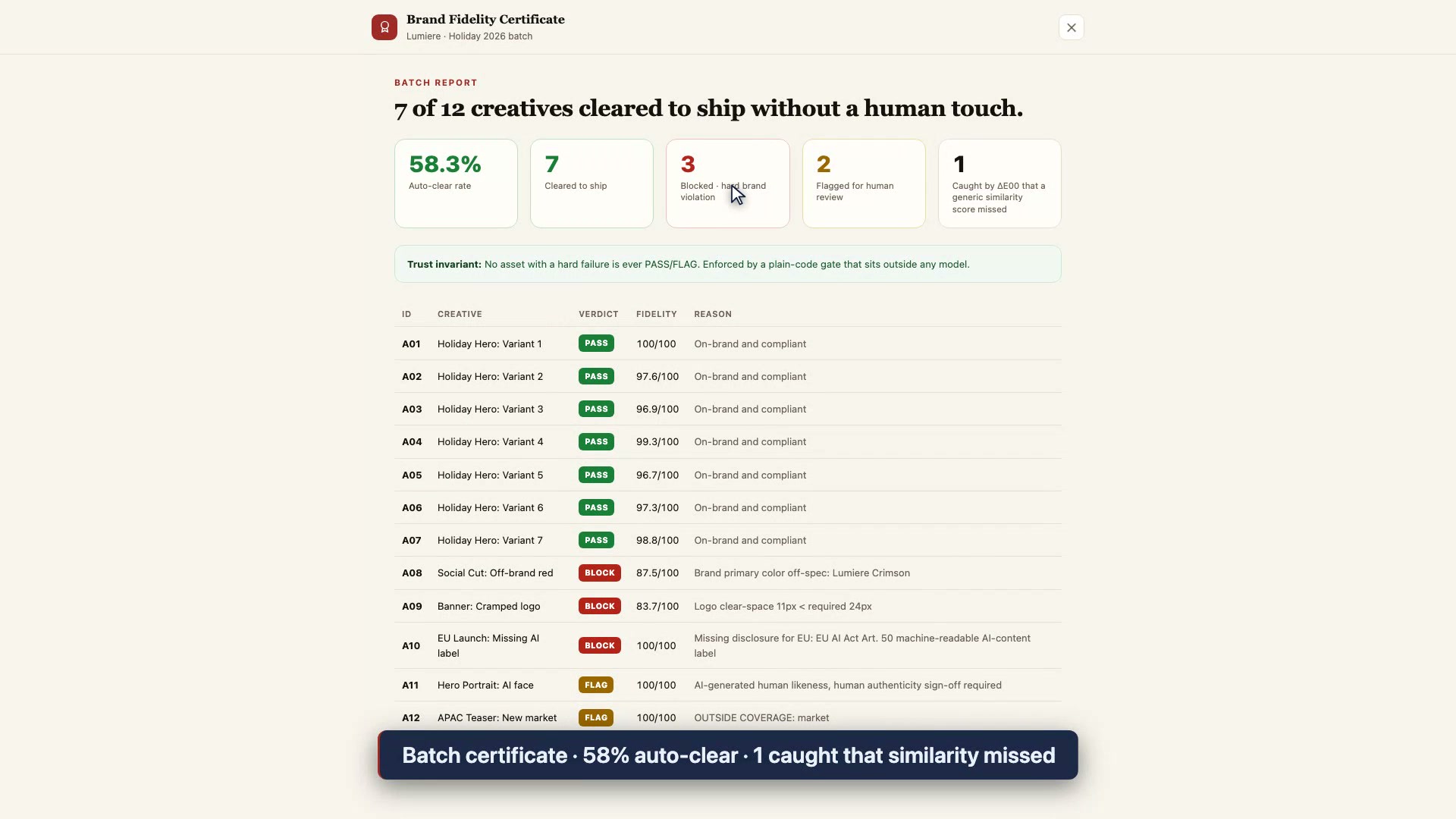
PASS, BLOCK, FLAG on the fixed batch. A 58.3 percent auto-clear rate.
Deterministic run
A runnable demo of the governance layer above the generators. The deterministic core runs fully offline with no API key; the LLM advisory layer abstains and never changes a verdict.
Enterprises can now generate campaign assets at unlimited volume, and that is the problem. A brand ships hundreds of AI-assisted variants a week, and every one is a chance to be off-brand (the wrong red, a cramped logo, an unapproved font) or non-compliant (an AI ad entering the EU with no Article 50 label). Human brand-and-legal review does not scale to that volume, and a generic "looks-fine" aesthetic score cannot tell a correct Pantone red from a competitor's.
The cost of getting it wrong is now measurable, and the market has already priced it. Roughly 50 percent of consumers prefer brands that avoid GenAI content (Gartner, Mar 2026), and about one-third stop interacting with a brand once content is revealed as AI (Adobe 2026 Digital Trends). Trust drops from 48 percent to 13 percent when an ad is fully AI versus co-created (Smartly.io, 2025). Regulators have set hard, dated deadlines: NY SB-8420A (Jun 9, 2026), EU AI Act Article 50 (Aug 2, 2026, up to EUR 15M or 3 percent of turnover), CA CAITA (Aug 2026), plus FTC Section 5.
The reflex answer, "score it with an AI aesthetic model," fails at the first hard case. So we built the inverse: a deterministic policy gate, outside any LLM, that measures every asset against the brand book and the per-market disclosure rules before it ships.
The pipeline is deliberately plain: an asset plus its provenance metadata is extracted (dominant colors in CIELAB, logo region, font), grounded against the brand book (palette, per-color delta-E00 tolerances, clear-space rule, approved fonts, covered markets), run through the checks, and handed to a deterministic policy gate. The checks that can BLOCK are objective measurements, not opinions.
A real CIEDE2000 (delta-E00) implementation, validated against the Sharma et al. reference color pairs, plus sRGB to CIELAB conversion. Each brand-palette color is judged against the dominant saturated hero region of the asset. A delta-E00 over the brand's per-color tolerance is a hard BLOCK. This is the ISO/CIE-standard color-difference metric, not author-invented ground truth.
A real, widely-used DCT perceptual hash (pHash) runs alongside as the concrete "generic similarity" stand-in. It is deliberately luminance and structure based, so it cannot tell a correct Pantone red from a wrong one. On the off-brand asset it rated 0.968 on-brand while CIEDE2000 blocked. It makes the miss visible.
Deterministic geometry on the logo region measures clear-space in pixels against the brand rule, plus approved-font and palette-coverage checks. A clear-space violation is a hard BLOCK. In the demo, logo localization uses placement metadata and a bounding box, not a trained detector.
From the asset's provenance (which elements are AI-generated, is a synthetic performer present) and its target markets, the engine derives the required disclosures for real, dated statutes: NY SB-8420A, EU AI Act Article 50, CA CAITA, FTC Section 5. A missing required disclosure is a hard BLOCK regardless of how good the pixels are.
The gate is plain code outside any model. It returns BLOCK if any hard check fails, FLAG for cases a human must own (an AI-generated human likeness needing authenticity sign-off, or a market outside the brand book's coverage), and PASS otherwise. A single advisory tonal and authenticity audit adds a provider-swappable vision or language read, but it is informational only, abstains on a missing key or error, and never changes a PASS, FLAG, or BLOCK. A unit-tested invariant holds: no asset with a hard failure is ever PASS or FLAG.
Every cleared asset can export a Brand Fidelity Certificate (JSON plus printable HTML): per-check measurements, provenance, per-market disclosure status, the gate result, the model and version, and a timestamp. The certificate is reproducible from the cached brand book and assets.
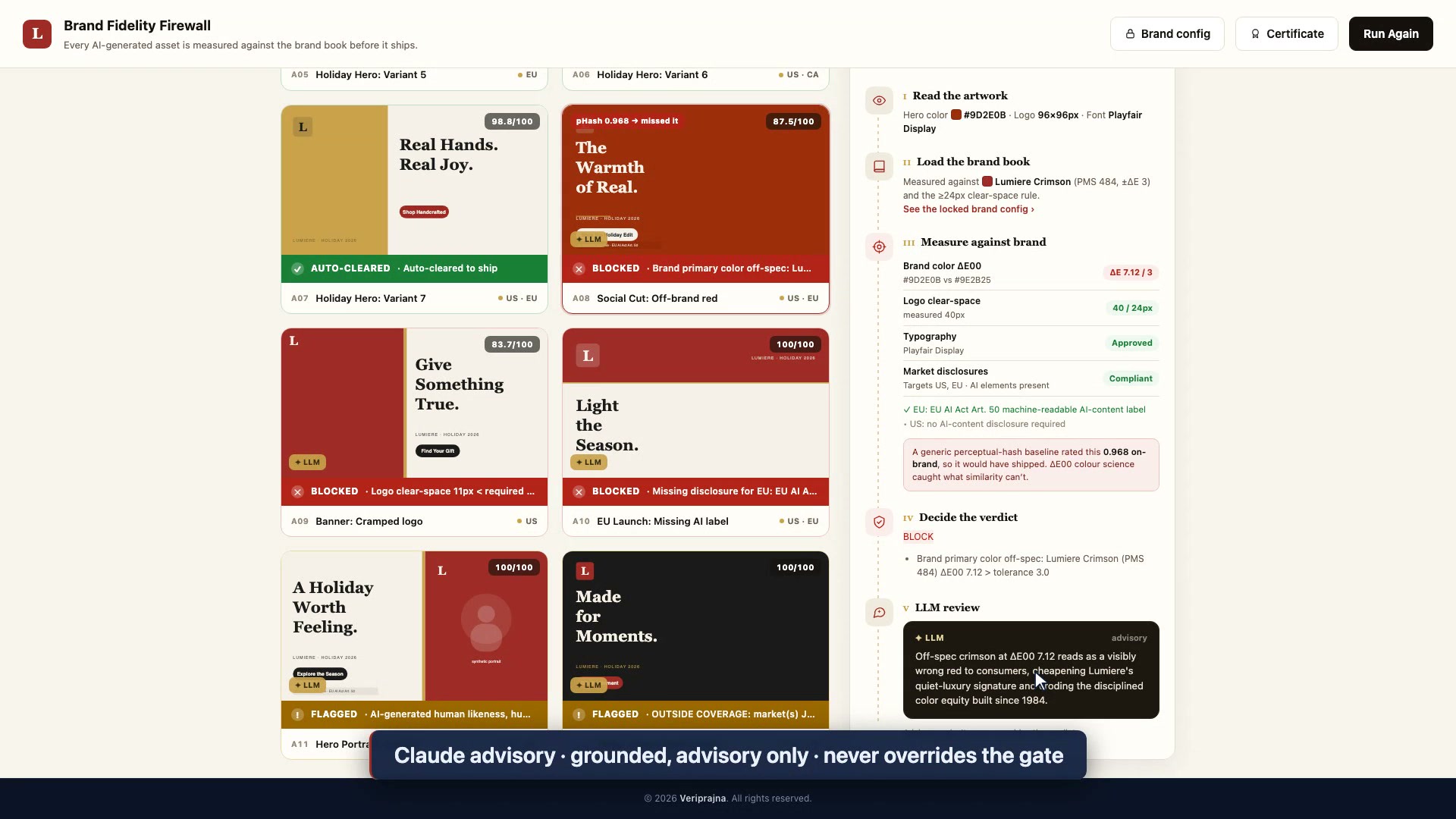
The demo scores a fixed batch of 12 synthetic AI-generated holiday-campaign assets. Seven auto-clear to PASS (fidelity 96.7 to 100.0). The three BLOCK and two FLAG cases each prove a distinct, provable point. These are real frames of the running app.
Asset a08's dominant hero color is 7.12 delta-E00 off the brand's Lumiere Crimson (PMS 484, hex 9E2B25), against a tolerance of 3.0. That is a hard BLOCK. The evidence panel shows the generic perceptual-hash baseline rated the same asset 0.968, roughly 0.97 on-brand, which means it would have passed. This is the whole thesis in one screen.
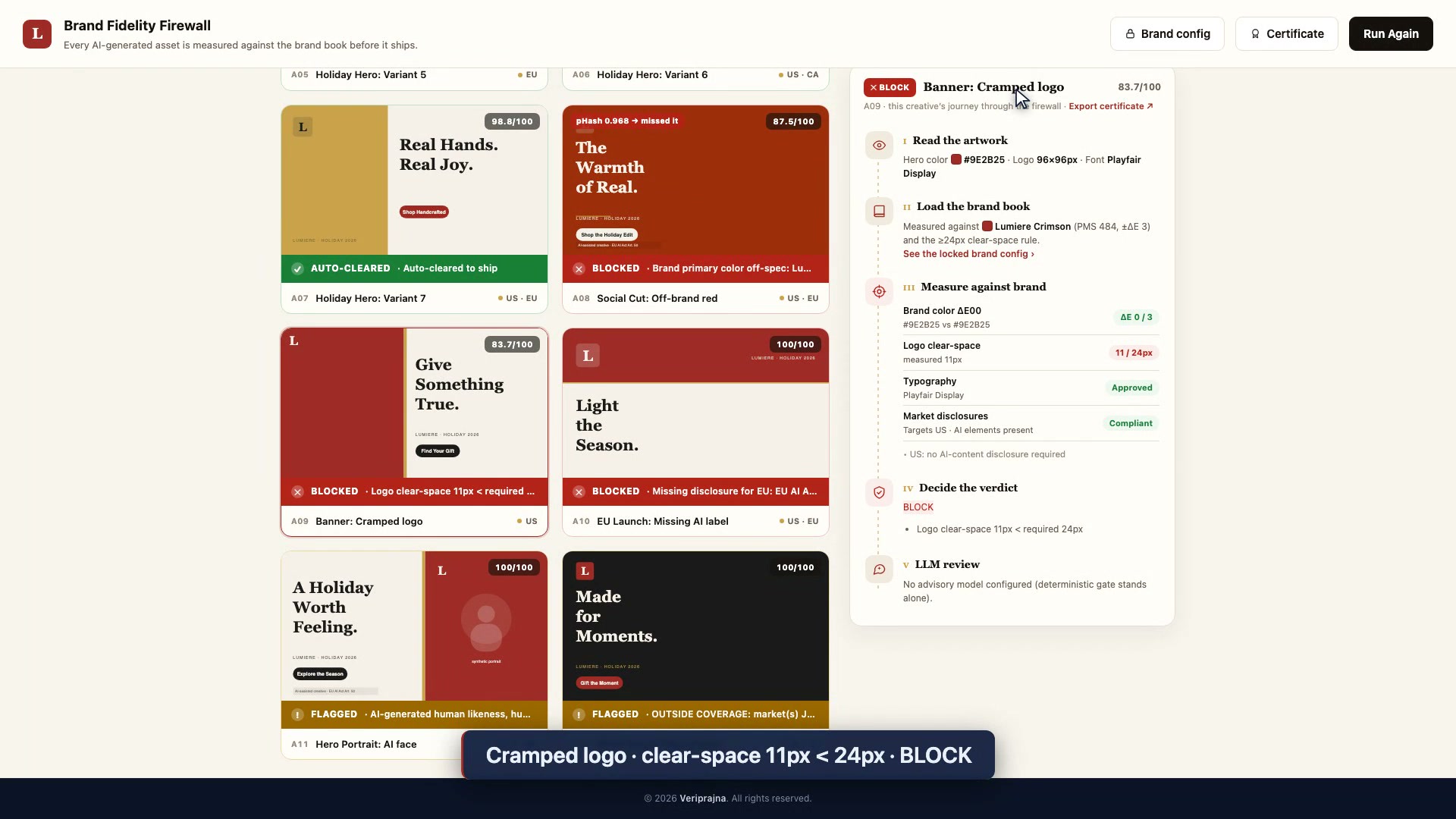
Asset a09's logo clear-space is 11 pixels against the required 24 pixel brand rule, so the gate blocks it. Its crimson is a perfect delta-E00 of 0.00; the block is purely geometry. The evidence panel separates the two so you can see exactly which rule failed.
Asset a10 is AI content shipping into the EU with no Article 50 machine-readable AI-content label. A missing required disclosure is a hard block regardless of how good the pixels are. The panel names the statute (EU AI Act Article 50, enforceable Aug 2, 2026, up to EUR 15M or 3 percent of turnover).

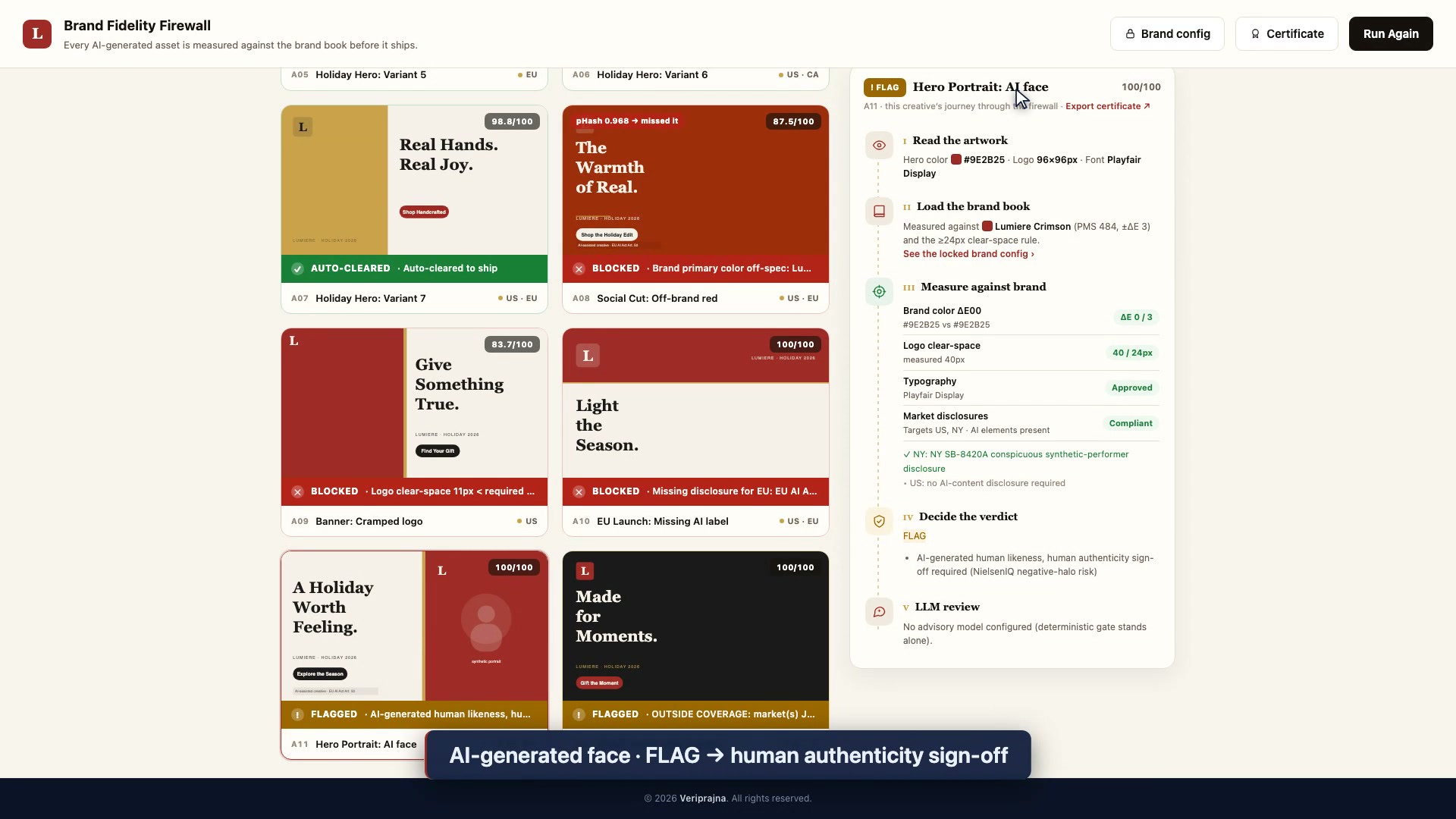
Asset a11 carries an AI-generated human likeness, so it is routed to a human for authenticity sign-off (the NielsenIQ negative-halo risk) rather than bluffed to PASS or BLOCK. Asset a12 targets JP, a market not in the brand book's coverage, so its disclosure rules are unknown and it is flagged OUTSIDE COVERAGE and routed to legal rather than falsely cleared.
On the off-brand red, the advisory layer adds a grounded creative-director note ("off-spec crimson at delta-E00 7.12 reads as a visibly wrong red to consumers, cheapening Lumiere's quiet-luxury signature"). It is labeled advisory. The deterministic gate had already decided BLOCK; the model only adds color.
The batch report shows the headline number: 7 of 12 creatives cleared to ship without a human touch, a 58.3 percent auto-clear rate, with 1 caught by CIEDE2000 that a generic similarity score missed. The trust invariant is stated plainly: no asset with a hard failure is ever PASS or FLAG, enforced by a plain-code gate that sits outside any model.
The firewall is a governance and scoring layer above the generators, vendor-neutral, not a generation engine. Here is how the deterministic gate compares with the two common alternatives.
| Approach | Catches the wrong Pantone red? | Handles per-market disclosure law? | Verdict is reproducible? |
|---|---|---|---|
| Human brand and legal review | Yes, but does not scale to hundreds of variants a week | Yes, if the reviewer knows every statute | No, it varies by reviewer |
| Generic similarity or aesthetic score | No. Rated the off-brand asset 0.97 on-brand | No | Partly |
| Deterministic pre-ship gate (this demo) | Yes. Blocked it at 7.12 delta-E00 | Yes, mapped to real dated statutes | Yes, exportable certificate |
A perfect generator still ships assets that have to be measured against your exact Pantone specs and stamped with the right per-market AI-disclosure label. The value is governing what is allowed to ship, not producing the pixels, so it holds at any model quality. In building this demo we found the off-brand catch and the missing-disclosure catch are policy facts about your brand book and the law, not artifacts of a weak model.
A generic similarity score is luminance and structure based, so it cannot tell your specific Pantone red from a competitor's. In this demo, a real perceptual-hash baseline rated an off-brand asset 0.968 on-brand, meaning it would have shipped, while real CIEDE2000 color science measured that same asset 7.12 delta-E00 off the brand's PMS 484 against a tolerance of 3.0 and blocked it. Color science catches the wrong red that similarity waves through.
No. The firewall maps an asset's provenance and target markets to the disclosures required by real, dated statutes (NY SB-8420A, EU AI Act Article 50, CA CAITA, FTC Section 5) and blocks anything shipping without a required label. What it exports is an evidence certificate, a filable audit artifact, not legal certification or legal advice. It tells you a required disclosure is missing; your legal team owns the compliance decision.
The verdict is plain code that sits outside any model. The gate returns BLOCK on any hard failure, FLAG on cases a human must own, and PASS otherwise, and a unit test enforces that no hard-failing asset is ever PASS or FLAG. A single advisory vision or language step adds a tonal read, but it is informational only, abstains on a missing key or error, and never changes a PASS, FLAG, or BLOCK.
Neither, in this demo. We generate nothing; we ingest pre-generated assets and decide what is safe to ship. The DAM link is a mock connector, and logo localization uses placement metadata and a bounding box rather than a trained detector (a production swap would be a model like YOLO or Detectron2). This is a demo of the governance and scoring layer that sits above whatever generators you already use.
Every figure is the live deterministic result on one fixed batch of 12 synthetic assets: 7 PASS, 3 BLOCK, 2 FLAG, which is a 58.3 percent auto-clear rate on that batch. That is a review-burden number for this demo batch, not an open-world guarantee that no off-brand asset ever ships. The brand "Lumiere" and the 12 assets are synthetic, authored so every check measures real pixels.
The research behind this demo — the architecture, the verification design, and the enterprise blueprint.
If your team is wrestling with how to put AI-generated creative in front of consumers and regulators at volume, we would genuinely like to hear how you are thinking about it.
The problem is industry-wide, and the answers will be too. We build the deterministic governance layer above the generators: color science, geometry, and a per-market disclosure engine that produce a provable, filable verdict.