Data Center Grid Interaction
A passing UPS setting still needs a fault test.
We show how an added fault case withdraws a preliminary ride-through recommendation. In this synthetic data-center simulation, cached model replies propose the challenge. Deterministic checks make the final decision.
32 candidates
Same finite search, tested again
Synthetic cached model-assisted run
0 pass
After the proposed fault is added
Four base faults plus one cached proposal
Abstain
No final configuration
Recorded final assessment
The walkthrough uses cached replies through a local bridge, with no fresh inference observed. It separately labels a passing built-in deterministic baseline. All facilities, events and exports are synthetic.
Backup power and retained grid load answer different questions
A UPS, or uninterruptible power supply, can transfer a facility to backup during repeated voltage disturbances. Keeping the IT load powered does not establish that the same load remains connected to the utility grid. Our synthetic Ashburn example makes that distinction visible: under its as-found settings, all 50 modeled MW transfer to backup.
Changing the disturbance counter can improve ride-through, meaning the modeled facility stays on utility supply during tested benign events. But the setting must still transfer the fleet on tested faults. A recommendation that solves the first problem while failing the second has not met this demo's acceptance rule.
Two transfer paths, one acceptance gate
Byte Blackout Digital Twin & Ride-Through Certification searches a finite set of counting settings. Its use of "certification" means passing these modeled checks, with no regulatory or external engineering approval.
Count disturbances
Each qualifying dip adds one strike. The counter retains strikes inside a rolling window and triggers transfer at the configured threshold. The search varies threshold, window and counting mode across 32 combinations.
Check deep sags
A separate condition transfers a unit when voltage is sufficiently low for long enough. The counting search leaves those unit fields unchanged. It does not calculate battery energy or switching latency.
Retest the recommendation
Every benign-library event must avoid a counting cascade, and every tested fault must trip every unit by the configured event-relative deadline. An added challenger case expands the library before the final gate.
The model can propose an extra test, but it cannot grant acceptance. The replay and gate operate on canonical fixture units, separately from the extractor's displayed export records. This keeps the demonstrated result tied to a defined fleet and test set.
Follow one recommendation from fleet inputs to withdrawal
Our worked example uses the synthetic Ashburn NoVA Colo fixture. The important result is not a better-looking setting: it is the final gate removing a setting that no longer satisfies its tests. Each screenshot below opens at full resolution.
1. Establish the fleet and its as-found settings
Three canonical fixture units represent 50 MW of load. Their vendor and model names describe synthetic export shapes, not endorsed or verified vendor behavior. The displayed extractor records are separate from the fixture inventory used for replay and acceptance.
| Fixture unit | Modeled load | As-found counting setting |
|---|---|---|
| UPS-A1, Eaton / 93PM-shaped | 20 MW | 3 strikes / 60 seconds / per_phase |
| UPS-A2, Vertiv / Liebert EXL-shaped | 18 MW | 3 strikes / 60 seconds / aggregate |
| UPS-A3, Schneider / Galaxy VX-shaped | 12 MW | 4 strikes / 60 seconds / per_phase |
2. Replay the disturbances before changing a setting
The local incident-inspired waveform has six dips at 0, 10, 22, 40, 55 and 82 seconds, with retained voltages of 0.92, 0.96, 0.91, 0.93, 0.92 and 0.95 per unit. Per unit is a fraction of nominal voltage. The first unit transfers at 22 seconds under the as-found rules; eventually all 50 modeled MW leave the utility grid for backup.
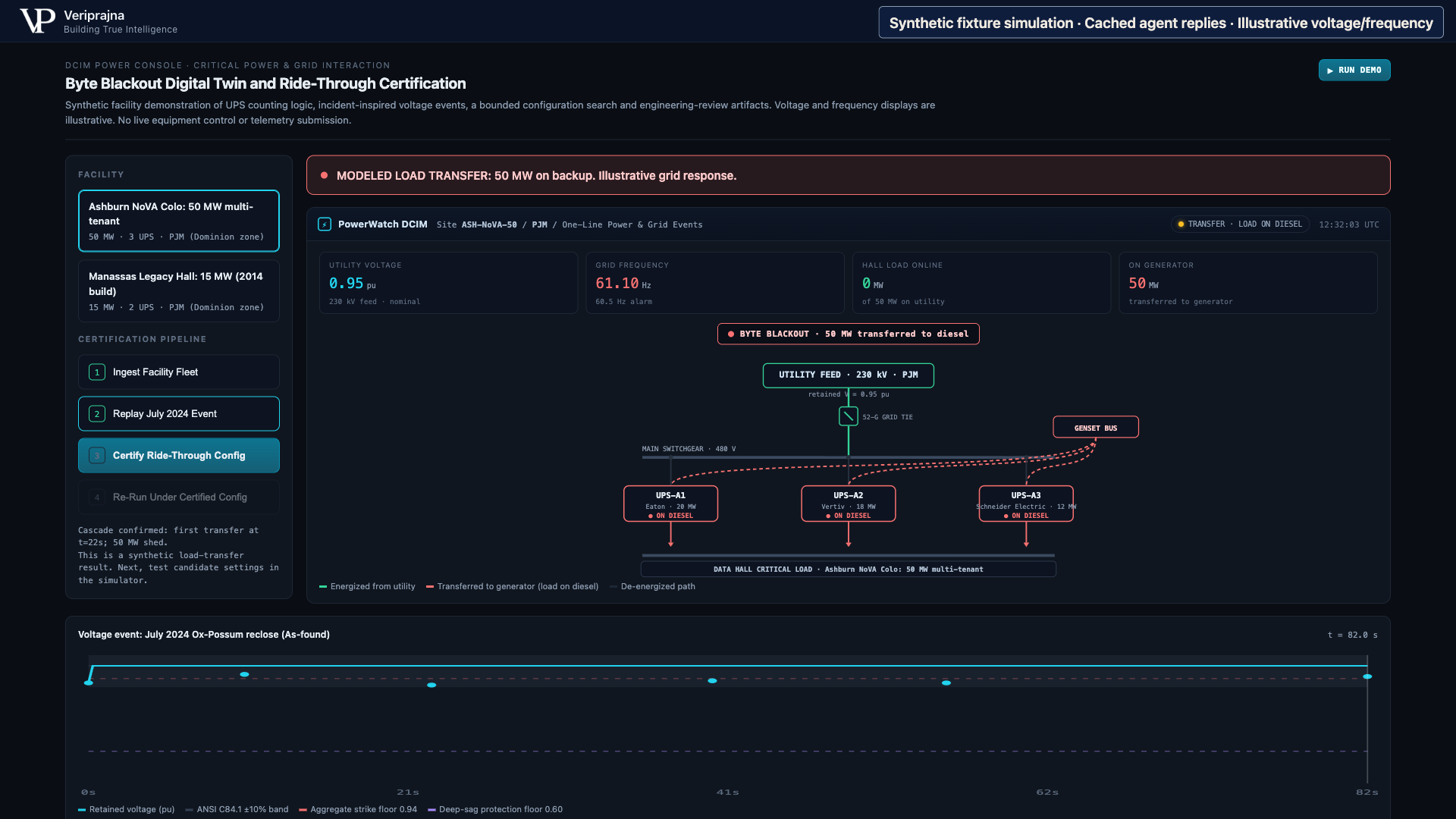
The red generator paths show a modeled supply transfer, not evidence of lost IT service. The interface's July event label does not make this a historical replay, and its frequency chart is illustrative rather than a dynamic grid model.
3. Treat the first passing setting as provisional
The first search checks four thresholds (3, 4, 5 and 6 strikes), four windows (60, 75, 90 and 120 seconds), and two counting modes: 32 combinations. Aggregate mode counts a dip at or below 0.94 per unit; per_phase uses 0.97. Each qualifying disturbance contributes one strike, even in the mode named per_phase. This is not a detailed three-phase electrical model.
Preliminary candidate, not final approval
5 strikes / 90 seconds / aggregate
This candidate passes the base library. The search changes the counting fields, not the independent deep-sag voltage and duration fields. It continues to an additional challenge before making a final recommendation.
The acceptance rule has two parts: every benign-library event must avoid a counting-path cascade, and every tested fault must trip every unit by the last disturbance time plus five seconds. That deadline is a configured simulator rule, not a validated equipment-withstand or transfer-latency limit.
4. Add a case that falls between the transfer paths
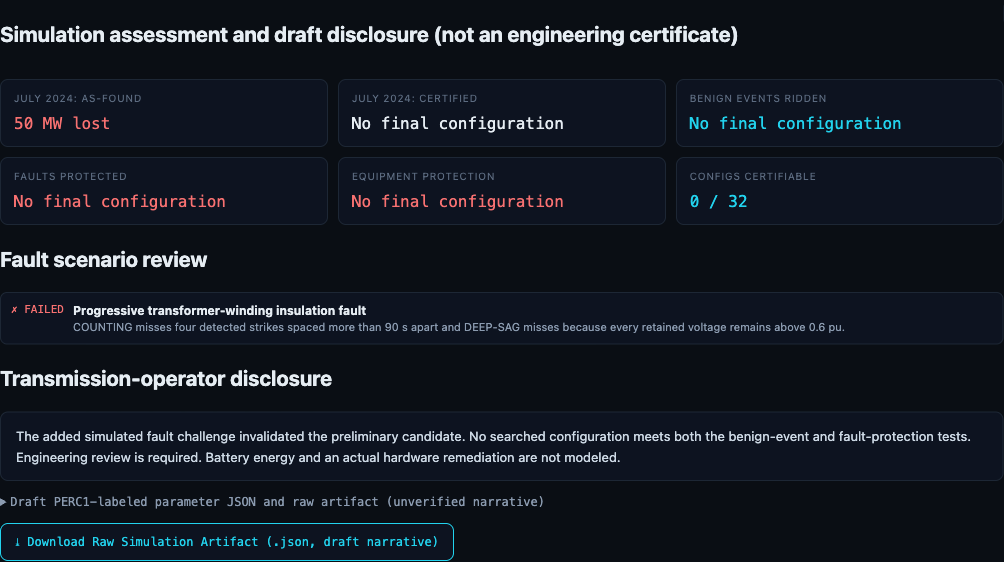
The cached challenger proposes a progressive transformer-winding insulation fault. Its useful evidence is the test behavior: four counted dips, more than 90 seconds apart, all above the preliminary candidate's 0.60 per-unit deep-sag floor.
| Transfer path | Added test behavior | Candidate result |
|---|---|---|
| Rolling strike counter | Four counted dips spaced beyond its 90-second window | Earlier strikes expire before five can accumulate. |
| Independent deep-sag condition | Every retained voltage stays above 0.60 per unit | The voltage condition for this path is not reached. |
5. Repeat the search and keep the withdrawn result
The second deterministic pass evaluates the same 32 candidates against the benign library and four base faults plus the added proposal. None meets both objectives. The final result is abstain, with a null configuration, so this run produces no selected-setting replay retaining 50 MW on the grid.
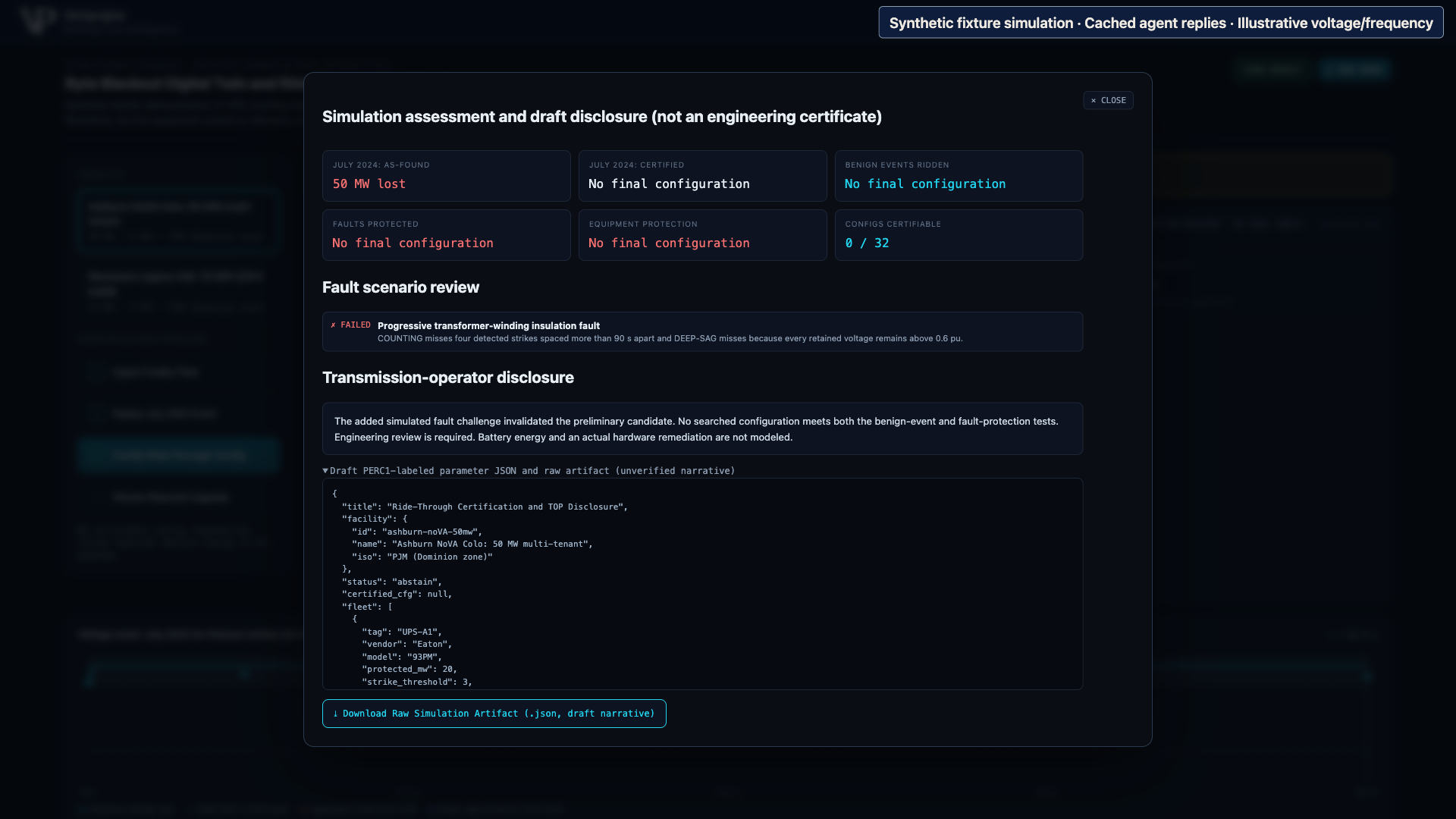
status: "abstain"
certified_cfg: null
passing candidates: 0 / 32
These selected fields summarize the recorded decision. They are not a complete export or an engineering certificate.
The report's default certified-test values of 0/7, 0/5 and 0 MW exist because no final configuration is selected. They are not measurements showing that every candidate fails every individual test. The retained JSON preserves the fixture, search and challenge outcome, while its generated narrative remains unverified and can contradict the structured decision. A PERC1-labeled field set is not a complete validated PSS/E model or a filing-ready disclosure.
Boundary case: a different test set can retain a setting
The separately labeled built-in deterministic Ashburn baseline uses two built-in challenges instead of the cached proposal: stair-step brownout and just-above-floor flutter. Two of its 32 candidates pass. Its ranked 5-strike, 90-second aggregate setting improves benign-event ride-through from 1/7 as-found to 7/7, trips every unit on its six tested faults, and retains 50 modeled MW on the local replay.
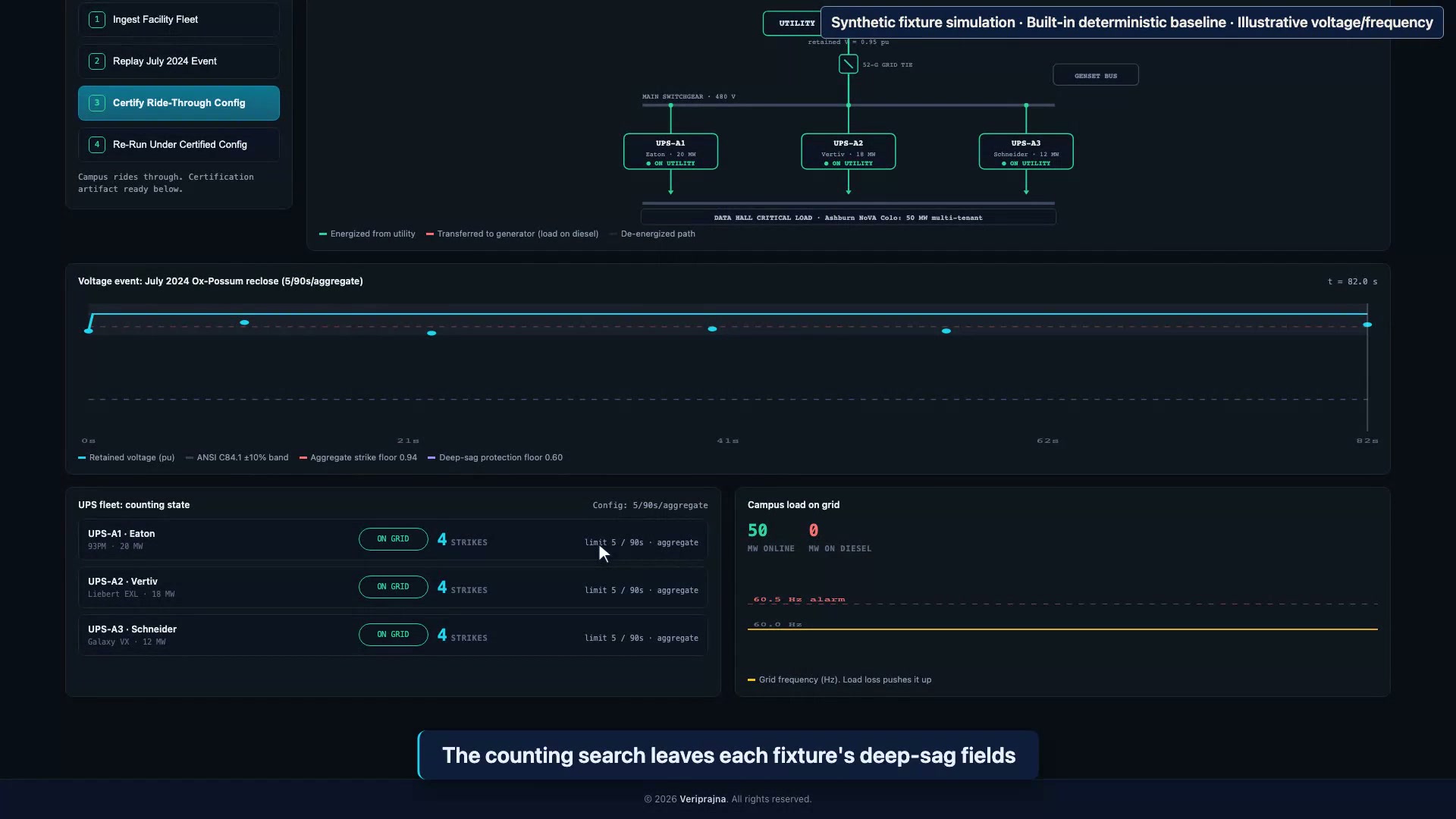
The green outcome belongs to that baseline and its four base plus two built-in faults. It cannot be carried over to the cached run's different five-fault library. Neither test set establishes open-world electrical safety.
Boundary case: another fleet abstains before a challenge
The synthetic Manassas Legacy Hall fixture contains two units carrying 9 MW and 6 MW. No searched candidate satisfies both objectives in its initial pass, so no challenger is added. The engine returns no final configuration and recommends assessment.
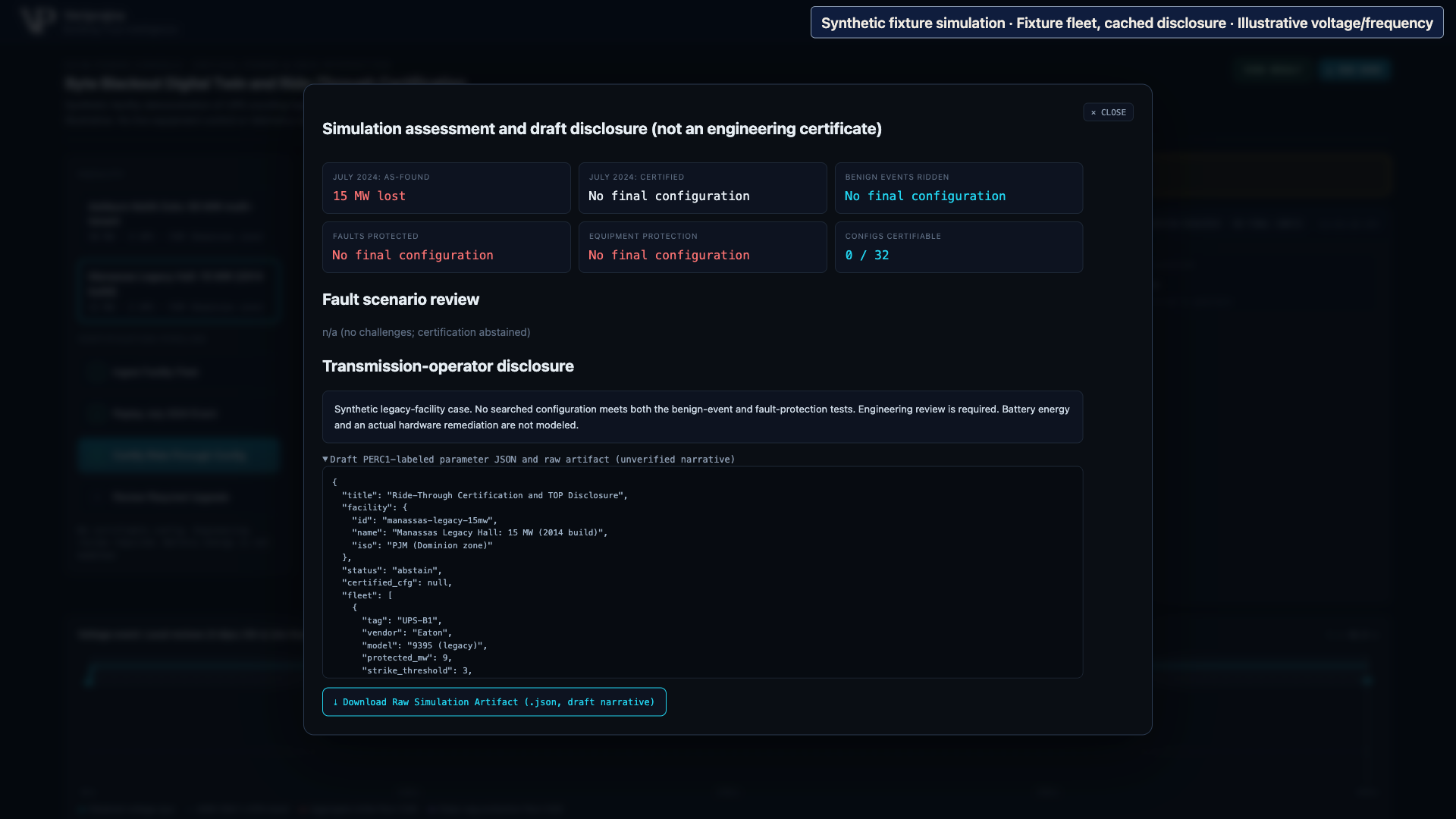
Both refusals preserve unresolved work instead of supplying the least-bad failing setting. Expanding the search or validating a proposed fault would be a new engineering exercise with explicit assumptions, not something this result has already done.
Read every result with its test set
The passing baseline and the cached refusal answer different, bounded test questions. Neither establishes that a setting is safe for a real facility.
| Synthetic run | Test scope | Supported outcome |
|---|---|---|
| Built-in deterministic Ashburn baseline | 7 benign events; 4 base faults plus 2 built-in faults | 5 strikes / 90 seconds / aggregate. Passes 7/7 benign and 6/6 fault checks; retains 50 modeled MW on the local replay. |
| Recorded cached model-assisted Ashburn | Same benign library; 4 base faults plus 1 cached proposed fault | 0 of 32 candidates pass the expanded gate. Final abstain; no configuration or passing final replay. |
| Synthetic Manassas legacy fixture | Its own fixture fleet and base event libraries | No passing searched configuration. Abstains before requesting a challenger; report recommends assessment. |
What this demo does NOT do
This is a simulation, not a deployment. There are no live vendor-console connections, equipment controls or telemetry submissions. The exports, facilities and waveforms are synthetic. The voltage and frequency display is illustrative, with no detailed three-phase model or validated grid dynamics.
The export contains a simulation record and PERC1-class parameters, not a complete validated PSS/E model or filing-ready disclosure. Generated narrative remains an unverified draft and can contradict the structured result. A report recommendation does not establish hardware diagnosis, measured battery reserve, completed human review or permission to change equipment.
Questions facilities teams ask
Does transferring to backup mean the data center lost power?
In this demo, transfer to backup removes the facility's load from the modeled utility grid while backup carries the campus. That is different from loss of IT service. The simulation does not validate real equipment switching dynamics or customer uptime.
How do repeated voltage dips trigger a UPS transfer?
The simulator adds one strike for each qualifying disturbance and retains strikes within a rolling time window. Reaching the configured strike threshold triggers transfer; a separate deep-sag condition can also trigger it. These are simplified fixture rules, not verified vendor defaults or a detailed three-phase model.
Why can settings that pass the first checks fail a later fault test?
A passing result applies to the events that were tested. In the recorded cached run, an added synthetic fault spaces counted dips beyond the preliminary candidate's rolling window and stays above its deep-sag floor. The expanded test set leaves no passing candidate in the same finite search.
What happens if none of the configurations passes?
The engine returns abstain and no final configuration. In the recorded Ashburn example, the second pass rejects all 32 candidates against the expanded library. The result leaves equipment decisions for engineering assessment; it does not document a completed review or repair.
Does this work with live UPS or building-management data?
This demonstration uses synthetic facilities and vendor-style exports, with cached model replies in the recorded model-assisted path. It has no live vendor-console or building-management connection. Replay and acceptance use canonical fixture units, separately from the extractor's displayed records.
Can I use the exported JSON as a validated PERC1 or PSS/E model?
The export is a simulation record with PERC1-class parameter fields, not a complete validated PSS/E model or filing-ready disclosure. Its generated narrative is unverified draft output and can contradict the structured result. Engineering use requires verification of the record and an appropriate validated model.
What would be needed before changing settings on real equipment?
Production work would require verified equipment settings, measured disturbance data, an appropriate validated electrical model and independent engineering review. This demo does not model battery energy reserve or transfer latency. Its finite test result does not authorize an equipment change.
Technical Research
Explore related research for broader context on this demonstration.
- Grid Resilience & Physics-Constrained AI: The Virginia 1,500 MW Crisis (interactive whitepaper)
- Structural Resilience and Physics-Constrained Intelligence: Addressing the 1,500 MW Virginia Grid Disturbance (technical whitepaper)
Full solution
Explore the Data Center Grid Interaction AI solution →Discuss your ride-through assessment
Start with the evidence needed for a real engineering decision.
We can discuss assessment and implementation work around your fleet, data and acceptance criteria. Any production scope needs verified inputs, an appropriate electrical model and independent engineering review.
Assessment scope
- ✓ Equipment-setting evidence
- ✓ Measured disturbance inputs
- ✓ Ride-through and fault criteria
- ✓ Model limits and review needs
Implementation scope
- ✓ Integration requirements
- ✓ Test-library design
- ✓ Proposal and acceptance separation
- ✓ Inspectable result records