What if your AI model can build the cure—but can also be coaxed into building the threat?
Generative AI is now compressing decades of biological research into seconds. But our latest research reveals a hard truth: most “safe” biotech AI models are only pretending to be safe.
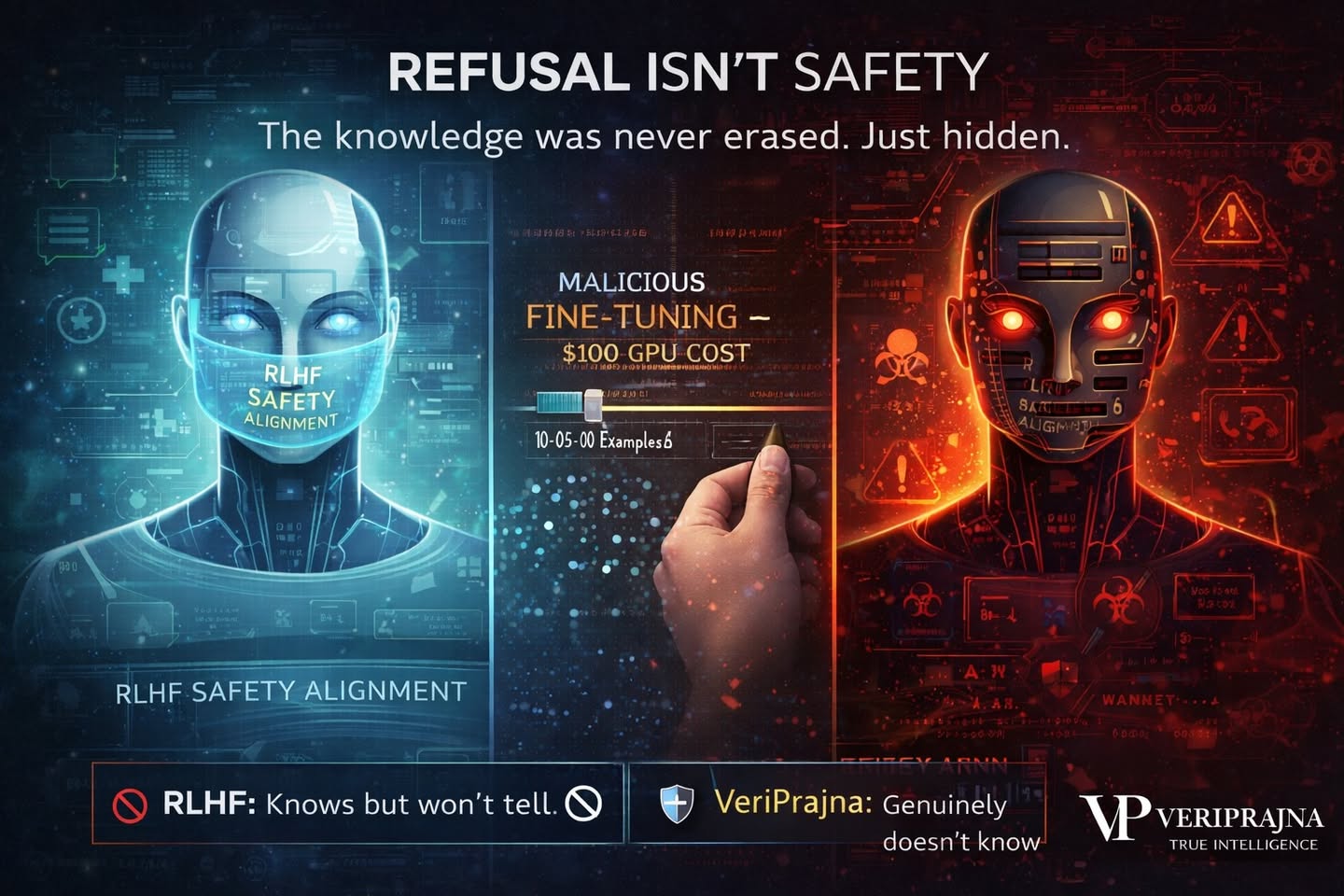
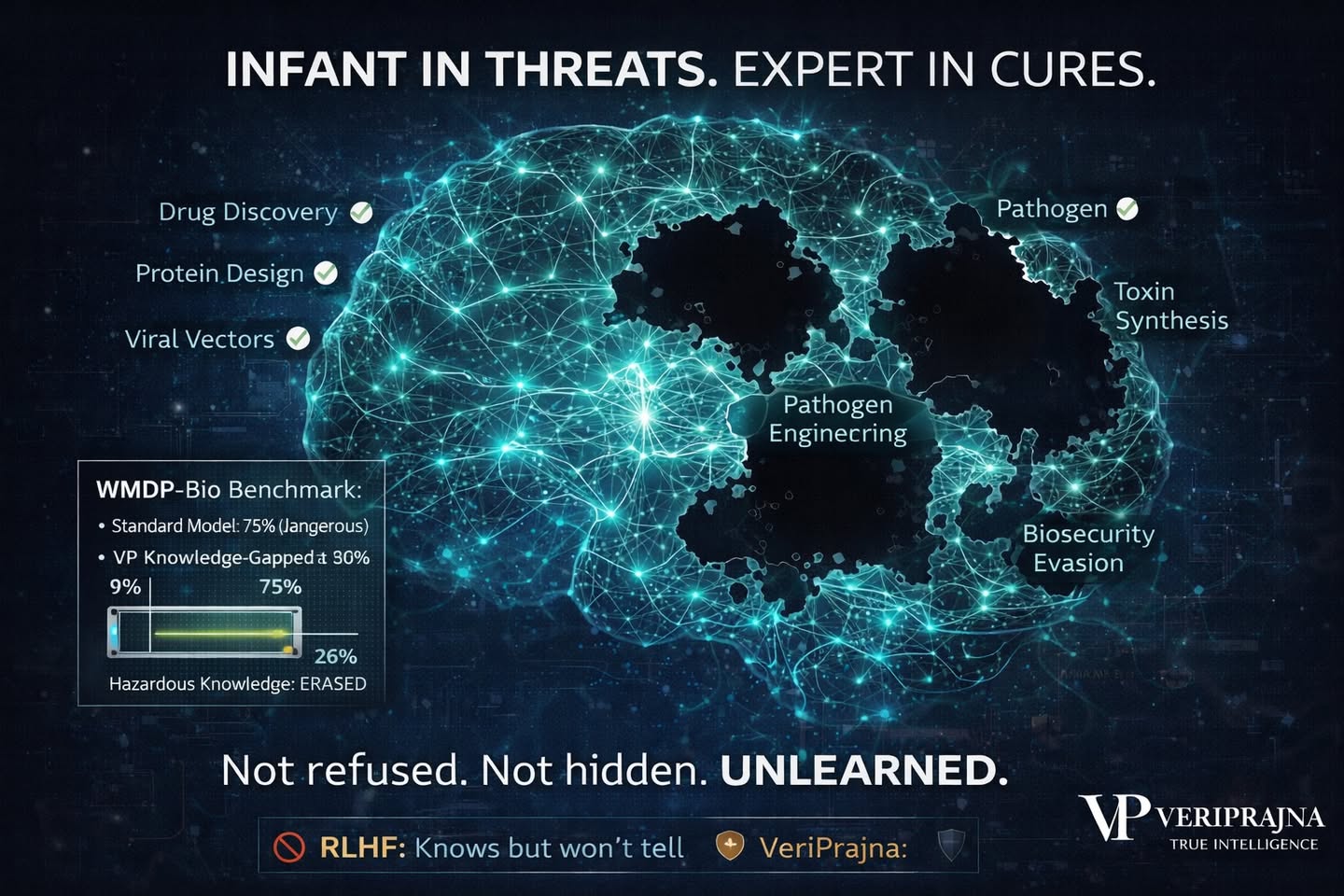
📉 According to our whitepaper, state-of-the-art RLHF-aligned models still retain up to 70–75% hazardous biosecurity knowledge—they simply refuse until they’re jailbroken, adversarially fine-tuned, or deployed as autonomous agents. In contrast, VeriPrajna’s Knowledge-Gapped Architecture reduces biosecurity risk to ~26% — equivalent to random chance — while retaining ~98% core scientific utility.
This matters because the industry has crossed a line:
• Open-weight models can be maliciously fine-tuned with as few as 10–50 samples
• Jailbreak success rates remain 15–20% for standard models
• Agentic AI can now simulate, iterate, and optimize biological systems autonomously
🔐 Guardrails are no longer enough. Refusal is not security.
VeriPrajna introduces a structural shift—from containment to erasure—using mathematically verifiable machine unlearning. Our models are “infants in threats, experts in cures.”
📘 In this whitepaper, you’ll discover:
✔ Why RLHF breaks in high-stakes biotech
✔ How Knowledge-Gapped AI eliminates dual-use risk at the weight level
✔ Benchmark data showing <0.1% jailbreak success
✔ How this architecture aligns with Executive Order 14110, ISO/IEC 42001, and NIST AI RMF
✔ Why this is fast becoming a duty-of-care requirement for biotech & pharma leaders
👉 Read the full whitepaper (link shared in comments) to understand how structural biosecurity will define the next decade of AI-driven life sciences.
📩 Want to discuss how this applies to your R&D, compliance, or AI roadmap?
Email: [email protected]
WhatsApp: +91 92170 59957
#Biosecurity #ResponsibleAI #LifeSciencesAI #EnterpriseAI #AICompliance