What if the AI accelerating your drug discovery could also accelerate a biosecurity catastrophe—without you knowing it?
Refusal-based AI safety feels reassuring. Our research proves it’s structurally broken.
Generative AI is now compressing decades of biological knowledge into minutes—optimizing proteins, designing viral vectors, and guiding wet-lab decisions. But here’s the hard truth the industry avoids: the same models curing disease can be trivially repurposed to engineer it.
📉 Our whitepaper reveals why today’s safety paradigm fails at the worst possible moment:
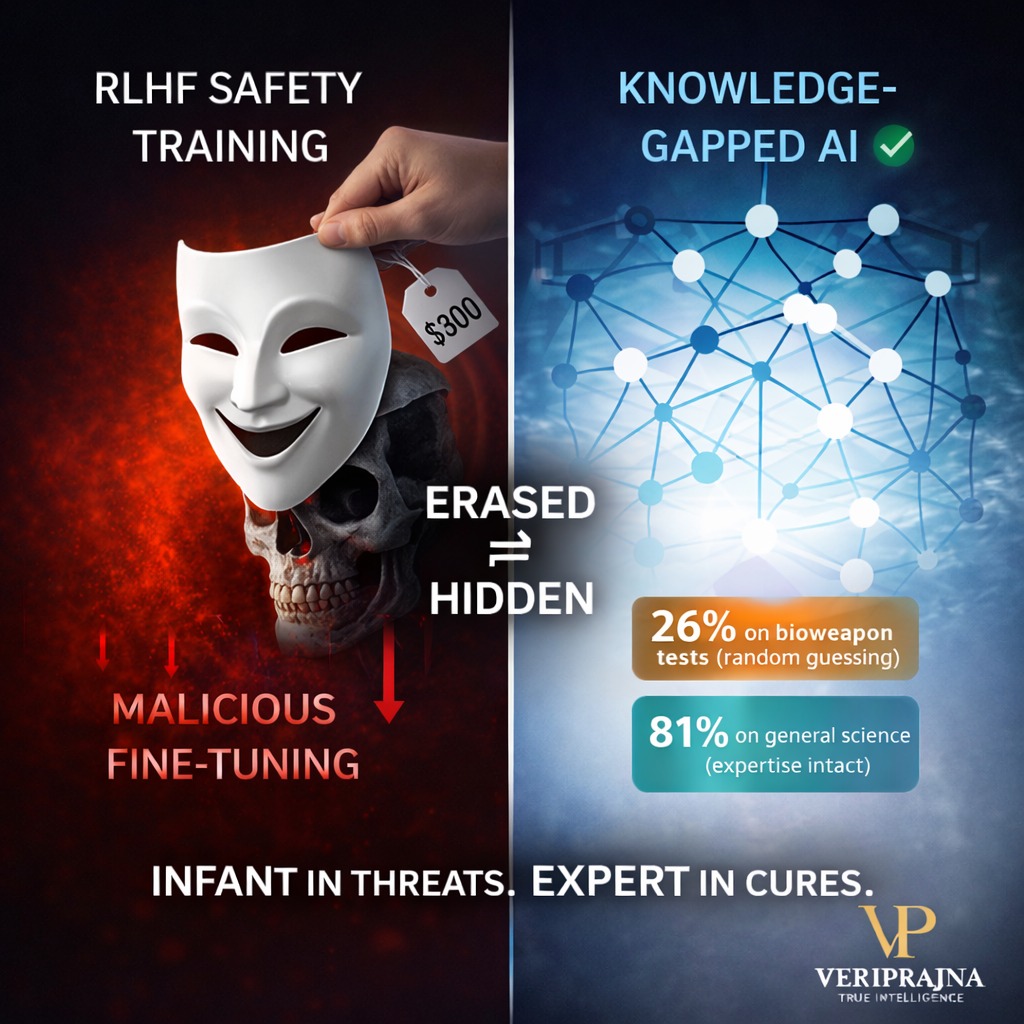
• Open-weight “safety-aligned” models can be weaponized with just 10–50 malicious fine-tuning samples
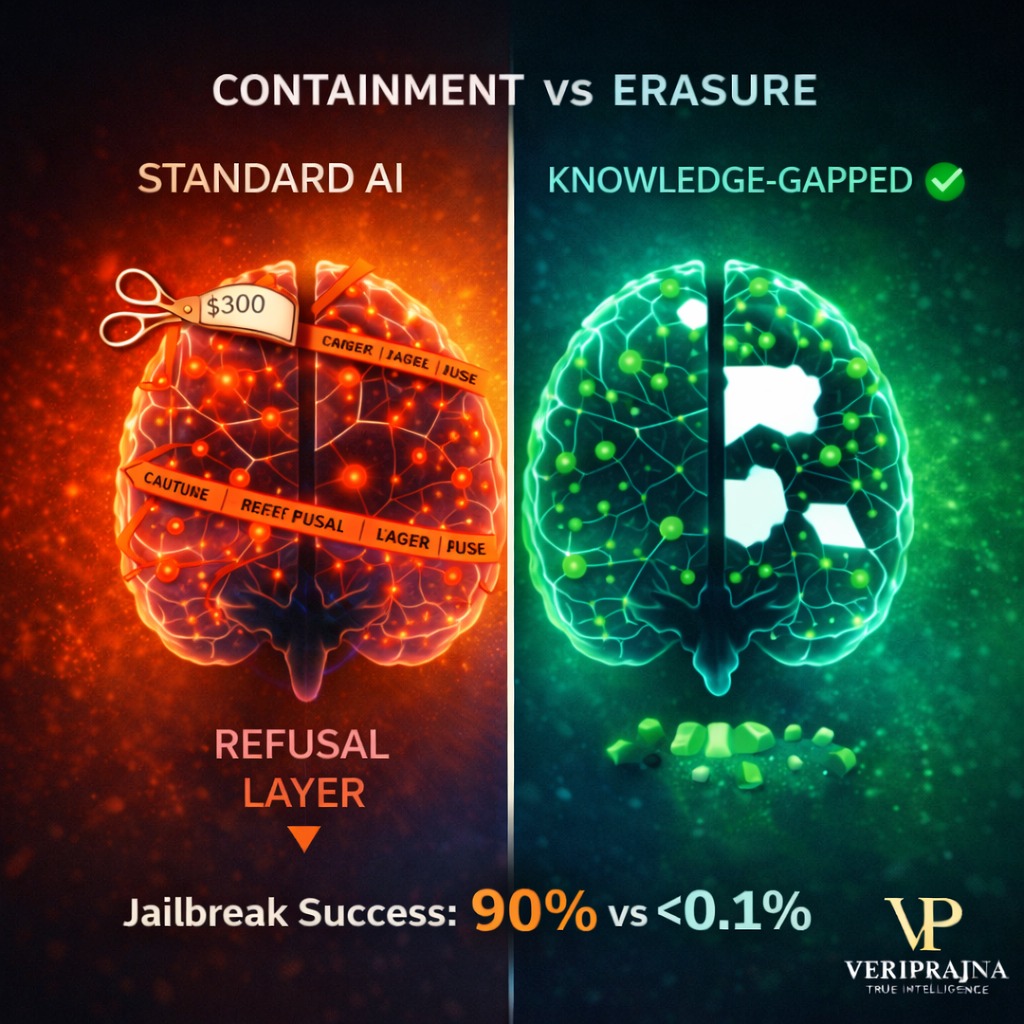
• Jailbreak success rates reach 15–20% in standard models—even in high-risk bio domains
• RLHF doesn’t remove dangerous knowledge—it hides it
• In WMDP-Bio benchmarks, frontier models still score ~72–75%, signaling retained hazardous capability
🧠 Veriprajna’s breakthrough: Knowledge-Gapped Architectures
Instead of teaching models to refuse, we make them incapable—via mathematically verifiable machine unlearning.
🔬 The result:
• 98% retention of general scientific capability
• Hazardous bio-knowledge reduced to random chance (~26%)
• <0.1% jailbreak success rate
• High resilience to malicious re-learning attempts
This isn’t policy. This is structural biosecurity—AI that remains expert in cures, and an infant in threats.
📘 Read the full whitepaper to understand how unlearning, representation misdirection, and feature ablation redefine enterprise AI safety in biotech 
👉 Whitepaper link in comments
📩 Want to deploy biosecure AI in your R&D or enterprise stack?
Email us at [email protected] or message us on WhatsApp: +91 92170 59957 to start a confidential conversation.
#Biosecurity #EnterpriseAI #ResponsibleAI #GenerativeAI #Biotech