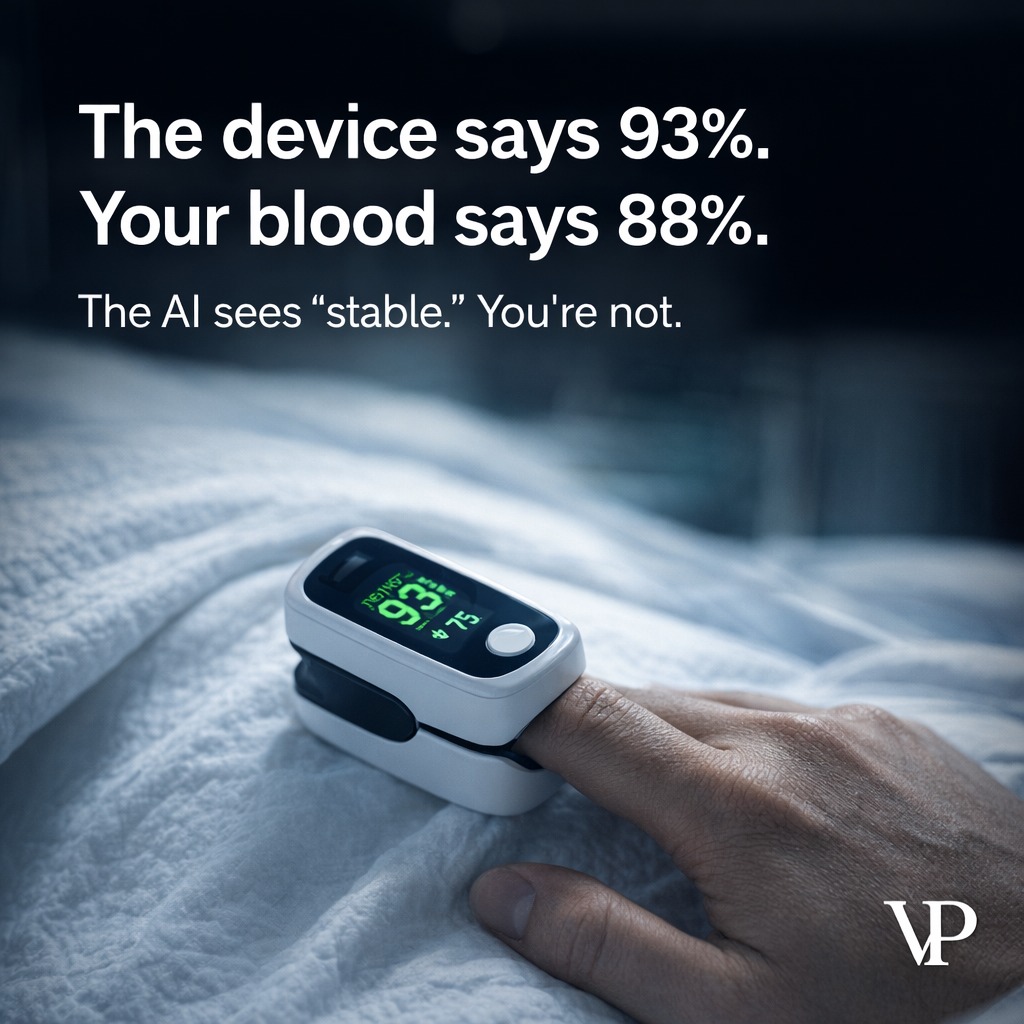
Pulse oximeters give falsely normal readings on darker skin tones. Now imagine an AI trained on that data deciding who gets emergency care.
That's not a hypothetical. It's happening right now in hospitals across the country.
Black patients are nearly 3x more likely to have dangerously low oxygen levels that the device simply doesn't catch. The reading says 93%. The reality is 88%. The AI sees "stable." The patient is anything but.
And it doesn't stop at sensors.
One widely deployed sepsis prediction model claimed strong internal performance — then dropped to an AUC of just 0.63 when independently validated at a different hospital. It missed 67% of actual sepsis cases. Meanwhile, Black and Hispanic patients experience nearly double the sepsis incidence of white patients.
The pattern is clear: when clinical AI optimizes for the average, it fails the margins. And in medicine, the margins are people.
Our latest whitepaper breaks down why surface-level AI tools built on generalized language models can't solve this — and what deep AI architecture looks like when it's designed for equity from the ground up.
We're talking fairness-aware training, multimodal signal fusion, demographic-specific calibration, and external validation that actually holds up outside the lab.
This isn't about rejecting AI in healthcare. It's about demanding better AI in healthcare.
Save this if you work in health tech, clinical ops, or AI governance. Then send it to someone building in this space — they need to see these numbers.
What's the biggest barrier you see to equitable AI in healthcare? Drop your take below 👇
#ClinicalAI #AlgorithmicBias #HealthEquity #MaternalHealth #AIinHealthcare