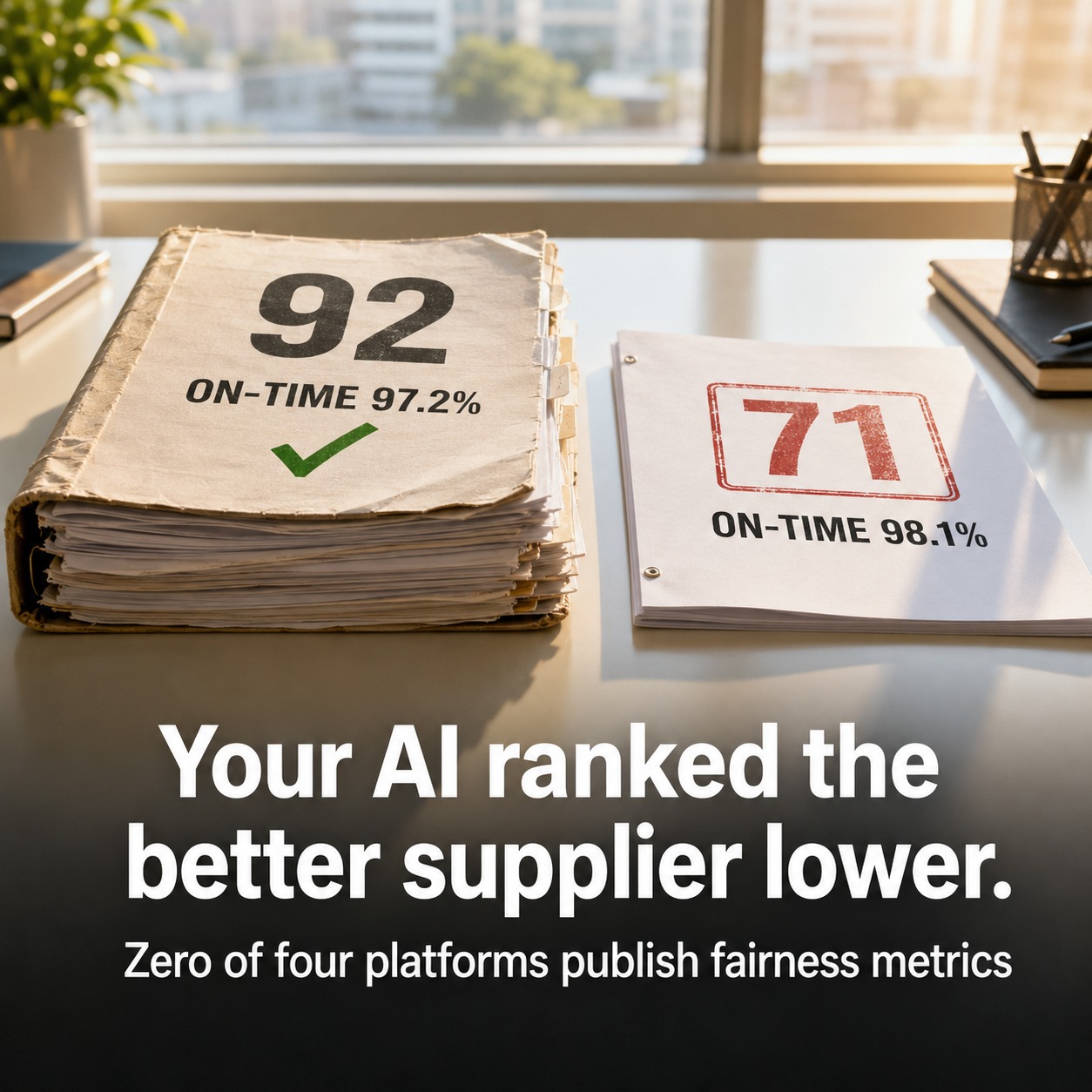
Supplier B had a better on-time delivery rate. Your procurement AI still ranked them lower.
Here's how that happens, and why it's a compliance problem hiding inside a "merit-based" score.
Picture a sourcing event for industrial fasteners. The AI scores five suppliers. Supplier A is a 12-year incumbent with 4,200 transactions. Supplier B is a certified MBE with 180 transactions and a 98.1% on-time rate — slightly better than A's 97.2%.
A still wins. Not because the model is malicious, but because delivery scores get confidence-weighted by transaction count. Fewer data points, lower confidence, lower score. B gets penalized for never having been given enough contracts to build a track record. Fewer contracts next cycle, fewer transactions, lower confidence again. The exclusion is self-reinforcing — an invisible wall built from historical spend data.
Now run the EEOC's four-fifths rule (29 CFR 1607.4) disparate-impact test on supplier selection. If your AI advances 60% of non-diverse suppliers, it has to advance at least 48% of MBE/WBE suppliers. Volume-weighted scoring routinely lands them near 22%. A disparity ratio of 0.37 is prima facie adverse impact — the kind of finding that shows up in a FAR Part 19 audit.
The uncomfortable part: across SAP Ariba, Coupa, GEP, and Ivalua, our March 2026 analysis found zero of four major platforms publish supplier-scoring fairness metrics. The platform gives you speed. The fairness layer is yours to build — and to prove.
So if leadership asks "doesn't our platform already handle this?" — the honest answer is no, and you can show them exactly where the gap lives. And it cuts both ways: EO 14319 now bars federal AI with ideological bias while FAR Part 19 still demands diversity goals — provable mathematical fairness is the only answer that satisfies both at once.
Save this for the next supplier-diversity review. 📌
#ProcurementAI #SupplierDiversity #AlgorithmicFairness #AIGovernance #FARPart19