The first time I decomposed an AI supplier scoring formula for a federal contractor client, I was looking for the intentional part. A bias complaint had been filed. The procurement director believed the platform was the source. I pulled the scoring configuration, ran it against a representative set of sourcing events, and traced the problem back to confidence weighting on delivery performance.
There was no intentional part. The algorithm was doing exactly what it was designed to do: reward suppliers with more historical data. That's when I realized the complaint was harder to defend against, not easier. There's a meaningful line between bias that a vendor might fix and structural exclusion that the architecture produces. Confidence weighting sits on the wrong side of that line, and it's present in every major S2P platform running today.
The Number That Stopped One Meeting Cold
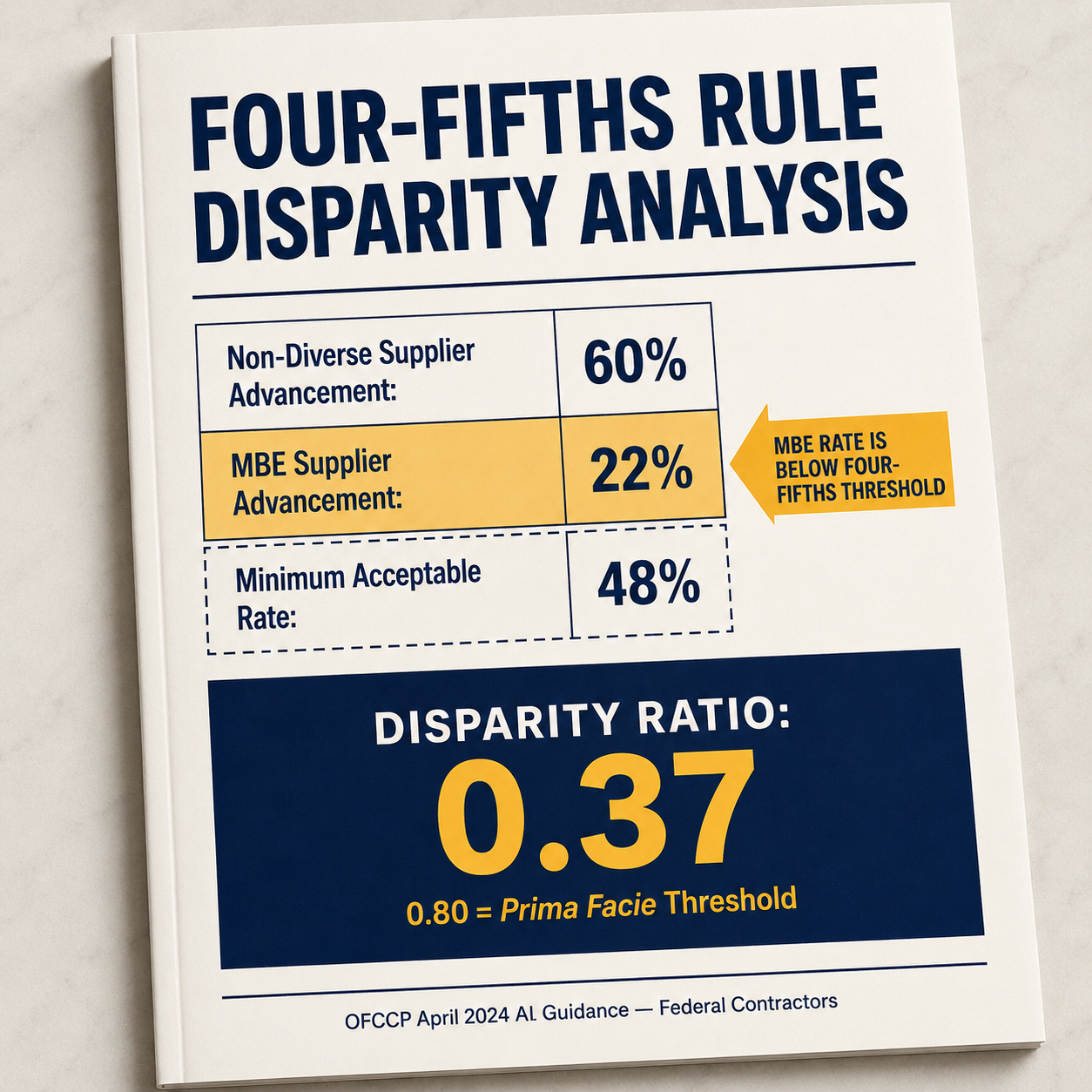
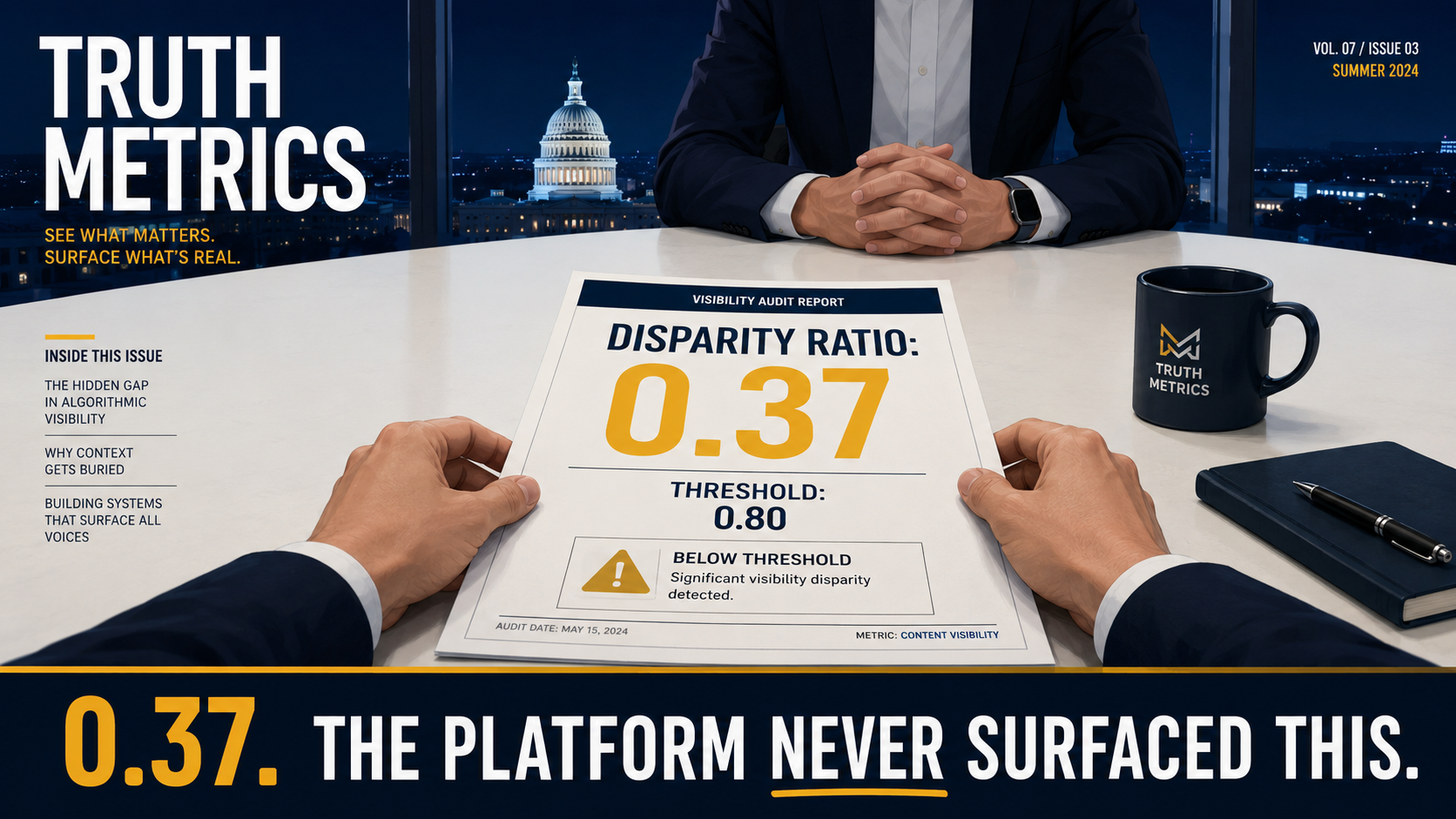
My first disparity report from that engagement showed a 0.37 ratio. Under the EEOC's four-fifths rule—29 CFR 1607.4, designed for employment screening but directly applicable to supplier selection—any group's selection rate must reach at least 80% of the highest group's rate. The MBE selection rate in that client's sourcing events was 22%. Non-diverse suppliers advanced at 60%. Forty-eight percent would have been the minimum acceptable rate. Twenty-two percent wasn't close.
What I put on the table was a four-fifths rule calculation worksheet: selection rate column, disparity ratio column, the 0.80 threshold line, the actual ratio at 0.37, and a note that OFCCP's April 2024 AI guidance explicitly extends the adverse impact framework to automated screening tools used by federal contractors. The procurement director asked why the platform had never surfaced this. I told him none of the four major platforms—SAP Ariba, Coupa, GEP, Ivalua—currently publish fairness metrics or disparate impact reports on their supplier scoring. He asked why not.
The honest answer is platform economics. SAP Ariba's Joule Bid Analysis Agent, launched commercially in Q1 2026, serves tens of thousands of customers with AI-powered award recommendations. Coupa's Navi Supplier Discovery Agent runs 100+ AI tools across a community scoring system where network transaction data feeds the signals. Per-customer fairness configuration isn't how either of them is priced or built. That's not evasion—it's accurate. What it means is that the fairness layer is what the customer has to build, and it's what almost none of them know they're missing until a desk review surfaces the gap.
The Call I Got After EO 14319 Dropped
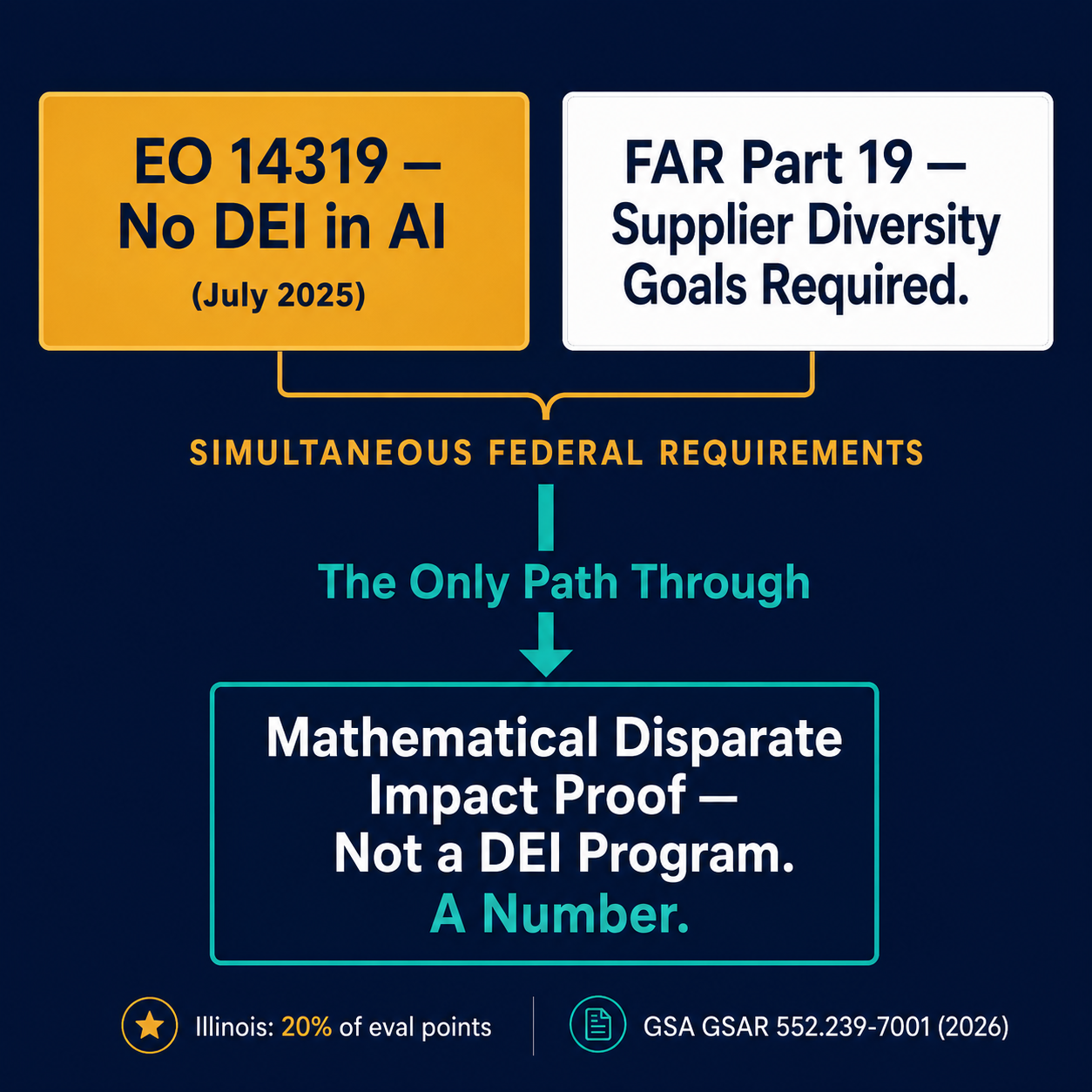
A procurement compliance officer at a federal prime called me about a week after EO 14319 was signed in July 2025. The order prohibits federal agencies from procuring AI with "ideological biases or social agendas," with language targeting DEI design. FAR Part 19 simultaneously requires her company to maintain specific subcontracting percentage goals for MBE, WBE, HUBZone, veteran-owned, and service-disabled veteran-owned suppliers—goals enforced through contracting officer reviews and contract award decisions.
She didn't frame it as a DEI question. She'd already figured that framing was a dead end. What she wanted to know was whether mathematical proof of algorithmic equity would survive an EO 14319 challenge. My read: yes, and it's the only path that satisfies both requirements simultaneously. EO 14319 prohibits DEI programs in AI—it doesn't and can't coherently prohibit a statistical analysis showing that your algorithm selects suppliers equitably across categories. A four-fifths test result is a number, not a philosophy. Illinois allocates up to 20% of technical evaluation points to supplier diversity; demonstrating algorithmic equity is increasingly what those points turn on in practice.
My advice to her was to get the disparity report in hand before the next CO desk review, not after. The GSA's draft GSAR 552.239-7001 AI clause from March 2026, currently in comment period, adds disclosure requirements that are moving in the same direction. The compliance pressure is increasing, and the only durable answer to it is mathematical.
What I Find Every Time I Pull the Scoring Data
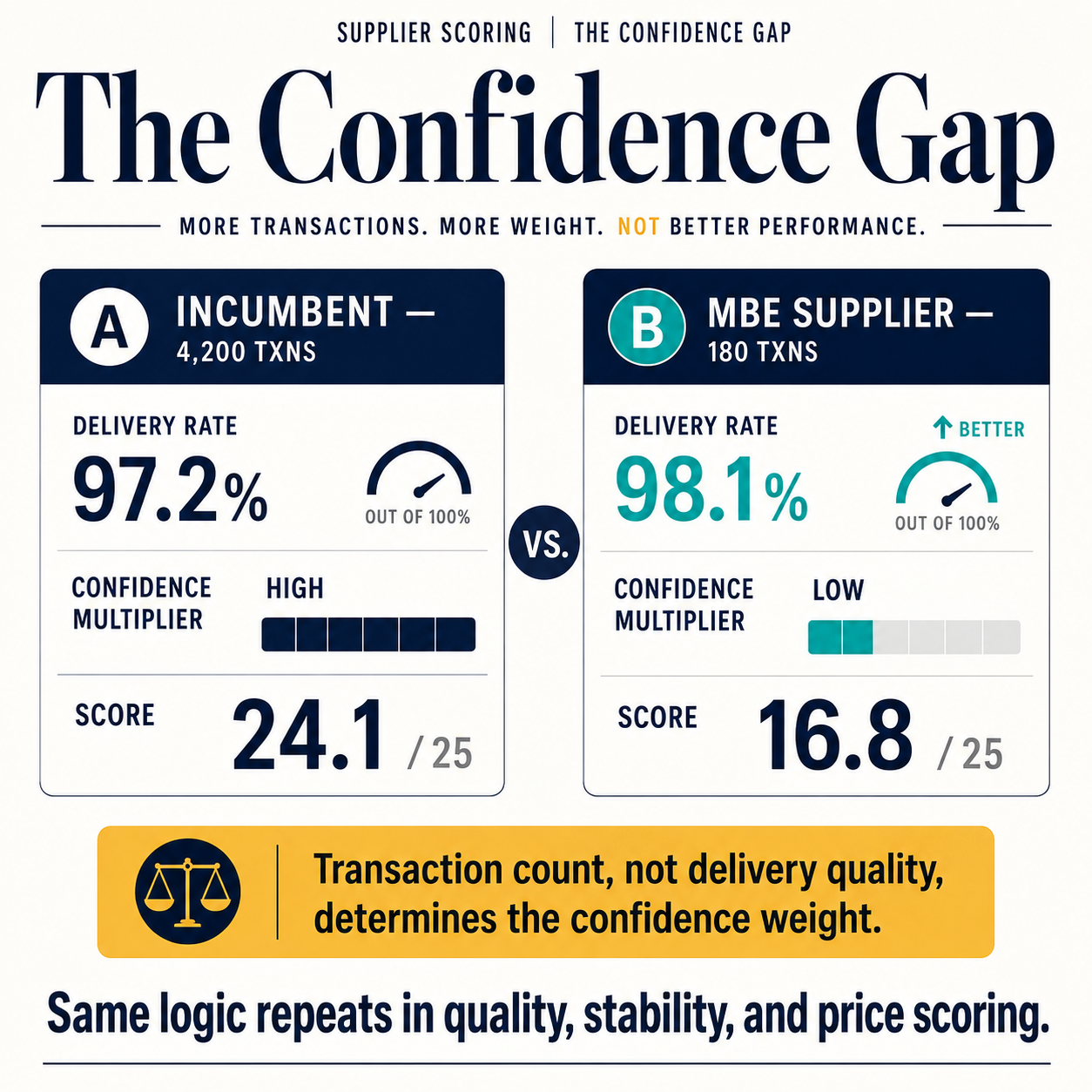
I've run this analysis across enough platform configurations now that the pattern doesn't surprise me anymore, but the specific numbers still land hard when I show them to clients. In any sourcing event where the S2P platform's AI scores suppliers on delivery performance, the confidence weighting on that factor is the primary driver. A large incumbent with 4,200 historical transactions and a 97.2% on-time rate generates a delivery score near the top of the range. A certified minority-owned supplier with 180 transactions and a 98.1% rate—a better actual delivery rate—scores several points lower, because the algorithm interprets "more data" as "more reliable."
The same structural logic repeats in quality metrics, where audit frequency tracks contract volume, and in financial stability scoring, where revenue size proxies for risk. By the time price is evaluated, the gap has compounded. And because lower-scoring suppliers win fewer contracts, they accumulate less transaction history, and score lower in the next sourcing cycle. I've never found a configuration where this self-reinforcement wasn't present in some form.
Supplier diversity discovery platforms—Supplier.io, which indexes 20M+ suppliers, and Tealbook, with 5M+ verified suppliers—are genuinely excellent at building the pool of diverse vendors who can enter a sourcing event. What I explain to clients is that getting diverse suppliers into the pool is not the same problem as auditing whether the scoring treats them equitably once the event opens. Both matter; they're different problems with different solutions.
What "Auditable" Means When a CO Is Asking
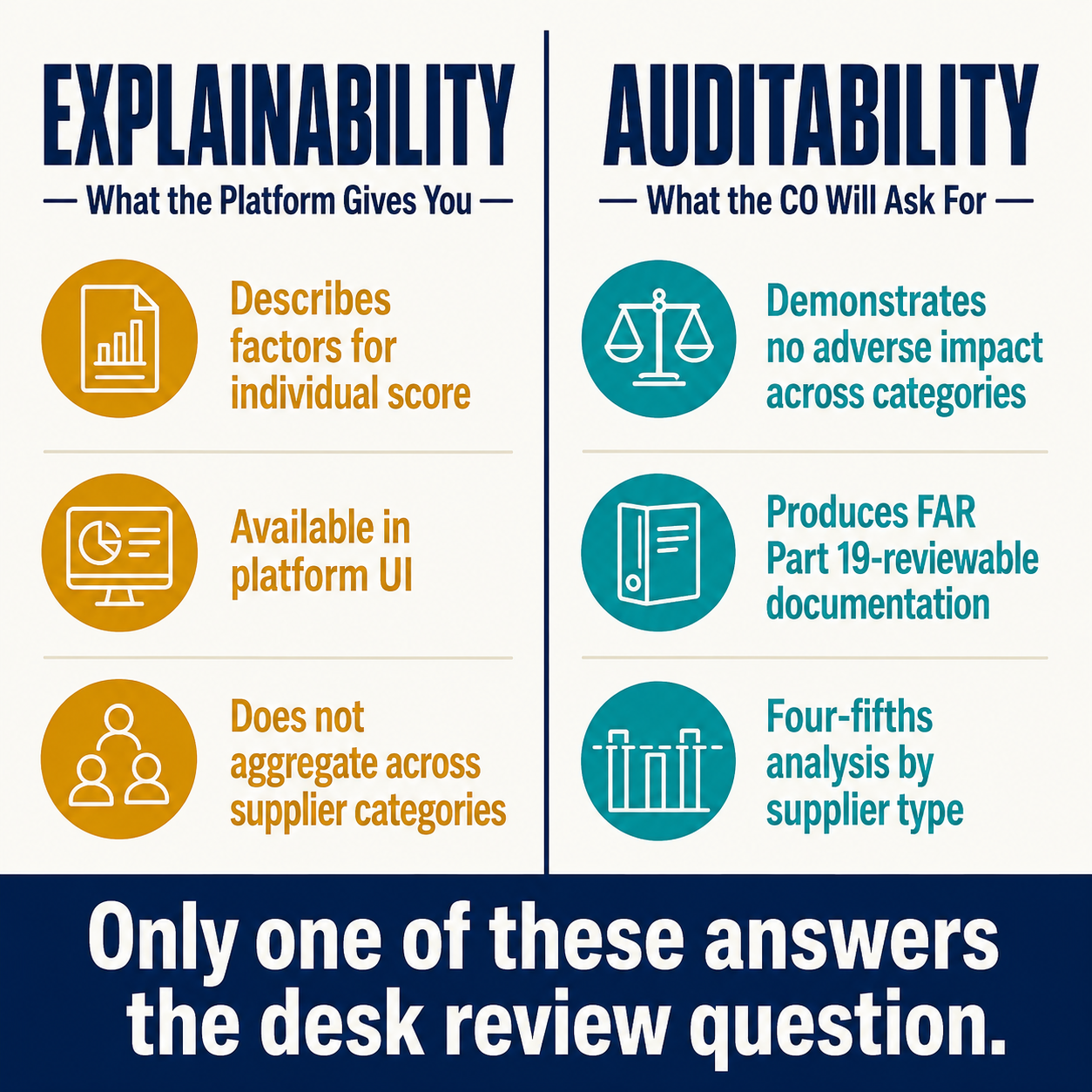
The engagement I do through Veriprajna's AI Procurement Fairness & Supplier Diversity Compliance practice connects to the client's platform APIs, pulls scoring outputs from representative sourcing events, runs the four-fifths analysis across supplier categories, and traces any disparity below 0.80 back to the specific scoring factors driving it. The output is a disparity report with documentation a contracting officer can read and a prime contractor can defend.
What I've found is that explainability and auditability are not the same thing, and buyers often conflate them. Explainability is the platform's ability to describe what factors drove an individual score. Auditability is the ability to demonstrate that the scoring system's outcomes don't produce adverse impact across supplier categories—and to document that in a form that satisfies FAR Part 19 oversight. Only one of those is what a CO will ask for at the desk review.
ProcureAbility's 2026 CPO Report put AI pilot adoption at 49%, with only 4% reaching meaningful deployment. I think the compliance gap is part of what's keeping teams in that 49%. A procurement director who can't answer the fairness question about their AI deployment doesn't fully deploy it. The documentation is part of what makes deployment defensible, not just technically, but organizationally.
What I keep returning to is that the platforms are not wrong about what their AI does. Cost reduction, risk mitigation, speed at scale—they deliver on those. The gap is that optimizing for efficiency on historical data is a fundamentally different objective from demonstrating equitable outcomes for current suppliers. You can buy the first and assume you're getting the second. Almost everyone does. The question worth sitting with before your next sourcing event is whether your four-fifths ratio is above 0.80 or below it—and whether you know the answer before someone else asks.