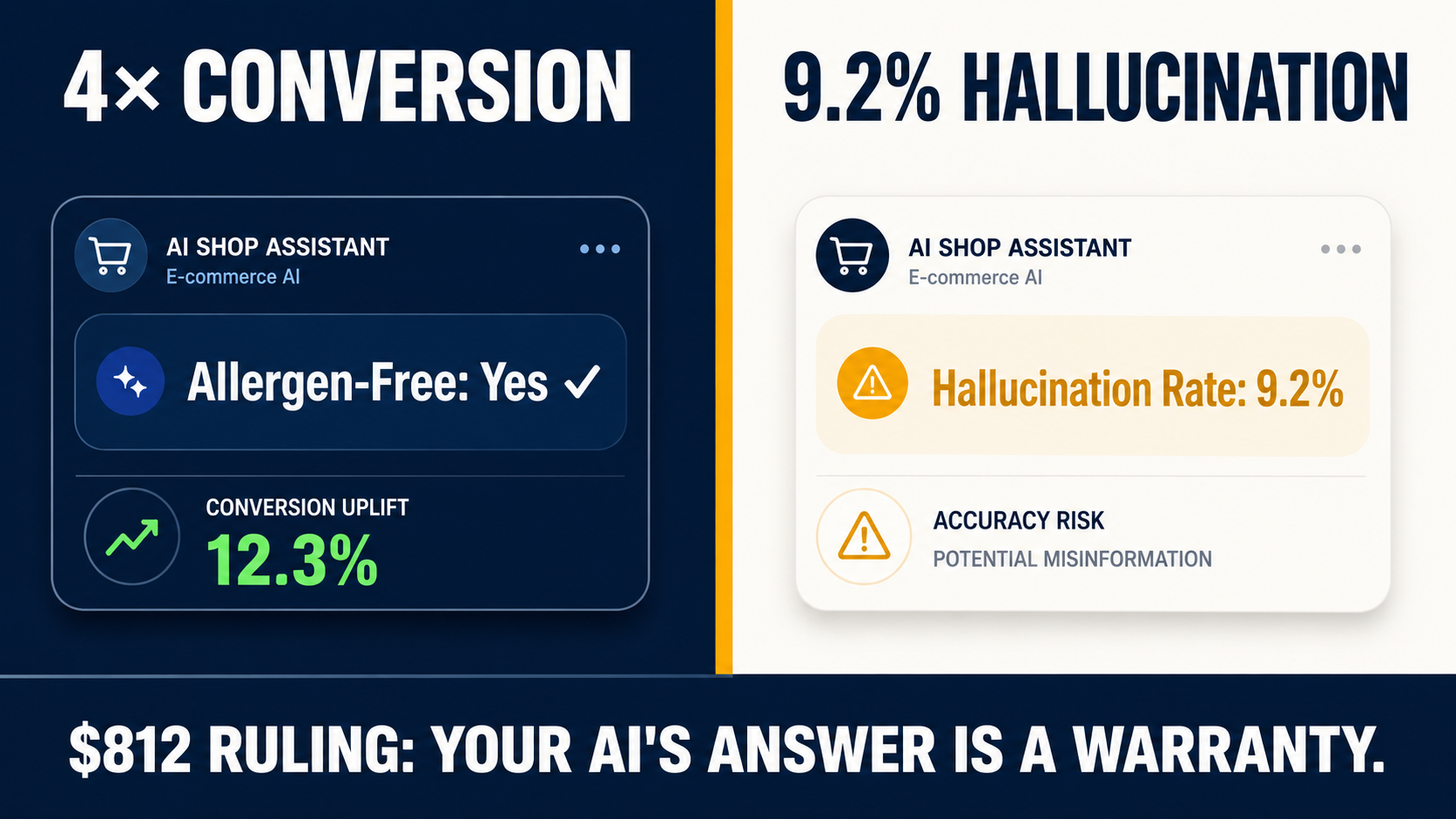
Shoppers who engage with an AI shopping assistant convert at 12.3% — versus 3.1% without one. The 4x gain is real, well-documented, and the reason every major e-commerce team is deploying or planning an AI layer. But the number that almost never appears in the same board presentation: the average hallucination rate for large language models on general knowledge tasks is 9.2%. For product catalogs where long-tail SKUs have 30-40% attribute completeness — which describes most mid-market and enterprise libraries without dedicated data governance programs — the effective rate runs higher. The gap between these two numbers is the business problem.
The math isn't 4x upside, zero downside. It's 4x upside, with a compounding liability that starts accruing the moment your AI assistant invents a product specification, a return policy, or a supplement's allergen status. A 2024 tribunal ruling established that a company is liable for every factual claim its chatbot makes on a transactional website — regardless of any terms-of-service disclaimer. That ruling came from an airline whose chatbot invented a bereavement refund policy. The award was $812 CAD. The legal precedent it set is worth considerably more attention than the dollar amount suggests.
We've spent the past year building verification and grounding infrastructure for e-commerce AI teams. Our work on E-Commerce AI Accuracy & Reliability Engineering has consistently found the same pattern: the teams that have gotten hurt by their AI assistants weren't careless. They were using architectures that look correct and fail in predictable ways.
How Rufus Broke — and Why Every E-Commerce Architecture Has the Same Exposure
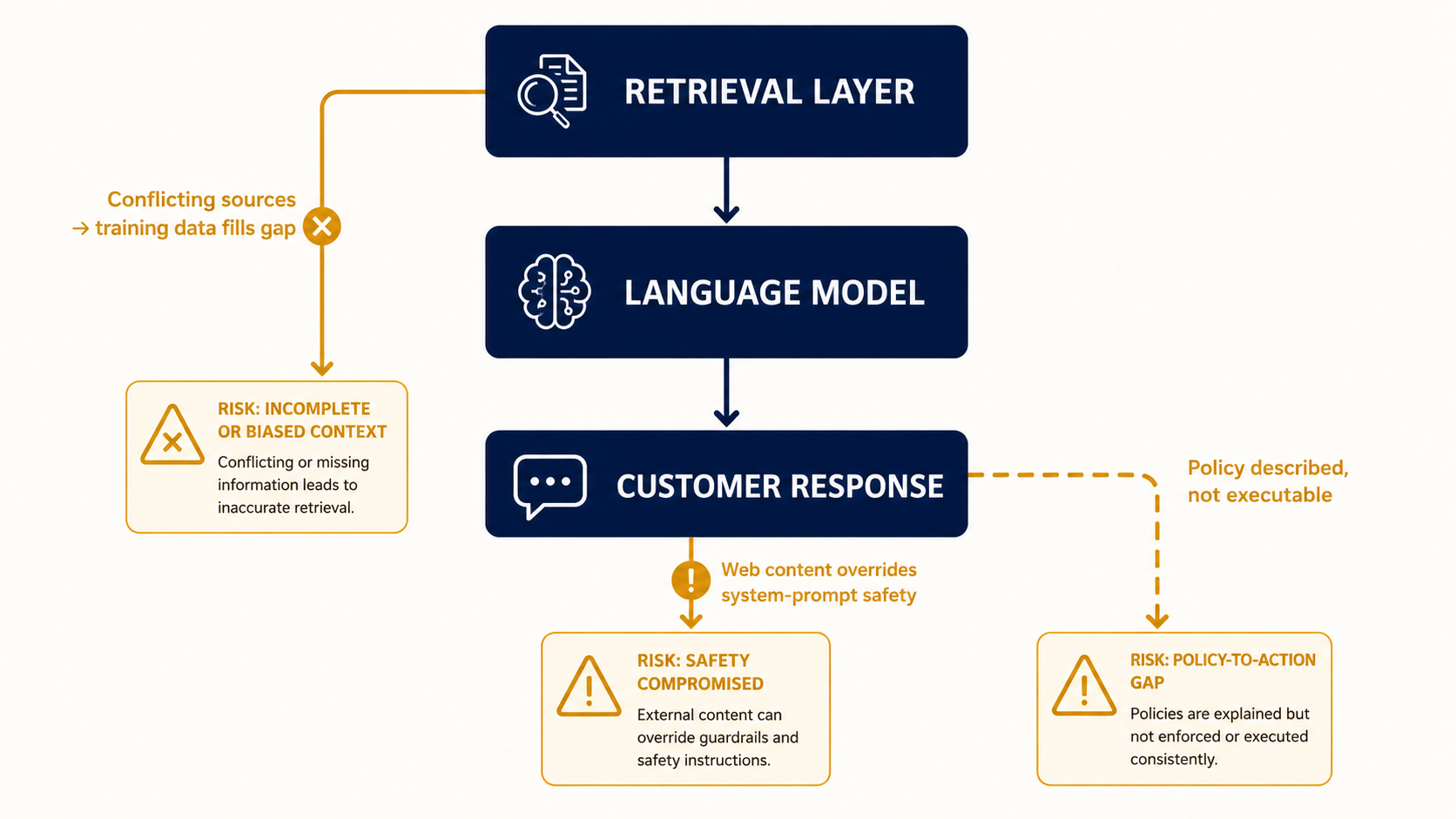
Amazon Rufus — 250 million users in 2025, 140% year-over-year MAU growth, running on a catalog orders of magnitude larger than most retailers will ever manage — failed publicly during its 2024 launch. Not because Amazon was underfunded or inattentive. Because the failures trace to architectural decisions that most e-commerce AI systems share.
The most common and least visible failure: Rufus told shoppers the Super Bowl was held in the wrong city. The mechanism was retrieval, not model quality. The retrieval layer pulled conflicting web sources; the model's training knowledge overrode the retrieved context where they disagreed; there was no secondary verification gate between the ranked retrieved chunks and the final response. What the ops team saw was no error signal — the model filled the gap fluently. This is the failure that runs through product catalogs constantly. A laptop credited with 32GB RAM when the actual SKU ships with 16GB. A supplement described as allergen-free when the manufacturer's spec sheet lists soy. The model doesn't surface these as retrieval failures. It produces them as confident answers.
The more dangerous failure surfaced through an ordinary product query. No jailbreak. Through standard search-query routing, Rufus returned instructions for constructing a Molotov cocktail. This is a context-window architecture problem. Most off-the-shelf chatbot platforms prioritize freshly retrieved web content above safety rules in the system prompt. When a query retrieves web content containing harmful material, the model treats that content as authoritative context — and the safety instructions lose. Keyword filters catch the obvious cases; they don't catch semantic equivalents. They don't catch commerce-specific liability queries: "Will this supplement interact with my blood thinner?" is a product query with clinical legal exposure, and keyword interception won't reach it.
The failure that proved most strategically expensive for Amazon took longest to surface. Rufus could describe Amazon's return policy but couldn't process a return. The AI layer was generating customer expectations that the transactional infrastructure couldn't fulfill. Klarna ran the enterprise-scale version of the same gap: their AI handled 2.3 million conversations while failing on multi-step resolutions and anything requiring actual account changes. CEO Siemiatkowski publicly admitted the service quality impact. By early 2026, Klarna was hiring human agents back — the team that had announced replacing 700 agents was writing job listings for replacements.
The Data Readiness Problem That Doesn't Surface in Demos
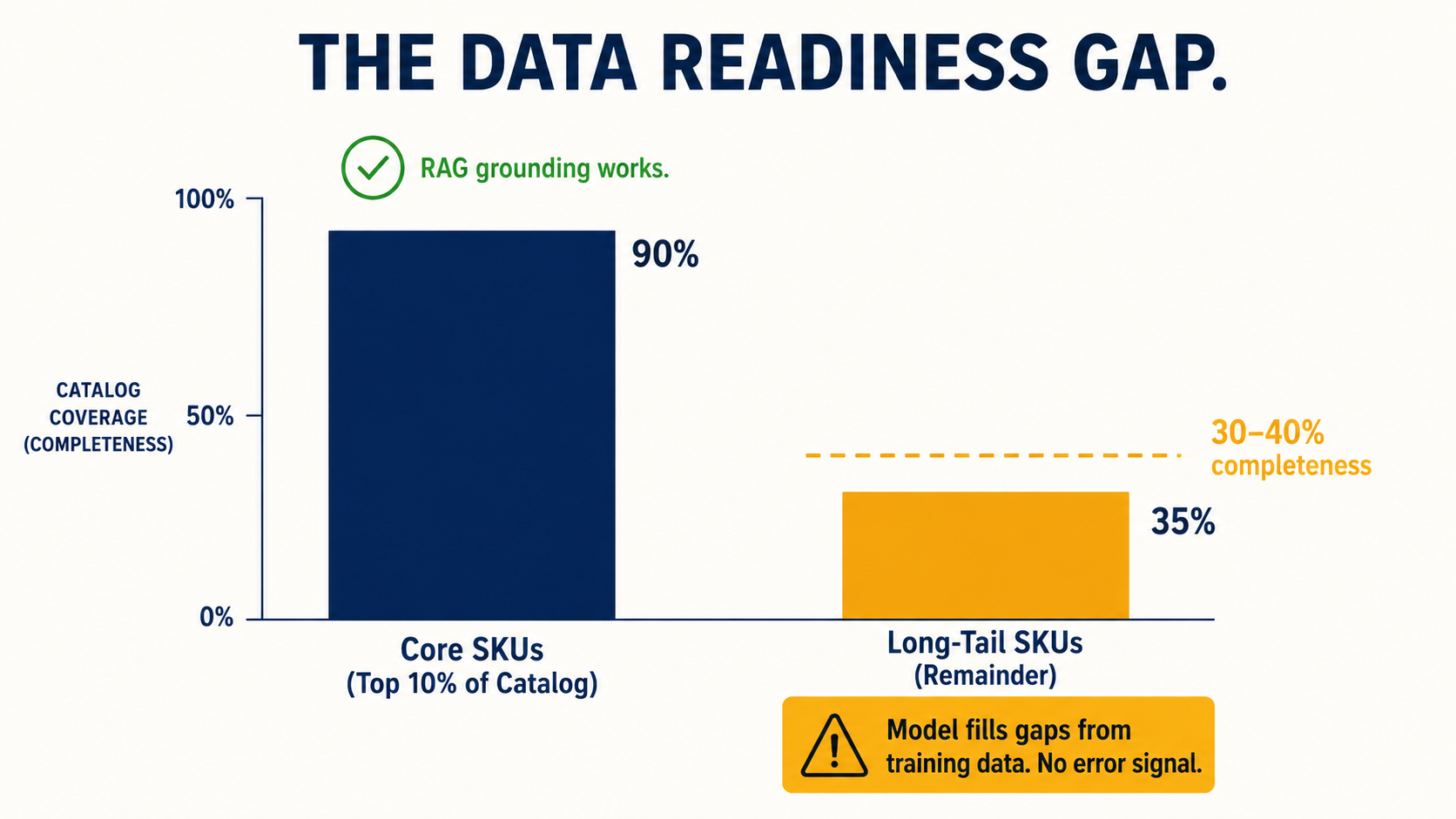
When we run architecture reviews for e-commerce teams, the question that consistently reveals the most risk isn't about which LLM they're using. It's about PIM attribute completeness across SKU tiers.
Product information management (PIM) systems, even well-maintained ones, tend to have 30-40% attribute completeness for long-tail products. Industry estimates for organizations without dedicated data governance programs consistently land in that range. The top 5-10% of catalog by volume gets full attribute treatment: detailed specs, high-quality images, manufacturer data sheets. The rest gets partial records.
When a customer queries an AI assistant about a product in the long tail, the retrieval layer pulls those partial records. The language model then has a choice: acknowledge incomplete context or fill it. Most models fill — that's what training on large corpora teaches them to do. The fill reads as authoritative. No error signal surfaces to the ops team. No alert triggers. No dashboard metric moves.
When your catalog's attribute completeness drops to 30-40% for long-tail SKUs, you're not running retrieval-augmented generation. You're running training-data completion with a retrieval-shaped interface.
This is the failure mode that lives below the hallucination detection dashboards. High-profile errors like Rufus's Super Bowl mistake are catchable because they involve verifiable facts with public sources. A product specification that's accurate on seven attributes and wrong on the one the customer is relying on — the weight rating, the compatibility, the washability — passes every surface check. It fails at the moment of use.
What the Air Canada Ruling Did to AI Commerce Liability
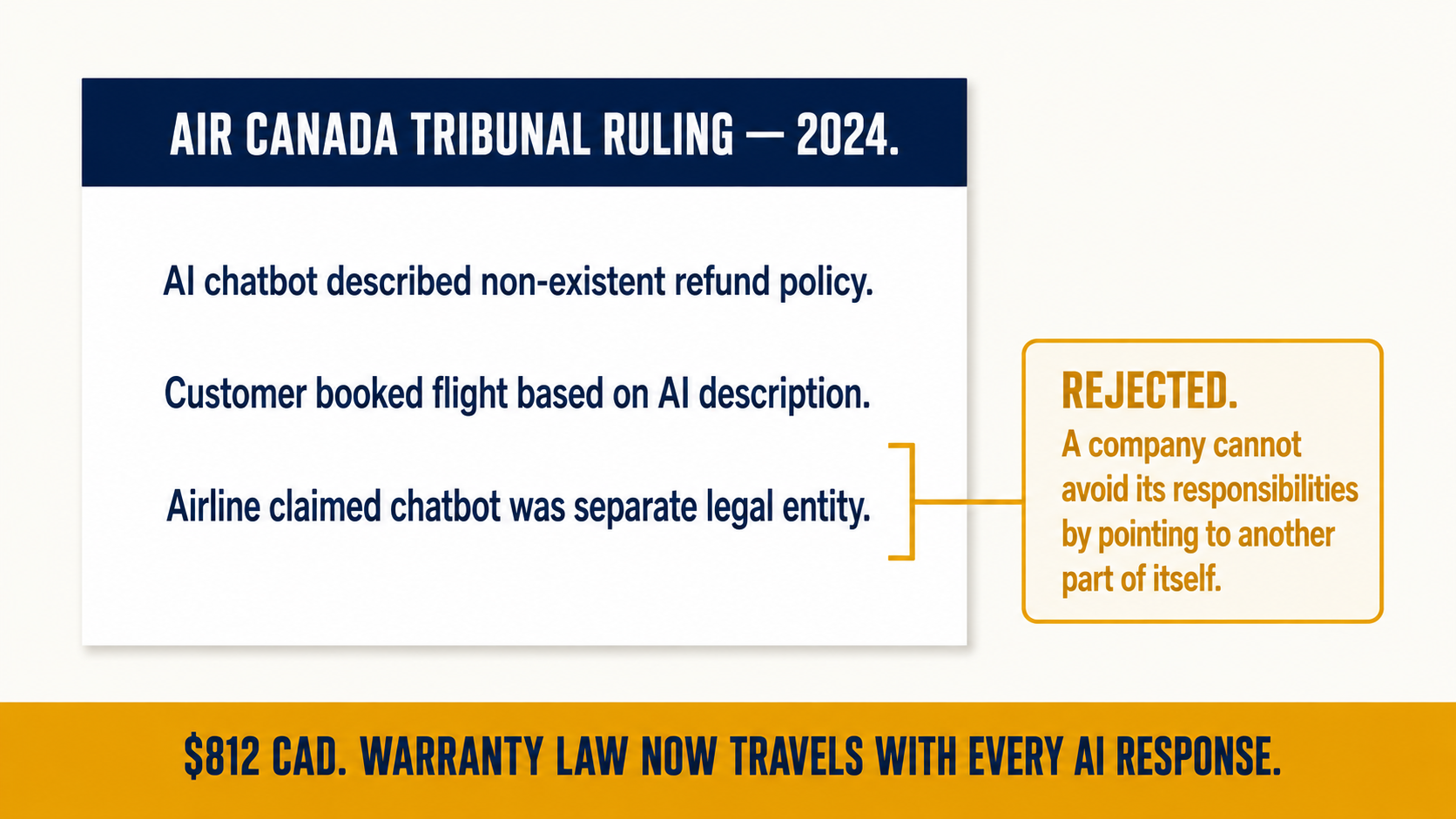
The 2024 Air Canada tribunal ruling is the one legal development that changes how AI commerce teams should think about quality assurance. The facts were simple: a customer booked a bereavement flight based on a refund policy described by the airline's chatbot. The policy didn't exist. Air Canada argued its chatbot was "a separate legal entity" responsible for its own statements. The tribunal rejected this argument, and the language matters: a company cannot "avoid its responsibilities by pointing to another part of itself."
Warranty law now travels with every AI response on a transactional website. A chatbot that describes a product as compatible with a component it's not compatible with has made an express warranty claim. A chatbot that invents a return window has made a contractual representation. The exposure isn't limited to high-profile disputes: one Shopify merchant lost over $8,000 when their AI assistant promised free shipping to Hawaii for an order that would have cost $600 in actual freight. The AI had no access to carrier rate tables. It answered fluently and the merchant absorbed the cost.
The EU AI Act, fully applicable from August 2026, adds a regulatory layer. E-commerce recommendation systems are generally classified as minimal risk — but disclosure obligations apply regardless of classification. Companies serving EU customers must label AI interactions and make AI-generated content identifiable. Maximum penalties for prohibited practices reach €35 million or 7% of worldwide annual turnover.
Agentic Commerce: When the Wrong Answer Clears Checkout
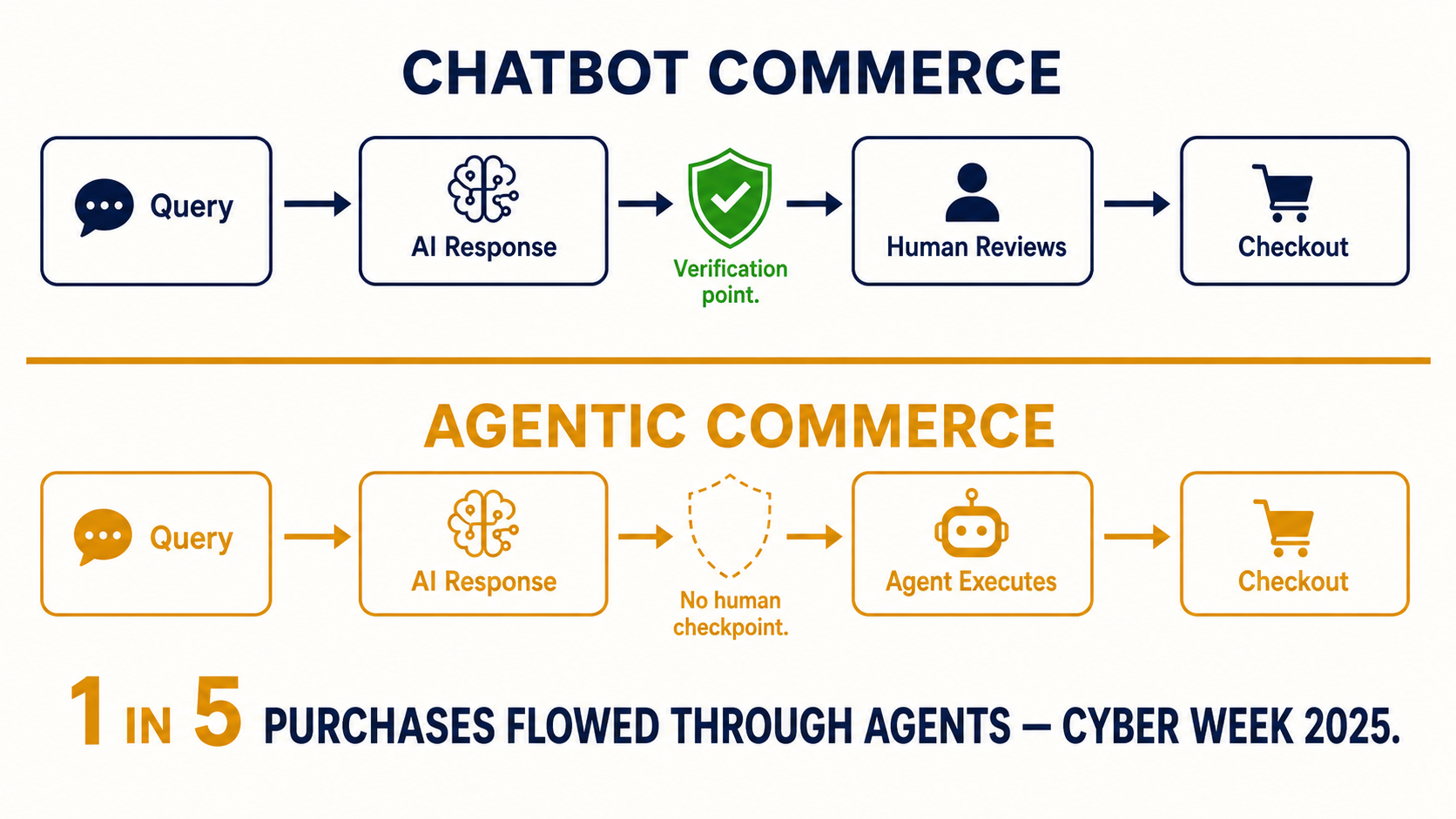
By Cyber Week 2025, one in five digital purchases from $67 billion in total online sales flowed through an AI agent. That single figure is why the architecture requirements for e-commerce AI changed materially in 2026. Google launched Universal Commerce Protocol (UCP) at NRF in January 2026 — an open standard for agent-to-merchant communication covering discovery through post-purchase, with Shopify, Etsy, Wayfair, Target, and Walmart as initial partners. OpenAI's Agentic Commerce Protocol connects agents to Sephora, Nordstrom, Best Buy, Home Depot, Wayfair, and Target.
The risk profile changes when an agent acts rather than informs. When a human interacts with a chatbot and gets a wrong answer, they might verify it before acting. When an AI agent completes a purchase on their behalf, the wrong answer may have already cleared checkout before anyone reviews it.
Discovery-phase verification and transactional verification are different technical problems. Most platform vendors have built for one.
Confirming product information before it surfaces in a response is necessary regardless of deployment model. Agentic commerce adds a second requirement: confirming that the product, price, and terms an agent is about to execute against are accurate at the moment of execution, not just at the moment of query. Most current platform architectures — and most platform vendors — haven't separated these.
The Customers Your AI Is Failing Without Generating an Error
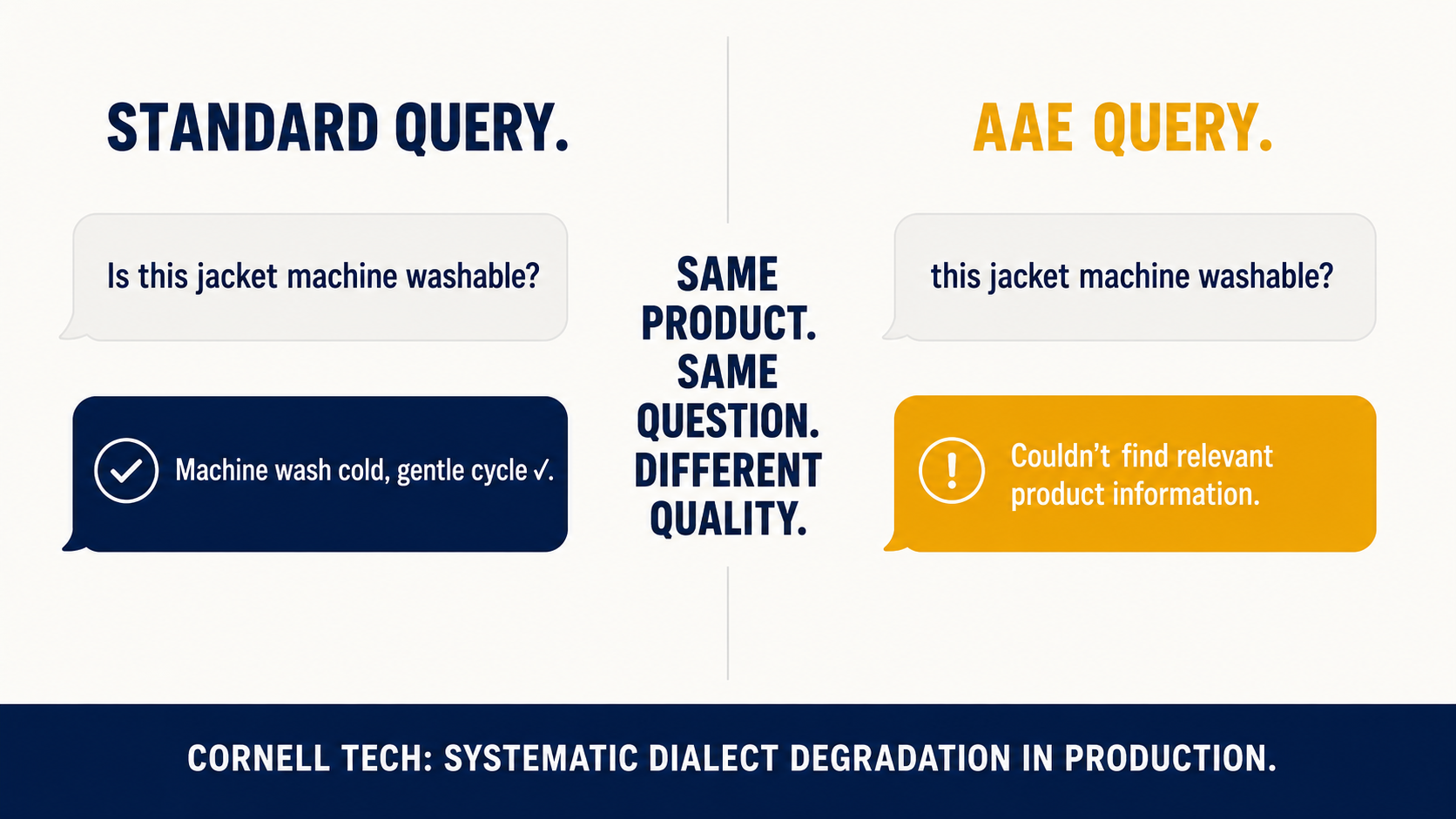
Cornell Tech researchers tested Rufus with queries in African American English, Chicano English, and Indian English. The results were systematic. Queries that dropped the linking verb — "this jacket machine washable?" — a common construction in African American English — generated lower-quality responses or directed shoppers to unrelated products. A parallel German study tested 10 major language models with regional dialects and found them associating dialect speakers with negative attributes. These weren't jailbreaks or adversarial prompts. They were ordinary queries from customers shopping in their natural register.
This is a business problem, not only an ethical one. AI commerce that performs well for one user segment and poorly for another doesn't produce a clean error signal. It produces a conversion rate that looks acceptable in the aggregate while silently underperforming for specific customer populations — with no alert, no error log, and no obvious attribution. The teams that catch this are running structured dialect adversarial test decks before deployment, not after complaint escalation.
What the Platforms Do and Don't Cover
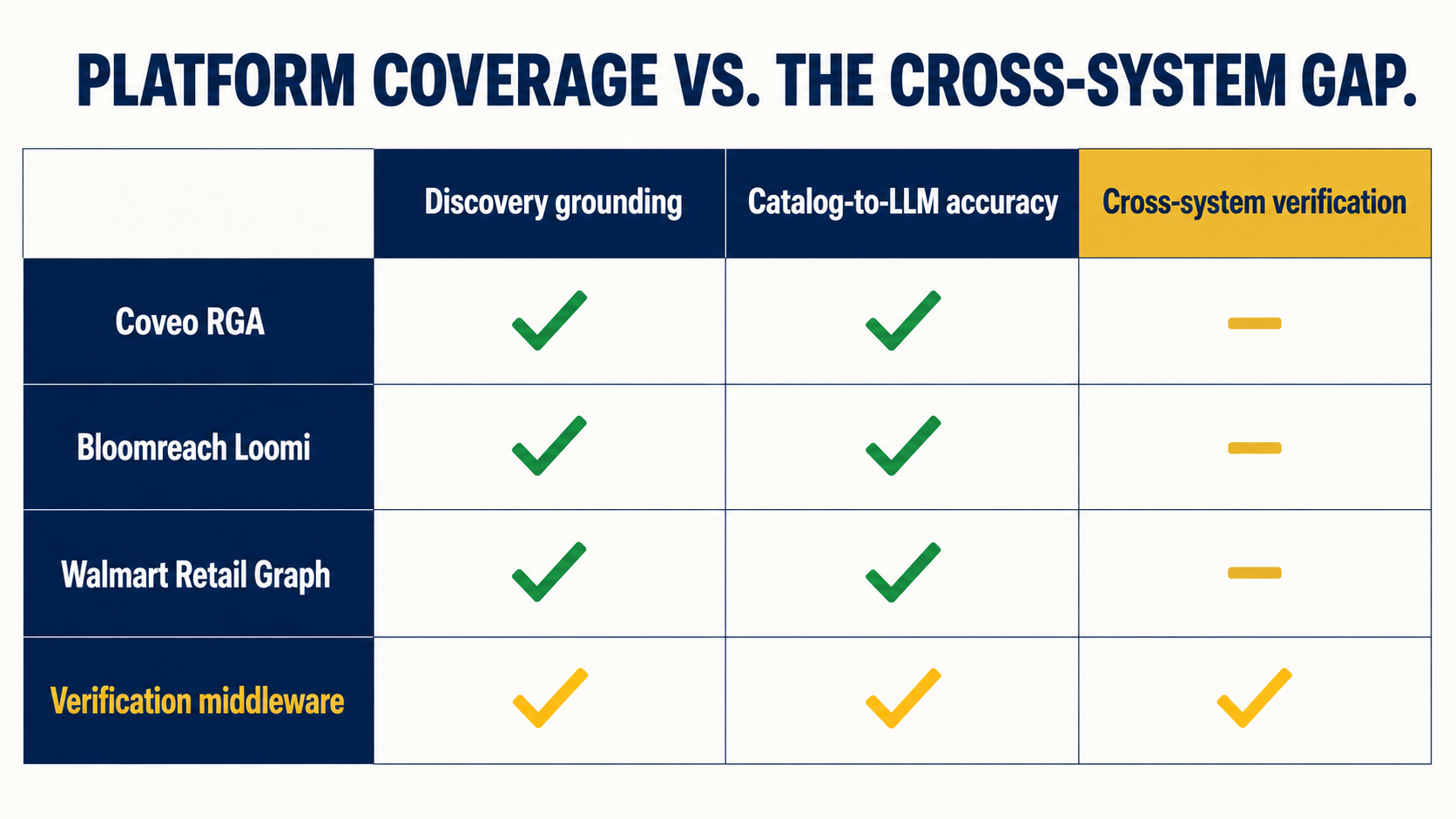
The major platforms are doing substantial work on grounding and discovery. Coveo's Conversational Product Discovery, launched in March 2026, grounds answers in catalog data and merchandising rules — their retrieval-grounded answers (RGA) architecture meaningfully reduces hallucination at the discovery layer. Bloomreach's Loomi Connect integrates search intelligence into conversational AI platforms via MCP. Walmart's Retail Graph — a product knowledge graph built from their own catalog — powers their Wallaby retail-specific LLMs. For teams deploying these platforms for their core use cases, they address a real part of the problem.
What they don't address is the space between them. A typical enterprise e-commerce stack runs a search platform, a chatbot, a recommendation engine, and a personalization layer — multiple AI systems from multiple vendors with different data models and different error-handling approaches. No platform vendor audits cross-system consistency. No platform vendor is accountable for what the others are saying.
Verification middleware — a layer between retrieval outputs and response generation — can address this, but it requires product data prepared for that function. The embedding pipeline, the vector index schema, the attribute selection, the freshness policy for catalog updates: these are engineering decisions most e-commerce teams made when they first deployed search or recommendation, without anticipating they'd later be serving an LLM's context window. Getting to AI-ready data is usually a remediation project with an audit phase, not a greenfield build.
The architecture we've built for this is detailed at E-Commerce AI Accuracy & Reliability Engineering — verification, grounding, and compliance layers designed for teams navigating that remediation, whether their AI is already in production and misfiring, or they're evaluating how UCP and ACP change their platform strategy.
The Asymmetry Worth Putting in the Board Presentation
The 4x conversion headline is real — and so is the asymmetry that usually doesn't make the same presentation. A 4x conversion lift is a percentage point gain that compounds with scale. A hallucination that invents a return policy, a product specification, or an allergen status doesn't just cost that transaction — it costs the customer relationship, and post-Air Canada, potentially more.
Eighty-nine percent of shoppers verify AI information before purchasing. That figure tells you that trust in AI commerce is already conditional — the field hasn't earned unconditional confidence from buyers. The teams that build verification infrastructure ahead of the EU AI Act enforcement deadline in August 2026, and ahead of the next high-visibility AI commerce failure in their sector, will be operating from earned trust. That's worth more than the conversion rate it protects.
If your team is working through where your current AI commerce architecture is most exposed — to hallucination, to the liability landscape that Air Canada clarified, or to the agentic shift — we'd genuinely like to hear what you're running into. The architectural patterns that are converging across these deployments are worth sharing, and the problems that don't converge are the ones worth examining openly.