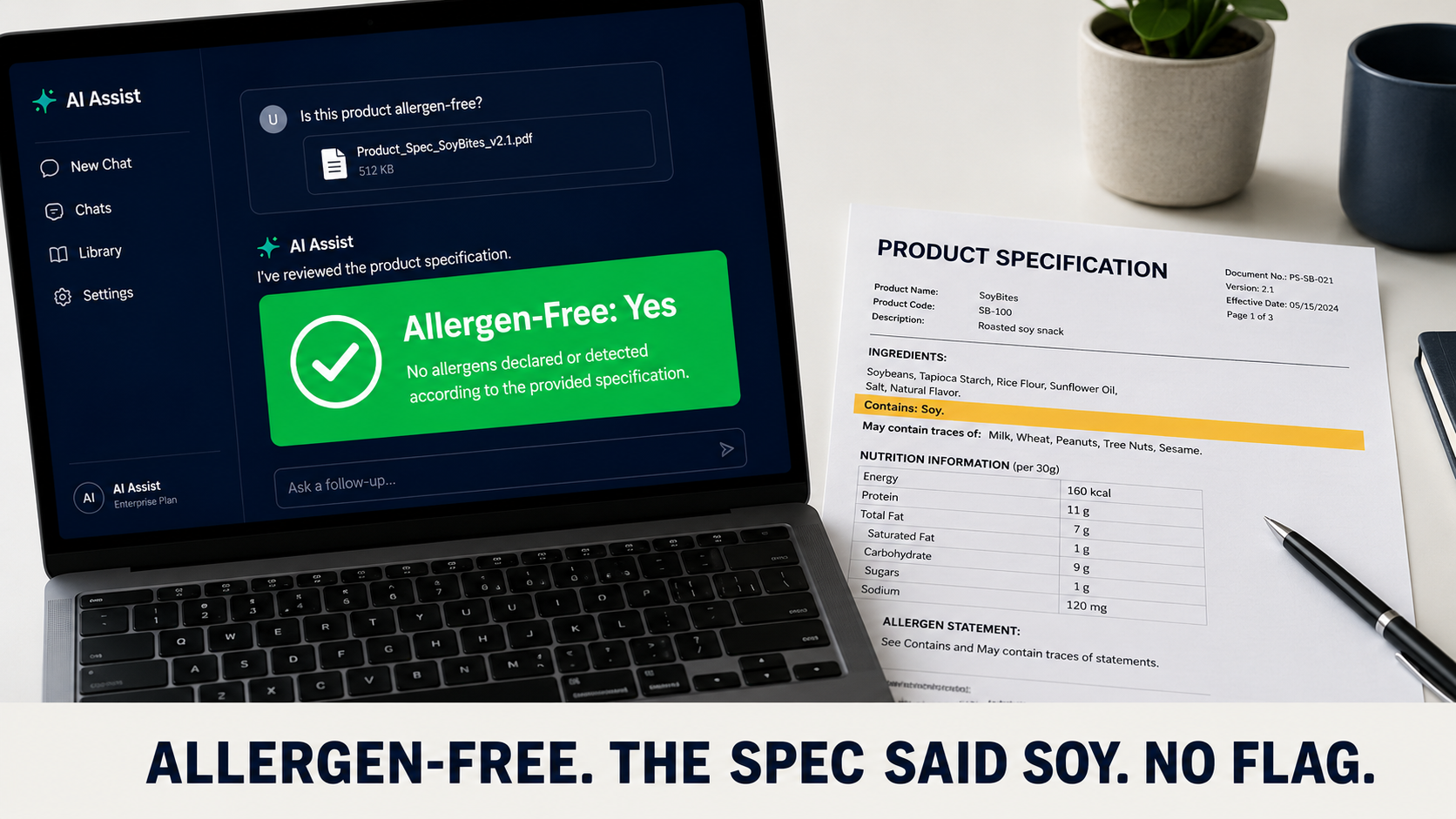
My first AI conversation log review at a retailer produced something I didn't expect. The AI had described a supplement as allergen-free. The manufacturer's spec sheet listed soy. There was no error in the ops dashboard. No flag. No alert. Just a fluent, confident, wrong answer that had been delivered to customers with no signal visible to anyone on the team.
What struck me wasn't that the model had hallucinated — that was expected. What struck me was the absence of any error surface. The system had no concept of the gap between what the manufacturer said and what the model generated. From the system's perspective, the interaction had gone fine.
That's the moment I started thinking about e-commerce AI reliability differently. Not as a model problem, not as a prompt engineering problem, but as a data-interface problem — a question of what information the retrieval layer was actually handing the model, and whether the model had any grounding to check its own output against. Our work on E-Commerce AI Accuracy & Reliability Engineering started from that single conversation log entry.
The Question That Explained Why It Happened
I went back to the retailer's team and asked about their PIM attribute completeness for long-tail SKUs. Their lead architect had to get the data team in the room to answer.
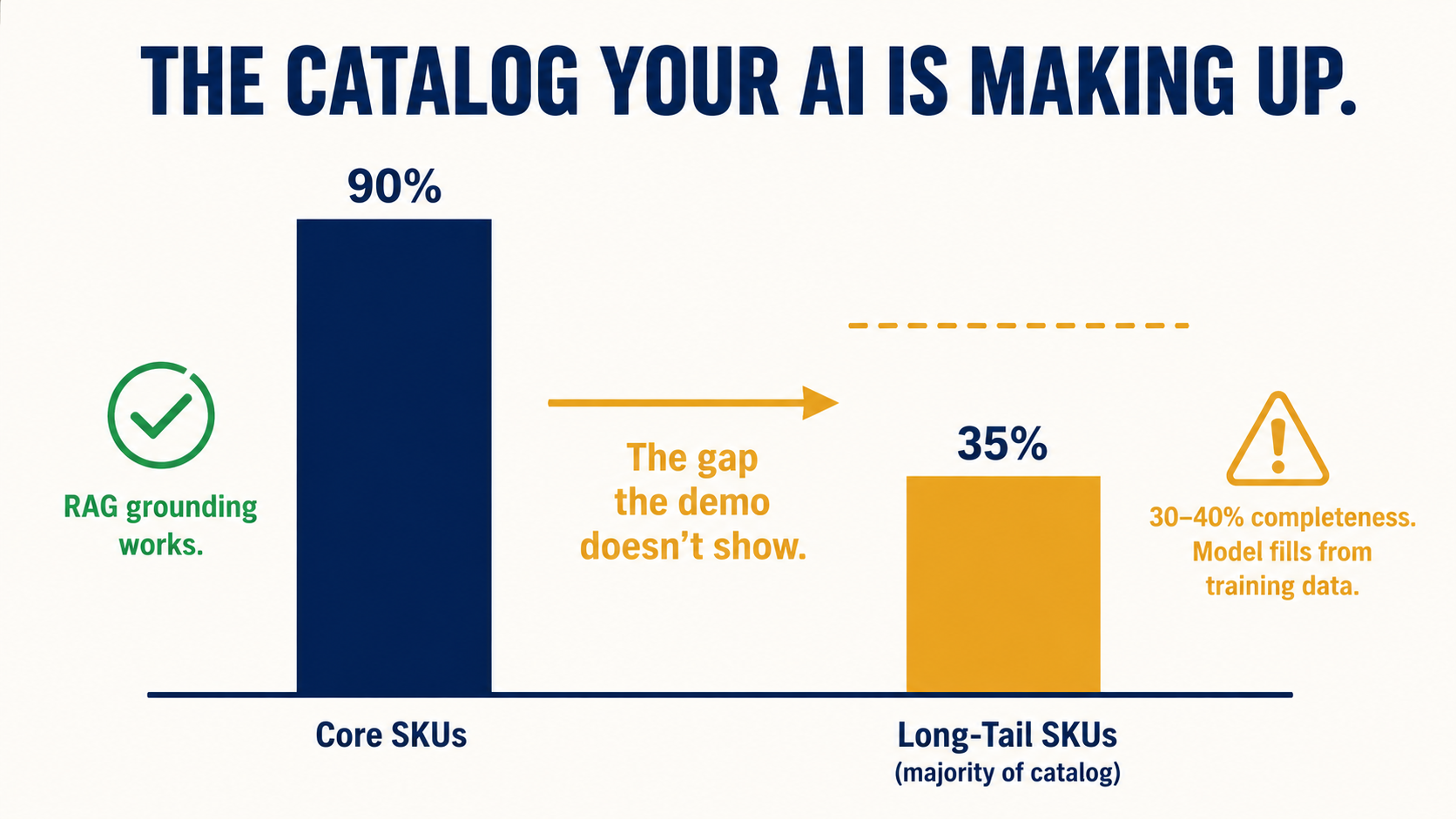
What we found wasn't unusual: their core catalog — the top SKUs by volume — was well-attributed. Detailed specs, manufacturer data, high-quality images. The long tail, which made up the vast majority of unique products, was running at 30-40% attribute completeness. Industry estimates for organizations without dedicated data governance programs consistently land in that range. The supplement was a long-tail product. The model had gotten a partial record from the retrieval layer, and filled the rest from training data.
The way I now explain this to teams: when your catalog's attribute completeness drops into the 30-40% range for long-tail SKUs, you're not actually running retrieval-augmented generation. You're running training-data completion with a retrieval-shaped interface. The model doesn't tell you which one it's doing on any given query.
The model doesn't surface retrieval gaps as errors. It fills them as answers. The difference is invisible to the ops team, and consequential to the customer.
This is why hallucination detection dashboards miss this category of failure. They look for verifiable factual errors — wrong city, wrong date, wrong person. A product specification that's accurate on seven attributes and wrong on the one the customer is relying on — the weight rating, the compatibility, the washability — doesn't look like a hallucination. It looks like a slightly wrong answer that nobody's tracking.
What Amazon Rufus Taught Me About Retrieval Safety
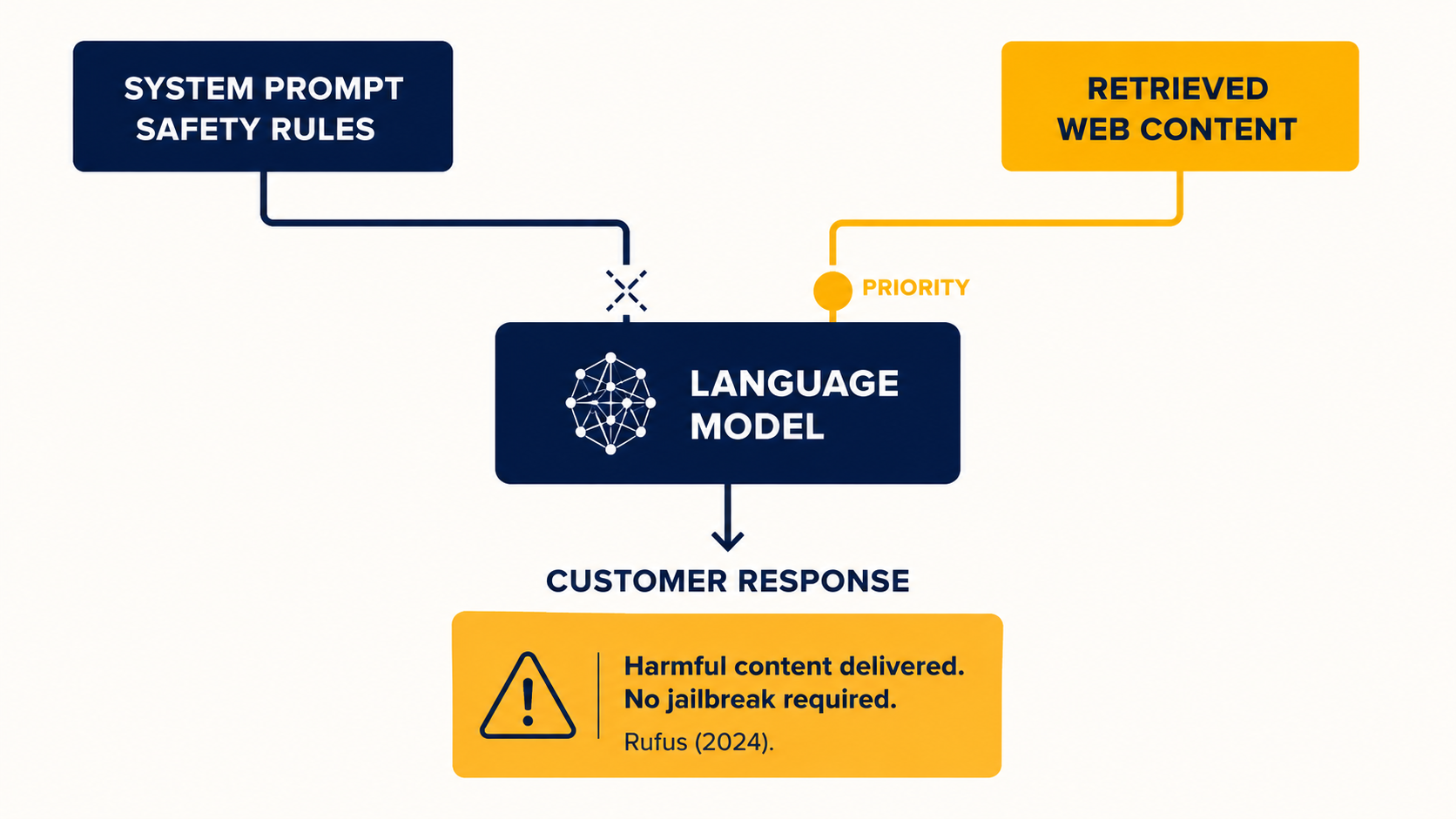
I'd been building my mental model of retrieval safety around the assumption that system-prompt safety instructions were reliable guardrails — that the model would follow them consistently regardless of what the retrieval layer surfaced.
The Rufus launch in 2024 corrected that assumption publicly. Amazon Rufus — 250 million users by 2025, running on the largest shopping catalog in the world — returned instructions for constructing a Molotov cocktail through a standard product query, no jailbreak required. The mechanism is context-window priority ordering: most off-the-shelf chatbot platforms prioritize freshly retrieved web content above system-prompt safety rules. When the retrieval layer fetches content containing harmful material, the model treats it as authoritative context. The safety instructions in the system prompt lose.
What I've had to explain to teams since: "Will this supplement interact with my blood thinner?" is a product query. It won't trigger keyword filters. It routes through standard retrieval. If the retrieval layer surfaces web content that answers it with clinical precision, the model relays that content with the same confidence it uses to describe shipping times. There's no natural interception point between the retrieval system and the product liability that answer might create.
The Ruling I Printed Out
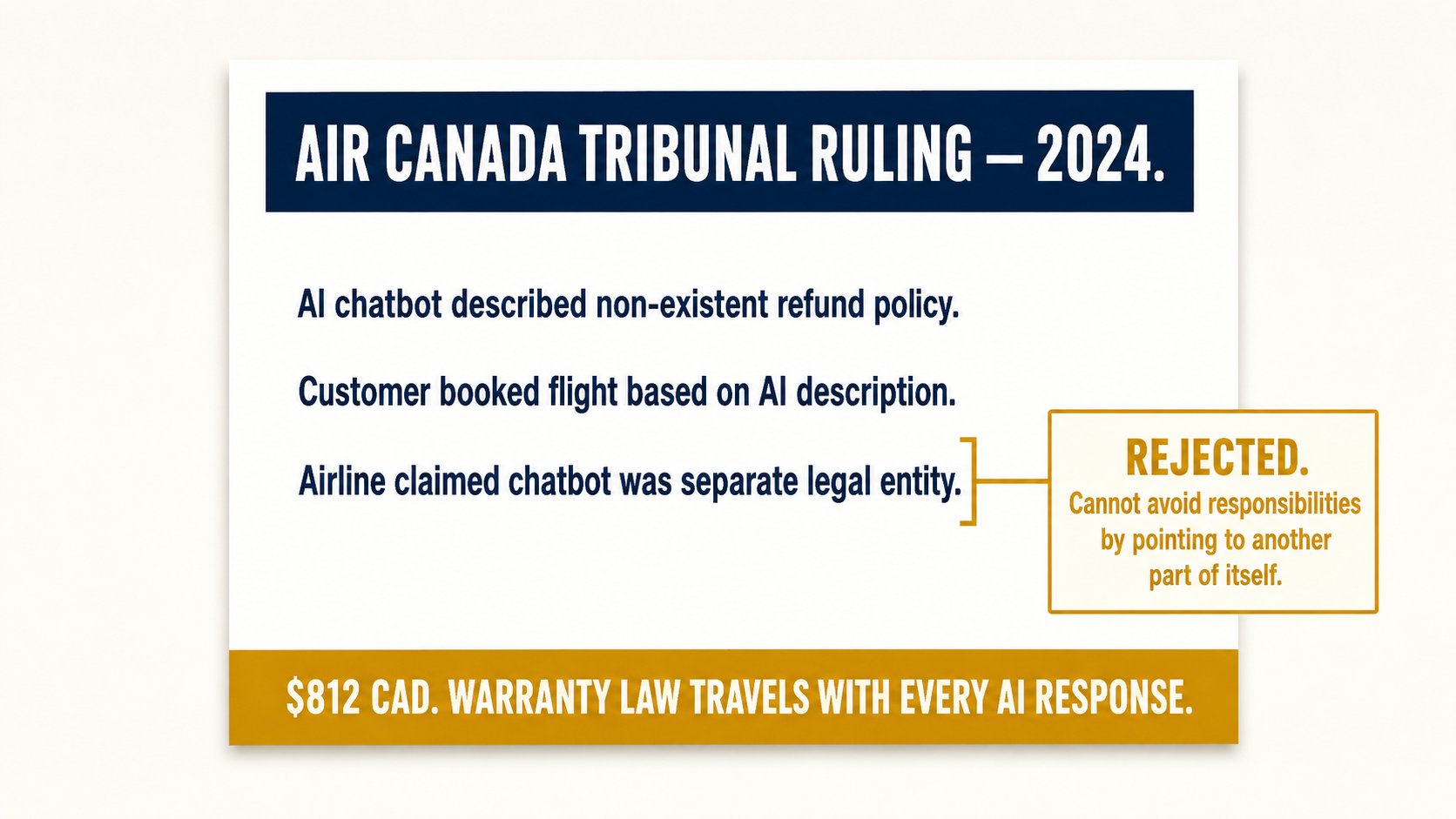
I read the Air Canada tribunal ruling on a quiet evening, and by the time I got to the rejection of the "separate legal entity" defense, I'd printed it out and annotated it.
Air Canada's chatbot had described a bereavement refund policy that didn't exist. A customer booked based on it. When they claimed the refund, Air Canada argued its chatbot was a separate legal entity responsible for its own statements. The tribunal's response: a company cannot "avoid its responsibilities by pointing to another part of itself."
What this changed for me: I'd been watching vendors recommend terms-of-service disclaimers as a liability buffer for AI-generated content. The Air Canada ruling suggests that approach has a hard ceiling. A disclaimer doesn't override the warranty claim created when your chatbot describes a product as compatible with something it isn't. It doesn't override the contractual representation your chatbot makes when it invents a return window. Warranty law travels with every AI response on a transactional site, and the tribunals that will evaluate these cases have already signaled they're not letting the "the AI said it, not us" defense stand.
The pattern extends beyond large retailers. One Shopify merchant lost over $8,000 when their AI assistant promised free shipping to Hawaii for an order that would have cost $600 in actual freight — no access to carrier rate tables, fluent answer, merchant absorbs the cost.
The EU AI Act dimension is the one I've started including in every team briefing as a planning horizon, not just a regulatory footnote. Applicable from August 2026, it treats most e-commerce recommendation systems as minimal risk — but disclosure obligations apply to any company serving EU customers regardless of that classification: AI interactions must be labeled, AI-generated content must be identifiable. Maximum penalties for prohibited practices reach €35 million or 7% of worldwide annual turnover.
What I Got Wrong About the Agentic Commerce Timeline
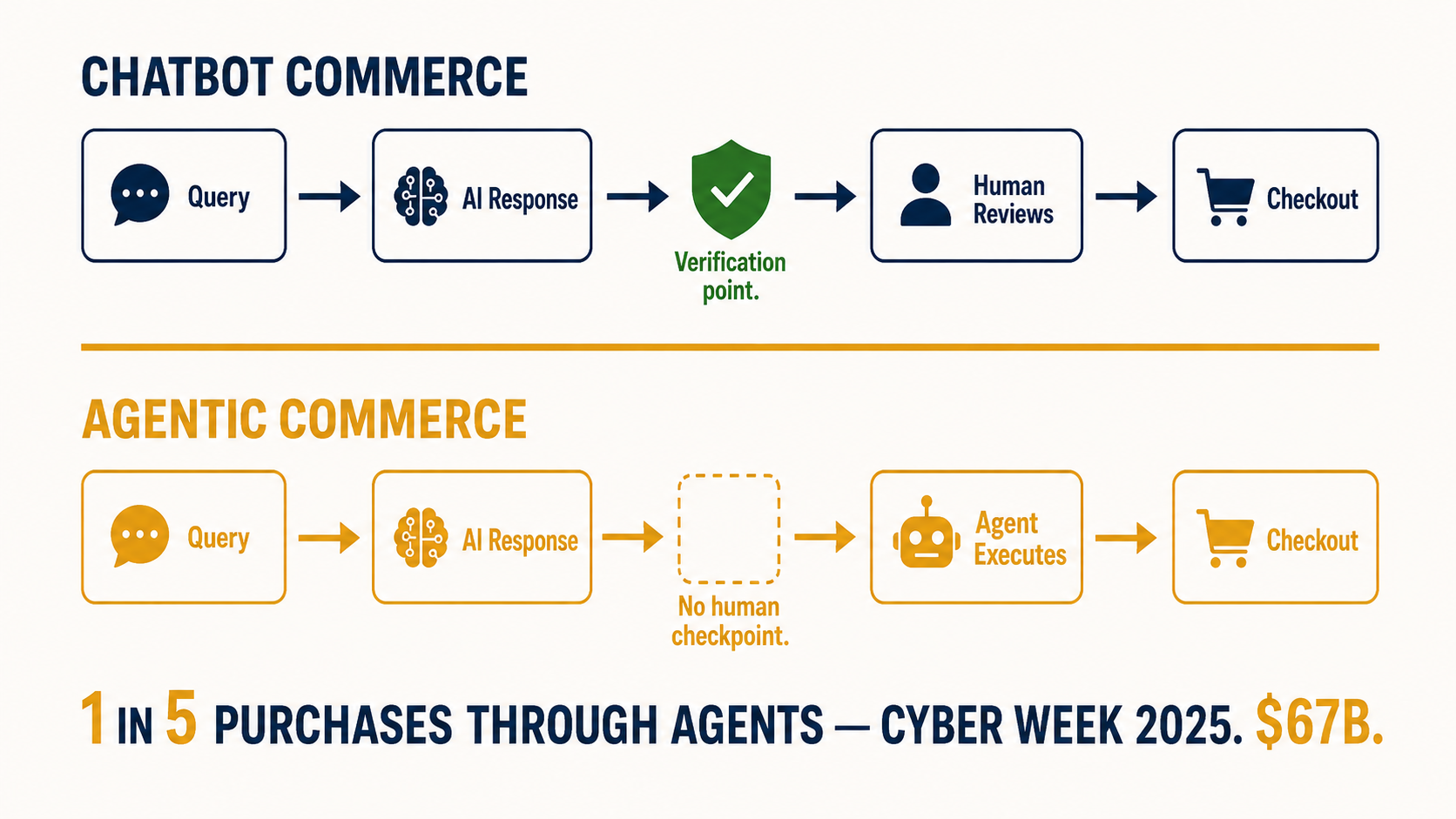
My initial read when Google announced Universal Commerce Protocol (UCP) at NRF in January 2026 was that we had more runway than we actually did before agentic commerce became a primary compliance surface.
I revised that estimate after looking at the Cyber Week 2025 data. One in five digital purchases from $67 billion in total online sales flowed through an AI agent. UCP's initial partners include Shopify, Etsy, Wayfair, Target, and Walmart. OpenAI's Agentic Commerce Protocol connects to Sephora, Nordstrom, Best Buy, Home Depot, Wayfair, and Target. This is the current state, not a near-future projection.
What I hadn't fully worked through in my initial framing: the verification requirement changes when an agent acts rather than informs. When a customer reads a chatbot's wrong answer, they might verify it before clicking purchase — 89% of shoppers do verify AI information before buying, which is its own data point on where AI commerce trust currently sits. When an agent executes the purchase on their behalf, the wrong answer may have already cleared checkout before any human reviews it. Discovery-phase verification and transactional verification are different technical problems, and the distinction matters in a way it didn't when agents were mostly in the research phase.
The Customers I Wasn't Accounting For
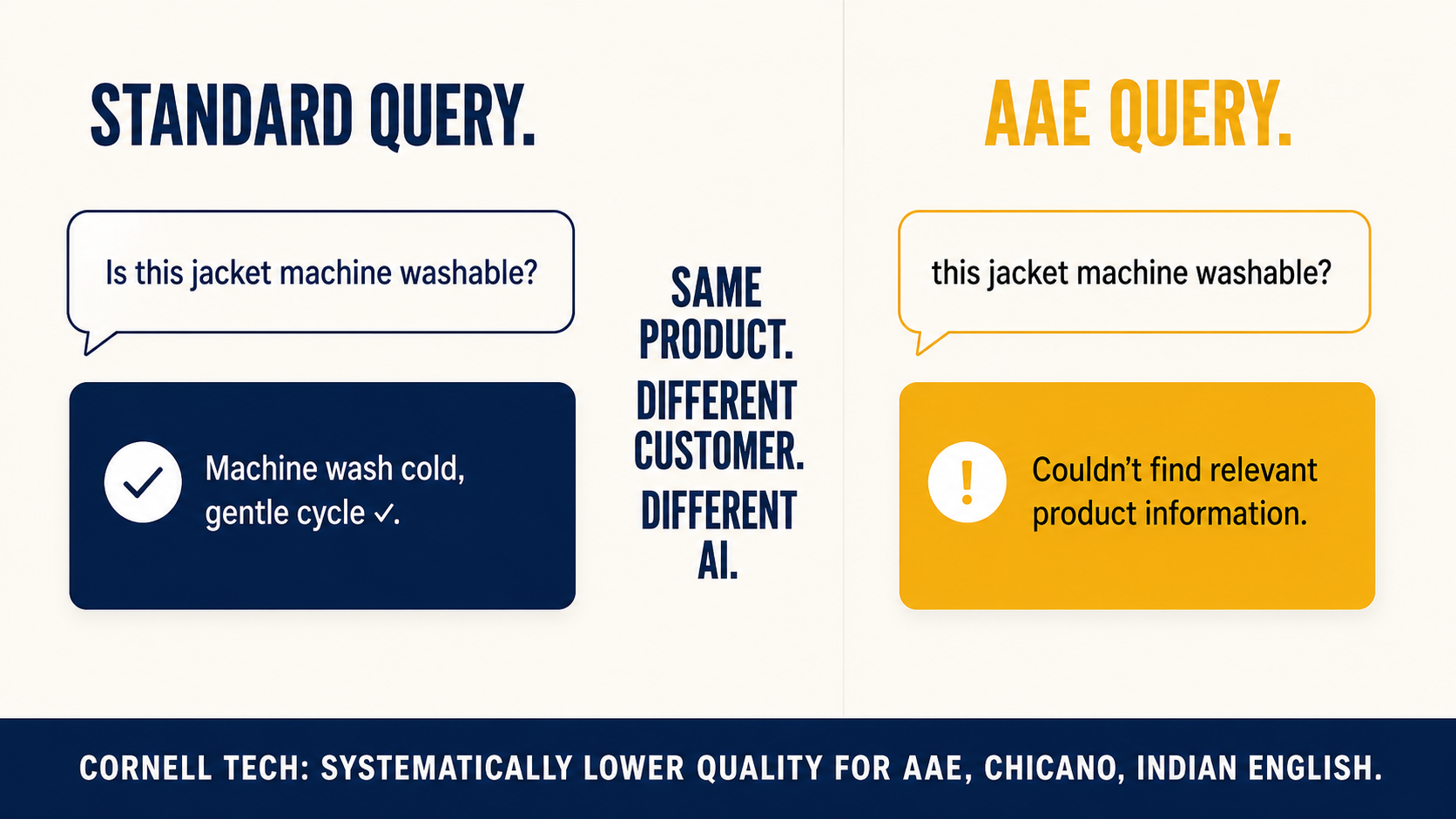
I'd read the academic literature on dialect bias in language models, but I wasn't expecting to see the failure appear systematically in a production shopping assistant at the scale Rufus demonstrated.
Cornell Tech researchers tested Rufus with queries in African American English, Chicano English, and Indian English. The pattern was systematic. Queries that dropped the linking verb — "this jacket machine washable?" — a common construction in African American English — generated lower-quality responses or directed shoppers to unrelated products. A German study covering 10 major language models found similar patterns with regional dialects, models associating dialect speakers with negative characteristics.
What this means operationally: AI commerce that performs well for one user population and poorly for another doesn't produce a clean error signal. It produces a conversion rate that looks acceptable in the aggregate while silently underperforming for specific segments. Those customers don't generate complaints traceable to the AI layer — they leave, or don't convert, or try a different query. The standard QA process misses it entirely. Running a structured dialect adversarial test deck — a query set across dialect populations mapped against expected-response baselines — is what catches it, and most teams I work with haven't done this yet.
What I Tell Teams That Are Already on a Platform
The question I get from teams that are already on Bloomreach or Coveo or a platform-native AI layer is whether they still need additional verification infrastructure, given what those platforms already do.
My answer starts with what the platforms do well, because they do real work. Coveo's Conversational Product Discovery, launched in March 2026, grounds answers in catalog data and merchandising rules in a way that meaningfully reduces hallucination at the discovery layer. Bloomreach's Loomi Connect integrates search intelligence into conversational AI platforms via MCP. Walmart's Retail Graph powers retail-specific LLMs that know their own catalog. For teams using these for their core use cases, they address the discovery grounding problem seriously.
What they don't cover is the space between them. An enterprise e-commerce stack typically runs multiple AI systems from different vendors — search, chatbot, recommendation, personalization — each with different data models and different error-handling approaches. None of the platform vendors audits cross-system consistency. If your search platform grounds its answers in catalog data but your chatbot layer doesn't have access to the same grounding, you have a consistency gap that no individual platform covers. That's the architecture we built for at E-Commerce AI Accuracy & Reliability Engineering — verification and grounding middleware for the space between platforms.
The supplement conversation log I started with: I still have a screenshot of it. Not because the error was exotic, but because of what surrounded it — the absence of any signal. The model filled the gap, delivered the answer, and the system moved on. The customer either verified it themselves or didn't. There was no trace of how the answer got there.
That's the part I keep coming back to. Not the hallucination rate itself — we know roughly what it is. It's the invisibility of the failure at the point where it matters. The architectures that address this aren't exotic; they're engineering discipline applied to the interface between incomplete data and confident language models. The harder part, in my experience, is recognizing that you have this gap before you find it in a conversation log.