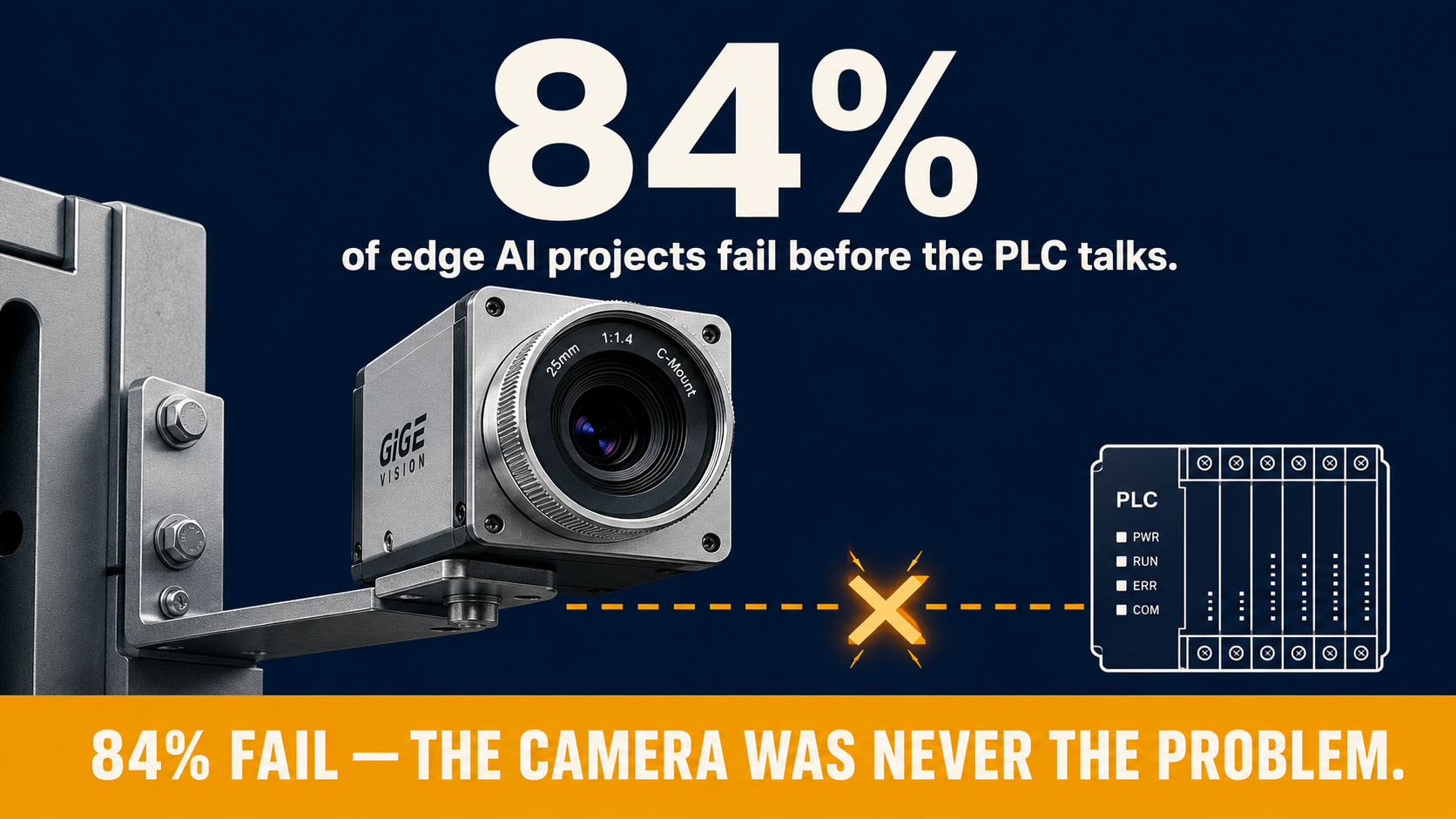
The model isn't failing. The deployment is.
84% of manufacturing edge AI projects fail or partially fail (HiveMQ / Industry, 2025), and the failure almost never shows up in the accuracy benchmark first. It shows up in the false reject rate two months in, in a PLC communication timeout that stops the line, in a model that ran at 1.8% false rejects for four months and then started flagging 9% of good parts as the tooling wore. The vendors who built the inference stack don't have a financial interest in that diagnostic — they already sold the hardware.
The pitch is consistent: mount a Jetson on the conveyor, run inference at 12ms latency, catch defects in real time. NVIDIA will sell you the compute. Landing AI will sell you the model. Cognex will sell you the training workflow. What none of them sell is the adapter between the inference output and the Allen-Bradley PLC that controls the reject gate.
When the Lab Score Doesn't Transfer
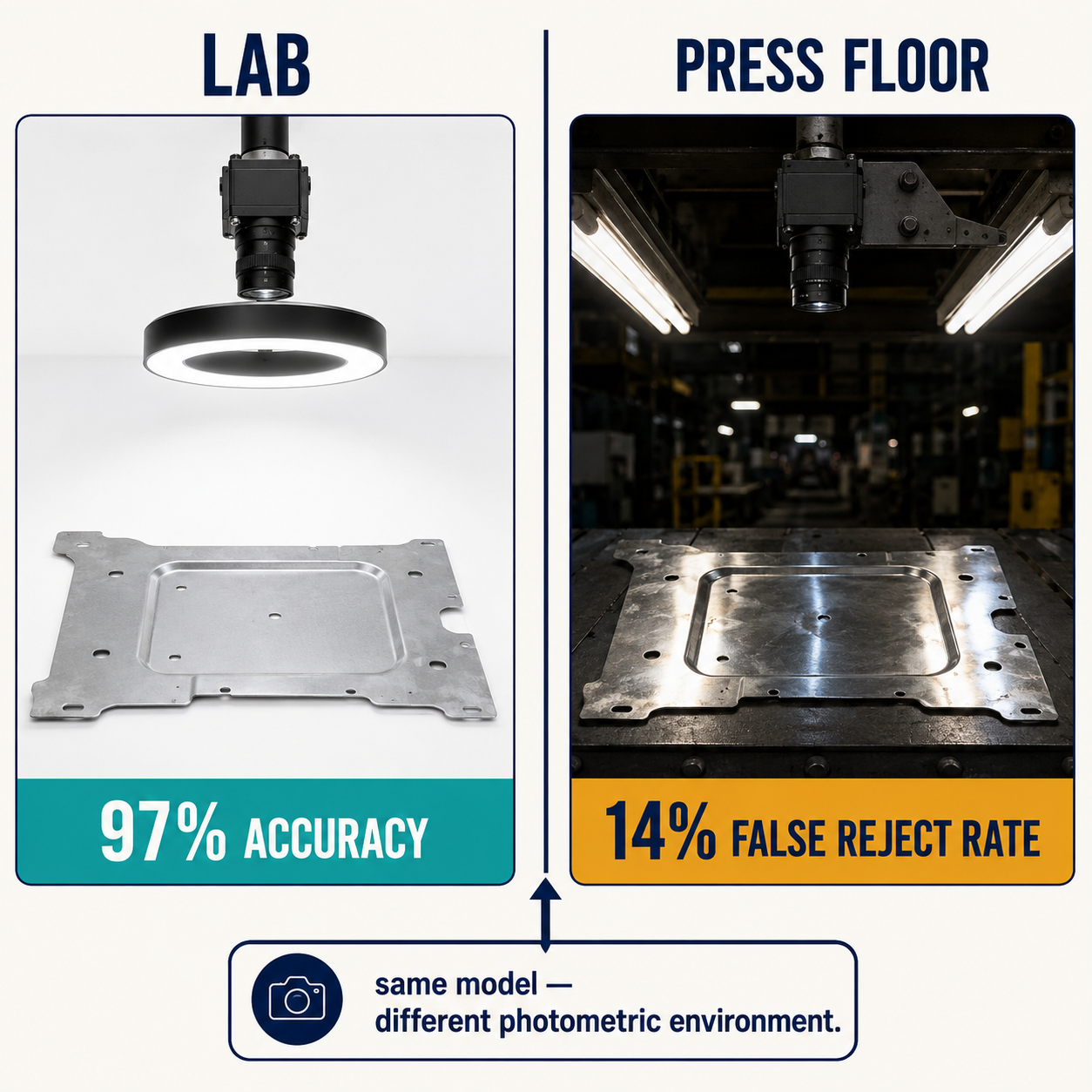
A Tier 2 automotive stamping shop installs GigE cameras on a 200-ton progressive die press running at 40 strokes per minute. The vision model catches burrs, short fills, and slug marks at 97% accuracy on calibrated test images. Week two on the press floor, the false reject rate hits 14%.
The failure wasn't in the model. The lab images were captured under a fixed LED ring at a consistent distance. On the press, overhead bay lights reflect differently off the sheet metal surface at each stroke angle. Stamping lubricant pools differently on warm versus cold dies. The first 50 parts of a shift look different from part 250.
Retraining on production samples helps only after the photometric calibration is addressed. Skip the environmental audit and go straight to retraining and you land in an iterative cycle that costs more in engineering time than the inspection system itself. The Edge AI Vision Alliance's 2026 production-line failure review consistently identified environmental preparation — lighting geometry, thermal variation, vibration isolation — as the root cause, not model architecture.
The destination — under 2% false rejects while maintaining 99%+ true defect detection — requires pixel-level segmentation so rejection logic can be as specific as "scratch longer than X mm within Y mm of the sealing surface," calibrated confidence thresholds per defect criticality, multi-frame verification for borderline cases, and scheduled photometric rechecks of lighting intensity and spectral output. It's a commissioning process, not a product you install.
The Communication Gap That Kills the Timeline
Getting the camera to see correctly is the entry problem. Getting inference output into the production workflow where it can act on a defect is the one that collapses the project timeline.
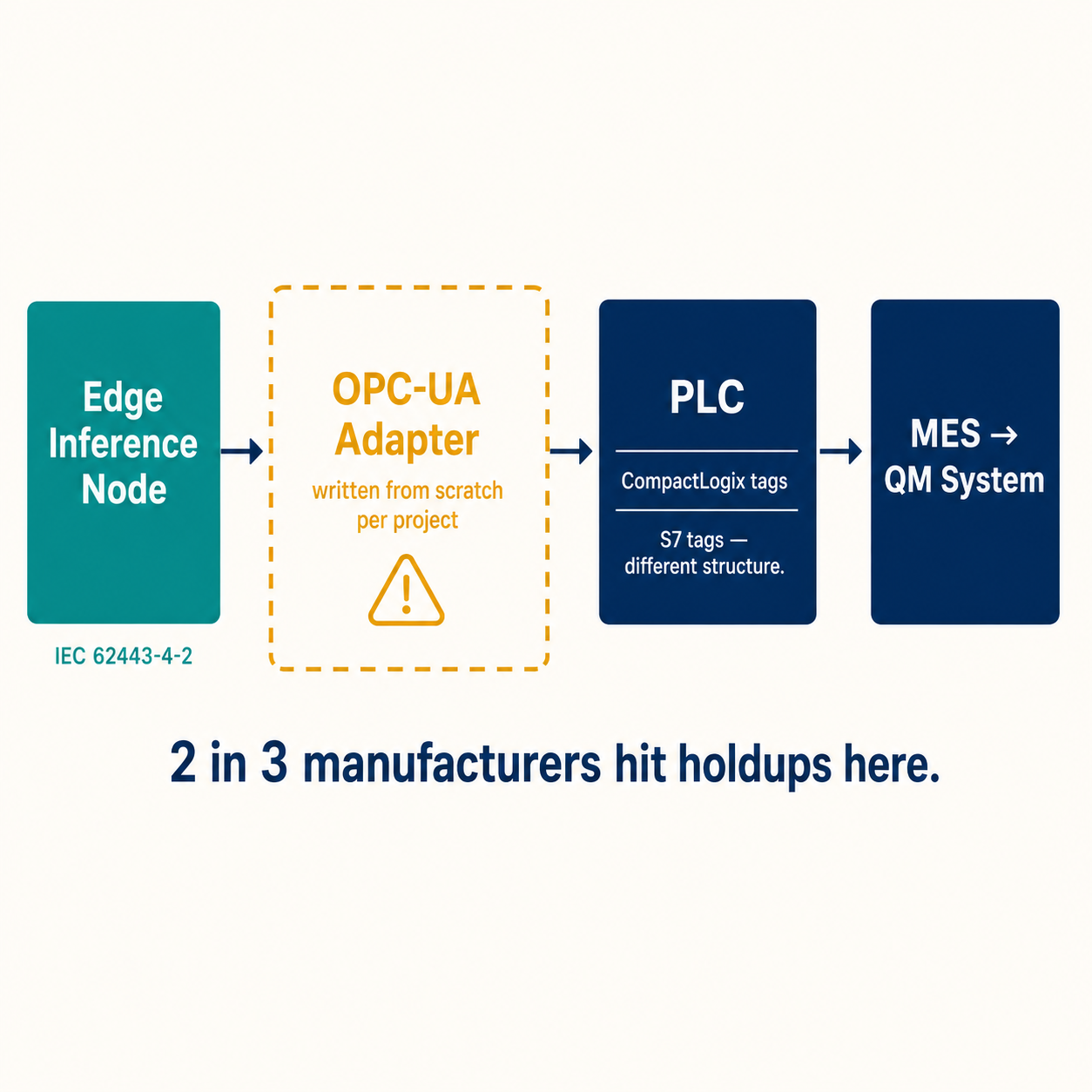
Two-thirds of manufacturers face production holdups because systems can't communicate properly. OPC-UA is the industry protocol for connecting AI inference nodes to PLCs, but the practical problem is more specific than "use OPC-UA." A CompactLogix tag file exported from Studio 5000 and a Siemens S7 tag mapping are structurally different. When an inference node sends a defect signal, it has to speak the exact tag dialect the line controller expects — and that adapter isn't in any vendor's product catalog. It gets written from scratch on every project.
The OPC Foundation launched a dedicated working group in 2025 — OPC UA for AI — specifically because this gap was blocking industrial deployments. The organizations that engineer past it achieve 4x faster AI deployment and 3x higher value capture rates. The ones that don't get into a months-long negotiation about whose responsibility the protocol bridge is.
The architecture that actually works: edge inference on IEC 62443-4-2 certified hardware (the OT security standard that plant network teams now require), an OPC-UA adapter feeding the MES, and the quality management system closing the loop into the reject-bin count. That full path — from inference output to actionable quality record — is what the custom integration work at Veriprajna's edge AI manufacturing inspection practice starts with, because an inference model that can't talk to the PLC is a demo, not a system.
The Slow Failure: False Reject Creep
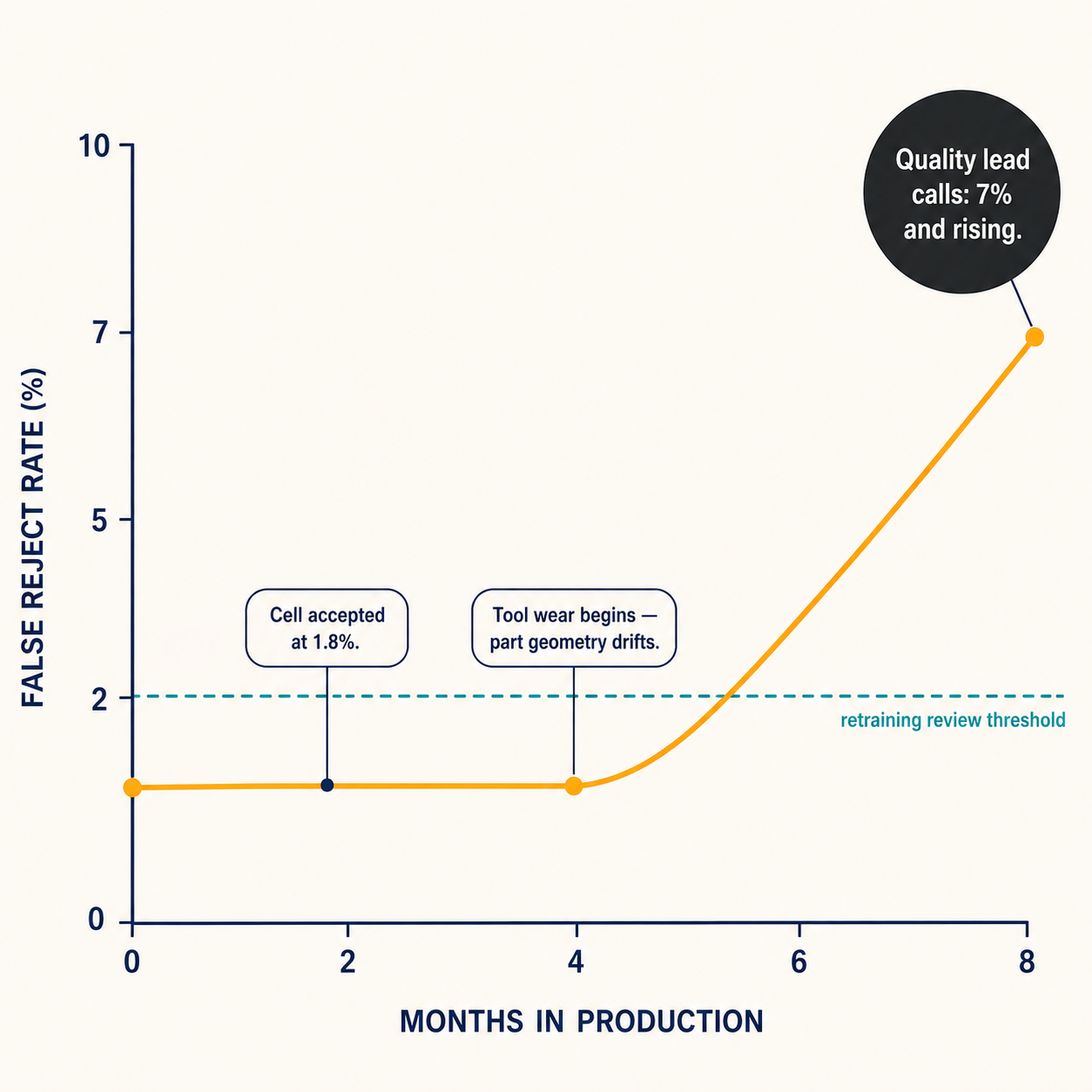
A well-commissioned inspection cell can run at 1.8% false reject rate for six months and start drifting. By month eight, it's at 7%. Nobody set an alert on that trajectory.
The cause is usually tool wear. As dies or cutting tools wear, part surface gradients shift in ways that weren't in the training data. The model was calibrated against good-parts images when the tooling was new. When the geometry changes by fractions of a millimeter, confident acceptances start landing in the uncertain range. The maintenance team notices their alert queue growing noisier and begins treating alerts as false until confirmed otherwise — alarm fatigue that's structural, not behavioral.
Most plants that monitor edge AI at all monitor accuracy against confirmed defects. They don't track false reject rate per shift. The drift from 2% to 9% happens across weeks; by the time quality engineering notices, the model needs full recalibration.
Ford's production-validated predictive maintenance deployment achieved a 2.5% false positive rate and saved an estimated $7M for a single component type — through continuous loop monitoring with human-in-the-loop checkpoints at defined thresholds, not periodic quarterly reviews. Per-shift FRR telemetry, a threshold trigger for retraining candidate review, and a change-management gate on new training data (so rushed retraining on bad samples doesn't make the problem worse) are the monitoring requirements. The operational discipline is what separates the deployments that hold from the ones that drift.
The ROI Case, Grounded
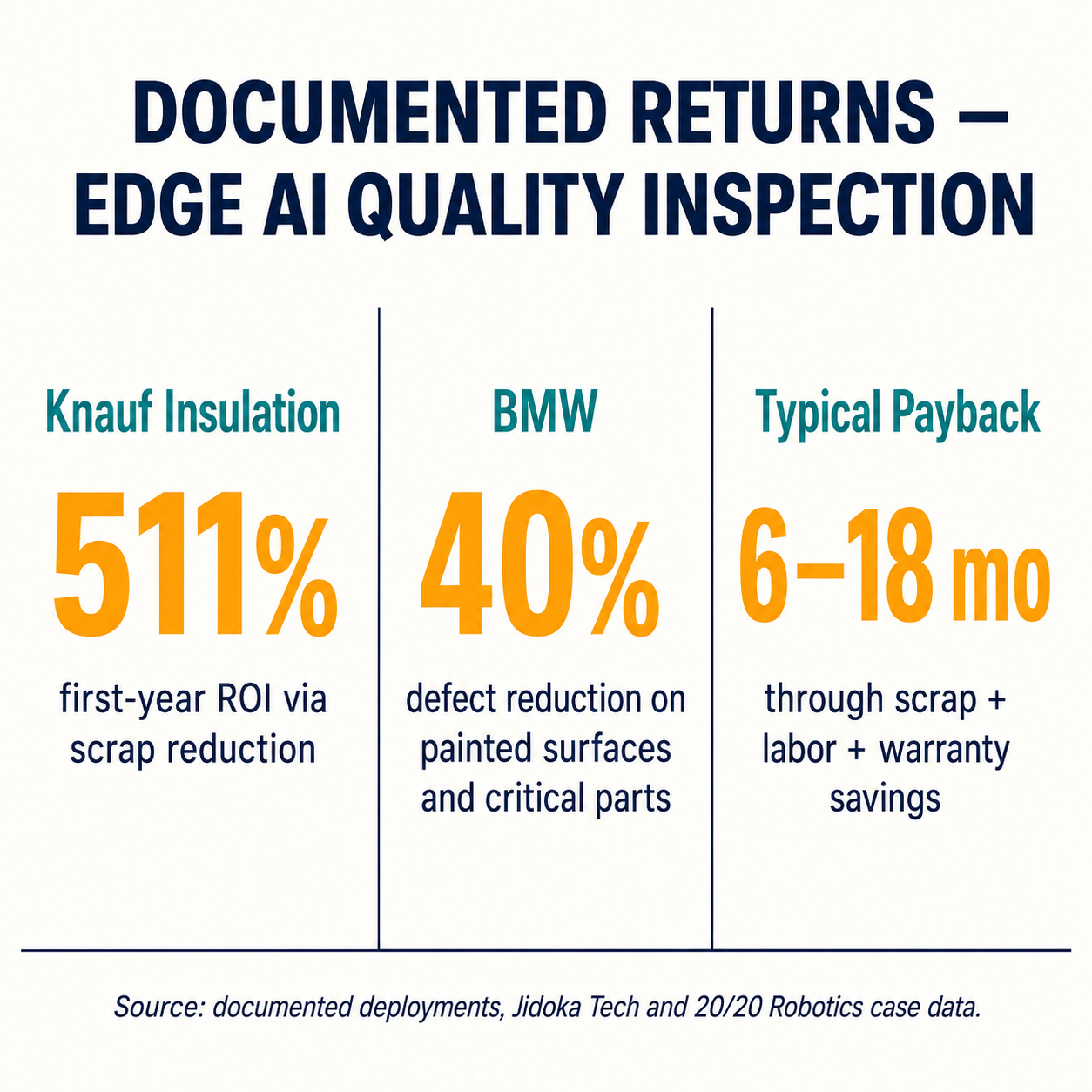
The business case for edge AI quality inspection is real, with documented results. Knauf Insulation's edge-vision deployment achieved 511% ROI in the first year, primarily through scrap reduction. BMW's CNN-based system for painted surfaces and critical parts reduced defects by 40%. A food manufacturer saved $94,000 annually by catching 8.7% scrap waste. Typical payback on a well-designed inspection system runs 6–18 months, through scrap reduction, labor savings, and warranty cost avoidance.
The outliers who don't capture that ROI aren't running worse models. They're running models that were never calibrated to the production environment, on integration architectures that couldn't scale from one line to fifteen plants. Augury's machine-health platform — now valued at $1B+, backed by PepsiCo and Nestlé deployments — built its acoustic AI around exactly this insight: the algorithm isn't the product. The operational framework for how maintenance teams act on alerts, and how the model evolves when it encounters new failure signatures, is what holds.
August 2026 Is Closer Than It Looks
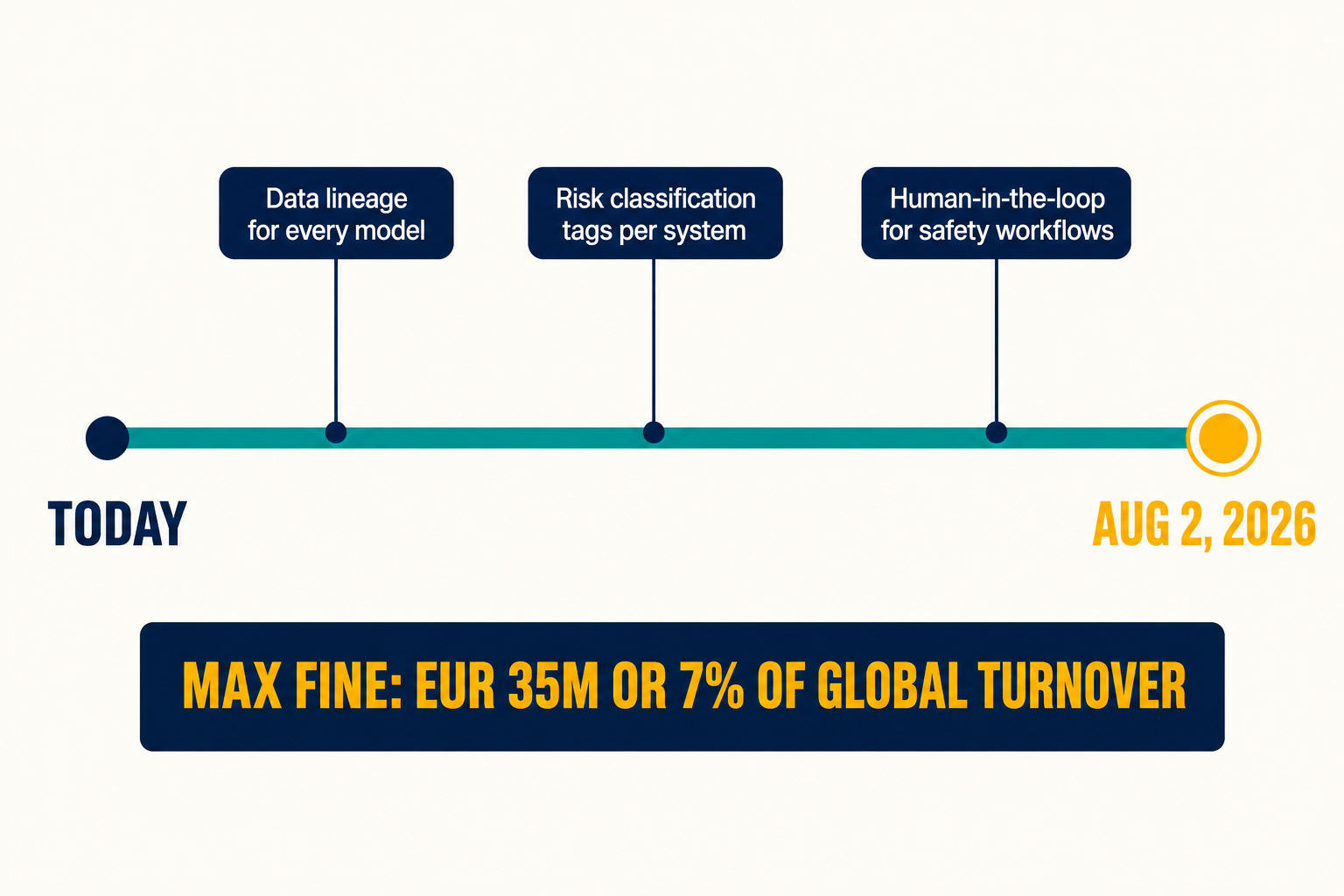
EU AI Act obligations become fully applicable August 2, 2026, and the manufacturing-specific requirements add to an already heavy deployment burden. Edge AI systems influencing safety or quality outcomes need data lineage tracking, risk classification tags labeling each model with its risk level and compliance status, and human-in-the-loop checkpoints for safety-relevant workflows. Maximum fines run to EUR 35 million or 7% of global annual turnover.
For manufacturers running undocumented edge AI pilots, the compliance architecture isn't a separate project — it's the monitoring and documentation layer a well-run deployment should have had from the start. A system with per-shift FRR logging, model version tracking, and defined escalation paths isn't just operationally sound. It's also substantially closer to what the regulation requires.
The Work That Actually Needs Doing
The gap between a vision AI demo and a production inspection system is almost entirely an integration and operations problem. Getting from 14% false rejects to under 2%, from one line to fifteen plants, from a pilot that passed the benchmark to a fleet someone can actually operate — requires someone who understands both the OT stack and the AI side and has done the OPC-UA wiring, the lighting calibration, and the drift monitoring enough times to know which part breaks first.
The full architecture and integration approach we use for custom edge AI quality inspection is documented at veriprajna.com/solutions/edge-ai-manufacturing-inspection.
If your team is working through a stalled pilot, a false-reject problem that retraining hasn't resolved, or an EU AI Act deadline arriving faster than the documentation — we'd genuinely like to understand what the specific integration constraint looks like on your line. The failure patterns are consistent across plants. The specifics of each line are not, and that's where the problem actually lives.